2027 Online BA in Psychology - Addictions vs. a BA in Psychology with a Criminal Justice Minor: Compare Curriculum, Cost, and Career Fit
Audited and Verified:
Our Editorial and Data Verification Process
Research.com uses government datasets, official education statistics and primary institutional information to support its career and degree guides. Our review process checks factual accuracy, occupational definitions, source dates and the requirements associated with the credentials discussed.
How This Article Was Fact-Checked
Our editorial team verifies salary estimates, employment projections, education requirements and program information against original data providers and official organizations. Salary figures are checked against the relevant occupational definitions and reporting periods. Information about licensure, accreditation and required in-person training is reviewed separately.
Fact-checked and verified on:

Co-Founder and Chief Data Scientist
An addictions focus and a criminal justice minor can lead the same psychology major toward different workplaces, but neither choice, by itself, qualifies you to provide therapy or conduct forensic evaluations. If you are choosing between these undergraduate routes, the useful comparison is not which sounds more specialized.
It is which courses and experiences support your target job, what each route will cost you to finish, and whether your next career step requires a separate credential. This guide puts those decisions side by side and identifies what to verify before enrolling.
Key Things You Should Know
- Choose an addictions focus for preparation in substance-use research, prevention, and recovery services; choose a criminal justice minor for broader exposure to courts, corrections, and justice systems.
- Neither BA alone authorizes psychotherapy, diagnosis, independent addiction counseling, or forensic psychological assessment; state credential rules and job duties matter more than the concentration's name.
- Compare the credits still required, published tuition and fees, and any placement costs, not just the advertised price per credit. A minor can add time if its courses do not also satisfy degree requirements.
What Is the Difference Between an Online Psychology Addictions BA and a Criminal Justice Minor?
Both options usually begin with a psychology BA. An addictions focus is coursework within or alongside the major on substance use, behavior, prevention, and recovery. Its official designation might be a concentration, emphasis, track, or set of electives.
Those labels are not interchangeable. A criminal justice minor is a separately defined group of courses in the justice system, added to the psychology major.
The distinction matters because a minor may require credits beyond the major, while a concentration may use credits already allocated to psychology electives. Neither arrangement is universal.
Check the catalog and a degree audit to see what will appear on your transcript and which requirements each course actually fulfills. For a closer look at program labels and coursework, use this guide to addiction psychology undergraduate degree selection.
Think in terms of the setting you want to understand: an addictions focus centers substance-use and recovery services; a criminal justice minor centers institutions and processes that may also serve people with substance-use needs. The overlap is useful, but it does not make the routes equivalent.
Which Degree Better Matches Your Psychology Career Goals?
Start with the work you want to do after graduation. If you hope to support prevention, outreach, referrals, or recovery programs, addictions coursework is the more direct academic match. If you want to work in victim services, reentry, corrections support, or justice-agency administration, the criminal justice minor supplies more relevant institutional context.
For a licensed treatment career, neither route is the final qualification. Investigate the state's rules for the exact occupation before choosing a BA: addiction counselor credentials differ from licenses for mental health counselors, social workers, and psychologists.
If mental health counseling is your goal, compare qualifying graduate programs and their supervised-training requirements rather than selecting a BA on the assumption that its addictions courses count toward licensure. Resources on shorter routes through mental health counseling graduate study can help frame that later decision, but speed should not override credential eligibility.
If your goal is an entry-level support job, existing experience can change the answer. A person already working in a recovery organization may gain more from justice-system courses and a reentry placement.
Someone with justice-agency experience may benefit more from addictions coursework. Seek the route that fills a demonstrated knowledge gap, not one that repeats what you already do.
What Courses Are Included in Each Psychology Degree Pathway?
The common psychology foundation is often more consequential than the label attached to the BA. Use the comparison below to check whether a prospective program retains research preparation while providing the specialization you want; these are illustrative course categories, not requirements at every school.
| Course area | Addictions-focused psychology BA | Psychology BA with criminal justice minor |
| Psychology foundation | Typically includes psychological theory, development, statistics, and research methods | Typically includes the same psychology-major foundation |
| Distinctive study | May include substance-use behavior, prevention, recovery systems, and co-occurring conditions | May include criminal law, courts, corrections, policing, and justice policy |
| Applied or research work | Potential fit for prevention evaluation or supervised recovery-service support | Potential fit for victim-service, reentry, or justice-program projects |
| Key gap to check | Whether the curriculum covers the particular state credential's required subjects, if relevant | Whether the minor leaves room for addiction, statistics, or advanced psychology electives you need |
Ask for the current course sequence, not just a list of electives: prerequisites and course rotation can determine when you finish. A course on addiction counseling teaches about an approach; it does not authorize counseling.
Likewise, justice or forensic coursework does not qualify you to conduct evaluations. If you are considering a later forensic specialization, one-year forensic psychology master's workload and outcomes are a separate comparison, not a credential benefit conferred by the minor.
Online delivery can reduce commuting and expand the programs available to you, but it does not necessarily remove fixed meeting times. Statistics classes may require scheduled group work.
An internship or community project may require daytime hours at an approved local site. Campus programs may make it easier to meet faculty and community partners in person, although the actual opportunities depend on the school.
For either format, ask how students access research supervision, career advising, library resources, and placement assistance. If you work or provide care for family members, obtain a sample weekly schedule and ask whether live sessions, exams, or field hours can be completed around those commitments.
When comparing psychology degrees available through online study, treat "online" as a delivery description, not proof that every requirement is asynchronous or remote.
Without named schools and their current tuition schedules, there is no defensible single price for either route. Your comparison should be based on remaining credits that count toward graduation, rather than total credits accepted in transfer or an advertised per-credit rate alone. This is particularly important if a criminal justice minor adds courses that cannot also meet general education or psychology requirements.
Build two estimates using each school's written degree audit: multiply remaining billable credits by the applicable tuition rate, then add mandatory fees, books, technology charges, and any travel or unpaid-placement costs. Note whether taking fewer courses per term changes fees, aid eligibility, or time away from full-time work.
An addictions-focused BA is not automatically cheaper than a BA with a minor; either can be the lower-cost option depending on overlap and transferred coursework. For a separate comparison of substance abuse counseling bachelor's affordability and duration, check whether the programs lead to the credential you actually seek.
Admission to the university, entry to the psychology major, and declaration of a minor or concentration may be distinct steps. First-time applicants generally need the institution's required secondary-school records; transfer applicants need official college transcripts.
Schools may impose additional GPA, prerequisite, or credit-completion conditions for the major or minor. Do not assume that admission means every previously earned course satisfies a degree requirement.
If you have prior college or military learning, request a program-specific degree audit showing where each accepted credit applies and what remains. Confirm equivalencies for statistics and research methods, the availability of minor courses, and any residency requirement before committing.
Comparing fast-paced psychology degree formats is useful only after you know which credits apply to your chosen curriculum; a shorter advertised schedule may not be your schedule.
Verify that the institution holds recognized institutional accreditation and that it covers the institution offering your online degree. Then check any recognition required for your specific next step. The American Psychological Association does not generally accredit psychology bachelor's degrees, so an "APA-accredited BA" should not be your screening test.
If you want an addiction-counselor credential, consult the relevant state board or certifying authority about acceptable degrees, required coursework, supervised experience, and examinations. If you intend to pursue licensed counseling later, evaluate accreditation and licensure alignment at the graduate program level.
Comparing condensed accredited counseling study routes addresses that different decision. Neither institutional accreditation nor a BA's concentration name, on its own, establishes professional-license eligibility.
These routes can support applications for nonclinical roles, but employers may require relevant experience, background checks, training, or a separate credential. Compare job descriptions by duties rather than relying on titles, which vary across agencies.
| Route | Roles to investigate | Evidence that strengthens an application |
| Addictions-focused BA | Recovery-program assistant, prevention-program coordinator, intake or referral assistant | Supervised service experience, accurate documentation, knowledge of referral boundaries |
| Psychology BA with criminal justice minor | Victim-services assistant, reentry-program assistant, justice-agency program support | Agency experience, understanding of confidentiality, communication with varied stakeholders |
| Either route | Research assistant or human-services program assistant | Research-methods skills, data handling, and relevant projects or work experience |
Entry-level intake, advocacy, and referrals are not psychotherapy. If your longer-term interest is research rather than direct service, inspect whether the BA offers faculty projects and methods courses before deciding whether online psychology master's completion planning is relevant. A master's may deepen preparation, but it is not automatically required for every research-support job.
Neither degree title has its own reliable salary or job-growth rate. The appropriate comparison is between specific occupations and their entry requirements.
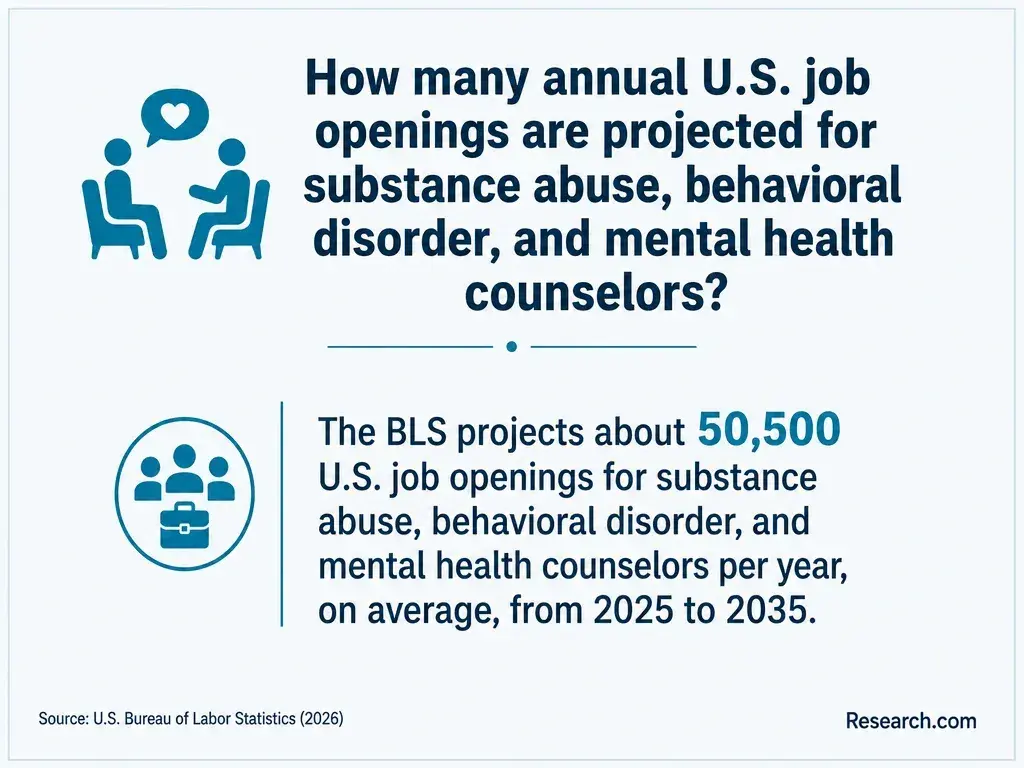
For example, Bureau of Labor Statistics figures for substance abuse, behavioral disorder, and mental health counselors describe a combined occupation, not the pay of graduates with an addictions-focused BA. Many counseling positions require a master's degree and licensure, so that occupational median would be misleading as an expected BA salary.
Justice-related pay varies just as much by function: a victim-services position, corrections role, and agency analyst job can have different employers, requirements, and pay structures. Before using an occupational wage or outlook figure in your decision, check its reference period, whether it covers your target job, and whether you would qualify on graduation.
Compare local entry-level postings with your expected education costs. If further study is necessary, affordable MA and MS psychology programs online may inform a cost comparison, but a general psychology master's is not a substitute for a required professional license.
What Licensing and Certifications Can Psychology Graduates Pursue?
An undergraduate psychology degree is academic preparation, not a license to diagnose, provide psychotherapy, or perform independent psychological assessments. Addiction-counselor titles and permitted duties vary by state and credential level.
Some pathways may accept specified bachelor's coursework, while others require additional education, supervised hours, examinations, or all three. Peer-support credentials have separate rules and should not be confused with counseling licensure.
For a decision you can act on, identify the exact job title and state where you intend to work. Read that state authority's education and supervision rules, then ask the BA program for a course-by-course account of how its curriculum aligns; obtain confirmation from the authority when eligibility is unclear.
If your target is licensed mental health counseling, plan around a qualifying graduate degree and supervised practice, using clinical counseling master's time-to-degree and salary outlook as a planning comparison rather than assuming either BA completes those requirements.
Other Things You Should Know About Psychology Programs
Possibly. Ask an advisor whether the electives are offered, fit your remaining credits, and can count toward graduation. Taking them does not necessarily earn an official addictions designation.
That depends on the institution's policy and whether you complete and formally declare the minor. Confirm how it is recorded before treating it as a credential you can list.
Only if the program approves the site, supervision, duties, and academic deliverables. Employment in a relevant organization alone does not establish internship credit.
Either can provide relevant subject matter. Law-school preparation depends more on strong academic performance, reading and writing, and the admissions requirements of your target schools than on choosing this particular focus or minor.
- Virginia Board of Counseling - CSAC application info https://www.dhp.virginia.gov/Boards/Counseling/ApplicantResources/CSACapplicationinfo/
- Treatment | Ohio Chemical Dependency Professionals Board https://ocdp.ohio.gov/get-certified-licensed/treatment/welcome
- Accreditation in the U.S. | ed.gov http://www.ed.gov/laws-and-policy/higher-education-laws-and-policy/college-accreditation/accreditation-in-the-us
- Cost of Attendance (Budget) | 2025-2026 Federal Student Aid Handbook https://fsapartners.ed.gov/knowledge-center/fsa-handbook/2025-2026/vol3/ch2-cost-attendance-budget
- Major in Psychology, Addictions Counseling Concentration | Colorado State University Catalog https://catalog.colostate.edu/general-catalog/colleges/natural-sciences/psychology/psychology-major-addictions-counseling-concentration/
- Online Bachelor's Degree (BA) in Psychology - ECU Flight Path https://onlineprograms.ecu.edu/programs/undergraduate-degrees/ba-psychology/
- Undergraduate Tuition and Fees | Financial Aid & Scholarships https://financialaid.ku.edu/calculate-costs/tuition-and-fees/undergraduate
- Applied Psychology: Addictions Studies, B.S. - CPS, CPSO | University of New Hampshire https://www.unh.edu/program/bachelor-science/applied-psychology-addictions-studies
- Criminal Justice Career Pathways | College of Arts & Sciences | Information Technology Services https://artsandsciences.louisville.edu/criminal-justice/career-pathways
- Online Bachelor's Degree in Psychology in Addictions | Purdue Global https://www.purdueglobal.edu/degree-programs/psychology/bachelor-psychology-addictions/