2027 Online AGPCNP Programs for Nurses in Delaware: MSN Options and Primary Care Clinicals
Audited and Verified:
Our Editorial and Data Verification Process
Research.com uses government datasets, official education statistics and primary institutional information to support its career and degree guides. Our review process checks factual accuracy, occupational definitions, source dates and the requirements associated with the credentials discussed.
How This Article Was Fact-Checked
Our editorial team verifies salary estimates, employment projections, education requirements and program information against original data providers and official organizations. Salary figures are checked against the relevant occupational definitions and reporting periods. Information about licensure, accreditation and required in-person training is reviewed separately.
Fact-checked and verified on:

Co-Founder and Chief Data Scientist
For a Delaware RN, an online adult-gerontology primary care nurse practitioner MSN can make graduate coursework easier to fit around work - but it cannot make supervised clinical care virtual. The decision hinges on finding the right population-focus track, confirming that Delaware residents can enroll, and securing approved primary care placements. This guide explains which in-state schools to investigate, how online and campus-based options differ, and what to verify about clinical hours, cost, certification, and Delaware APRN licensure before committing.
Key Things You Should Know
- An AGPCNP MSN prepares licensed RNs for primary care across adulthood and older age; it is not an initial RN program or an acute care NP track.
- National NP education standards use a benchmark of at least 750 direct patient-care clinical hours; confirm the hours and rules that apply to your entry cohort and certification pathway.
- Online coursework does not eliminate in-person clinical placements. Confirm Delaware enrollment eligibility, approved sites, and preceptor support before paying a deposit.
What are online AGPCNP programs for nurses in Delaware?
An online adult-gerontology primary care nurse practitioner (AGPCNP) MSN is a postlicensure graduate program that prepares an RN to assess, diagnose, manage, and coordinate ongoing care for adults and older adults. "Online" generally describes coursework, not the whole degree: supervised patient encounters occur in person, and some programs require campus visits or live online sessions.
Primary care is the defining distinction. An adult-gerontology acute care NP track prepares nurses for a different care focus and certification. An FNP track includes patients across the lifespan, including children; an AGPCNP track does not. An applicant without an RN license needs initial nursing preparation first, not an AGPCNP MSN. Shorter graduate-entry nursing programs address that separate starting point, but their degree titles alone do not establish NP preparation.
Which Delaware schools offer online AGPCNP MSN programs?
Start an in-state inquiry with the University of Delaware and Wilmington University, both of which have offered graduate nursing pathways relevant to prospective NP students. Do not treat an institution's general MSN listing - or an adult-gerontology label - as confirmation that an online, primary care, MSN-level track is accepting Delaware applicants for your intended term. Track names, degree awards, delivery formats, and admissions cycles can change.
The distinction below keeps the school search focused on facts that determine whether a listing is actually usable. Request the current catalog and a written response from each program before making an application or travel commitment.
| School to investigate | Confirmation needed for an AGPCNP MSN search |
| University of Delaware | Whether the current adult-gerontology primary care pathway awards an MSN, its online/on-campus requirements, and eligibility for your entry term |
| Wilmington University | Whether its current adult-gerontology NP offering is specifically primary care, awards an MSN, and supports your proposed Delaware clinical sites |
| Out-of-state online programs | Authorization to enroll Delaware residents, required campus travel, Delaware placement arrangements, and the certification exam the track supports |
Ask each school for its exact track title and current program page rather than relying on a general "online NP" search result. If neither in-state option fits, an out-of-state program may be workable - but placement support matters more than its mailing address. Preceptor-provided FNP program comparisons illustrate a useful question to ask about placement assistance; they are not a substitute for verifying AGPCNP-specific support.
What are the clinical requirements for online AGPCNP programs?
Expect faculty-supervised, documented direct patient care with approved preceptors. National NP education standards identify at least 750 direct patient-care clinical hours as a benchmark, but a school's curriculum, the standards applicable to its cohort, and certification eligibility must be checked together. Neither RN employment hours nor simulation automatically substitutes for approved AGPCNP clinical hours.
Primary care exposure should fit the adult-gerontology population and the program's competency requirements. Before enrolling, obtain written answers to these placement questions:
- Does the school arrange sites and preceptors, help locate them, or leave the search to students?
- Which Delaware settings and preceptor credentials qualify, and who signs affiliation agreements?
- How are encounters, hours, faculty oversight, and competency assessments documented?
- When are placements scheduled, and can working RNs complete them without assuming evening or weekend availability?
Prior APRN practice in another population focus may inform a school's gap analysis, but it does not automatically replace new AGPCNP experiences. The same principle matters when comparing shorter online PMHNP certificate programs: a different specialty's clinical hours are not automatically interchangeable with adult-gerontology primary care preparation.
The meaningful comparison is not "online versus clinical." Both formats require approved, supervised patient care. The difference is where didactic learning happens and how much travel, scheduling, and placement coordination the student must manage.
This comparison highlights the format questions most likely to affect a working Delaware RN's ability to finish the program.
| Decision factor | Online or hybrid AGPCNP MSN | Campus-based AGPCNP MSN |
| Course attendance | Remote coursework; live sessions or campus intensives may still apply | Regular travel for scheduled classes and potentially labs |
| Clinical learning | In-person, school-approved placements; local availability must be confirmed | In-person placements; proximity to campus does not guarantee a site |
| Best fit | RNs who can organize remote study and secure feasible placements | RNs who value recurring face-to-face instruction and can travel reliably |
Ask for a term-by-term calendar, including synchronous classes, intensives, and clinical days. A longer, predictable schedule can be more workable than an accelerated format with inflexible placements. If considering a doctorate instead of an MSN, online DNP program length comparisons provide a separate timeline discussion; verify that any DNP option actually contains an AGPCNP track.
AGPCNP curricula typically combine advanced pathophysiology, pharmacology, and health assessment with diagnostic reasoning, evidence-based practice, and adult-gerontology primary care management. Supervised courses apply that learning to preventive services, chronic conditions, and complex care needs in older adults. Specific course names and sequences vary by school.
Review the clinical syllabi as closely as the course titles: they show which patient populations and competencies the program expects students to demonstrate. An FNP curriculum has a broader lifespan population focus, so accelerated FNP education comparisons should not be used as evidence that a shorter FNP route meets an AGPCNP career goal.
Applicants should expect a current RN license and program-specified nursing education, transcripts, academic standing, and application materials. Schools may also set experience, recommendation, interview, or prerequisite requirements. An RN whose bachelor's degree is outside nursing should ask whether a bridge or additional coursework is required rather than assuming either eligibility or exclusion.
Check admission to the specific AGPCNP track, not just to the university or its MSN degree. Ask whether the license must be unrestricted, whether prior graduate coursework can be evaluated, and when clinical-site screening must be completed. TEAS and HESI requirement comparisons concern nursing-school entry policies; they should not be mistaken for AGPCNP graduate admission requirements.
There is no reliable Delaware-wide price or completion time: credit requirements, accepted prior coursework, part-time sequencing, tuition categories, and clinical scheduling differ. Compare written, entry-term-specific estimates rather than an advertised per-credit rate alone. Delayed placement can extend enrollment even when coursework proceeds on schedule.
For each finalist, request a term-by-term plan and an itemized estimate. The following costs belong in the comparison:
- Tuition and mandatory university, course, and technology fees
- Books, equipment, screenings, immunizations, and clinical compliance expenses
- Travel and lodging for clinical sites or required campus visits
- Certification, licensure, and possible additional-semester charges
- Reduced work hours and any conditions attached to employer tuition assistance
Use budget planning for online NP programs to frame the comparison, but calculate total cost from each school's actual AGPCNP plan. The least expensive tuition quote may not be the lowest-cost route if placement travel or extra semesters are substantial.
Verify institutional accreditation and the nursing program's accreditation, commonly through the Commission on Collegiate Nursing Education (CCNE) or Accreditation Commission for Education in Nursing (ACEN), as applicable. Then confirm that the exact AGPCNP track prepares graduates for the intended national certification examination and that the school can enroll and place students in Delaware. These are separate checks; accreditation alone does not secure a clinical site or grant APRN licensure.
Ask the school and accreditor how the current accreditation applies to the MSN offering and your entry term. A comparison of prerequisite policies in DNP programs concerns admission standards, not proof of accreditation or AGPCNP certification eligibility.
Graduation is one step, not authorization to practice. A Delaware applicant generally must complete an appropriate graduate AGPCNP track, meet the chosen national certifier's eligibility requirements, pass an accepted adult-gerontology primary care NP certification exam, and apply to the Delaware Board of Nursing for APRN licensure or recognition under its current rules. The American Nurses Credentialing Center and American Academy of Nurse Practitioners Certification Board offer adult-gerontology primary care NP credentials; check their current eligibility guides and Delaware's accepted-certification rules before choosing a track.
Confirm separately the status of the underlying RN license, application documentation, any prescribing requirements, and applicable practice or collaboration rules. An APRN credential in a different focus does not itself authorize AGPCNP practice. Likewise, accessible nursing school entry pathways concern entry into nursing education, not this post-RN certification and Delaware APRN process.
What salary and career opportunities are available to AGPCNPs?
AGPCNPs may pursue adult and older-adult primary care roles in outpatient practices, community clinics, and other settings that match their preparation and employer requirements. Work can emphasize preventive care, chronic-condition management, medication review, referrals, and care coordination. Job fit also depends on patient mix, visit length, mentorship, documentation workload, and the employer's expectations for new NPs.
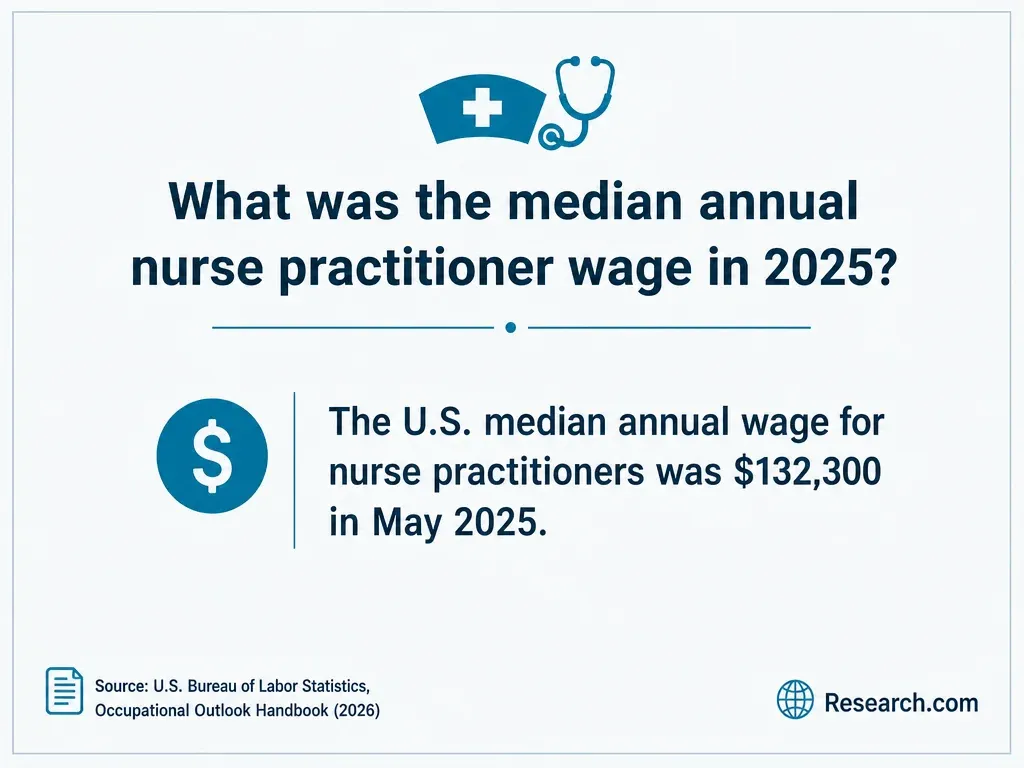
The U.S. Bureau of Labor Statistics reports wages and employment projections for the broader nurse practitioner occupation, not a separate Delaware AGPCNP salary. Those occupation-wide figures are useful for context but cannot predict an offer or the return on a particular MSN. Compare actual local postings and total compensation against the program's full cost and the earnings you may give up while studying. Master's nursing education on a BSN graduate's budget can help frame that financial decision, provided the option under consideration truly includes AGPCNP preparation.
Other Things You Should Know About Nursing
Possibly, but clinical days may conflict with shifts. Ask for the actual clinical and live-class schedule before assuming full-time employment will remain feasible.
No. AGPCNP education focuses on adults and older adults. Nurses seeking preparation across childhood and adulthood should investigate an FNP track.
Experience may strengthen an application, but the receiving program determines whether prior graduate work or documented supervised hours meet its requirements. RN employment alone is not a substitute.
It can be for an eligible nurse who already has graduate nursing preparation. The school must assess prior coursework and clinical competencies, and the completed certificate must support the intended certification and Delaware APRN pathway.
- Advanced Practice Registered Nurse (APRN) License | State of Delaware https://dpr.delaware.gov/boards/nursing/apnlicense/
- Cost of Attendance (Budget) | 2025-2026 Federal Student Aid Handbook https://fsapartners.ed.gov/knowledge-center/fsa-handbook/2025-2026/vol3/ch2-cost-attendance-budget
- title 16 | delaware.gov https://delcode.delaware.gov/title16/c001/sc10/index.html
- Get Prepared for AGPCNP-BC Certification With WP Online | WPUNJ https://online.wpunj.edu/degrees/healthcare/msn/agnp/eligibility-and-requirements/
- 24 Del. Admin. Code § 1900-6.0 - Requirements and Procedures... - LII | LII / Legal Information Institute https://www.law.cornell.edu/regulations/delaware/24-Del-Admin-Code-SS-1900-6.0
- Adult-Gerontology Primary Care Nurse Practitioner Postgraduate Certificate | Purdue Global https://www.purdueglobal.edu/degree-programs/nursing/adult-gerontology-nurse-practitioner-certificate/
- MSN: Adult-Gerontology Primary Care Nurse Practitioner | gwu.edu https://nursing.gwu.edu/programs/msn/adult-gerontology-primary-care-nurse-practitioner
- MS Adult-Gerontology Primary Care Nurse Practitioner | CU Anschutz Nursing https://nursing.cuanschutz.edu/degrees-programs/graduate-programs/ms/ag-pcnp
- Adult-Gerontology Primary Care Nurse Practitioner FAQs | UAMS College of Nursing https://nursing.uams.edu/programs/dnp/program-information/specialities/agpcnp/faqs-2/
- MSN Adult-Gerontology Primary Care Nurse Practitioner | West Coast University https://westcoastuniversity.edu/online-programs/msn/agpcnp