2027 Nursing Escalation and the Chain of Command: Roles and Communication Channels
Audited and Verified:
Our Editorial and Data Verification Process
Research.com uses government datasets, official education statistics and primary institutional information to support its career and degree guides. Our review process checks factual accuracy, occupational definitions, source dates and the requirements associated with the credentials discussed.
How This Article Was Fact-Checked
Our editorial team verifies salary estimates, employment projections, education requirements and program information against original data providers and official organizations. Salary figures are checked against the relevant occupational definitions and reporting periods. Information about licensure, accreditation and required in-person training is reviewed separately.
Fact-checked and verified on:

Co-Founder and Chief Data Scientist
A nurse who recognizes a worsening patient condition needs more than a name on an organizational chart: they need a way to reach someone who can act, communicate the concern clearly, and keep seeking help if the first contact does not resolve it.
This guide explains the nursing chain of command for students, new graduates, and practicing nurses. It covers escalation triggers, team roles, SBAR, documentation, and unresponsive providers, then shows what to look for in education and orientation. The goal is to help you respond safely without confusing escalation with authority to make decisions outside your scope.
Key Things You Should Know
- Escalate a time-sensitive patient safety concern promptly; the usual reporting line does not replace an emergency response pathway.
- SBAR organizes a report into 4 parts: situation, background, assessment, and recommendation. It does not replace reassessment, read-back when required, or documentation.
- Students practice escalation under supervision. Graduation alone does not confer an RN license, and an RN license alone does not establish competence for every unit or specialty.
What is the nursing chain of command and why does escalation matter?
The nursing chain of command is an organization's defined route for raising a concern when the person initially responsible cannot address it or a decision needs higher-level review. Depending on the setting, it may move from the bedside nurse to a charge nurse, supervisor, nursing administrator, or another designated leader. A separate clinical route may reach the treating clinician, covering provider, rapid response team, or emergency services.
Escalation means communicating a concern to someone with the authority or resources to help, then checking whether the response addresses the risk. It is not the same as handing off responsibility. A nurse continues to assess, provide care within scope, and follow applicable orders and protocols while help is being arranged.
The distinction that matters most: an organizational reporting line and an urgent clinical response pathway can operate at the same time. Nurses should learn both during orientation. Additional degrees may prepare someone for leadership, but they do not replace unit-specific escalation training; even when comparing ADN-to-MSN nursing programs, an RN should evaluate workplace responsibility separately from academic advancement.
When should nurses escalate patient safety concerns?
Escalate when assessment findings, a patient or family report, or a care-process failure suggests a risk that cannot safely wait for routine communication. Examples include a meaningful change from the patient's baseline, a potentially unsafe medication order, delayed treatment, conflicting instructions, or a concern that remains unresolved after an initial discussion. The required response depends on the patient, setting, current orders, and local protocols - not on a single universal threshold.
Choose the channel according to urgency. These are distinct routes, not a mandatory sequence to complete before calling for emergency help:
- Immediate threat: activate the facility's emergency or rapid response process when its criteria are met; provide care within scope and alert the responsible team.
- Urgent change or time-sensitive decision: contact the responsible clinician through the approved urgent channel, give current assessment findings, and set an appropriate expectation for a response under policy.
- Persistent or systemic concern: involve the charge nurse or supervisor and use the organization's safety-reporting process as appropriate, without treating a report as a substitute for patient care.
An RN completing RN-to-BSN study without added bedside rotations still needs current employer training on these pathways. Academic coursework can strengthen reasoning, but it does not establish that a nurse knows a particular unit's response criteria.
Which roles are involved in nursing escalation and decision-making?
Titles differ by employer, but each participant has a different decision-making role. The table distinguishes who can help with a concern; it is not a substitute for a facility's contact directory or state scope-of-practice rules.
| Role | Typical contribution | Important boundary |
| Bedside RN | Assesses, communicates changes, carries out authorized care, reassesses, and documents. | Does not independently assume a prescriber's authority. |
| LPN/LVN | Reports observations and performs assigned care within state law and employer policy. | Assessment and delegation responsibilities vary by jurisdiction and setting. |
| Charge nurse or supervisor | Supports prioritization, staffing, access to resources, and further escalation. | Does not necessarily replace the clinician responsible for treatment decisions. |
| Treating or covering clinician | Evaluates concerns and makes decisions within their professional authority. | May need direct examination or additional information before deciding. |
| Rapid response or emergency team | Provides a defined response to urgent deterioration under facility policy. | Activation criteria and team composition vary. |
| Student nurse and instructor or preceptor | Practice recognition and communication through supervised clinical learning. | A student's responsibilities depend on school and site rules. |
Advanced practice registered nurses may serve as treating clinicians when their role, population-focused preparation, state authorization, and employer privileges permit it. For someone pursuing that role, family NP programs that help arrange clinical placements address an educational need; placement assistance alone does not confer independent decision-making authority.
SBAR gives the recipient a concise reason for the call and enough context to respond. It works best when the nurse prepares the latest relevant assessment, reviews the record, and makes a clear request rather than reciting every detail in the chart. For example, a student practicing a hypothetical change-in-condition call could structure it this way:
- Situation: Identify the patient through the approved communication channel and state the change and why the call is urgent.
- Background: Give the diagnosis, relevant history, recent treatment, and baseline information that affect the concern.
- Assessment: Report observed findings, their timing and trend, and what has already been done within scope.
- Recommendation: State the needed next step, such as immediate evaluation or clarification of an order, and confirm the response plan.
Use the approved method to confirm critical information and orders, including read-back when policy requires it. Document objective findings, relevant times, who was contacted, information communicated, instructions received, actions taken, reassessment, and further escalation. Follow local rules for late entries; never alter a record to make events appear earlier or chart care that was not provided. A safety-event report, when required, serves a different purpose from the clinical record.
Documentation quality can also become a practice-improvement topic, but it requires appropriate oversight and privacy safeguards. Nurses considering DNP project-based practice expectations should distinguish studying an escalation workflow from documenting an actual patient encounter.
An unanswered page is not a clinical resolution. While continuing assessment and care within scope, use the organization's urgent contact process, notify the charge nurse or supervisor, and reach the designated covering clinician or response team as the situation requires. If the patient meets emergency activation criteria, do not wait to work through every supervisory level first.
If a clinician responds but the concern remains unresolved, communicate the specific risk and new or continuing findings, ask for clarification, and escalate through the facility's defined clinical and nursing pathways. An objective account of contacts, response times, decisions, and reassessment helps the next person understand what has happened. Disagreement should be described in terms of patient findings and safety concerns, not assumptions about another professional's motives.
Specialty graduate education may deepen a clinician's preparation but does not replace a facility's immediate response process. That distinction also applies to nurses exploring fast-track mental health nursing graduate study: program length does not determine how a bedside concern should be escalated during a shift.
Recognizing and reporting a safety concern is part of nursing practice, but the assessment, intervention, delegation, and decision-making permitted afterward depend on the person's license, state law, employer policy, and demonstrated competence. A student reports concerns promptly to the assigned nurse and instructor or preceptor under site rules. An LPN/LVN and an RN may have different responsibilities; neither should assume the other's scope from a job title alone.
Prelicensure ADN/ASN and BSN programs prepare eligible graduates to seek RN licensure, subject to state board requirements and the NCLEX-RN. Graduation is not an active license. Postlicensure RN-to-BSN study assumes existing RN preparation; an MSN, DNP, certificate, or leadership title does not by itself expand legal scope. APRN practice requires the applicable population-focused education, certification, and state authorization.
For example, shorter psychiatric-mental health NP certificates are relevant to eligible nurses seeking that specific advanced practice preparation, not a prerequisite for an RN to raise a patient safety concern. Most nurses seeking to improve escalation should first use employer training, supervised practice, and feedback rather than pursue another degree for that purpose alone.
Programs commonly develop these skills through clinical judgment coursework, case discussion, simulation, supervised placements, and feedback. A student may need to recognize a concerning trend, decide what information to report, contact the appropriate person, and reassess after the response. Faculty and clinical instructors evaluate performance against program objectives; taking part in a simulation is not proof of independent workplace competence.
Delegation is related but different: it concerns assigning appropriate tasks while retaining the accountability required by law and policy. Escalation concerns obtaining help or a decision when risk exceeds the student's or nurse's available authority or resources. Leadership education can strengthen both, but it cannot substitute for learning the actual unit's communication channels.
Even accelerated family NP study options must be evaluated for their own supervised clinical preparation. Their pace is not a measure of how well an entry-level RN program teaches escalation.
Online coursework can teach terminology, clinical reasoning, and written or video-based handoffs. Campus labs can offer face-to-face practice and immediate observation. Neither format, by itself, establishes that a student can communicate effectively during patient care. For a prelicensure program, ask where supervised clinical learning occurs, how faculty observe escalation, and what happens when a student needs to repeat a communication competency.
Compare the actual schedule as well as the format label. Online lectures may be asynchronous while simulation days, live discussions, and clinical shifts require attendance at fixed times. Working students should check placement travel, evening or weekend availability, and whether clinical schedules can change during the term.
These questions also apply to graduate study. A nurse looking at short online Doctor of Nursing Practice degrees should verify required on-site activities and project expectations rather than assume that online delivery means fully flexible clinical learning.
Start with the credential you need and the jurisdiction where you plan to seek licensure. Check the institution's accreditation, the nursing program's applicable accreditation - such as ACEN or CCNE where relevant - and state board approval or recognition separately. Ask the program and state board to confirm whether your intended track meets eligibility requirements; accreditation alone does not answer every licensing question.
Then request evidence of how communication is taught and evaluated. Useful questions for an admissions or clinical education team include:
- Where do students practice urgent handoffs, SBAR, speaking up, and unresolved-concern escalation?
- Who arranges and approves clinical placements, and who observes student performance?
- How are students assessed after simulation, during supervised care, and before graduation?
- What are the required on-site days, clinical scheduling limits, and published progression and NCLEX outcomes for the relevant cohort?
For an RN considering advanced practice instead, check population-specific supervised preparation rather than relying on a program's broad "clinical training" claim. Comparisons of post-master's family NP clinical training requirements can frame questions, but the receiving program, certifier, and state regulator determine what applies to an individual nurse.
What nursing careers, salaries, and job outlook follow degree completion?
Escalation skill matters across bedside, ambulatory, community, and supervisory nursing work, but these jobs differ in responsibilities and entry requirements. A new graduate typically needs an active license and employer orientation before managing a patient assignment within that setting's expectations. Charge nurse and manager roles generally call for experience and demonstrated leadership; an advanced practice role requires its own education and authorization. No degree guarantees promotion or specialty readiness.
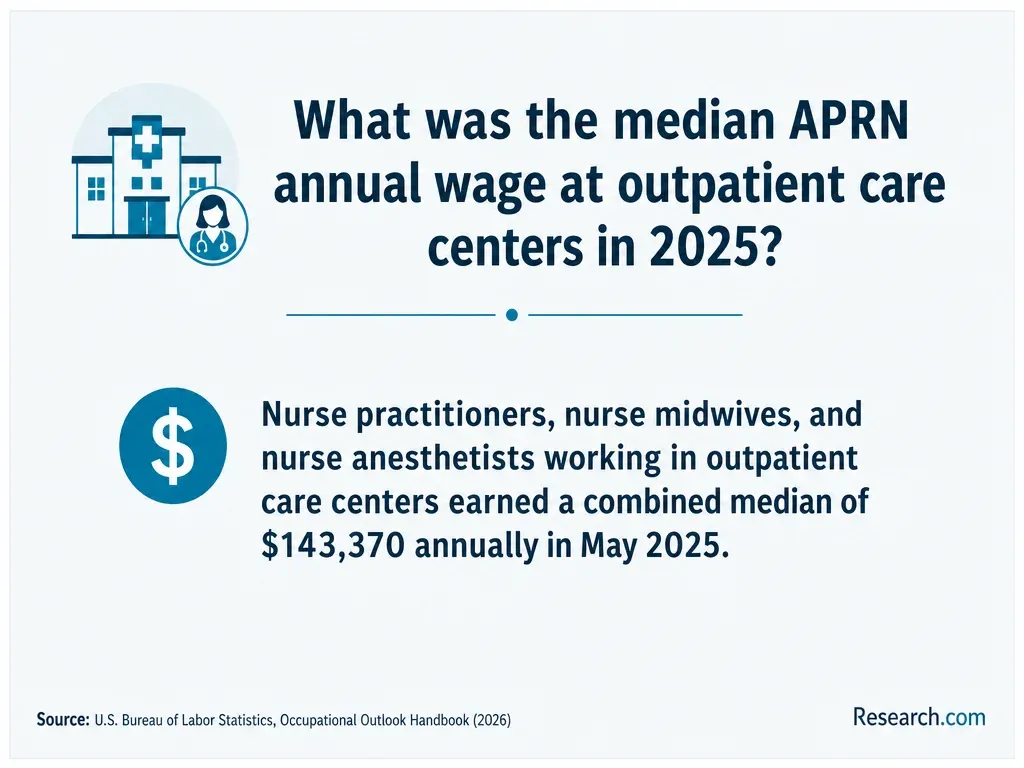
For pay and outlook, use the U.S. Bureau of Labor Statistics occupational figures for the exact role - such as registered nurse or nurse practitioner - and confirm the published wage reference year and projection period before making a financial decision. An occupation-wide median combines workers with different locations, experience, and schedules; it is not a new graduate's offer or the return on a particular degree. Compare an actual job offer with the full cost of any proposed study, including fees, clinical travel, and earnings forgone.
If the goal is better escalation rather than a different licensed role, orientation, mentoring, and targeted continuing education are usually more direct than graduate tuition. If the goal is NP practice, nurse practitioner program tuition comparisons are only one part of the decision; verify the track's eligibility, placements, total costs, and authorization in your state.
Other Things You Should Know About Nursing
Some employers offer confidential reporting channels for system-level concerns, but an immediate patient-care issue usually requires direct communication with someone who can respond. Follow workplace policy and do not rely on an anonymous report to obtain urgent care.
Listen to the concern, address immediate safety needs, and connect them with the appropriate charge nurse or supervisor under facility policy. A request for review does not relieve the care team of ongoing assessment and communication.
Follow the clinical site's emergency policy and your instructor's directions. If you recognize an immediate threat, summon help promptly; do not delay solely because you are a student.
Organizations generally manage safety-event reports separately from clinical documentation. Record the patient's condition and care in the medical record according to policy, and ask your supervisor how to complete any additional report.
- Failure To Rescue - Rapid Response Systems - NCBI - NIH https://www.ncbi.nlm.nih.gov/books/NBK603026/
- Rapid Response Systems | PSNet https://psnet.ahrq.gov/primer/rapid-response-systems
- Effects of simulation in improving the self-confidence of... - PMC https://pmc.ncbi.nlm.nih.gov/articles/PMC10614341/
- Tool: Check-Back (or Repeat-Back) | Agency for Healthcare Research and Quality https://www.ahrq.gov/teamstepps-program/curriculum/communication/tools/checkback.html
- Whistleblower Protections | U.S. Department of Labor - DOL https://beta.dol.gov/policy-regulations/pay-benefits/employment-rights/whistleblower-protections
- Nursing Practice FAQ - Texas Board of Nursing - Texas.gov https://www.bon.texas.gov/faq_nursing_practice.asp
- Recognising and Responding to Acute Deterioration Standard | safetyandquality.gov.au https://www.safetyandquality.gov.au/national-standards/nsqhs-standards/recognising-and-responding-acute-deterioration-standard
- Chapter 09 Standards of Practice for Registered Nurses | Library of Maryland Regulations https://regs.maryland.gov/us/md/exec/comar/10.27.09/index.full.html
- Rapid Response Guide | Department of Medicine | UNC School of Medicine Office of Student Affairs https://www.med.unc.edu/medicine/rapid-response-guide/
- Chain of command: What nurses need to know | WSNA https://www.wsna.org/news/2023/chain-of-command-what-nurses-need-to-know