2027 Nursing Abbreviations and Job Titles: A Beginner's Glossary
Audited and Verified:
Our Editorial and Data Verification Process
Research.com uses government datasets, official education statistics and primary institutional information to support its career and degree guides. Our review process checks factual accuracy, occupational definitions, source dates and the requirements associated with the credentials discussed.
How This Article Was Fact-Checked
Our editorial team verifies salary estimates, employment projections, education requirements and program information against original data providers and official organizations. Salary figures are checked against the relevant occupational definitions and reporting periods. Information about licensure, accreditation and required in-person training is reviewed separately.
Fact-checked and verified on:

Co-Founder and Chief Data Scientist
A nursing job posting might ask for an RN, BSN, and BLS certification - but those letters describe three different things. If you are new to nursing, mixing up a degree, a license, and a workplace credential can lead you toward the wrong program or job.
This glossary explains the abbreviations and titles you are most likely to encounter, then connects them to education, exams, clinical preparation, and career options. Use it to identify the qualification your goal actually requires before comparing schools or applying.
Key Things You Should Know
- ADN and BSN are degrees; RN is a license designation. Completing a degree does not itself authorize nursing practice.
- Initial US nursing licensure generally involves one of two exams: NCLEX-PN for practical or vocational nurses, or NCLEX-RN for registered nurses.
- APRN describes four advanced practice roles: nurse practitioner, clinical nurse specialist, certified nurse-midwife, and certified registered nurse anesthetist. Each requires role-specific preparation beyond RN licensure.
What do common nursing abbreviations and job titles mean?
The quickest way to decode nursing terminology is to ask whether an abbreviation names an academic award, a legal license, an advanced practice role, a certification, or a job assignment. Those categories are related, but they are not interchangeable.
This glossary groups common terms by what they actually identify. A posting may combine several entries - for example, "BSN-prepared RN" specifies both education and licensure.
| Abbreviation or title | Meaning | What it tells you |
| CNA | Certified nursing assistant | Assistant credential; not an RN or LPN/LVN license |
| LPN / LVN | Licensed practical nurse / licensed vocational nurse | Different state titles for practical or vocational nurse licensure |
| RN | Registered nurse | Professional nursing license designation, not a degree |
| ADN / ASN | Associate degree in nursing / associate of science in nursing | Associate-level nursing awards; program names vary |
| BSN | Bachelor of science in nursing | Bachelor's degree, available through prelicensure and RN-completion routes |
| MSN / DNP / PhD | Master of science in nursing / doctor of nursing practice / doctor of philosophy | Graduate degrees with different practice, leadership, education, or research purposes |
| APRN | Advanced practice registered nurse | Umbrella term for four regulated advanced practice roles |
| BLS / ACLS | Basic life support / advanced cardiovascular life support | Training credentials that may be required for particular jobs, not nursing licenses |
| Charge nurse / nurse manager | Unit coordination / management job titles | Work responsibilities, not separate license categories |
One easily missed distinction is that an RN-to-BSN program is for someone who already holds an RN license; it does not prepare a newcomer for initial RN licensure. Experienced RNs comparing BSN completion options for experienced RNs should check what a program means by "no clinicals," including any projects or in-person requirements.
What nursing degrees and pathways lead to RN, LPN, and APRN roles?
Start with the role you want, then check whether a program prepares students for initial licensure or assumes they are licensed already. The same degree abbreviation can appear in programs with very different entry requirements.
The pathways below show the usual direction of travel, not a guarantee that a particular program qualifies its graduates in every state.
| Starting point and goal | Common pathway | Important distinction |
| New student seeking LPN/LVN licensure | State-approved practical or vocational nursing program | Prepares for practical nursing licensure, not RN licensure |
| New student seeking RN licensure | Approved ADN/ASN, nursing diploma, or prelicensure BSN | Each can be an RN entry route when the program meets applicable requirements |
| Person with a non-nursing bachelor's seeking RN licensure | Accelerated BSN or an eligible direct-entry nursing program | Prior degree does not replace nursing prerequisites or clinical preparation |
| Licensed RN seeking another degree | RN-to-BSN or an eligible RN-to-MSN bridge | Postlicensure study does not issue a new initial RN license |
| RN seeking an APRN role | Role- and population-focused graduate degree or eligible post-graduate certificate | A general MSN or DNP is not automatically APRN preparation |
An ADN-prepared RN considering graduate study can review an ADN-to-MSN bridge program guide, but should confirm exactly which degree the bridge awards and whether its specialty track leads toward the intended credential. If the goal is RN practice rather than an advanced role, an ADN or prelicensure BSN may be more direct than a graduate-entry option.
What education and exams are required for nursing licensure?
For initial LPN/LVN or RN licensure, the usual sequence is completion of an eligible nursing program, application to the relevant state board of nursing, satisfaction of that board's other requirements, authorization to test, and passage of the appropriate NCLEX exam. The NCLEX-PN corresponds to practical or vocational nursing; the NCLEX-RN corresponds to registered nursing. The board - not the school or exam alone - makes the licensing decision.
APRN authorization is a separate step after RN licensure. It generally involves graduate-level preparation in a specific role and population focus, applicable national certification, and state requirements. A nurse must also meet employer credentialing and competency requirements for the job.
If practical nursing is your target, compare state-approved programs before judging shorter practical nursing study pathways. An accelerated schedule does not remove required supervised learning, and online coursework alone cannot establish eligibility for licensure. Check the board's rules in the state where you plan to practice before enrolling.
LPN and LVN refer to the same broad level of practical or vocational nursing, with terminology varying by state. These nurses provide care within their state-defined scope and the setting's policies. RNs have a distinct professional license and broader responsibilities for assessment, nursing care planning, coordination, and evaluation. Actual tasks and delegation rules depend on state law, patient needs, and the workplace.
APRNs are RNs with advanced preparation for a regulated role. Their authority - including diagnosing, prescribing, or practicing independently where applicable - depends on their role and jurisdiction. An experienced bedside RN does not become an APRN through years of employment alone.
Job titles add another layer: "ICU nurse," "school nurse," and "charge nurse" describe a setting, assignment, or responsibility, not a new license. Likewise, an NP career requires qualifying specialty preparation, certification, and state authorization. Nurses weighing that transition can compare cost-focused nurse practitioner study options without assuming the least expensive program meets their population-focus or clinical-placement needs.
APRN abbreviations identify both a role and, often, the patient population for which a nurse is prepared. They are not interchangeable: experience with one population does not automatically qualify a nurse for another.
This table separates common advanced practice designations from the broader APRN umbrella term.
| Abbreviation | Meaning | Key distinction |
| NP | Nurse practitioner | Role with a defined population focus |
| FNP | Family nurse practitioner | NP population focus across the lifespan |
| PMHNP | Psychiatric-mental health nurse practitioner | NP focus in psychiatric-mental health care |
| AGACNP / AGPCNP | Adult-gerontology acute care / primary care nurse practitioner | Different adult-gerontology practice focuses |
| PNP / NNP | Pediatric nurse practitioner / neonatal nurse practitioner | Different patient populations and preparation |
| CNS | Clinical nurse specialist | Advanced practice role distinct from NP |
| CNM | Certified nurse-midwife | Advanced practice midwifery role |
| CRNA | Certified registered nurse anesthetist | Advanced practice nurse anesthesia role |
For an RN who already has an MSN, an eligible post-graduate specialty certificate may be more focused than a second full degree. For example, online FNP certificate routes after an MSN still require a program review of prior coursework, supervised clinical preparation, and certification eligibility; a short advertised timeline is not a substitute for those checks.
Three checks answer different questions. Institutional accreditation concerns the school. Nursing program accreditation concerns an identified nursing program; ACEN and CCNE are two nursing accreditors, but their coverage is not identical for every program type. State board approval or recognition is central to determining whether a prelicensure program meets requirements in the relevant jurisdiction. State authorization to enroll or place students may also matter when you live elsewhere.
Check the exact campus, degree, track, and entry term rather than relying on a school-wide accreditation claim. For APRN study, also ask whether the track's role and population focus align with the intended national certification and state requirements. Applicants considering DNP admissions and applicant preparation should make that check before comparing acceptance criteria: a DNP in leadership or education is not necessarily an APRN pathway.
"Online nursing program" usually describes where some coursework happens, not where all training happens. Prelicensure programs still need approved hands-on preparation; graduate clinical tracks may require supervised placements, skills assessments, simulation, or campus visits. Campus-based programs may make scheduled labs easier to locate but can impose more frequent travel.
Compare formats using the commitments that could interrupt your progress: required attendance, placement location and responsibility, approved preceptors, synchronous class times, and travel costs. This matters especially if you work or provide care at home; asynchronous lectures do not make a fixed clinical shift flexible.
Even accelerated Doctor of Nursing Practice programs should be evaluated by their actual specialty, project or clinical requirements, and calendar - not the word "online" or "shortest." Ask the program for the schedule and site requirements that would apply to your state and entry term.
Prelicensure nursing study commonly combines anatomy and physiology, microbiology, health assessment, pharmacology, nursing care across patient populations, clinical judgment, simulation, and supervised patient care. Course names and clinical arrangements vary. Students must demonstrate safe performance under program standards; attending a simulation or completing a course is not the same as being cleared for independent practice.
Postlicensure study changes with the goal. RN-to-BSN coursework may emphasize population health, evidence-based practice, and leadership. APRN tracks add advanced assessment and other graduate clinical content tied to their role and population, along with supervised experiences accepted by the program and relevant credentialing authorities. A PhD instead centers on research preparation, while a DNP's requirements depend on its practice-focused track.
When comparing psychiatric NP certificate length options, ask how the program evaluates prior graduate work and arranges or approves the required psychiatric-mental health clinical experiences. A shorter course sequence does not mean prior employment hours automatically count toward the new qualification.
Requirements differ by entry point. Prelicensure programs may review science prerequisites, grades, entrance assessments, and clinical-site eligibility. Accelerated BSN applicants often have a previous bachelor's degree but may still need specific sciences and labs. RN-completion programs require an RN license, while APRN programs typically require RN licensure plus track-specific academic and clinical qualifications.
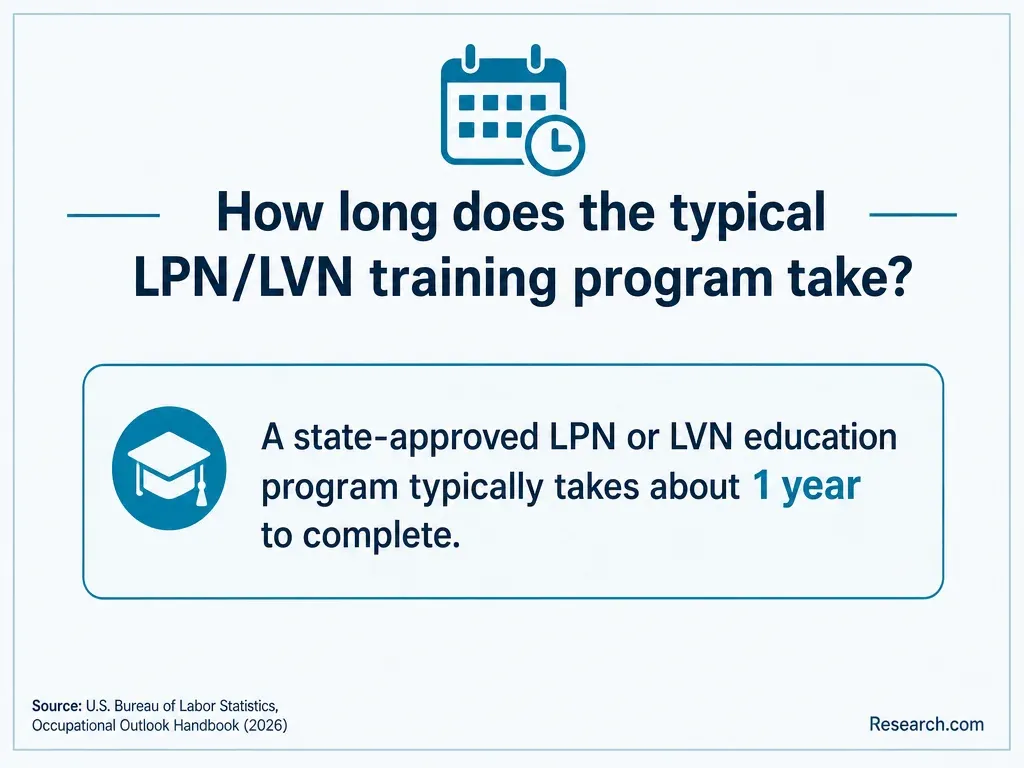
As broad planning ranges rather than promises, practical nursing programs often take about a year; ADN programs commonly take about two academic years of nursing study; and traditional prelicensure BSN programs commonly take four years. Prior coursework, prerequisite sequencing, part-time enrollment, and available clinical places can change the total time. Graduate and certificate lengths vary more substantially with the starting credential and specialty.
Price comparisons should include tuition and fees, supplies, immunizations and checks, testing and licensing charges, clinical travel, possible campus visits, and income lost to scheduled training. Published tuition alone does not establish total cost or financial return. If comparing GPA requirements in accelerated BSN programs, check prerequisite grades and course-recency rules alongside price and length; a school's general admission standard may not be its nursing cohort's standard.
What salaries and job outlooks can nursing graduates expect?
Salary data follow occupations, not degree abbreviations. The US Bureau of Labor Statistics reported May 2024 median annual pay of $62,340 for licensed practical and licensed vocational nurses, $93,600 for registered nurses, and $129,210 for nurse practitioners. These are occupation-wide historical benchmarks - not starting salaries, wages for graduates of a particular program, or estimates of what an individual offer will be. Consult the latest BLS release for updated medians and projection periods before making a financial commitment.
Outlook also depends on the occupation and local market. Demand for an RN in one setting does not establish demand for an FNP, educator, or manager nearby. Compare actual postings for the license, specialty, shifts, experience, and certifications they require; then weigh likely earnings against the full cost and time of training. An RN considering budget-conscious graduate nursing options for BSN nurses should first confirm that the resulting track qualifies them for the intended role. A cheaper degree that does not meet that goal offers poor value.
Other Things You Should Know About Nursing
PRN generally means work scheduled as needed rather than a guaranteed full-time schedule. Ask about minimum shifts, weekend requirements, benefits, and whether hours are guaranteed.
No. Medical assistants and certified nursing assistants have different training, typical duties, and applicable rules. Neither title means the person holds an RN or LPN/LVN license.
CCRN is a specialty certification associated with eligible nurses who care for acutely or critically ill patients. It does not replace an RN license or an employer's unit-specific orientation.
A nurse extern is typically a nursing student working in a supervised healthcare position. Duties, eligibility, and permitted titles vary by employer and state; extern work does not itself grant a nursing license.
- Certified registered nurse anesthetist and anesthesiologist assistant education programs in the United States - PMC https://pmc.ncbi.nlm.nih.gov/articles/PMC8437993/
- Licensure FAQ - Texas Board of Nursing https://www.bon.texas.gov/faq_licensure.asp.html
- Appendix B: Some Common Abbreviations | MedlinePlus https://medlineplus.gov/appendixb.html
- SCOPE OF PRACTICE - Nursing Fundamentals - NCBI - NIH https://www.ncbi.nlm.nih.gov/books/NBK610819/
- Certification vs. Licensure for Nurses: What Are the Differences? | Bradley University Online https://onlinedegrees.bradley.edu/blog/certification-vs-licensure
- What Are the Different Types of Nursing? | Digital Crafts https://www.trident.edu/articles/what-are-the-different-types-of-nursing
- Charge Nurse vs. Head Nurse vs. Nurse Manager Roles | American College of Education https://ace.edu/blog/charge-nurse-vs-head-nurse-vs-nurse-manager-differences-and-similarities/
- LPN vs. RN: Key Differences in Education, Practice & Career Paths - Nightingale College https://nightingale.edu/blog/lpn-vs-rn.html
- LVN vs RN: Complete Nursing Career Guide | American Career College https://americancareercollege.edu/blog/lvn-vs-rn-comprehensive-nursing-career-guide
- Charge Nurse vs. Nurse Manager: How Are They Different? | Nevada State University https://nevadastate.edu/son/rn-bsn/charge-nurse-vs-nurse-manager-how-are-they-different/