2027 Social Work Program Budgets: Personnel, Operations, Training, and Service Costs
Audited and Verified:
Our Editorial and Data Verification Process
Research.com uses government datasets, official education statistics and primary institutional information to support its career and degree guides. Our review process checks factual accuracy, occupational definitions, source dates and the requirements associated with the credentials discussed.
How This Article Was Fact-Checked
Our editorial team verifies salary estimates, employment projections, education requirements and program information against original data providers and official organizations. Salary figures are checked against the relevant occupational definitions and reporting periods. Information about licensure, accreditation and required in-person training is reviewed separately.
Fact-checked and verified on:

Co-Founder and Chief Data Scientist
A social work program can appear affordable until its budget accounts for supervision time, travel, documentation, and the work required for each client contact. For nonprofit and public-sector managers, those omissions can translate into overloaded staff or services the organization cannot sustain.
Students also need to distinguish an agency's delivery costs from their own education costs. This guide shows how to estimate personnel, operations, training, and service expenses; calculate a defensible cost per client; and use those figures to make funding, staffing, and education decisions.
Key Things You Should Know
- Budget paid service time and the work around it: supervision, documentation, outreach, travel, and referrals all consume capacity even when they are not billable client visits.
- For a hypothetical program spending $200,000 directly and $40,000 indirectly to serve 120 distinct clients, the full cost is $2,000 per client - not the $1,667 direct-cost figure.
- Keep agency operating budgets separate from student budgets: placement travel and lost wages affect affordability, while field instruction and onboarding affect what an agency can sustainably provide.
What does a social work program budget include?
A social work program budget is a plan for the resources needed to deliver a defined set of services over a defined period, usually a fiscal year. A school may use a similar structure for teaching and field education, but its students, funding sources, and outputs are different from those of a service agency. State the population, service model, location, expected volume, and budget period before assigning dollar amounts.
The categories below separate costs that managers can trace to a program from shared costs that need an allocation method. They also identify the assumptions most likely to change the estimate.
| Category | Typical costs | Main budget driver |
| Personnel | Practitioners, supervisors, coordinators, payroll taxes, benefits | Paid hours and staffing mix |
| Operations | Space, technology, insurance, supplies, accessibility, travel | Sites, staff, and service format |
| Training and supervision | Orientation, continuing education, field instruction, consultation | Learner and staff needs |
| Direct service | Client transportation, interpretation, approved assistance, service supplies | Number and intensity of services |
| Shared or indirect support | Finance, human resources, executive oversight, organization-wide systems | Documented allocation basis |
For a university, enrollment and field-placement capacity also drive costs. Comparing online social work degree programs requires looking beyond tuition to the staff and agency partnerships that support their delivery.
How much do personnel cost in a social work program budget?
Personnel cost is more than salary. For each position, calculate the share of annual pay charged to the program, then add employer-paid payroll taxes, benefits, any applicable overtime, and anticipated vacancies or temporary coverage. Use actual compensation schedules and benefit rates rather than treating a sample percentage as an industry standard.
Start staffing estimates with workload: referrals received, expected caseload, contact frequency, visit length, documentation, coordination, travel, leave, and supervision. A practitioner with 40 paid hours a week cannot provide 40 hours of client appointments. Include supervisors and intake or administrative staff when their work is necessary to keep services safe and accessible. Public agencies should also check civil-service classifications and negotiated pay rules.
Different services need different roles. Case management, school-based coordination, licensed clinical treatment, and program evaluation should not be priced as interchangeable labor; MSW job families and professional development can help managers identify duties before matching them to a job description. Confirm degree, license, and supervision requirements with the employer and applicable state authority rather than paying for a credential the position does not require.
What operating expenses should a social work program budget cover?
Operating expenses keep staff able to work and clients able to reach the service. Check lease or facility charges, secure records systems, devices, phone and internet access, insurance, interpretation, accessible materials, supplies, staff travel, vehicle use, and any approved client-facing assistance. Separate startup purchases from recurring subscriptions or replacement costs.
Service format changes the mix rather than eliminating expenses. Remote contact may reduce some travel or room needs but can increase technology, privacy, accessibility, and staff-training requirements; in-person outreach may require mileage, safety procedures, and flexible meeting space. For an education program, advertised online delivery likewise does not settle the cost of live skills sessions or local placements. When reviewing online undergraduate social work degree choices, ask which activities still require travel or scheduled attendance.
Use vendor quotes, existing contracts, and the organization's purchasing rules. Record which costs are fixed for the year and which rise with additional sites, staff, or clients so a proposed expansion does not rely on unused capacity that does not exist.
Define a service unit before forecasting costs. It might be an intake, a completed visit, a month of case management, or a distinct client served during the fiscal year. Then estimate referral-to-enrollment rates, contact frequency, average service duration, no-shows, travel, follow-up, and expected case complexity. A count of clients alone conceals why one program needs more staff time than another.
Build the forecast from capacity as well as demand. If expected contacts exceed the hours available after documentation, meetings, leave, and supervision, the options are to add resources, narrow eligibility, change the service model, or revise the volume target - not assume staff can absorb the difference. Include interpretation, transportation, and accessible delivery when those are needed for equitable access.
Educational pipelines should not be mistaken for immediate staffing capacity. Faster graduate social work study routes may affect when a student finishes a degree, but an agency should not count future graduates or current field students as independent licensed practitioners. Base the service forecast on authorized staff and approved learner roles.
Direct costs can be assigned to the service program, such as its staff time and supplies. Indirect costs support multiple programs, such as shared finance or facilities staff. The allocation must follow the organization's accounting rules and any funder agreement; a negotiated indirect-cost rate, if applicable, is not permission to charge the same expense twice.
A reproducible calculation takes three steps. Keep the service period and client definition identical across the expense and volume figures.
- Add direct program expenses, including the properly allocated share of each worker's pay and benefits.
- Add eligible shared expenses using a documented allocation method, such as occupied space or staff time.
- Divide the resulting full cost by the number of distinct clients served during that period, and report the service-unit definition alongside the figure.
For illustration only, $200,000 in direct costs plus $40,000 in allocated indirect costs equals $240,000. Divided by 120 distinct clients, that is $2,000 per client. It is not a recommended reimbursement rate: clients may use very different amounts of service, and restricted funding may cover only certain costs. Report cost per visit or per service month as well if either better reflects the decision.
Education budgets need their own denominator, such as enrolled students or completed placements. Comparing affordable online MSW programs by advertised tuition alone will not reveal a school's cost per student - or a student's total cost.
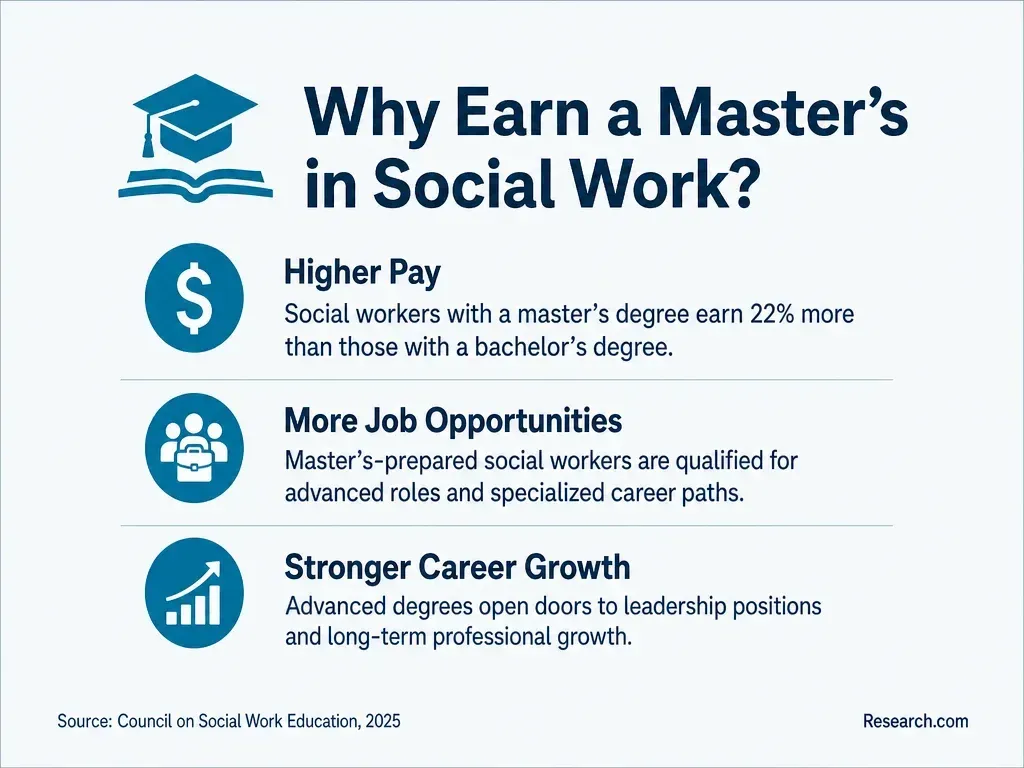
Before paying a deposit, confirm the exact program's institutional and relevant CSWE accreditation status, including whether that status covers the student's anticipated cohort. Then check the intended state licensing board's current education rules. The school awards the degree; the board decides license eligibility and issuance. An MSW, even with a clinical concentration, does not itself authorize independent clinical practice.
Entry route also changes cost. A traditional or foundation MSW can admit qualified applicants whose bachelor's degree is in another field; advanced standing generally requires a qualifying social work degree and must be approved under the individual program's rules. Compare the total required credits, field sequence, and time away from paid work rather than assuming the shorter advertised route applies. Comparing social work graduate applicant requirements can help identify questions to take to admissions staff, but only the program can confirm an applicant's entry track.
If clinical licensure is the goal, ask the state board about any examination and post-degree supervised-experience requirements separately. Academic field hours are not automatically credited as post-degree clinical supervision. A mistaken assumption here can add terms of study or delay an intended career move.
How do social work salaries and job outlook affect education decisions?
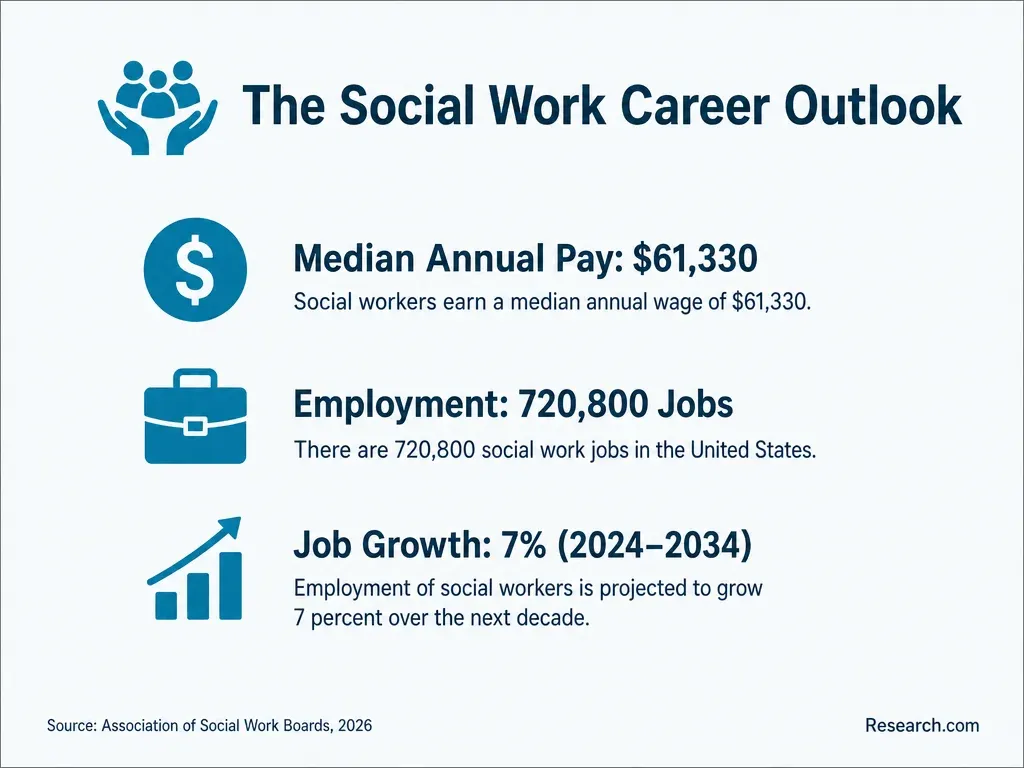
Pay and demand can inform both agency staffing plans and a student's education decision, but occupational medians are not starting salaries or returns guaranteed by a degree. The U.S. Bureau of Labor Statistics reports a May 2025 median annual wage of $61,780 for social workers across specialties and projects 6% employment growth from 2025 to 2035. The specialty and setting matter: healthcare social workers have a reported $67,880 median and 8% projected growth, while mental health and substance abuse social workers have a $60,280 median and 10% projected growth.
Managers should compare those occupation-wide figures with local pay schedules, benefits, licensing needs, and the wages required to recruit for the actual duties. Prospective students should compare likely roles with total education costs and forgone earnings. A guide to comparing social worker pay by location can help frame geographic differences, but local job postings and public pay schedules are more useful for a specific offer.
If the target role is nonclinical program coordination or administration, relevant experience or focused management training may be more direct than another social work degree. If the role requires a particular accredited degree or license, budget for the full qualifying pathway rather than relying on the occupational median to justify it.
Other Things You Should Know About Social Work
Yes, if the funder and organization permit it. Identify the reserve separately, explain what could trigger its use, and check whether unspent funds can carry forward.
They can be shown as in-kind support when accurately valued and permitted by the funder. Do not treat them as cash available for payroll or assume they satisfy a grant match without checking its rules.
Review actual spending and service volume at least during regular financial reporting, and revise forecasts when staffing, contracts, client needs, or service locations change materially.
Include finance staff and the program leader, plus supervisors and people responsible for accessibility, data systems, or contracts where relevant. Their review can reveal costs a spreadsheet based only on client contacts misses.
- Policy Recommendations for Coordinated and Sustainable Growth of the Behavioral Health Workforce - PMC https://pmc.ncbi.nlm.nih.gov/articles/PMC11576582/
- 7.9 Allowability of Costs/Activities | nih.gov https://grants.nih.gov/grants/policy/nihgps/HTML5/section_7/7.9_allowability_of_costs_activities.htm
- NASW Standards for Social Work Case Management | nycourts.gov https://www.nycourts.gov/reporter/webdocs/nasw_standards_socialwork_casemgt.htm
- OMB Circular A-122, Cost Principles for Non-Profit Organizations | archives.gov https://georgewbush-whitehouse.archives.gov/omb/circulars/a122/a122.html
- Office of Finance and Operations (OFO) | FAQs on Indirect Costs | U.S. Department of Education http://www.ed.gov/about/ed-offices/ofo/ocfos-financial-improvement-post-audit-operations
- Understanding Non-Federal Match Requirements | transportation.gov https://www.transportation.gov/grants/dot-navigator/understanding-non-federal-match-requirements
- 2 CFR Part 200 Subpart E -- Cost Principles | ecfr.gov https://www.ecfr.gov/current/title-2/subtitle-A/chapter-II/part-200/subpart-E
- Overview of Costs for Project Budgets (Budget and Costing Guide) | Cornell Research Services https://researchservices.cornell.edu/resources/overview-costs-project-budgets-budget-and-costing-guide
- The 10 Best States to be a Social Worker in 2026 | sbu.edu https://online.sbu.edu/blog/10-best-states-to-be-a-social-worker-2026
- Direct Costs vs. Indirect Costs - University Research https://vpresearch.louisiana.edu/pre-award/building-your-budget/direct-costs-vs-indirect-costs