2027 Most Affordable Bachelor's Degrees for Students Balancing Work and Family

Co-Founder and Chief Data Scientist
Choosing a bachelor's degree while working and caring for family is a cost, time, and risk decision-not just an academic one. BLS 2024 data shows workers with a bachelor's degree had median weekly earnings of $1,543, compared with $930 for those with only a high school diploma, but tuition and lost time can reduce the payoff. This guide helps adult learners compare affordable majors, online and hybrid formats, accreditation, hidden costs, and career outcomes so they can choose a degree that fits real-life schedules and budgets.
Key Things You Should Know
- Affordability should be measured by total net cost, not sticker tuition; College Board 2024 data lists average published tuition and fees at $11,610 for in-state public four-year colleges and $43,350 for private nonprofit four-year colleges.
- The most budget-friendly bachelor's options for working caregivers often combine online coursework, generous transfer credit, asynchronous classes, and majors with clear labor-market demand.
- Strong ROI usually depends on choosing an accredited program tied to specific roles, since BLS May 2024 wage data shows fields such as nursing, IT, cybersecurity, business, and engineering often sit above the $49,500 median for all U.S. occupations.
Top 10 2026 Most Affordable Bachelor's Degrees for Students Balancing Work and Family
Business Degrees
Business degrees are often affordable because many schools offer fully online bachelor's programs with transfer-friendly general education and elective requirements. They fit adults seeking management, operations, accounting, marketing, human resources, or entrepreneurship roles.
BLS May 2024 data places accountants and auditors at a median annual wage of $81,680, which makes accounting-focused business programs especially practical for cost-conscious students. Choose programs with regional accreditation, clear transfer policies, and concentrations aligned with target jobs. Avoid vague "general business" plans unless the curriculum includes marketable skills such as analytics, budgeting, compliance, or project management.
Healthcare Degrees
Healthcare bachelor's degrees can be affordable when they build on existing allied health credits, certifications, or associate degrees. Common low-cost options include health administration, public health, health informatics, and healthcare management. These programs usually suit caregivers who want stable employment without completing clinical nursing requirements.
They may lead to roles in medical office management, care coordination, insurance operations, or community health. Check whether internships are required and whether they can be completed locally. Students seeking licensed clinical practice should confirm state-specific requirements before enrolling.
Information Technology Degrees
Information technology degrees are practical for working adults because many courses use remote labs, cloud platforms, and project-based assignments. Affordable IT programs often accept transfer credits and industry certifications, reducing both tuition and time. Graduates may pursue help desk leadership, systems administration, network support, cloud operations, or database roles.
BLS May 2024 data reports a $105,990 median annual wage for computer and mathematical occupations, but entry-level pay varies widely. Look for programs that include hands-on work with operating systems, networking, cybersecurity basics, scripting, and IT service management.
Computer Science Degrees
Computer science can offer strong long-term value, but it is not always the easiest option for overloaded students. Courses often require sustained focus in programming, algorithms, discrete math, data structures, and software engineering. Affordable CS degrees work best for learners who can schedule regular practice time.
BLS May 2024 data lists software developers at a median annual wage of $133,080, but employers often expect portfolios, internships, or demonstrable coding ability. Choose programs with strong tutoring, project work, and flexible pacing rather than selecting solely by low tuition.
Cybersecurity Degrees
Cybersecurity degrees can be affordable when they include certification preparation and accept prior IT credits. They suit students interested in risk management, network defense, compliance, incident response, or security operations. BLS May 2024 data lists information security analysts at a median annual wage of $124,910, reflecting strong demand for specialized skills.
However, many cybersecurity jobs are not truly entry-level; employers may prefer IT experience. Working parents should compare lab requirements, evening support, and whether courses prepare for credentials such as Security+, Network+, or cloud security certifications.
Psychology Degrees
Psychology is usually affordable and widely available online, but students should understand its limits. A bachelor's alone may support roles in case management, human services, behavioral health support, research assistance, sales, or HR, but licensed counseling or clinical psychology requires graduate education.
This degree fits caregivers who want a broad people-focused foundation and may later pursue social work, counseling, education, or organizational roles. To improve ROI, choose programs with statistics, research methods, applied psychology, internship options, and clear advising about graduate school costs and licensure pathways.
Nursing Degrees
Nursing can be one of the strongest affordability-to-outcome choices, especially for licensed RNs completing an RN-to-BSN program. BLS May 2024 data lists registered nurses at a median annual wage of $93,600. RN-to-BSN programs are often online, shorter, and designed around shift work, though clinical or practicum expectations vary.
Pre-licensure BSN programs are less flexible because they require labs, clinical placements, and strict attendance. Confirm state board approval, clinical scheduling, and employer tuition reimbursement before committing, especially if you are balancing childcare or eldercare.
Education Degrees
Education degrees can be affordable at public universities, but licensure rules make careful program selection essential. Students pursuing teaching should verify that the bachelor's program leads to certification in their state and includes required student teaching placements.
BLS May 2024 data lists elementary school teachers, except special education, at a median annual wage of $63,680, though salaries vary by district and state. This path fits students who value stable schedules and public-service work. It may not fit those unable to complete daytime classroom placements.
Criminal Justice Degrees
Criminal justice degrees are often low-cost and flexible, especially online, but ROI depends heavily on the target role. They can support careers in law enforcement, corrections, probation, security management, homeland security support, or public administration. Some roles require academy training, background checks, physical standards, or civil service exams rather than only a degree.
To keep costs aligned with outcomes, choose programs that include policy analysis, data literacy, ethics, report writing, and internship options. Students aiming for federal roles may benefit from adding cybersecurity, accounting, or foreign language skills.
Engineering Degrees
Engineering degrees can produce strong earnings, but they are less commonly offered in fully online, low-cost formats because of lab, math, and accreditation requirements. BLS May 2024 data lists mechanical engineers at a median annual wage of $99,510. Working parents should look for ABET-accredited programs when licensure, government work, or traditional engineering roles are goals.
Hybrid schedules, community college transfer pathways, and employer tuition benefits can reduce costs. This degree is best for students who can commit to rigorous math, labs, and structured course sequences.
What makes a bachelor's degree truly affordable for working parents and caregivers?
A bachelor's degree is truly affordable when the total cost fits your household budget and the schedule is realistic enough for you to finish. Sticker tuition matters, but adult learners should also weigh net price after grants, transfer credits, employer reimbursement, childcare, transportation, technology, and the number of semesters required.
The table below summarizes the main affordability factors working parents and caregivers should compare before enrolling. It is designed to show why the cheapest advertised tuition is not always the lowest-cost path:
| Affordability factor | Why it matters for working caregivers | What to look for |
| Net price | This is closer to what you actually pay after grants and scholarships. | School-specific net price calculator, aid estimate, and tuition guarantee |
| Transfer credit | Accepted credits can remove entire terms from your plan. | Written transfer evaluation before enrollment |
| Schedule fit | A low-cost program becomes expensive if the format causes stop-outs. | Asynchronous classes, part-time tracks, evening support, and predictable terms |
| Fees and materials | Online, lab, clinical, testing, and course-material fees can change the real cost. | Itemized cost of attendance, not only tuition per credit |
| Career alignment | A degree should connect to roles that justify the investment. | Major-specific outcomes, licensure alignment, internships, and employer partnerships |
For many students, the best value is a public university, community college transfer pathway, or accredited online completion program. Private nonprofit schools can also be cost-effective if scholarships, transfer credits, or employer partnerships reduce the final bill.
How do online, hybrid, and evening bachelor's programs compare for busy adult students?
Online, hybrid, and evening bachelor's programs can all work for busy adults, but they solve different problems. The best format depends on your work schedule, childcare coverage, commute, learning style, and whether the major requires labs, clinicals, fieldwork, or supervised placements.
The table below compares the main formats from the perspective of working parents and caregivers. Use it to identify which format protects your study time instead of simply choosing the option that sounds most flexible:
| Format | Best fit | Common trade-off | Programs where it often works well |
| Fully online asynchronous | Students with unpredictable work or caregiving schedules | Requires strong self-management and fewer real-time reminders | Business, IT, psychology, criminal justice, healthcare administration |
| Online synchronous | Students who want structure but cannot commute | Live class times may conflict with shifts or family needs | Education, cohort-based business, some healthcare programs |
| Hybrid | Students who need some campus support or labs | Commutes and fixed meeting days reduce flexibility | Nursing, engineering, education, lab-based sciences |
| Evening or weekend campus | Students near campus with predictable childcare | Fewer sections may be available each term | Business, education, criminal justice, social science |
A common mistake is assuming "online" means "easy" or "work at any pace." Many online degrees still have weekly deadlines, group projects, exams, and proctored assessments, so students should ask for a sample course calendar before enrolling.
How can you verify accreditation and financial aid eligibility for low-cost bachelor's programs?
Accreditation and financial aid eligibility are nonnegotiable for an affordable bachelor's degree. Regional or institutional accreditation affects credit transfer, graduate school eligibility, employer recognition, and access to federal student aid.
Before applying, use a verification process that creates a paper trail. These steps help you avoid programs that look inexpensive but create transfer, licensure, or aid problems later:
- Confirm the institution is listed in the U.S. Department of Education's recognized accreditation database or with a recognized accreditor.
- Check programmatic accreditation when it matters, such as ABET for many engineering programs, CCNE or ACEN for nursing, and state approval for teacher preparation.
- Ask whether the program is Title IV eligible, which determines whether students can use federal grants and loans.
- Request a written transfer credit evaluation before committing, especially if you have community college, military, workplace, or prior university credits.
- For licensure fields, verify requirements with the state licensing board rather than relying only on admissions materials.
Red flags include pressure to enroll immediately, vague accreditation language, no clear cost of attendance, refusal to provide transfer details in writing, or claims that licensure is automatic in every state.
Which bachelor's majors offer strong career outcomes while keeping tuition and debt low?
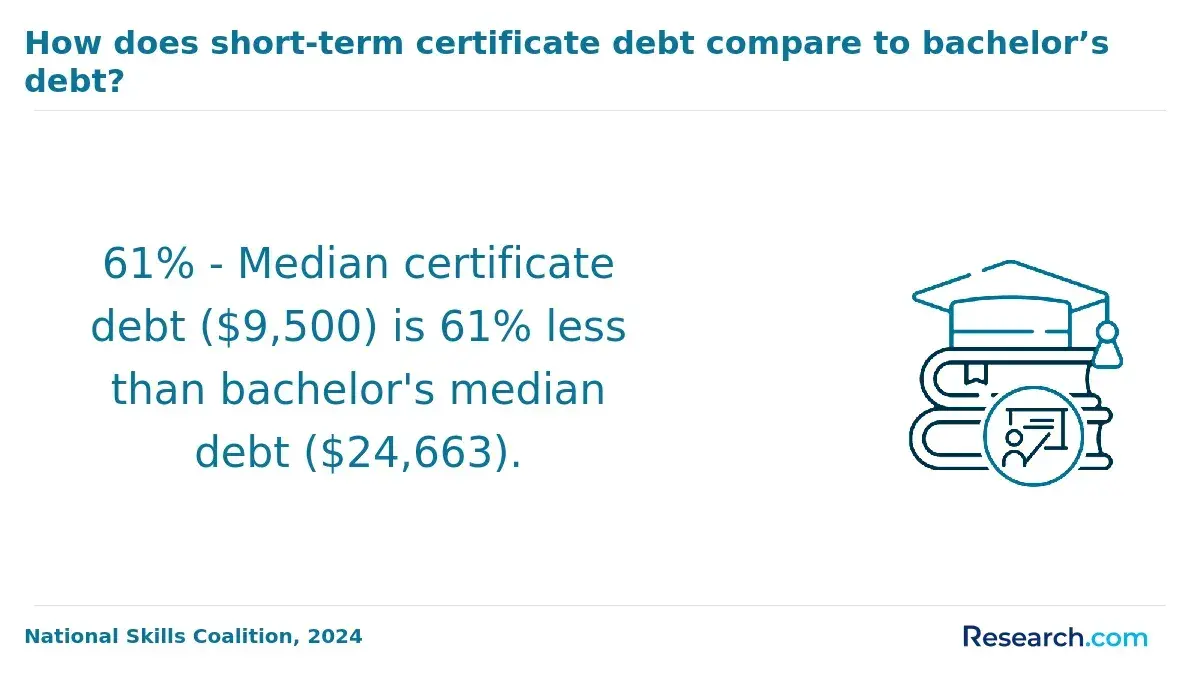
The strongest low-cost majors tend to connect to clear job families, measurable skills, and employer-recognized credentials. Students who are unsure about a full degree can also compare shorter online certificates, especially in fields such as IT, project management, data analytics, bookkeeping, and healthcare administration.
The table below compares common affordable bachelor's majors by career fit. Salary figures are not promises; they are BLS May 2024 median annual wages for selected U.S. roles that may align with the degree and usually depend on experience, location, and employer requirements:
| Major | Cost-control advantage | Example role | BLS May 2024 median annual wage |
| Business or accounting | Widely available online and transfer-friendly | Accountant or auditor | $81,680 |
| Information technology | May award credit for certifications or prior technical study | Computer support specialist | $61,550 |
| Computer science | Strong portfolio value if the program includes projects | Software developer | $133,080 |
| Nursing | RN-to-BSN pathways can shorten the route for licensed nurses | Registered nurse | $93,600 |
| Education | Public university pathways may be lower cost | Elementary school teacher | $63,680 |
| Cybersecurity | Can pair with certifications for stronger entry signals | Information security analyst | $124,910 |
Students should avoid choosing a major only because it is cheap. A low-cost degree with weak career alignment can be more expensive over time than a moderately priced program that leads to a realistic promotion, licensure pathway, or higher-demand role.
What are typical tuition, fees, and hidden costs for budget-friendly bachelor's degrees?
Budget-friendly bachelor's degrees usually keep costs low through in-state tuition, online delivery, transfer credit, flat-rate terms, employer reimbursement, or competency-based pacing. College Board 2024 data reports average published tuition and fees of $11,610 for in-state students at public four-year institutions, which is a useful benchmark when comparing advertised prices.
When building a budget, include costs that may not appear in the headline tuition rate. Students trying to reduce upfront expenses may also compare schools with free online college applications before paying multiple application fees.
- Tuition and mandatory fees by credit, term, or academic year.
- Online course fees, technology fees, lab fees, clinical fees, proctoring fees, and graduation fees.
- Books, access codes, software, laptops, webcams, calculators, uniforms, or equipment.
- Transportation, parking, childcare, unpaid clinical time, or reduced work hours.
- Transcript fees, prior learning assessment fees, certification exam costs, and licensure application costs.
A smart comparison uses total program cost after accepted transfer credits. For example, a school with higher tuition per credit may still be cheaper if it accepts more prior credits and reduces the number of terms you must attend.
How long does it take to finish an affordable bachelor's while working and parenting?
Completion time depends on transfer credits, course load, term length, prerequisites, and whether the program has lockstep sequencing. Working parents often finish faster when they choose a realistic pace they can sustain instead of repeatedly stopping and restarting.
The table below shows typical timelines for adult students. These are planning ranges, not guarantees, because course availability and personal workload can change the schedule:
| Starting point | Typical remaining credits | Common pace while working | Approximate completion range |
| No prior college credit | About 120 credits | 6 to 12 credits per term | 4 to 6 years |
| Some college credit | Varies by transfer evaluation | 6 to 12 credits per term | 2 to 5 years |
| Associate degree completed | About 45 to 75 credits | 6 to 12 credits per term | 18 months to 3 years |
| RN-to-BSN or degree completion | Often fewer major-specific credits | Part-time or accelerated blocks | 12 months to 2 years |
To shorten the timeline without overloading yourself, focus on credit efficiency rather than maximum speed. Practical options include requesting transfer reviews from multiple schools, asking about credit for military or professional training, using summer terms selectively, and taking prerequisite courses at a lower-cost community college when the bachelor's institution allows it.
What admission requirements do flexible, low-cost bachelor's programs usually have?
Flexible, low-cost bachelor's programs usually ask for a high school diploma or GED, official transcripts, an application, and sometimes a minimum GPA. Adult-friendly schools may use transfer GPA, professional experience, placement tests, or conditional admission when a student's academic record is older or uneven.
Applicants with lower prior grades should compare policies carefully because some reputable colleges that accept 2.0 GPA still require certain majors, such as nursing, education, or engineering, to meet higher standards.
Before applying, gather the items most likely to affect admission and cost. Having these ready helps admissions and financial aid staff give more accurate answers:
- Official transcripts from every college attended, even if credits were not completed.
- High school transcript or GED documentation when required.
- Resume showing work, military, caregiving, volunteer, or certification experience.
- Proof of licensure or certification for completion programs such as RN-to-BSN or allied health pathways.
- Personal statement or appeal letter if applying through conditional or adult-degree admission.
A common mistake is applying before knowing whether old credits will transfer. Ask for transfer estimates early, but wait for the official written evaluation before making a final enrollment decision.
How do affordable bachelor's degrees impact salaries, promotion opportunities, and job security?
An affordable bachelor's degree can improve salary potential, promotion access, and job security when it removes a credential barrier or builds skills employers already need. It is most valuable when paired with experience, a clear occupational target, and a manageable debt level.
The table below shows how a bachelor's degree may affect different career situations. It is meant to help readers evaluate likely fit, not predict individual outcomes:
| Current situation | How a bachelor's may help | Best-fit degree strategy | Risk to watch |
| Experienced worker without a degree | May qualify for promotions that require a bachelor's | Degree completion program with maximum transfer credit | Choosing a major unrelated to advancement goals |
| Parent reentering the workforce | May refresh skills and signal current preparation | Online program with career services and applied projects | Underestimating time needed for job search and networking |
| Healthcare or public service employee | May meet requirements for supervisory or licensed roles | Accredited program aligned with state or employer rules | Assuming all online programs meet licensure standards |
| Career changer | May provide structured entry into a new field | Major plus internships, portfolio, certifications, or practicum | Expecting the degree alone to replace relevant experience |
Debt matters because monthly payments reduce the real value of higher earnings. A practical rule is to borrow as little as possible, use grants first, ask employers about tuition assistance, and compare expected entry-level pay rather than only mid-career salary headlines.
How can you compare and choose reputable low-cost programs that fit work and family needs?
Choosing a reputable low-cost program is a comparison process, not a single ranking decision. Start with your target role, then work backward to the degree, accreditation, schedule, and total cost that support that goal.
If your priority is online flexibility, compare an affordable online bachelor's degree against local public options, community college transfer pathways, and employer-partner schools before committing.
Use the following sequence to narrow your choices without overlooking red flags. Each step should produce a concrete answer you can compare across schools:
- Define the job or promotion you want and identify whether a bachelor's degree, license, certification, or graduate degree is normally required.
- Eliminate schools without recognized accreditation or unclear financial aid eligibility.
- Request written transfer credit evaluations from your top options before comparing final cost.
- Calculate total remaining cost, including fees, books, childcare, technology, and any unpaid placement hours.
- Compare course format, deadline structure, tutoring hours, career services, and advisor availability for evenings or weekends.
- Ask for graduation, retention, licensure exam, or job-placement information when relevant, and be cautious if the school cannot explain outcomes clearly.
- Choose the program that you can finish consistently, not simply the one with the lowest advertised tuition.
The best program for a working caregiver is usually the one that balances price, credibility, pacing, and support. If any one of those is missing, the risk of stopping out-and paying for credits that do not lead to a credential-goes up.
Other Things You Should Know About
The cheapest option is often a public in-state online or degree-completion program that accepts many transfer credits. Business, criminal justice, psychology, healthcare administration, and IT are commonly available in flexible, lower-cost formats.
Yes, if the school is properly accredited and the program fits the role. Employers usually care more about accreditation, skills, experience, licensure, and relevant projects than whether the coursework was online or on campus.
Part time is often more sustainable for students managing work and caregiving, but it can extend the timeline. Full time may work if the student has stable childcare, predictable work hours, and enough financial support to avoid burnout.
Many accredited bachelor's programs qualify for federal financial aid if the institution participates in Title IV programs and the student meets eligibility rules. Always complete the FAFSA and ask the school for a full aid estimate before enrolling.
References
- Student Financial Aid Models - Finance | Learn & Work Ecosystem Library https://learnworkecosystemlibrary.com/topics/student-financial-aid-models/
- 31 Affordable Universities in the USA for International Students https://www.wemakescholars.com/blog/cheapest-universities-in-usa-for-international-students
- Is College Worth It? - Public Policy Institute of California https://www.ppic.org/publication/is-college-worth-it/
- Proven Ways to Support Student Parents College Success - Campus Mind https://www.campusmind.org/support-student-parents-college/
- How Online College Degree Programs Can Transform Your Life https://www.tuw.edu/school-news/online-degree-programs-transform-your-life/
- Employer Tuition Assistance Aids Student Parents | Edcor https://www.edcor.com/blog/10107-2/
- Earn While You Learn: Jobs That Pay For College - Citizens National Bank https://www.cnbohio.com/earn-while-you-learn/
- For Student Parents, the Biggest Hurdles Are Costs and Child Care https://www.luminafoundation.org/resource/for-student-parents-the-biggest-hurdles-to-a-higher-education-are-costs-and-finding-child-care/
- Average In-State vs. Out-of-State Tuition [2025]: Cost Comparison https://educationdata.org/average-in-state-vs-out-of-state-tuition
- For Student Parents, The Biggest Hurdles to A Higher Education are Costs and Finding Child Care https://edtrust.org/rti/for-student-parents-the-biggest-hurdles-to-a-higher-education-are-costs-and-finding-child-care/