
2027 Most Affordable Associate Degrees for Students With Some College Credit

Co-Founder and Chief Data Scientist
Already have college credit but no degree? The cheapest way forward may be the program that applies the most of your credits - not the one advertising the lowest tuition. The College Board reported average published in-district tuition and fees of $4,050 at public two-year colleges for 2024-25, before books, transportation, and other expenses.
That makes the number of credits you still need especially important. This guide compares associate degree fields, explains how to estimate your remaining cost, and helps you choose between a transfer-focused degree and a career-focused one.
Key Things You Should Know
- Start with an official degree audit: a low tuition rate matters less if prior courses do not satisfy general education, major, or prerequisite requirements.
- Associate degrees commonly require about 60 credits, but accepted transfer credits, residency rules, and required course sequences determine how many credits you must still complete.
- Compare business, IT, and transfer-oriented programs for scheduling flexibility; compare healthcare and nursing programs with particular attention to lab, clinical, equipment, and licensure costs.
Top 10 Most Affordable Associate Degrees for Students With Some College Credit
Business Programs
A business administration AA or AS can be a cost-conscious choice if your previous writing, math, and introductory business courses fulfill degree requirements. It often supports transfer into a bachelor's program. An accounting or business AAS may be more focused on immediate employment but less transferable. Compare the remaining course list - not just the number of credits accepted - and check whether the college charges extra for online courses or business software. A business associate degree can support entry-level work; management positions typically require experience and may require further education.
Healthcare Programs
Healthcare administration and health information programs may apply previous general education credits while offering more scheduling options than clinical programs. Career-focused allied-health AAS degrees can have strong occupational relevance, but prerequisites, labs, background checks, equipment, and supervised placements may raise the remaining cost. Some health information roles also favor or require a separate credential. Before choosing the cheaper-looking program, confirm that it prepares students for the specific job or certification you want and that required in-person components are practical for you.
Information Technology Programs
IT support, networking, and cybersecurity associate programs may suit students who can apply prior math, writing, or computing courses. An AS may emphasize transfer; an AAS may emphasize technical skills and workforce entry. Compare required hardware, software, lab access, and certification-exam costs alongside tuition. Older technology courses may not satisfy current major requirements even if a college accepts them as electives. Employer expectations vary, so inspect local job postings before assuming the degree alone qualifies you for a particular role.
Nursing / Pre-Nursing Programs
A pre-nursing AS can be a transfer pathway, but it is not a nursing license. An associate degree in nursing is a different, typically selective program with science prerequisites, clinical placements, and state-specific approval requirements. Previously earned science credits may face recency or grade rules, making these programs less inexpensive to finish than their tuition rate suggests. Ask whether admission to the college differs from admission to nursing, where clinicals occur, and what the complete cost includes. Graduates must meet applicable licensing requirements, including the licensing examination, before practicing as registered nurses.
Criminal Justice Programs
A criminal justice AA or AS may be economical for a student whose previous general education courses fit a transfer plan. An AAS may emphasize applied public-safety coursework. Neither degree automatically qualifies someone for a law-enforcement position: agencies set their own hiring, training, fitness, and background requirements. Before enrolling, check whether the credential is required or preferred for your target employer. If your goal is a bachelor's degree, confirm that the destination institution will apply the courses to your intended major rather than accepting them only as electives.
Psychology / Counseling Programs
A psychology AA or AS often works best as an affordable transfer foundation when prior general education credits satisfy its requirements. It does not qualify someone to practice independently as a counselor or psychologist; those careers generally require substantial additional education and state licensure. If immediate employment is the priority, compare this pathway with career-focused human services programs and check whether they require a practicum. Choose psychology for a documented bachelor's pathway, not because its associate-level courses appear inexpensive or its name resembles a licensed occupation.
What Are the Most Affordable Associate Degrees for Students With Some College Credit?
The most affordable associate degree is the accredited program with the lowest realistic cost to complete your remaining requirements. For many students with prior credit, that means an in-district public community college offering a business, general studies, psychology, or IT pathway that applies previous courses directly to the degree. It is not a verified ranking of those majors: prices and accepted credits vary by institution and student.
The comparison below identifies where each field may save money and where an apparently low-cost option can become expensive. AA and AS degrees are often transfer-oriented, while AAS degrees are often career-oriented, but the college's actual curriculum and transfer agreements matter more than the initials.
| Degree field | Potential affordability advantage | Cost or pathway trade-off |
| Business or general studies | Prior general education courses may fulfill a substantial share of requirements. | A broad degree may need a bachelor's pathway or additional experience to support a specific career goal. |
| Psychology | Previous general education credits may fit a transfer-focused plan. | Licensed counseling and psychology careers require further education and other qualifications. |
| Information technology | Existing general education and relevant computing courses may apply. | Technical-course recency rules and equipment or certification costs can affect the total. |
| Healthcare or nursing | Previously completed prerequisites may reduce remaining coursework. | Selective admission, clinical sequencing, and required supplies can increase cost and time. |
| Criminal justice | Prior writing, social science, and other general education courses may apply. | Employer hiring and academy requirements remain separate from the degree. |
Request a written evaluation and an itemized estimate from each college. Compare tuition for remaining credits, mandatory fees, books and equipment, travel or clinical expenses, and aid you can actually use. Sticker price is the published charge; net price accounts for grants and scholarships; total completion cost also depends on how many credits remain. If you are still deciding on a field, a guide to the best associates degrees to get can broaden your options, but your credit evaluation should settle the affordability question.
How Can Students Transfer Existing College Credits Into an Associate Degree?
Transfer credit helps only when the receiving college both accepts it and applies it to your chosen degree. A course awarded as a free elective might reduce neither your required major coursework nor your time to graduation. Policies differ on eligible institutions, minimum grades, course age, maximum transfer credits, and the credits that must be completed at the degree-granting college.
Use this sequence before you commit to a program or pay a nonrefundable enrollment charge:
- Send official transcripts from every previous college and request a program-specific, written transfer evaluation before enrollment if the school offers one.
- Ask the advisor to identify which credits satisfy general education, major, and prerequisite requirements; which count only as electives; and which requirements remain.
- Confirm the college's residency requirement and ask separately about evaluated military training, examinations, industry credentials, or documented prior learning.
Experience does not automatically become credit. A college may require an approved examination, portfolio, or other assessment, and may charge a fee. If you plan to earn a bachelor's degree later, also obtain the destination school's guidance: credit accepted toward an associate degree does not necessarily meet bachelor's major requirements.
Are Online Associate Degrees More Affordable Than Campus-Based Programs?
Online study is not automatically cheaper. It may eliminate commuting or relocation costs, but online course fees, technology requirements, and out-of-district tuition can offset those savings. A nearby community college may offer the lowest in-district rate even when its classes meet on campus; another college's online program may cost less overall if it accepts substantially more of your prior credits.
Check whether "online" means asynchronous classes or scheduled live attendance. Healthcare and nursing programs may also require local labs or clinical placements. When comparing accredited online universities with community colleges, verify the institution's accreditation, the exact associate program offered, your tuition classification, and every required in-person component. A useful comparison is each school's written estimate for the same student - not its advertised per-credit rate alone.
How Long Do Affordable Associate Degrees Take to Complete?
An associate degree commonly requires about 60 credits, but a student with previous college work does not necessarily need to repeat them all. Completion time depends on how accepted credits fit the degree, the college's residency rule, enrollment intensity, course availability, and prerequisite or clinical sequencing. A student with many applicable credits may still wait for a required course that is offered infrequently.
Ask for a term-by-term plan showing only your outstanding requirements. Compare the cost of finishing quickly with a heavier course load against a part-time schedule you can sustain while working. Treat an advertised fast completion time as conditional until you know the transfer-credit starting point it assumes; short course terms do not shorten an entire degree by themselves.
What Accreditation Should Students Look for When Choosing an Associate Degree?
Start with institutional accreditation recognized by the U.S. Department of Education. It matters for federal student aid eligibility and may affect how another college evaluates transfer credit, although accreditation never guarantees that a particular course will transfer. Confirm the institution's current status rather than relying on an advertisement or an outdated listing.
For regulated career programs, check a second layer: any programmatic accreditation or state approval needed for your intended credential. In nursing, for example, state board approval and eligibility to pursue licensure are essential questions; other healthcare occupations may have their own requirements. Ask the licensing board or credentialing organization which standards apply in the state where you intend to work. An inexpensive program is poor value if it does not support the next required step.
What Are the Admission Requirements for Affordable Associate Degree Programs?
Many associate programs ask for an application and prior transcripts, and colleges may use placement information to determine an appropriate starting course. Requirements vary; do not assume that admission to a college means admission to a specific major. Nursing and some allied-health programs can require prerequisite science courses, minimum grades, a separate application, and other selection criteria.
If you have previous credit, ask admissions for both the college's entry requirements and the major's requirements. Disclose all prior institutions so the transfer evaluation and aid review reflect your full academic record. Before enrolling, confirm whether a required course must be repeated because of its grade, age, or program-specific policy.
What Courses Are Included in Affordable Associate Degree Programs?
Most associate plans combine general education - such as writing, mathematics, and social science - with courses in the chosen field. Business may include accounting and management; IT may include networking and systems; psychology may include introductory psychology and research foundations. Career-focused degrees can add applied labs, internships, or practicums, while nursing includes science prerequisites and supervised clinical education.
Your cheapest curriculum is not necessarily the one with the fewest named courses. A degree audit should show whether earlier classes replace required courses or merely fill elective space. If a program is meant to lead to a bachelor's degree, compare its course map with the receiving institution's major requirements before choosing electives.
What Jobs and Salaries Can Associate Degree Graduates Expect?
Career value depends on the occupation, local hiring requirements, and what the associate degree actually prepares you to do. The examples below distinguish possible pathways from jobs for which additional qualifications are typically necessary; they are not placement or earnings promises.
| Field | Possible pathway | Important qualification limit |
| Business | Administrative or bookkeeping support | Job duties and preferred credentials vary by employer; management usually requires experience. |
| Healthcare administration or information | Medical office or records-related work | Some roles favor or require a separate credential. |
| Information technology | Computer support | Employers may value hands-on skills and certifications as well as education. |
| Associate degree in nursing | Registered nursing after meeting licensure requirements | The degree alone is not a license. |
| Psychology | Transfer toward further study or certain support roles | Independent counseling and psychology practice requires additional education and licensure. |
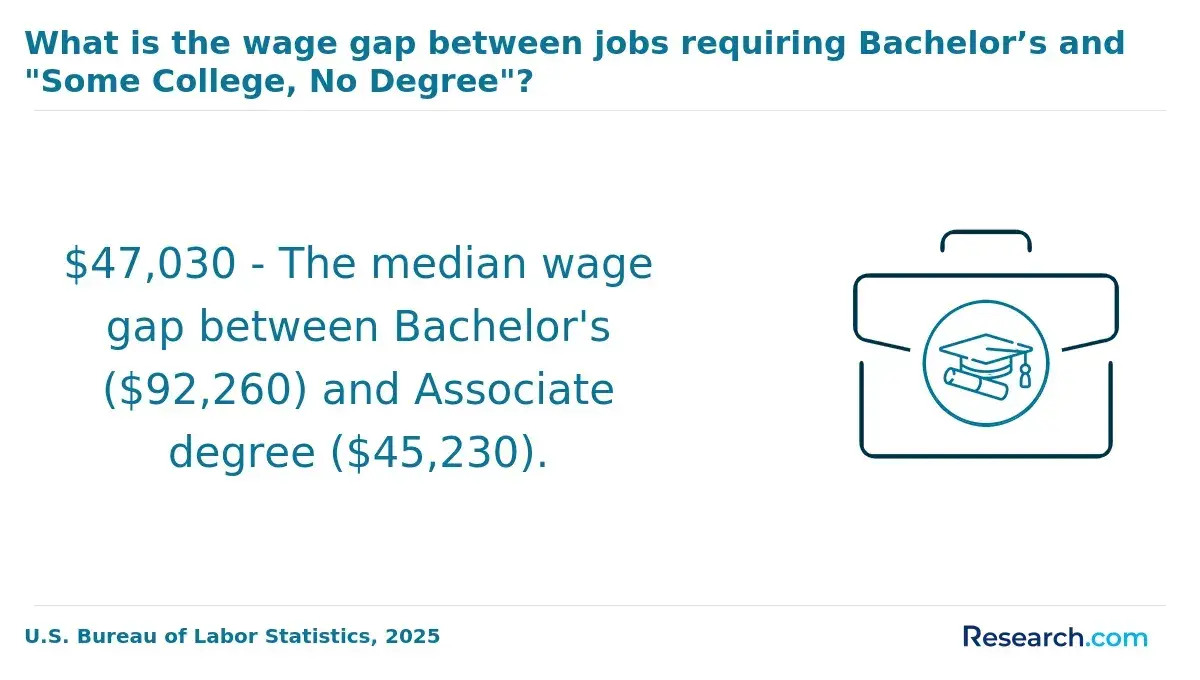
The U.S. Bureau of Labor Statistics reported a May 2024 median annual wage of $93,600 for registered nurses. That is the median for people working in the occupation - not an expected salary for new associate degree graduates, and not a reason to overlook clinical costs or licensing requirements. For any field, compare local job postings with the program's curriculum. Some IT and administrative jobs may permit remote work, but a degree does not guarantee it; consider whether work from home degrees that pay good money match your skills and the jobs available where you plan to apply.
Which Certifications or Licenses Do Associate Degree Careers Require?
Licenses and certifications are separate from the associate degree. Registered nursing requires meeting state board rules and passing the applicable licensing examination. Other clinical careers may require state authorization, a credentialing examination, or supervised experience. IT certifications may help demonstrate specific skills, but whether they are necessary depends on the job. Public-safety employers may impose academy, background, and physical requirements.
Check the requirements for your target occupation and state before paying for a program. This is particularly important for counseling and psychology: independent practice requires education and licensure well beyond an associate degree. Someone considering an online doctorate as a later step should verify that its curriculum and supervised training meet the relevant state's rules; online delivery alone establishes nothing about licensure eligibility.
Other Things You Should Know About
Often, yes. Send official transcripts from each institution and ask the receiving college how every accepted course applies to your specific degree, subject to its transfer and residency rules.
No. It may apply more previous coursework, but another major could cost the same to complete and fit your career or transfer goal better. Compare written degree audits and total remaining costs.
You may qualify, but eligibility depends on the institution, program, and your individual aid record. Ask the financial aid office to review your situation before relying on an estimated award.
Choose based on where the required courses lead. AA and AS programs often support transfer, while AAS programs often emphasize workforce preparation. Confirm the particular college's agreements and your intended employer's or bachelor's program's requirements.
References
- Your financial path to graduation | consumerfinance.gov https://www.consumerfinance.gov/paying-for-college/your-financial-path-to-graduation/
- Annual Earnings by Educational Attainment - COE https://nces.ed.gov/programs/coe/indicator/cba/annual-earnings
- [PDF] Study on Best Practices in Credit Transfer - THECB Report Center https://reportcenter.highered.texas.gov/reports/data/board-x-m-transfer-of-course-credit-between-public-institutions-of-higher-education-10-18/
- Credit for Prior Learning - Ohio Department of Higher Education https://highered.ohio.gov/students/adult-learners/credit-for-prior-learning
- .16 Graduation Requirements. | Library of Maryland Regulations https://regs.maryland.gov/us/md/exec/comar/13B.02.02.16
- Transfer Credit | Empire State University https://catalog.sunyempire.edu/undergraduate/transfer-credit/
- Transfer Agreements | Dean College https://www.dean.edu/admissions/apply-now/transfer-students/transfer-agreements/
- Credit for Prior Learning | Alamo Colleges https://www.alamo.edu/credit-for-prior-learning/
- University Associate Degree Graduation Requirements | asu.edu https://catalog.asu.edu/associatereq
- Transfer of Elective Credits / MassTransfer / Massachusetts Department of Higher Education | mass.edu https://www.mass.edu/masstransfer/tools/electivecredit.asp


