2027 Model Deployment in an Online Data Science Master's: Courses, Projects, and Program Selection

Co-Founder and Chief Data Scientist
Model deployment is the difference between building a promising model and making its predictions usable, reliable, and maintainable. If you are comparing online data science master's programs, a course title alone will not tell you whether you will practice that work. This guide shows what to look for in the curriculum, what a credible deployment project involves, and how to weigh those findings against cost, format, and career goals.
Key Things You Should Know
- Look for substantial work on serving, testing, monitoring, and updating models - not just training a model or presenting its results.
- A strong deployment project documents how users receive predictions, how performance is checked after release, and what happens when the system fails.
- The U.S. Bureau of Labor Statistics projects 35% employment growth for data scientists from 2025 to 2035; that outlook does not establish demand for every deployment-focused role or guarantee a job.
What Is an Online Data Science Master's Degree?
An online data science master's is a graduate program that teaches students to work with data through statistics, computing, and applied analysis. Programs differ substantially: some emphasize modeling and research, while others give more attention to software systems that put models into use. "Online" describes how students study, not a standard curriculum or a promise that every activity is asynchronous.
For a deployment-focused student, the important distinction is between developing a model and operating a model-based service. The latter can involve packaging code, connecting a prediction service to an application, testing it, controlling access, monitoring performance, and planning updates. If your goal is primarily to design AI systems rather than develop broader statistical and data-science skills, compare online AI degrees as a separate option. Judge either degree by its actual courses and project requirements, not its name.
What Courses Are Included in an Online Data Science Master's?
Foundational coursework commonly covers statistics, programming, data management, and machine learning. Deployment may appear in a dedicated machine learning operations course, a cloud or software engineering elective, or an applied project. It may also receive only brief treatment. A syllabus and recent assignment descriptions are more informative than a course title.
Use the following progression to distinguish exposure from practice. It shows what evidence to request from a program; it does not imply that every program includes each level.
| Level of coverage | What students may do | Evidence to look for |
| Passing mention | Discuss how a model could be used after training | A lecture topic, with no deployment assessment |
| Single unit | Run a guided serving or cloud exercise | A lab or assignment description |
| Dedicated course | Build and test a prediction service and address its operation | A syllabus with assessed implementation work |
| Advanced project depth | Make design choices, measure system and model behavior, and document maintenance | A project rubric and examples of permitted deliverables |
Graduate-level deployment work builds on the ability to write reliable code, evaluate models, and understand data pipelines. Students who need to strengthen those foundations before advanced AI coursework can explore pre-master's preparation for artificial intelligence study. Such preparation is not automatically a substitute for a particular program's admissions prerequisites.
What Projects Do Online Data Science Master's Students Complete?
A useful project might serve demand forecasts through an application interface or run scheduled predictions for an operations team. Before calling it a deployment project, examine whether its deliverables address the full operating problem:
- Problem and data: Identify the user, prediction task, data permissions, and risks of using the output.
- Implementation: Package the model and preprocessing consistently, with clear instructions for running and testing the service or batch pipeline.
- Evaluation: Report model performance alongside relevant operational checks, such as response behavior, failures, or data-quality checks.
- Maintenance: Explain how changes will be monitored, how a new version will be evaluated, and how a problematic release could be withdrawn.
A local demonstration or simulated deployment can still teach useful skills. Do not describe it as sustained production operation unless the project actually includes that experience. Ask programs whether students choose their own project topic, receive cloud resources, and can share a sanitized version of the work in a portfolio.
How Do You Choose an Accredited Online Data Science Master's?
First, verify the institution's accreditation through the accreditor or the U.S. Department of Education's recognized-accreditation resources, and confirm that the school can enroll students where you live. Institutional accreditation does not, by itself, establish that a degree teaches model deployment well.
Then compare programs using evidence you can inspect. The following questions target the features most likely to affect deployment learning:
- Which required courses assess model serving, testing, monitoring, or updating, and which relevant courses are optional?
- Can the program provide recent syllabi, project rubrics, or appropriately shared examples of student work?
- What software, cloud access, technical support, and faculty feedback are available to online students?
- Can students complete a deployment-oriented capstone, and are there restrictions on datasets, employers, or project topics?
- Do graduates or employers provide relevant project feedback or connections, and how does the school substantiate those opportunities?
Choose a program with required implementation work if deployment is central to your goal; an elective-only pathway is more suitable if you want flexibility and already have substantial software experience. Network access may also matter when you are changing roles. If you are considering an AI-focused alternative, examine AI master's degree options with alumni career networks, then verify what support online students can actually use. A ranking or prominent employer logo is not a substitute for that evidence.
What Are the Admission Requirements for Online Data Science Master's Programs?
Admissions requirements vary by institution. Programs may assess prior study in programming, calculus, linear algebra, and statistics alongside an applicant's degree, work history, and other application materials. Do not assume that relevant professional experience formally waives a prerequisite - or that a bachelor's degree outside computing rules you out. Check the published policy and ask admissions staff how your specific coursework will be evaluated.
For a deployment-focused path, distinguish eligibility from readiness. You might meet admission requirements but still benefit from practicing Python, version control, software testing, and model evaluation before a demanding systems project. Conversely, cloud experience is useful evidence of preparation but does not replace statistical foundations. Request prerequisite and course-sequencing information before applying so you can identify gaps without paying for unnecessary preparatory courses.
How Long Does an Online Data Science Master's Take and Cost?
Time to completion depends on required credits, course availability, enrollment pace, and any capstone sequence. Published tuition is only part of the decision: mandatory fees, materials, cloud usage, travel requirements, and the cost of extending enrollment can change the total. Schools may charge by credit or term, so compare estimates using the same planned pace and your applicable tuition category.
Request a written estimate of the full program cost and ask whether deployment projects require paid services or whether school-provided resources are available. Also check whether relevant electives run often enough to fit your schedule. For a comparison with another credential path, online AI master's programs for cost-conscious students may offer alternatives, but compare current official tuition schedules and required fees before treating any option as less expensive. A lower sticker price is less compelling if the program cannot support the project work you need.
How Does Online Study Compare With Campus-Based Data Science Programs?
Both formats can support rigorous deployment work. The practical difference is how students access instruction, collaborators, computing resources, and feedback. Online study may fit a working professional who needs to stay employed; campus study may be preferable for someone who values regular in-person lab access or collaboration. Neither format alone proves that students will operate a real model-based system.
Check whether online courses are asynchronous or require live attendance, particularly for team projects and project reviews. Ask how groups coordinate across time zones, whether cloud environments work remotely, and how instructors troubleshoot failed pipelines. An online program with structured reviews and usable infrastructure may offer stronger deployment practice than a campus program centered on lectures; the reverse may also be true. Compare the actual project experience rather than the delivery label.
What Jobs Can You Get With an Online Data Science Master's?
Deployment skills can support applications for data scientist, machine learning engineer, applied scientist, and related roles, but job titles and requirements vary by employer. A degree does not automatically qualify someone for an engineering-intensive position. Read target job descriptions to see whether employers expect software development, infrastructure, statistical modeling, domain knowledge, or a combination.
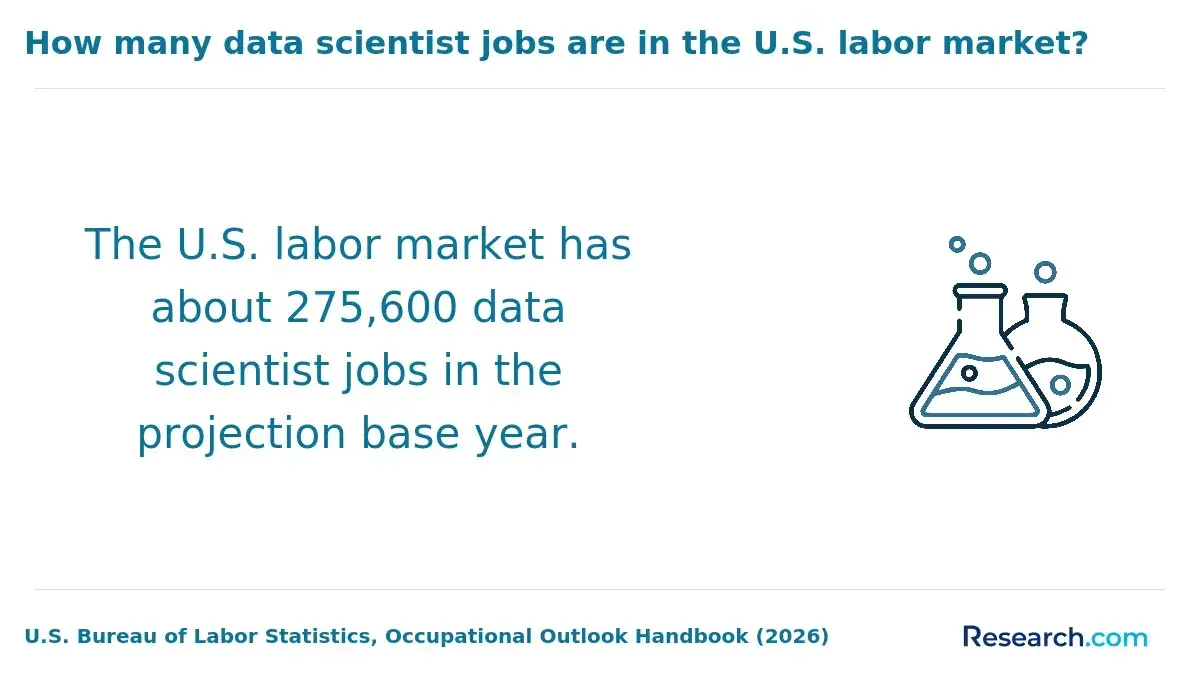
The Bureau of Labor Statistics projects about 24,800 data scientist openings per year on average from 2025 to 2035. That figure includes openings created when workers leave the occupation; it is not a count of deployment-specific vacancies. If your goal is a specialized field, such as healthcare, assess domain and data-governance preparation as well as technical coursework. You can compare graduate AI training for healthcare innovation careers when that setting is your target, while checking each program's actual projects and access to appropriate data.
How Much Do Data Science Graduates Earn?
The Bureau of Labor Statistics reports a median annual wage of $120,230 for U.S. data scientists in May 2025. This is an occupational figure, not the median salary of online master's graduates or evidence that completing a degree produces that wage. Pay depends on role, experience, location, employer, and technical responsibilities.
If a program publishes graduate salaries, check who was surveyed, how many responded, when they graduated, and whether the figure represents salary level or salary increase. For a personal return-on-investment estimate, compare the full education cost and income you may forgo with plausible opportunities in your own market - not with the occupational median treated as a guaranteed outcome.
What Certifications and Skills Strengthen Data Science Career Prospects?
For deployment-oriented work, employers may value evidence that you can write maintainable code, manage data and model versions, test a pipeline, use appropriate cloud services, and explain monitoring results. A portfolio project can show how those skills fit together more clearly than a list of tools. Communication also matters: a team needs to understand what the model predicts, where it can fail, and who should act on its output.
A relevant cloud or platform certification may help document familiarity with a tool, particularly when a target job names that platform. It is not a substitute for implementing and evaluating a working system. Prioritize the skills repeatedly requested in the roles you want, then choose a certification only if its content fills a real gap. Avoid collecting credentials while leaving your deployment project undocumented or impossible for a reviewer to reproduce.
Other Things You Should Know About Data Science
Only if your employer and program permit it. Confirm data ownership, confidentiality, security rules, and publication limits before proposing the project. A public or approved synthetic dataset may be a safer alternative.
That depends on the course. Ask whether the school provides credits or a managed environment, which services assignments require, and how to prevent unexpected charges before creating resources in a personal account.
Yes, if you can explain and document your contribution. Keep a record of the components you built, tests you wrote, decisions you made, and limitations you identified, subject to your team's sharing rules.
Ownership and sharing rights depend on institutional policies and any employer or project-partner agreement. Check those terms before enrolling in a sponsored project or publishing its code in a portfolio.
References
- STRIDES Initiative | Data Science at NIH https://datascience.nih.gov/strides
- Online Master's in Data Science (MSDS) | Northwestern University https://sps.northwestern.edu/masters/data-science/
- Skills Every MLOps Engineer Needs | College of Engineering | Boston University https://www.bu.edu/eng/2026/05/20/skills-every-mlops-engineer-needs/
- Master of Science in Data Science - National University https://www.nu.edu/degrees/engineering-data-and-computer-sciences/programs/master-of-science-in-data-science/
- 2026 UNC Online Master of Applied Data Science (MADS) https://online.unc.edu/online-masters-programs/masters-data-science/
- MS in Data Science - Online Engineering Programs https://onlinesoe.tufts.edu/online-programs/ms-data-science
- Frequently Asked Questions - eCornell - Cornell University https://ecornell.cornell.edu/about-ecornell/faq/
- 6 Models for Blended Synchronous and Asynchronous Online Course Delivery | educause.edu https://er.educause.edu/blogs/2020/8/6-models-for-blended-synchronous-and-asynchronous-online-course-delivery
- Cloud Computing at U-M - Information and Technology Services https://its.umich.edu/computing/virtualization-cloud/cloud-computing
- M.S. in Data Science, Online | virginia.edu https://datascience.virginia.edu/degrees/msds-online