2027 Master's in Data Science vs. Master's in Cognitive Science: Choosing Your Graduate Path

Co-Founder and Chief Data Scientist
A master's in data science and a master's in cognitive science can both lead to work involving human behavior and technology, but they prepare students to ask different questions. Data science emphasizes building and evaluating analytical systems; cognitive science examines how people think, learn, perceive, and interact.
If you are choosing between them, the decisive issue is the work you want to do - not which degree title sounds more versatile. This comparison will help you evaluate programs against your target roles, preparation, budget, and preferred way of learning.
Key Things You Should Know
- Choose data science if your priority is statistical modeling, programming, and data-intensive roles; choose cognitive science if your priority is studying minds and behavior through research.
- The U.S. Bureau of Labor Statistics projects 35% employment growth for data scientists from 2025 to 2035. That figure describes an occupation, not the placement rate of data science graduates or the outlook for cognitive science graduates.
- Compare actual courses, projects, faculty access, and total program costs before applying. Neither degree title alone establishes technical depth, research opportunities, or career outcomes.
What Is the Difference Between a Master's in Data Science and Cognitive Science?
A data science master's generally trains students to turn data into models, analyses, and decisions. A cognitive science master's generally investigates cognition across fields such as psychology, neuroscience, linguistics, philosophy, and computer science. Both can address questions about human behavior, but their starting points differ: one centers on analytical methods, while the other centers on explaining mental processes.
The overlap matters if you are interested in human-AI interaction, language technology, or computational models of cognition. In those cases, inspect the curriculum rather than assuming either degree covers your interests. If building AI systems is the main goal, compare both paths with artificial intelligence study options for your goals.
Which Graduate Degree Offers Better Career Opportunities?
Data science offers the more direct route to jobs explicitly titled data scientist or machine learning specialist when the program develops the required computing and statistical skills. Cognitive science is a more direct fit for students seeking research on perception, learning, language, or human interaction with technology. Its career paths are often less clearly labeled by the degree name, so relevant methods and project experience matter especially.
Neither path is universally better. A student who wants to build predictive models for an employer should favor data science; a student who wants to design experiments about how people use those models may favor cognitive science. For roles between the two, compare job descriptions with course assignments and graduates' actual roles rather than relying on promotional career lists.
How Do Data Science and Cognitive Science Curricula Compare?
The table shows typical emphases, not required courses at every school. Use it to identify the coursework and project evidence your target role calls for.
| Dimension | Data science master's | Cognitive science master's |
| Core questions | What can data reveal or predict, and how reliably? | How do people perceive, learn, reason, or use language? |
| Common methods | Statistics, programming, data management, machine learning | Experimental design, behavioral analysis, cognitive modeling; methods vary by program |
| Typical project evidence | A reproducible analysis, model, or data product | An experiment, research paper, or computational account of behavior |
| Depth to verify | Advanced statistics, software practice, and model evaluation | Quantitative methods, laboratory access, and the intended specialization |
Course titles are not enough: read syllabi and recent project descriptions. A cognitive science program with substantial programming and modeling may fit a computational goal better than a data science program with little room to study people. Conversely, an experimental methods course alone will not replace the technical sequence needed for many data science jobs.
What Are the Admission Requirements for Each Master's Program?
Requirements vary by institution. Data science applicants may be asked to show preparation in programming, calculus, linear algebra, or statistics. Cognitive science programs may seek evidence of research interests and preparation in a relevant discipline; quantitatively oriented tracks can also expect coding or statistics. A prior major does not automatically qualify or disqualify you.
Check whether a missing course is a formal prerequisite, an expectation that can be demonstrated another way, or simply recommended preparation. Ask admissions staff what evidence they accept - transcripts, professional work, or projects - and whether any preparatory coursework must be completed before enrollment.
Applicants exploring AI alongside these degrees can use non-CS background options for an AI master's to frame questions about prerequisites, without assuming another program's policy applies here.
How Long Do These Master's Degrees Take and What Do They Cost?
There is no reliable universal price or completion time for either degree: credit requirements, enrollment pace, residency rules, and institutional fees differ. A research thesis or required laboratory work may also affect the cognitive science timeline; sequencing and capstone requirements may affect either path. Compare each school's published degree requirements and current tuition schedule for the same enrollment assumptions.
Calculate total expected charges using required credits, your applicable per-credit tuition, and mandatory fees. Then account separately for materials, travel or campus visits, and income you may forgo while studying. A lower tuition rate may not mean a lower total cost if the degree requires more credits or a longer period away from work. If time is your principal constraint, a guide to shorter online data science master's degrees can help you identify pacing questions to put to schools.
A common mistake is to compare one program's tuition-only quote with another's estimated full cost. Request an itemized estimate for your residency status and schedule, and ask whether funding or employer support applies to your specific program.
How Do Online and Campus-Based Programs Compare?
Online study can make either degree accessible without relocating, but delivery format may change what you can do - not just where you watch lectures. For data science, check access to computing resources, feedback on code, group projects, and career support. For cognitive science, check whether your intended research requires in-person experiments, specialized equipment, or regular laboratory collaboration.
Ask whether classes are live or asynchronous, whether visits are required, and whether online students can work with the faculty or research groups that interest them. If your goal is primarily applied AI and cost is a major constraint, inexpensive online artificial intelligence programs offer another category to compare - but verify that their curriculum serves the same career goal before treating them as substitutes.
What Careers Can You Pursue With Each Degree?
A data science curriculum can support applications for data scientist, analytics, and some machine learning roles, depending on technical depth and prior experience. Cognitive science can support research-focused work, user research, human-computer interaction, and roles drawing on experimental or behavioral methods. Employers hire for skills and experience, not degree labels alone; some research positions also expect doctoral training.
If you want to cross between fields, make the overlap visible. A data science student interested in people might analyze behavioral data while documenting experimental limitations. A cognitive science student targeting analytics might build a reproducible coding and statistics portfolio. For the first path, online data science education and career readiness provides additional context for evaluating whether a program develops job-relevant evidence of skill.
How Do Salaries and Job Outlook Compare?
The Bureau of Labor Statistics reports a $120,230 median annual wage for U.S. data scientists in May 2025. This is an occupation-wide figure, not an expected starting salary or a return attributable to a master's degree. Pay for cognitive science graduates cannot be summarized with one comparable figure because they enter multiple occupations with different duties and pay structures.
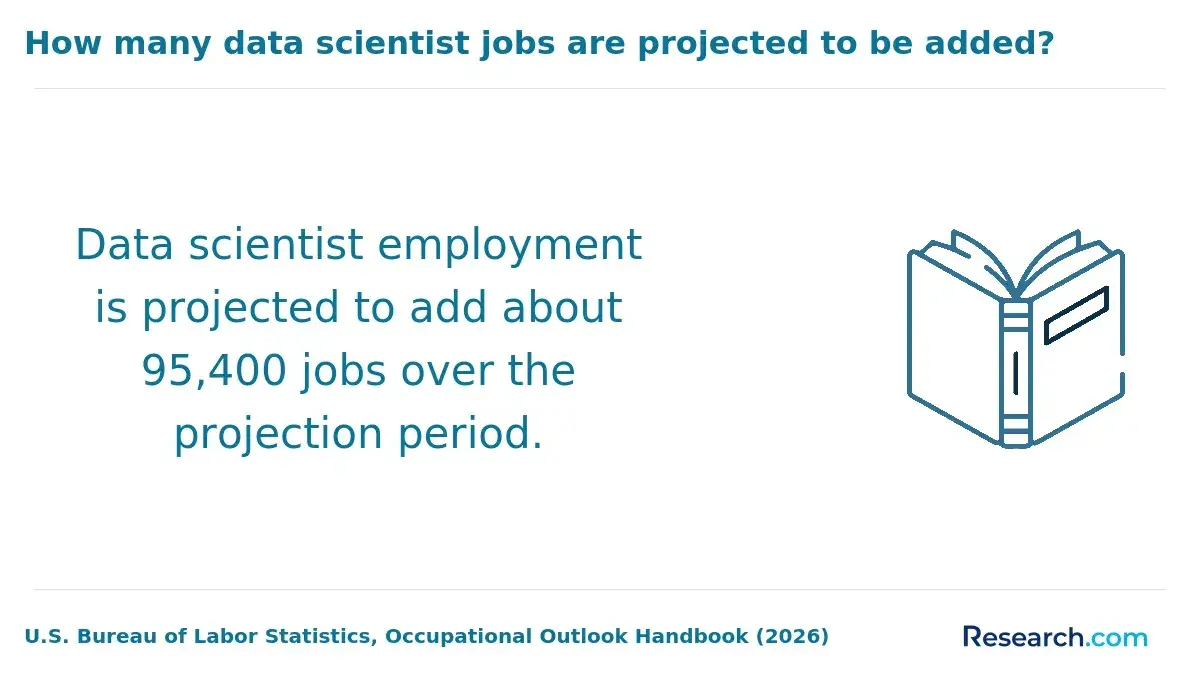
BLS projects about 24,800 data scientist openings annually, on average, from 2025 to 2035. That signals a sizable occupational market, but openings include replacement needs and do not show how many positions require a master's. For either degree, evaluate the specific roles and locations you would pursue, then weigh potential pay against program cost, your existing experience, and the risk of a career change.
Do These Degrees Require Licensure or Professional Certification?
Data scientist roles generally do not have a profession-wide government license, and neither degree title itself is a professional certification. Individual employers may value particular technical credentials, but a certificate does not replace evidence that you can perform the work.
A cognitive science degree likewise does not, by itself, qualify someone for a regulated clinical role. If your goal involves practicing psychology, providing clinical services, or using a protected professional title, check the relevant state licensing board's educational and supervised-experience requirements before choosing a program. Do not assume a research-oriented master's meets them.
How Can You Choose an Accredited, Reputable Program?
First, verify that the institution holds recognized institutional accreditation and that the program is authorized to enroll students where you live, particularly if you will study online. Then judge program quality against your goal: accreditation is an important baseline, not proof that a curriculum, research opportunity, or career service will fit you.
Use a short, consistent review process for each finalist. It helps prevent a strong ranking or appealing degree title from obscuring a poor match.
- Match required courses and available electives to the methods used in your target roles or research area.
- Examine recent student projects and ask what supervision, computing access, or laboratory participation students actually receive.
- Request current, itemized costs and confirm scheduling, completion rules, and any required campus visits.
- Ask for program-specific outcome information, including the graduating cohort and response rate; treat missing or small-sample results cautiously.
Choose data science when its technical training and projects directly address the work you want. Choose cognitive science when access to the right research methods, questions, and mentors matters more. If neither program provides convincing evidence of that fit, keep looking rather than paying for a degree title alone.
Other Things You Should Know About Data Science
No. Cognitive psychology studies mental processes within psychology. Cognitive science is interdisciplinary and may also draw on neuroscience, linguistics, philosophy, and computation.
Yes, if the program offers relevant courses or projects. Cognitive science may examine how people acquire or process language; data science may focus on analyzing text or building language-related models.
Academic research careers often expect a doctorate, particularly for faculty positions. A master's can provide research experience and help you determine whether doctoral study fits your goals, but it is not a substitute for checking the qualifications of specific roles.
Possibly. Flexibility depends on elective space, course availability, faculty capacity, and program rules. Ask when students must choose a track or adviser and whether switching would delay completion.
References
- Healthcare data scientist qualifications, skills, and job focus | nih.gov https://pmc.ncbi.nlm.nih.gov/articles/PMC7787353/
- Master's Degree - Data Science - On Campus | Monroe University https://www.monroeu.edu/academics/king-graduate-school/masters-degree-data-science
- MS in Data Science Curriculum & Course Descriptions | Eastern University https://www.eastern.edu/academics/colleges-seminary/college-health-and-sciences/departments/department-mathematical-5
- Quantitative Methods Master's Program - College of Education https://education.utexas.edu/academics/masters/qm-masters-program/
- What Is a Capstone Project? | National University https://www.nu.edu/blog/what-is-a-capstone-project/
- Elective Training in Quantitative Concentration | Ohio University https://www.ohio.edu/cas/psychology/graduate/experimental/manual/quantitative-concentration
- What Can I Do With a Degree in Data Science? Career Paths & Skills | Harvard SEAS https://seas.harvard.edu/news/what-can-i-do-degree-data-science-career-paths-skills
- Career Outlook | wisc.edu https://datascience.psych.wisc.edu/careers/
- Curriculum - MU Institute for Data Science and Informatics https://muidsi.missouri.edu/academic-programs/m-s-data-science-and-analytics-program/masters/curriculum/