2027 A/B Testing in an Online Data Science Master's: Courses, Projects, and Program Selection

Co-Founder and Chief Data Scientist
A/B testing can be a substantial part of an online data science master's - or a brief example in a general statistics course. For prospective students interested in product analytics, experimentation, or causal inference, that difference matters more than a program's title. This guide explains what meaningful coursework and projects look like, how to check whether online delivery supports hands-on experiments, and when a broader or more specialized program is the better fit.
Key Things You Should Know
- Look for experimental design, statistical inference, and causal reasoning - not just a course description that mentions A/B tests.
- A strong project should justify random assignment, define a primary outcome, check data quality, and interpret uncertainty and practical impact.
- The U.S. Bureau of Labor Statistics projects 35% growth in data scientist employment from 2025 to 2035; that outlook does not show which programs teach experimentation well or guarantee a job.
What is an online data science master's degree?
An online data science master's is a graduate degree delivered primarily through online coursework. Programs typically combine computing, statistics, and applied analysis, but their treatment of experimentation varies. An A/B test randomly assigns eligible units - such as users or accounts - to alternatives and compares outcomes. The hard part is not calculating a difference; it is designing an assignment and measurement plan that supports a credible conclusion.
If experimentation is your main goal, a general data science degree is a good fit when it lets you build that foundation through courses and projects. A program centered on machine learning but offering little experimental design may better suit model-development goals than product experimentation.
How do you choose an accredited online data science master's program?
First, verify the institution's current accreditation through the accreditor or official institutional information; do not treat marketing language as proof of a separate accreditation for the data science degree. Also confirm that the institution can enroll students in your state and whether any required campus visits or live sessions fit your schedule.
Then examine evidence of A/B testing depth. A passing mention in a catalog is weaker evidence than a dedicated experimental-design course; a course is weaker evidence of applied proficiency than a substantial, assessed project. Ask for recent syllabi, assignment descriptions, and the current elective schedule. Check whether students study power, randomization, measurement bias, multiple comparisons, and interpretation - not merely how to run a significance test.
Finally, compare the program's actual path to those courses. An attractive elective is of limited use if it rarely runs, has prerequisites you cannot meet, or conflicts with required classes. Rankings cannot resolve those scheduling and curriculum questions.
What courses do online data science master's programs include?
For A/B testing, the most useful foundation is probability and statistical inference, followed by regression, experimental design, and causal inference. Programming and data-management courses matter because experiment results depend on reliable assignment records, outcome definitions, and analysis code. Course names differ, so judge the assessed work rather than assuming every "analytics" course covers these skills.
The table distinguishes levels of exposure a student might find in a catalog or syllabus. It describes evidence of depth, not a standard curriculum that every school offers.
| Level of exposure | What the coursework might show | What remains uncertain |
| Passing mention or unit | An A/B test appears as an example or short exercise. | Whether students can design or diagnose an experiment. |
| Dedicated course | Assignments address randomization, sample size or power, estimation, and interpretation. | Whether students apply those methods to messy, realistic data. |
| Advanced elective and project | Students examine complications such as repeated monitoring, interference, heterogeneous effects, or imperfect measurement. | Whether the elective is offered when they need it. |
Graduate-level work should also distinguish statistical significance from a useful decision. For example, students should be able to explain why a precisely estimated but tiny improvement may not justify a change, or why a promising result with substantial uncertainty needs further testing. AI-related coursework can complement this training when students must evaluate whether a new model actually improves outcomes; it does not replace experimental design.
What projects and capstone experiences do online data science master's programs offer?
Programs may use course projects, a capstone, or both. The best A/B testing opportunity is one in which you make defensible design choices, analyze imperfect data, and communicate a decision - not simply apply a test to a cleaned dataset. Live experimentation can be difficult to offer when a university does not control a production platform, so a carefully documented simulation or analysis of appropriately sourced experiment data can still be valuable.
When reviewing a sample assignment or proposed capstone, look for a complete chain of reasoning:
- A specific intervention, eligible population, assignment unit, primary outcome, and meaningful effect to detect.
- A plan for sample size or power, exposure tracking, missing data, and a check that assignment produced the expected group sizes.
- An analysis that reports uncertainty, examines relevant guardrail outcomes, and avoids presenting exploratory subgroup findings as confirmed effects.
- Reproducible code, a clear recommendation for stakeholders, and appropriate treatment of privacy and consent.
If your intended domain is healthcare, data access and ethical constraints may make a live test inappropriate. In that case, ask whether faculty can supervise a suitable evaluation project and whether the curriculum covers the domain knowledge you need; artificial intelligence graduate study for healthcare applications offers a related route to consider.
What are the admission requirements for an online data science master's?
Requirements vary by program. Check the official admissions page for degree, mathematics, programming, transcript, recommendation, and application requirements rather than assuming that prior A/B testing experience is necessary. For success in experimentation coursework, comfort with probability, basic inference, and coding is especially useful even when a school does not list each as a formal prerequisite.
If your background is outside computer science, separate eligibility from readiness: a preparatory course may strengthen your skills without satisfying a required for-credit prerequisite. Ask admissions staff what evidence they accept and whether foundation courses add time or cost. Readers also comparing AI degrees can review AI master's admissions considerations for non-CS graduates, while confirming the rules of each specific program.
How long does an online data science master's take and cost?
Time and total cost depend on required credits, course availability, enrollment pace, tuition rules, and fees. No single duration or price describes online data science master's programs. For an experimentation-focused student, the relevant timeline is the time to finish the desired sequence - including prerequisites, an experimental-design elective, and any project - not just the advertised fastest completion time.
Request a written estimate that separates tuition from mandatory fees and accounts for software, materials, travel if required, and any added foundation courses. Compare that estimate at a pace you can sustain alongside work. Lower-tuition online data science master's programs can provide a starting list, but a lower sticker price is not necessarily the lowest total cost or the strongest experimentation curriculum.
How do online and campus-based data science master's programs compare?
The credential's delivery format alone does not establish A/B testing depth. Online study may make it easier to keep a job while applying course concepts at work; campus study may provide easier access to certain research teams or locally organized projects. Neither benefit is automatic. Compare the same syllabus, instructor access, project supervision, elective availability, and opportunities to work with real stakeholders in each format.
Online fit also depends on operations: live meetings, time zones, group-project schedules, and whether project data or software can be accessed remotely. Choose the format that lets you complete substantive experimentation work consistently, not simply the one advertising the shortest calendar. For a wider planning reference, see data science master's duration and tuition comparisons; verify current requirements directly before applying.
What careers can you pursue with an online data science master's?
A/B testing skills are relevant to data scientist, product analyst, experimentation analyst, and decision scientist roles where employers evaluate changes to products, services, or processes. Job titles vary: some roles emphasize experimental design and causal interpretation, while others emphasize dashboards, predictive models, or engineering. Read actual role descriptions for the balance you want.
For experimentation-focused applications, a portfolio project that explains assignment, outcome selection, uncertainty, limitations, and a decision can be more informative than a collection of significance tests. A master's can provide structured training and project access, but it is not the only route into these roles; relevant work experience and demonstrable skills matter to employers.
What salary and job outlook can data science graduates expect?
The U.S. Bureau of Labor Statistics reports a $120,230 median annual wage for data scientists in May 2025. That occupation-wide figure is not an entry-level offer or an outcome attributable to a master's. Prior experience, role, location, and employer can substantially change an individual offer.
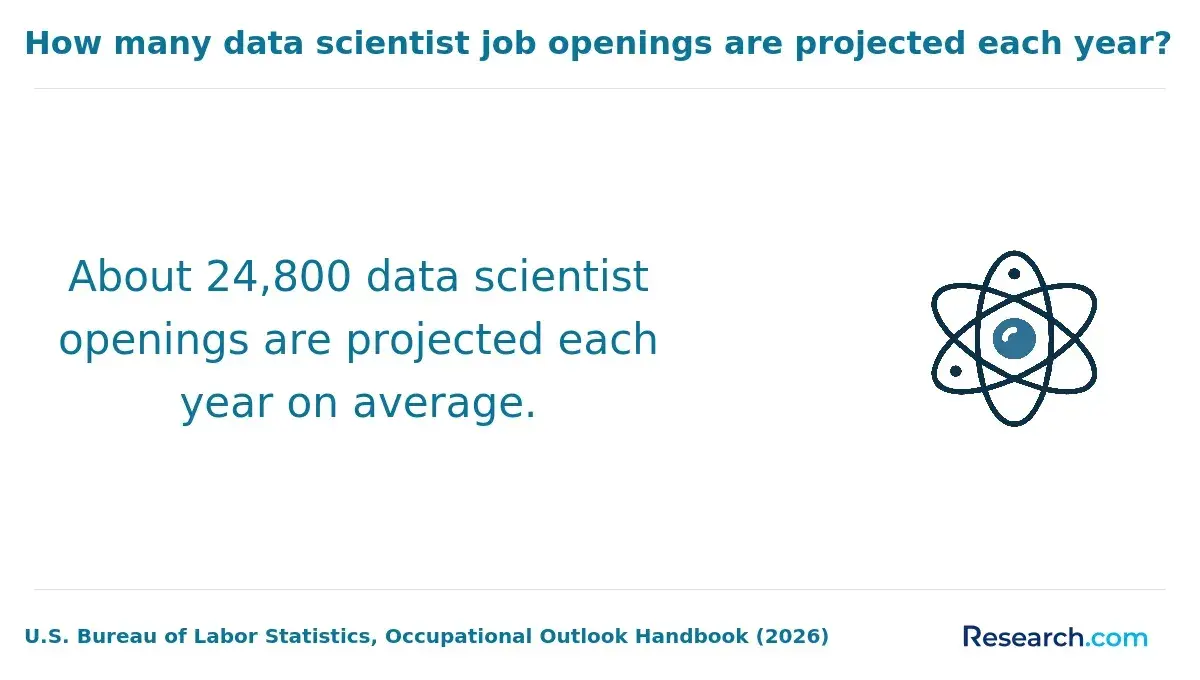
BLS also projects about 24,800 data scientist openings per year, on average, from 2025 to 2035. That indicates opportunities across the occupation, not the number of openings devoted to A/B testing. If compensation is central to your choice, compare data science graduate pay across industries and investigate salaries for the specific roles and markets you would pursue. Do not use an occupation-wide median as a forecast of your degree's return.
Are certifications required after earning a data science master's?
There is no general certification requirement to perform A/B testing as a data scientist. An employer may value familiarity with its analytics or experimentation tools, but a tool certificate does not by itself demonstrate that you can choose a valid assignment unit, catch a measurement problem, or interpret an uncertain result.
Choose additional training only for a documented gap in the roles you seek. If a program offers strong statistical coursework but limited practice with common workplace tools, a focused course or certificate may help; if your portfolio already shows both, another credential may add less value than a stronger project.
Other Things You Should Know About Data Science
An A/A test compares groups that receive the same experience. Teams can use it to investigate whether assignment, tracking, and analysis behave as expected before relying on a treatment comparison.
It may be unsuitable when random assignment is unethical or impractical, outcomes take too long to observe, or participants affect one another in ways that undermine the comparison. Other evaluation designs may be needed.
Not exactly. An A/B test compares alternatives, while a multivariate or factorial design examines combinations of changes. The latter can answer different questions but may require more data and more careful interpretation.
It can provide evidence that the tested change affected a measured outcome under the study conditions. Explaining the mechanism usually requires additional measurement, analysis, or research.
References
- School-Determined Requirements | 2024-2025 Federal Student Aid Handbook https://fsapartners.ed.gov/knowledge-center/fsa-handbook/2024-2025/vol1/ch1-school-determined-requirements
- Informed Consent FAQs | hhs.gov https://www.hhs.gov/ohrp/regulations-and-policy/guidance/faq/informed-consent/index.html
- Research Involving Individuals with Questionable Capacity to Consent | Grants & Funding https://grants.nih.gov/policy-and-compliance/policy-topics/human-subjects/policies-and-regulations/vulnerable-populations/questionable-capacity
- Master's in Data Science | utexas.edu https://cdso.utexas.edu/msds
- Master of Data Science | pitt.edu https://www.sci.pitt.edu/academics/masters-degrees/data-science
- Online M.S. in Data Science | njit.edu https://www.njit.edu/academics/degree/online-ms-data-science
- What Can I Do With a Degree in Data Science? Career Paths & Skills | Harvard SEAS https://seas.harvard.edu/news/what-can-i-do-degree-data-science-career-paths-skills
- Online Program - UChicago Data Science Institute https://datascience.uchicago.edu/education/masters-programs/online-program/
- Online Experimentation: Benefits, Operational and Methodological Challenges, and Scaling Guide · Issue 4.3, Summer 2022 https://hdsr.mitpress.mit.edu/pub/aj31wj81
- Data Science - UW Online Collaboratives https://uwex.wisconsin.edu/data-science/