2027 Health Administration PhD Internships Outside Academia

Co-Founder and Chief Data Scientist
A health administration PhD can lead beyond faculty positions, but a doctoral internship is useful only if its work matches the career you want. Hospitals, insurers, government agencies, and healthcare companies may offer opportunities to apply research and management skills to operational problems.
This guide is for US-based doctoral students and prospective applicants weighing those options. It explains where to look, what eligibility and pay questions to ask, and how to judge whether an internship will build a credible path into nonacademic work.
Key Things You Should Know
- Look beyond jobs labeled "health administration intern": health policy, quality improvement, population health, analytics, and strategy placements may be a closer match for PhD-level work.
- Check doctoral eligibility, funding rules, work location, data access, and supervision before applying; an online PhD does not make an internship remote.
- There is no reliable nationwide pay figure for health administration PhD interns. Compare the actual offer, benefits, travel costs, and likely career value rather than treating a management salary as internship pay.
What are health administration PhD internships outside academia?
These are supervised, time-limited placements in which doctoral students use skills such as research design, program evaluation, organizational analysis, and data interpretation for a nonacademic organization. A project might assess patient-access bottlenecks, evaluate a payment initiative, or translate evidence into recommendations for health system leaders. Titles and duties vary; some employers call similar opportunities fellowships, practicums, research placements, or summer associate roles.
A PhD internship should provide a defined deliverable and feedback from someone who understands the organization's decisions. It is not the same as a clinical rotation or a general administrative placement primarily designed for master's students. Students comparing degree paths can examine comparing CAHME-accredited online healthcare administration study; an MHA typically emphasizes professional management preparation, while a PhD emphasizes original research and its application.
Which organizations offer health administration PhD internships?
The best employer depends on whether you want to influence internal operations, public policy, or products used across healthcare organizations. These organization types offer different problems, stakeholders, and constraints; none should be assumed to recruit doctoral interns every year.
| Organization type | Potential project | Fit consideration |
| Hospitals and health systems | Care access, workforce planning, or quality evaluation | Operational data may be restricted and decisions may move quickly. |
| Insurers and other payers | Utilization, network performance, or payment analysis | Methods must connect to coverage and cost decisions. |
| Government and public health agencies | Program evaluation or policy implementation | Eligibility, hiring procedures, and public accountability matter. |
| Consulting firms and healthcare companies | Market, operations, or product research | Projects may require concise recommendations on short deadlines. |
| Nonprofits and foundations | Community health or grant-funded program assessment | Funding and project scope can constrain the placement. |
If a listing focuses on clinical data systems rather than organizational decisions, clarify the function before applying. A comparison of health information management versus administration program fit can help distinguish records and information-governance work from broader administration projects.
What careers can health administration PhD internships prepare you for?
For a student with prior healthcare operations experience, an internship may support a move into system-level strategy, quality leadership, or internal evaluation. Someone coming from research or a different industry may first need an analyst or program-evaluation role to build healthcare-specific judgment. Other plausible destinations include health policy analysis, payer analytics, consulting, and research leadership within a health organization.
The useful question is what responsibility the placement lets you demonstrate. A published paper shows research capability; an internship can additionally show that you worked with operational stakeholders, handled real constraints, and communicated a decision-ready result. Neither a PhD nor an internship automatically qualifies someone to run a hospital or practice a licensed health profession.
If your goal is broad managerial advancement rather than doctoral research, shorter online MBA options in healthcare management may be worth comparing. An MBA develops general business management skills; it does not replace the PhD's research training or healthcare work experience.
Requirements come from both the employer and the doctoral program. Employers may specify current enrollment, research methods, software proficiency, work authorization, location, or availability during a set period. Some placements require background screening, confidentiality agreements, or approval to access protected health information. Government and other restricted positions may have additional eligibility rules.
Before accepting an offer, ask your graduate director whether the work can count toward a practicum requirement, whether your funding permits outside work, and whether dissertation milestones or assistantship duties conflict with the schedule. Confirm who will supervise you, what information you can access, and whether you can use any project results in a dissertation or portfolio. Permission to analyze an employer's data does not necessarily mean permission to publish it.
These are doctoral-stage checks, not undergraduate admission rules. For someone still planning an earlier academic transition, questions about transferring into a health administration program should be resolved separately; transfer credit does not establish eligibility for a PhD internship.
The doctoral program's delivery format and the internship's work arrangement are separate decisions. An online student can pursue an in-person placement, while a campus student can pursue remote work. What changes is often access to local employer relationships and the practical cost of attending meetings or relocating.
Use this comparison to identify scheduling questions, not to assume that every program or employer follows the same model.
| Consideration | Online PhD student | Campus-based PhD student |
| Employer access | May search near home or nationally, subject to employer location rules. | May have easier access to nearby faculty and institutional partners. |
| Schedule | Must reconcile internship hours with any live classes, research meetings, and employment. | Must reconcile internship hours with campus obligations and assistantships. |
| Travel and data | May face travel costs or restrictions on remote access to sensitive information. | May also need to travel or work on-site for protected data access. |
When comparing healthcare administration doctoral study schedules and formats, ask specifically whether internships are required, optional, or eligible for academic credit. "Online" alone answers none of those questions.
The strongest preparation combines a method with a healthcare decision. Courses in health services research, statistics, organizational theory, health economics, quality improvement, and policy evaluation can support different placements. An intern should be able to explain not just how an analysis was done, but what leaders can reasonably conclude from it.
Employers may also value SQL or statistical software, interview design, financial interpretation, and concise presentation. Choose depth according to the role: a quality-improvement placement may need process measurement and stakeholder interviews, while a payer analytics placement may put more weight on quantitative work. Coursework alone is weaker evidence than a well-scoped project you can explain without disclosing confidential data.
For students whose interests center on records, coding, or information governance, health information management degrees with CAHIIM accreditation describe a more specialized educational route. That focus differs from using data to study an organization's strategy or performance.
Search by the work you want to do, not only by degree title. A doctoral student interested in reducing missed appointments, for example, might find a better fit in an access, operations research, or population health team than in a posting labeled "administration." This sequence keeps the search focused on roles that can advance your intended career.
- Choose a target function and identify employers that employ people doing that work.
- Search employer career pages and doctoral career resources using project terms such as "program evaluation," "quality improvement," or "health policy."
- Read eligibility and location rules before contacting a recruiter or potential supervisor; ask whether doctoral students are considered if the posting is unclear.
- Tailor your résumé to the employer's problem, showing a relevant method, a completed deliverable, and how you communicated findings.
- In interviews, ask about supervision, project ownership, data access, pay, work hours, and whether a shareable final product is possible.
Faculty collaborators and alumni can help identify teams even when no internship is advertised. If you are earlier in your education and do not yet meet doctoral eligibility, online healthcare administration bachelor's degrees at accredited universities address a different stage of preparation; seek roles appropriate to your current credentials.
There is no dependable national wage benchmark specific to health administration PhD interns. Compensation depends on the employer, duties, location, duration, and whether the position is classified as employment, a fellowship, or an academic placement. Some opportunities include wages or stipends; others may offer academic credit without pay. Do not infer internship compensation from salaries for permanent management jobs.
Compare offers using the actual written terms: gross pay or stipend, expected hours, benefits, travel or relocation costs, and any effect on university funding. An unpaid placement deserves particular scrutiny if it would replace paid work or require substantial travel. Whether an internship may legally be unpaid depends on the arrangement and applicable law; an employer's label does not settle the question.
For a student considering a shorter credential instead of a research doctorate, review affordable graduate healthcare administration degrees alongside the income and time you would give up. A lower tuition price does not by itself make an unpaid placement affordable.
Most nonclinical administration, policy, and evaluation roles do not require a general "health administrator" license. Requirements instead depend on the job and jurisdiction. For example, nursing home administrator positions have state-specific licensure requirements; a health administration PhD alone does not satisfy them. Clinical licenses are likewise separate from a management doctorate.
Optional credentials can be useful when they match a target function, such as project management or healthcare quality, but check each credential's experience and examination requirements before investing. For many doctoral applicants, a strong applied project is more relevant than collecting unrelated certificates.
If you do not need doctoral research training, you can review 12-month healthcare administration graduate programs as a possible faster path to management preparation. Verify the actual curriculum and schedule rather than assuming a short program provides equivalent research experience.
How do internships affect health administration careers, salaries, and job outlook?
An internship can improve a candidate's evidence of fit: it may produce a reference, a defensible account of applied work, and contacts within a target function. Its value is greatest when the project resembles the responsibilities of the next job. It is less persuasive when the title sounds relevant but the student has little ownership or cannot describe a result.
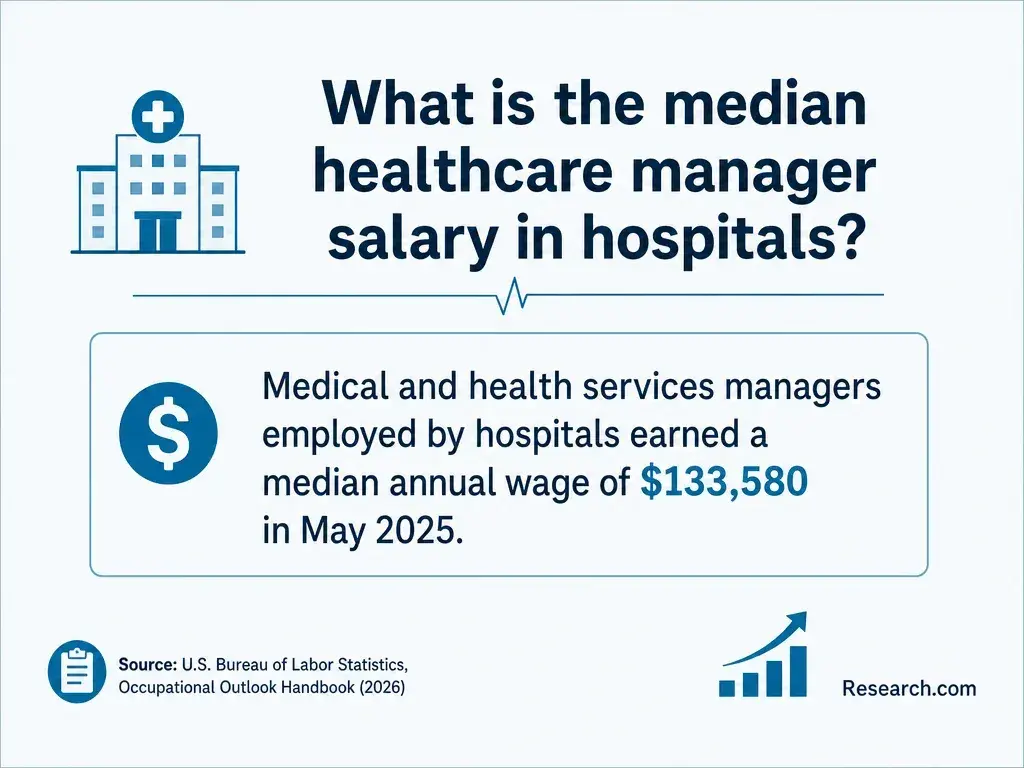
For salary context, the US Bureau of Labor Statistics reports a $126,520 median annual wage for all management occupations in May 2025. That figure covers many industries and levels of experience; it is neither a health administration PhD graduate salary nor a likely starting salary after an internship. BLS also projects management employment overall to grow faster than the average for all occupations from 2025 to 2035, but that broad outlook cannot predict openings in a particular healthcare team.
Judge the placement against a realistic next step: the experience you already have, the job descriptions you intend to pursue, and whether the internship closes a specific gap. If management preparation matters more than conducting original research, healthcare management master's completion planning may help you compare a shorter route. Neither path removes the need for relevant experience.
Other Things You Should Know About Healthcare Administration
Possibly, but obtain approval from your doctoral committee and the host organization before relying on it. Data-use agreements, confidentiality terms, and research review requirements may limit what you can publish.
Eligibility depends on the student's immigration status, work authorization, university guidance, and the employer's rules. Online enrollment or an internship offer alone does not grant permission to work in the United States.
Not necessarily. Fellowships vary widely in eligibility, funding, duration, and independence. Compare the actual duties and supervision rather than relying on the title.
Use a project summary that describes the problem, your methods, and your contribution without revealing protected information. Get the employer's approval before sharing documents, figures, or identifiable results.
- Chapter 5 - Practical Training https://www.uscis.gov/policy-manual/volume-2-part-f-chapter-5
- 9 FAM 402.5 (U) STUDENTS AND EXCHANGE VISITORS | state.gov https://fam.state.gov/fam/09FAM/09FAM040205.html
- Fact Sheet #71: Internship Programs Under The Fair Labor Standards Act | U.S. Department of Labor https://www.dol.gov/agencies/whd/fact-sheets/71-flsa-internships
- HHS Office of Human Resources Guidance, Hiring Assessment Strategies | HHS.gov https://www.hhs.gov/about/agencies/asa/ohr/hr-library/hiring-assessment-strategies.html
- Guidance for Students/Advisors Relating to Student Externships/Internships | MIT Office of General Counsel https://ogc.mit.edu/latest/guidance-studentsadvisors-relating-student-externshipsinternships
- Healthcare Consulting, Administration and Policy Careers | Cawley Career Education Center https://careercenter.georgetown.edu/jobs-internships/researching-jobs-internships/industry-resources/health-science/healthcare-consulting-management-and-policy/
- Should I consider doing an unpaid internship? | brooklyn.edu https://students.brooklyn.edu/knowledge-base/should-i-consider-doing-an-unpaid-internship/
- Ph.D. in Health Policy and Administration | psu.edu https://hhd.psu.edu/hpa/graduate/phd-health-policy-and-administration
- MHSA, MS, MHI & PhD Internships | Career Services https://sph.umich.edu/careers/internships-experiential-learning/mhsa-ms-phd-internships.html
- Researching Careers | MIT https://capd.mit.edu/resources/researching-careers/