2027 Fastest Accredited Online Oceanography Degree Programs That Accept Transfer Credits

Co-Founder and Chief Data Scientist
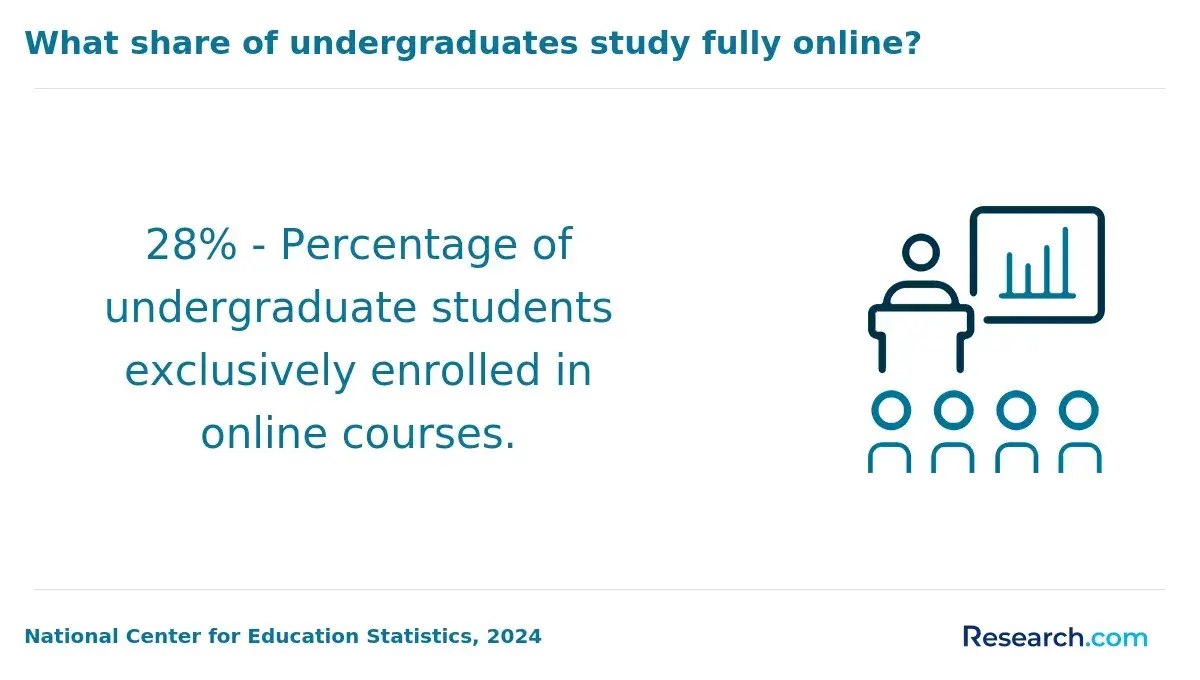
Choosing an online oceanography degree is really a transfer-credit decision: the fastest legitimate path depends on how many prior credits apply to the major, not just how many a school accepts. NCES data released in 2024 shows that more than 30% of undergraduate students take at least one distance education course, making online transfer pathways increasingly important.
This guide is for transfer students, military learners, community college graduates, and degree completers who want an accredited route to graduation without wasting credits, time, or tuition.
Key Things You Should Know
- The fastest realistic online oceanography pathway is usually a transfer-friendly bachelor's completion program in ocean and earth science, marine science, environmental science, or geoscience, with about 30 to 45 credits completed at the degree-granting school.
- A school may accept up to 90 transfer credits toward a 120-credit bachelor's degree, but major prerequisites, lab science sequences, upper-division requirements, and residency rules determine whether you can finish in 12 to 24 months.
- Prioritize regionally accredited institutions, written transfer evaluations before enrollment, online availability of required lab courses, and clear graduation audits over the largest advertised transfer-credit maximum.
What Are the Fastest Accredited Online Oceanography Degree Programs That Accept Transfer Credits?
Fully online degrees with the exact title "oceanography" are uncommon in the United States because oceanography is a lab- and field-intensive discipline. The fastest accredited options are usually online bachelor's completion programs in ocean and earth sciences, marine science, environmental science, geoscience, or earth systems that include oceanography coursework and accept substantial transfer credit.
The table below summarizes the kinds of accredited online programs most likely to help transfer students finish quickly. Because program names, modalities, and transfer rules can change, use this as a decision framework and confirm the current catalog, accreditation, and graduation audit before applying.
| Program type | Best fit | Why it can be fast | Main limitation |
| Online ocean and earth sciences bachelor's completion program | Students with previous general education, calculus, chemistry, biology, or geology credits | Often designed for upper-division completion after transfer | May require specific science prerequisites before major courses |
| Online environmental science bachelor's with aquatic, marine, or earth systems coursework | Students seeking oceanography-adjacent careers in environmental consulting, water quality, GIS, or conservation | Broader degree plans may accept more prior coursework as electives or requirements | May not be enough for research-heavy oceanography graduate programs without extra math or physics |
| Online geoscience or earth science bachelor's | Students interested in physical oceanography, coastal processes, climate, or marine geology | Transfer pathways often align with community college geology, physics, and math sequences | Coursework may focus more on land-based earth systems unless electives are chosen carefully |
| Hybrid marine science or coastal studies program | Students who can travel for short labs, fieldwork, or summer intensives | Hybrid delivery can preserve hands-on requirements while allowing most coursework online | Travel, scheduling, and lab fees can slow completion |
For transfer students, the "fastest" program is not necessarily the one with the shortest advertised term length. It is the one that applies the most prior credits to the actual degree plan, offers remaining courses online in predictable rotations, and does not require hidden in-person labs that delay graduation.
Use this screening sequence before choosing a program:
- Ask whether the program is available fully online or whether labs, field courses, exams, or internships require campus attendance.
- Request a preliminary transfer evaluation showing which credits apply to general education, major requirements, upper-division requirements, and electives.
- Compare the number of credits accepted with the number of credits still required for graduation.
- Check whether required courses are offered every term, once per year, or only on rotation.
- Confirm whether the degree title and transcript will meet your intended career or graduate-school goal.
How Fast Can You Complete an Online Oceanography Degree With Transfer Credits?
A transfer student with the right prerequisites can sometimes finish an accredited online oceanography-related bachelor's degree in about one year, but 18 to 30 months is more realistic for many students. The biggest time drivers are not only credit count; they are course sequencing, science prerequisites, lab availability, and whether upper-division major courses are offered often enough.
The table below shows realistic completion ranges for a 120-credit bachelor's degree. These are planning ranges, not guarantees, because schools may apply credits differently after transcript review.
| Credits that apply to the degree | Approximate credits remaining | Fast full-time timeline | More realistic working-adult timeline |
| 90 credits | 30 credits | 10 to 12 months | 12 to 18 months |
| 75 credits | 45 credits | 15 to 18 months | 18 to 24 months |
| 60 credits | 60 credits | 20 to 24 months | 24 to 36 months |
| 30 credits | 90 credits | 30 to 36 months | 36 to 48 months |
Science-heavy degree plans often include prerequisite chains. For example, a student may need general chemistry before ocean chemistry, calculus before physical oceanography, or introductory geology before marine geology. Even when the total credit count looks favorable, one missing prerequisite can push graduation into a later term.
To estimate your fastest legitimate timeline, ask the school to answer these questions in writing:
- How many of my completed credits apply directly to the degree, not just to the institution?
- Which required courses are still missing, and are any of them prerequisites for later courses?
- Are all remaining lab, field, capstone, internship, or research requirements available online?
- Can I take the remaining courses in back-to-back terms without scheduling conflicts?
- What is the minimum number of credits I must complete at this institution to graduate?
Students who have not yet earned many college credits may finish faster by completing a lower-cost associate pathway first. If that applies to you, comparing a quickest associates degree can help you understand how general education and lower-division science credits may transfer into a bachelor's completion plan.
How Many Transfer Credits Can You Apply Toward an Online Oceanography Degree?
Many U.S. bachelor's programs require about 120 semester credits, and transfer-friendly schools may allow up to 75, 90, or sometimes more credits to be evaluated. However, the more important number is the amount that applies to your oceanography-related degree requirements after the registrar and academic department review your transcripts.
The table below explains the difference between common transfer-credit categories. This distinction matters because a high transfer total can still leave you with many required science courses to complete.
| Transfer-credit category | What it means | How it affects speed |
| Accepted institutional credit | The school recognizes the credit on your record | Helpful, but it may only count as elective credit |
| General education credit | Prior coursework satisfies writing, humanities, social science, math, or basic science requirements | Can shorten the degree if it clears broad requirements |
| Major prerequisite credit | Prior courses satisfy required foundations such as biology, chemistry, geology, physics, statistics, or calculus | Often the most valuable transfer credit for speed |
| Upper-division major credit | Advanced coursework applies directly to the major | Can reduce remaining terms, but departments often review this strictly |
| Elective credit | Credits count toward total graduation hours but not specific requirements | Useful only if the degree has open elective space |
For oceanography-related programs, science equivalency is especially important. A general "physical science" course may not replace required chemistry, geology, or oceanography coursework, and some departments require recent lab science credits if the content changes quickly or supports advanced courses.
Common transfer mistakes include assuming an associate degree automatically completes the first half of the bachelor's degree, enrolling before receiving a written evaluation, and choosing a school based only on a maximum transfer-credit number. A better strategy is to compare the final list of remaining courses at each school and choose the program with the fewest bottlenecks.
Accreditation is the quality-control checkpoint that helps protect transferability, federal financial aid eligibility, employer recognition, and graduate-school acceptance. For U.S. online oceanography-related degrees, look first for institutional accreditation from a recognized accreditor; programmatic accreditation is less common for oceanography bachelor's programs than it is in fields such as engineering, nursing, or counseling.
Use this verification process before you submit deposits or enroll:
- Search the school in the U.S. Department of Education's accreditation database or the Council for Higher Education Accreditation directory.
- Confirm that the accredited institution is the same school awarding the online degree, not only a partner company or platform.
- Check whether the online program is included under the institution's accreditation scope.
- Review state authorization if you live outside the school's home state.
- Ask graduate schools or target employers whether the degree title and coursework are acceptable for your intended path.
Do not rely on marketing language such as "nationally recognized," "career-ready," or "college-level" without confirming formal accreditation. Also be cautious with extremely short completion claims, especially if the school does not publish course requirements, faculty credentials, transfer rules, or licensure and graduate-school limitations.
Students comparing regulated or credential-sensitive online degrees should use the same level of scrutiny they would apply to fields such as BCBA masters programs online, where accreditation, supervised experience, and eligibility rules can directly affect professional options.
Online oceanography-related programs may accept credits from several sources, but each source is evaluated differently. The most useful credits are usually those that satisfy required science, math, writing, statistics, GIS, or research-methods courses.
These credit types are commonly reviewed in transfer evaluations:
- Regionally accredited college credits in biology, chemistry, geology, physics, calculus, statistics, environmental science, GIS, or marine science.
- Community college associate degree coursework that maps to general education and lower-division science requirements.
- Previous bachelor's-level credits that can satisfy electives, upper-division requirements, or supporting coursework.
- Military credits evaluated through official military transcripts, especially for technical, environmental, mapping, meteorology, or logistics training.
- Exam-based credits such as CLEP or Advanced Placement, usually applied to general education rather than advanced major coursework.
- Credit for prior learning portfolios, when the school allows documented professional experience to be evaluated for academic credit.
Course age can matter. A school may accept older humanities credits without issue but require recent science, math, or technology coursework if the material supports advanced classes. This is especially relevant for GIS, remote sensing, data analysis, environmental modeling, and laboratory methods.
If your transcript includes many unrelated credits, do not assume they are useless. Open electives can still reduce total credits remaining, but once elective space is full, additional accepted credits may not shorten the degree.
Residency requirements are one of the most important reasons that 90 accepted transfer credits may not always mean only 30 credits remain. In degree planning, "residency" usually means the minimum number of credits you must complete through the institution awarding the degree, not where you physically live.
The table below shows the policy areas that most often determine whether transfer credits actually reduce your time to graduation.
| Requirement | Typical issue for transfer students | Why it matters |
| Institutional residency | The school may require a minimum number of credits completed through its own courses | Sets the floor for how fast you can finish |
| Major residency | Some advanced major courses must be completed at the degree-granting school | Limits how much upper-division science transfer credit can apply |
| Upper-division credit minimum | A bachelor's degree may require a certain number of 300- or 400-level credits | Lower-division transfer credits may not satisfy advanced requirements |
| Capstone requirement | Many programs require a final research, policy, data, or field-based project | Usually cannot be transferred in |
| Lab or field requirement | Some science courses require hands-on work, field observation, or approved alternatives | Can delay completion if not offered every term |
The best way to compare programs is to request a degree audit rather than a general credit estimate. A degree audit shows exactly which boxes are checked and which remain open.
If two schools accept the same number of credits, choose the one with fewer remaining prerequisites, clearer course rotations, and a lower required in-house credit total. A lower tuition rate may not save money if poor course sequencing forces you to stay enrolled for extra terms.
Prior learning credit can help, but it rarely replaces the core upper-division oceanography, marine science, or geoscience courses that define the major. Its best use is clearing general education, electives, introductory computing, statistics, technical writing, or applied environmental skills so you can focus on the remaining major sequence.
Before paying for exams or portfolio assessments, confirm the school's rules. These are the areas where alternative credit is most likely to help:
- CLEP exams for general education subjects such as composition, college algebra, social sciences, humanities, or introductory natural science, if accepted by the school.
- Advanced Placement or International Baccalaureate scores that meet the institution's minimum score policy.
- Military training evaluated through official transcripts, especially if it aligns with mapping, meteorology, environmental operations, leadership, or technical systems.
- Professional certifications in GIS, data analytics, environmental compliance, safety, diving, or remote sensing, when the school has a credit-for-prior-learning process.
- Portfolio-based assessment for documented college-level learning gained through work, research, fieldwork, or technical training.
The main risk is paying for credit that does not fit your degree plan. Ask whether alternative credits count toward residency limits, whether there is a cap on prior learning credit, and whether the department will accept them as major requirements or only electives.
Students with substantial work experience should also ask whether prior learning credit appears differently on the transcript. Some graduate programs may prefer traditional graded coursework for prerequisites such as chemistry, calculus, physics, or advanced biology.
The total cost of a fast online oceanography-related degree depends on tuition per credit, the number of remaining credits, online fees, lab kits, field expenses, textbooks, transfer evaluation fees, and financial aid eligibility. The National Center for Education Statistics reported in 2024 that average undergraduate tuition and required fees were lower at public institutions than private nonprofit institutions, which makes residency status and school type important cost variables for transfer students.
Here is a simple way to compare costs after transfer credits:
- Multiply tuition per credit by the number of credits remaining after the official degree audit.
- Add mandatory online, technology, lab, field, proctoring, and graduation fees.
- Subtract grants, scholarships, employer tuition assistance, military education benefits, or other aid that does not need to be repaid.
- Estimate borrowing only after you know the net price, not the advertised tuition.
- Compare total cost against career goals, graduate-school plans, and whether the degree title matches your intended path.
Transfer credits can reduce cost significantly because they reduce the number of credits you pay for at the new school. However, the cheapest per-credit tuition is not always the cheapest total degree if the school accepts fewer applicable credits or requires extra prerequisite terms.
If affordability is your main filter, compare online schools broadly as well as by major. A guide to the best affordable online colleges can help you evaluate tuition, flexibility, and value before narrowing your list to oceanography-related programs.
Accelerated formats can shorten calendar time, but they work differently. Oceanography-related degrees are less likely to be fully competency-based than business, IT, or general studies programs because science labs, field methods, and sequenced prerequisites are harder to compress.
The table below compares common online formats so you can choose the one that fits your credits, schedule, and learning style.
| Format | How it works | Best for | Speed trade-off |
| Accelerated terms | Courses run in shorter sessions, often with multiple start dates | Students who can handle intensive weekly workloads | Fast if courses are offered in the right sequence |
| Traditional asynchronous online | Courses follow a standard semester or quarter calendar without live attendance requirements | Working adults who need schedule flexibility | Reliable but may be slower if key courses rotate annually |
| Competency-based education | Students progress by demonstrating mastery rather than sitting through fixed weekly modules | Experienced learners in fields with flexible assessment models | Less common for lab-heavy oceanography requirements |
| Self-paced independent study | Students complete coursework within a broad time window | Highly disciplined learners with unpredictable schedules | Can be fast for electives but risky for sequenced science courses |
| Hybrid intensive | Most work is online, with short in-person labs or field sessions | Students who need hands-on science preparation | May improve academic fit but requires travel planning |
Accelerated study is best for students who already have prerequisites complete, can take 12 or more credits per term, and do not need to retake foundational math or science. A slower format may be better if you work full time, need strong grades for graduate school, or must build field and research experience.
Students comparing fast online formats across majors may notice that a degree in finance often compresses more easily than an oceanography-related degree because it usually has fewer lab and field sequencing constraints.
Are Fast Accredited Online Oceanography Degrees Respected by Employers and Graduate Schools?
A fast online degree can be respected when it is earned from an accredited institution, includes appropriate science and quantitative coursework, and gives the student enough preparation for the intended career or graduate program. The "online" label is usually less important than accreditation, transcript content, grades, research or field experience, and technical skills.
Oceanography-related careers vary widely. Some roles are available with a bachelor's degree, while research scientist roles often require a master's degree or doctorate. The U.S. Bureau of Labor Statistics Occupational Outlook Handbook updated in 2024 reports that geoscientists had a median annual wage above the national median for all occupations, but salaries vary by industry, education level, location, and specialization.
For career planning, match the degree to the outcome you want:
- For environmental consulting, prioritize environmental science, GIS, water quality, statistics, and regulatory coursework.
- For marine laboratory or field technician roles, prioritize lab methods, sampling, data management, safety training, and field experience.
- For physical oceanography or climate-related graduate study, prioritize calculus, physics, programming, statistics, and modeling.
- For marine geology or coastal hazards, prioritize geology, sedimentology, geomorphology, remote sensing, and geospatial analysis.
- For policy, conservation, or coastal management, prioritize environmental law, resource management, communication, and applied research projects.
Graduate schools may require specific prerequisites even if your bachelor's degree is accredited. Before enrolling, compare your target graduate programs' requirements against the online degree plan and ask whether you can add missing math, chemistry, physics, or biology courses as electives.
This same fit-first approach applies across fields. For example, students evaluating art therapy graduate programs must look beyond speed and confirm that coursework, supervision, and admissions requirements align with their long-term professional goals.
Other Things You Should Know About Oceanography
It can be, especially if your goal is environmental analysis, GIS, data work, coastal policy, or graduate preparation. However, students who want ship-based research, wet lab work, or field-intensive roles should look for programs with labs, field intensives, internships, or local experiential options.
Many oceanography-related programs require or strongly recommend calculus, statistics, chemistry, biology, geology, and sometimes physics. Physical oceanography, climate modeling, and graduate research tracks usually require stronger math and physics preparation than policy-oriented or general environmental tracks.
Yes, and this is often one of the most efficient pathways. The best results come from choosing community college courses that match the receiving school's general education, lab science, math, and lower-division major requirements before transfer.
The biggest red flag is a program that promises unusually fast completion without providing accreditation details, a written transfer evaluation, required course lists, lab or field expectations, and a clear explanation of how credits apply to the degree.
- Best Oceanography Degrees Online and On-Campus: Top 10 Values 2026 https://www.collegevaluesonline.com/rankings/bachelors-oceanography/
- Home https://www.husson.edu/online/online-degrees/bachelor-of-science-in-marine-biology-and-conservation
- Full Transfer Guide - OnlineDegree.com https://www.onlinedegree.com/full-transfer-guide/
- Marine Biology Degree Programs in the U.S. | MarineBio Conservation Society https://www.marinebio.org/careers/us-schools/
- Transfer Credits https://oac-program-counselling.uoguelph.ca/current-students/transfer-credits
- Best Online Oceanography Courses and Programs | edX https://www.edx.org/learn/oceanography
- Marine Biology Field Research Training Course - Oceans Research https://www.oceans-research.com/oceans-field-research-program/