2027 DrPH Applications After a Career Break

Co-Founder and Chief Data Scientist
A career break can make a Doctor of Public Health application feel harder to judge: your strongest leadership work may be several years old, while your current schedule or professional network has changed.
This guide is for experienced practitioners returning after caregiving, illness, a layoff, or another pause. It explains how to assess DrPH fit, document earlier work, address the gap without oversharing, and check whether a program's project, schedule, and cost are workable before you apply.
Key Things You Should Know
- A career break is not an automatic DrPH admissions barrier; programs assess their own experience requirements, and evidence of prior responsibility matters more than a title alone.
- Before applying, confirm access to a feasible practice project and a schedule you can sustain. Online classes may still require live sessions, travel, and partner meetings. Compare total cost and likely job fit, not degree prestige.
- The Bureau of Labor Statistics' $117,960 median annual wage for medical and health services managers in May 2024 is an occupation-wide benchmark, not a DrPH graduate salary.
What Is a DrPH Degree and Is It Suitable After a Career Break?
A Doctor of Public Health is a practice-focused doctorate for people seeking to lead population-health programs, systems, or policy work. Unlike a research-focused public health PhD, a DrPH typically emphasizes applying evidence, managing change, and producing a substantial practice-oriented doctoral project. The exact curriculum and final project vary by school.
Time away does not erase earlier practice experience. The stronger fit question is whether you can connect past responsibilities to a specific leadership problem you want to address next.
Someone who directed a community program before a caregiving break may be ready to apply; someone seeking a first public health role may benefit more from supervised work or a master's degree.
If your break interrupted undergraduate study rather than an established career, online bachelor's study in public health may be a more appropriate starting point.
What Are the Admission Requirements for DrPH Programs After Time Away?
DrPH programs commonly request prior graduate study, relevant professional experience, a statement of purpose, references, and academic records, but no single MPH requirement or minimum number of working years applies everywhere.
Some schools define qualifying experience as post-master's or full-time work; others evaluate broader practice backgrounds. Check each program's published rules before deciding that you are either eligible or competitive.
For a returning applicant, the key distinction is eligibility versus evidence. A résumé might establish the required experience, while a strong application shows what you were responsible for: budgets managed, partnerships sustained, staff supervised, decisions informed by evaluation, or changes implemented.
Ask admissions staff whether earlier experience qualifies under their policy and whether the program expects you to have a current organization or prospective project partner.
If older grades complicate your academic history, do not assume DrPH reviewers apply the same rules as master's programs. Guidance on public health master's entry with a modest GPA may help you frame academic improvement, but only the doctoral program can explain its own review process.
How Can Applicants Explain a Career Break in a DrPH Application?
Explain the break briefly, accurately, and in proportion to its relevance. You can name caregiving, health needs, a layoff, or a planned pause without disclosing private medical or family details.
Then return to the admissions question: what did you accomplish before the break, how have you maintained or refreshed relevant skills, and why can you undertake doctoral work now?
Prepare a short evidence trail before writing the statement. It will also help former supervisors write specific recommendations:
- Build a dated record of earlier roles, responsibilities, and outcomes you can document without exposing confidential information.
- Identify one recent, verifiable sign of readiness, such as relevant employment, training, volunteer responsibility, or a completed analytical project.
- Describe a realistic practice problem and the relationships or approvals you would need to investigate it during the degree.
Ask potential recommenders whether they can discuss your work in detail, even if you last worked together before the break. If references are difficult to obtain, do not assume a DrPH will waive them; public health master's programs that omit reference letters describe a different admissions route, not a doctoral exception.
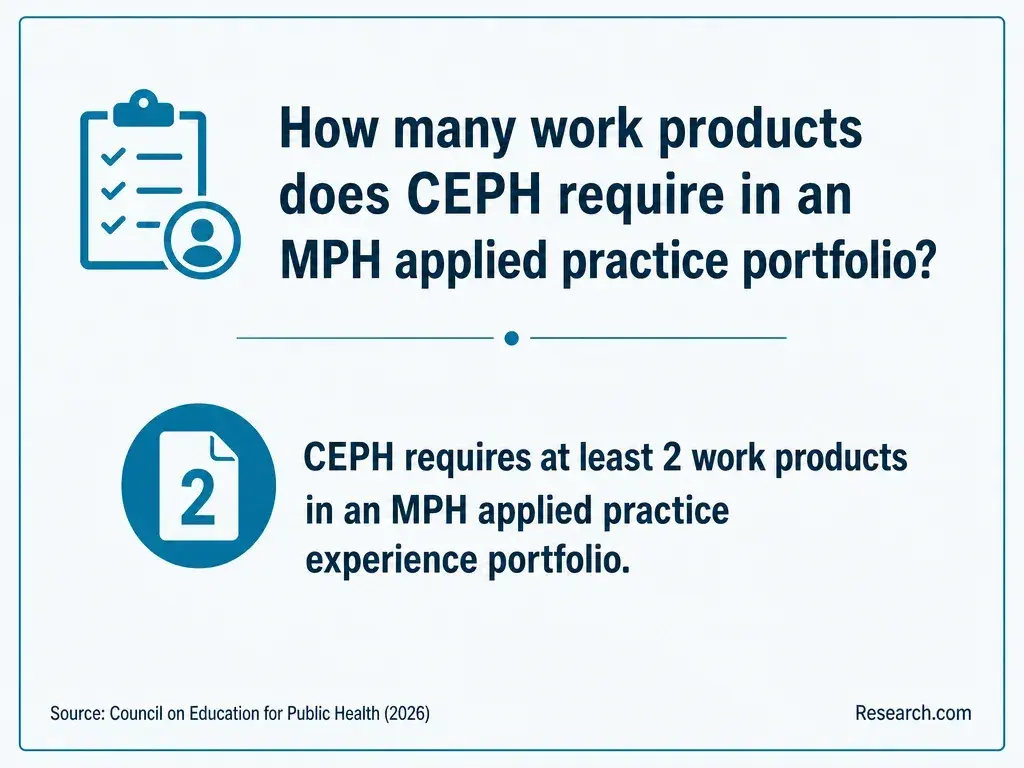
Yes, but check what is accredited. Institutional accreditation concerns the university. Council on Education for Public Health (CEPH) accreditation concerns a specified public health school, unit, or program; a university's accredited MPH does not, by itself, establish that its DrPH is within the accredited scope.
Check CEPH's current listing and the school's accreditation documentation for the exact unit and degree. Ask the program to clarify any ambiguity, particularly if accreditation or program ownership has changed.
If an MPH is a better next step than a doctorate, lists of CEPH-accredited online MPH programs can support that separate search; verify each program's status directly before applying.
The best format is the one that accommodates your actual work, caregiving, and project obligations, not simply the one labeled "online." This comparison identifies scheduling questions to resolve with each program:
| Format | Potential advantage | Constraint to verify |
| Mostly online | Less routine commuting | Live classes, time zones, required visits, and local project-site support |
| Hybrid | Regular in-person collaboration | Travel frequency and whether visits occur on weekdays |
| Campus-based | Face-to-face access to faculty and peers | Commute, course times, and ability to continue employment |
Request a sample term schedule, residency calendar, project milestones, and leave-of-absence policy. Ask whether group meetings and partner-site work can occur outside business hours.
If a doctorate is not yet feasible, affordable public health programs with faster schedules may suggest alternatives, but compare their actual credentials and obligations rather than treating them as abbreviated DrPH degrees.
DrPH study generally combines advanced public health practice with leadership, policy, organizational management, evidence appraisal, and evaluation.
Students may learn to interpret population-health data, work with community partners, plan budgets, assess implementation, and communicate decisions to officials or organizational leaders. Programs differ in methodological depth and available specialties.
After a break, compare the curriculum with both your established strengths and your rusty skills. A former program director may need a statistics refresher; an experienced analyst may need more opportunities to lead teams and negotiate with partners.
Also examine how doctoral project supervision works: your proposed site may require organizational permission, data-use approval, community input, or ethics review before work begins. If introductory graduate preparation is the immediate gap, information on reviewing conditional public health graduate entry addresses a distinct, master's-level possibility.
Employer Confidence in Online vs. In-Person Degree Skills, Global 2024

There is no reliable universal completion time or price. Credit requirements, part-time enrollment, residencies, doctoral-project progress, and continuation rules determine both. Compare published costs for your expected enrollment pattern rather than relying on a program's shortest advertised timeline.
Ask for a written estimate that separates tuition and mandatory fees from travel, required visits, project expenses, and charges that continue after coursework.
Check whether employer assistance covers doctoral study, requires continued employment, or must be repaid if you leave. A career break may also have changed your household's capacity to absorb reduced work hours.
A lower-cost master's degree is not interchangeable with a DrPH, but it can be useful if your immediate goal is to rebuild practice skills. Figures about public health master's tuition after university aid should therefore be compared only with master's options, not used as a proxy for doctoral funding.
A DrPH can support advancement into public health program leadership, health department management, health-system population-health work, nonprofit direction, policy implementation, or practice-focused teaching.
Which roles are attainable depends heavily on your earlier record and the sector you plan to reenter. A doctorate does not replace required clinical licenses, specialized technical experience, or an employer's management requirements.
Use target job postings to test the value of returning to school. If they call chiefly for recent supervision, grant management, or agency relationships, rebuilding those credentials through work may be more direct.
If they call for leading complex population-health initiatives and evaluating organizational change, a DrPH may add more. For a narrower practice transition, lower-cost Master of Public Health study online may be worth comparing before committing to doctoral study.
There is no dependable salary figure that applies to DrPH graduates as a group. Pay depends on the job, employer, location, responsibilities, and prior experience. For one relevant comparison, the U.S. Bureau of Labor Statistics reports a $117,960 median annual wage in May 2024 for medical and health services managers.
That occupation includes managers without a DrPH and does not represent all health department or nonprofit leadership jobs.
For a personal financial decision, compare salaries in postings for roles you could plausibly obtain before and after the degree, then account for tuition and earnings you might forgo. An earnings outlook for public health master's holders offers context for a different degree; neither figure predicts your return from a DrPH.
What Job Outlook and Certifications Apply to DrPH Graduates?
Job growth forecasts describe occupations, not demand for a particular doctorate. The Bureau of Labor Statistics projects 23% employment growth for medical and health services managers from 2024 to 2034.
That is relevant if your target role falls within the occupation, but it does not predict vacancies in your preferred public health agency or a promotion after graduation.
Professional credentials are separate decisions. The Certified in Public Health (CPH) credential has its own eligibility and examination rules; health education credentials such as CHES and MCHES serve different roles and have separate requirements.
A DrPH does not automatically award any of them. If your goal is primarily epidemiologic research rather than practice leadership, investigate PhD fit and funding separately; online epidemiology doctoral funding options are not evidence of DrPH funding or equivalent training.
Other Things You Should Know About Public Health
Often, yes, but check the program's rules. Explain your previous practice responsibilities and ask how students without a current employer arrange an approved doctoral project.
Completed degrees generally remain on your academic record, but programs may set recency expectations for particular skills or courses. Ask whether a refresher would strengthen your application.
Only if the doctoral program accepts it toward specific requirements. Request its transfer-credit policy and a written evaluation before assuming a shorter timeline.
Only if you have permission to share them and can protect confidential, identifiable, or proprietary information. A redacted description of your role may be safer than the original document.
- Analysis of CEPH-accredited DrPH programs in the United States: A mixed-methods study - PMC https://pmc.ncbi.nlm.nih.gov/articles/PMC7861440/
- DrPH Public Health | University at Albany https://www.albany.edu/cihs/programs/drph-public-health
- Writing the Statement of Purpose: General Advice | University of Washington https://english.washington.edu/writing-statement-purpose-general-advice
- Writing Your Academic Statement of Purpose - Graduate School https://gradschool.cornell.edu/inclusion/recruitment/prospective-students/writing-your-statement-of-purpose/
- Doctoral program in Public Health Executive Leadership (DrPH) | UNC Gillings School of Global Public Health https://sph.unc.edu/hpm/hpm-drph/
- Admissions Checklist (DrPH) | College of Public Health | University of Kentucky https://cph.uky.edu/programs/doctor-public-health/apply/admissions-checklist-drph
- Admissions - Johns Hopkins Bloomberg School of Public Health https://publichealth.jhu.edu/academics/explore-programs/doctoral-degrees/doctor-of-public-health-drph/admissions
- Applying to the Doctor of Public Health | Emory University https://sph.emory.edu/admissions/how-to-apply/drph
- Choosing a PhD or a DrPH: Key Differences | NYU School of Global Public Health https://publichealth.nyu.edu/events-news/news/2024/10/10/choosing-phd-or-drph-key-differences
- Can You Work Full-Time While Earning a DrPH? | Fairfield University https://www.fairfield.edu/news/insights/nursing-health-studies/can-you-work-full-time-while-earning-a-drph.html