2027 DNP Pediatric Primary Care NP Programs for Nurses in Wisconsin: BSN and MSN Entry Routes and Clinical Training
Audited and Verified:
Our Editorial and Data Verification Process
Research.com uses government datasets, official education statistics and primary institutional information to support its career and degree guides. Our review process checks factual accuracy, occupational definitions, source dates and the requirements associated with the credentials discussed.
How This Article Was Fact-Checked
Our editorial team verifies salary estimates, employment projections, education requirements and program information against original data providers and official organizations. Salary figures are checked against the relevant occupational definitions and reporting periods. Information about licensure, accreditation and required in-person training is reviewed separately.
Fact-checked and verified on:

Co-Founder and Chief Data Scientist
A Wisconsin nurse seeking to become a pediatric primary care nurse practitioner needs more than a doctoral degree with a pediatric-sounding title. The program must provide the right population-focused coursework and supervised clinical preparation for certification and state authorization. This guide compares BSN and MSN entry routes, identifies Wisconsin schools worth checking, and explains the placement, cost, accreditation, and credentialing questions to resolve before applying. It is designed to help licensed nurses choose a feasible route without assuming that prior experience, online delivery, or a DNP alone qualifies them to practice as a pediatric NP.
Key Things You Should Know
- Look for a pediatric primary care nurse practitioner (PNP-PC) track - not merely a DNP or general pediatric coursework. The intended outcome is population-focused preparation for PNP-PC certification.
- BSN-to-DNP and MSN-to-DNP are two different entry routes; an MSN-prepared nurse without prior PNP-PC preparation may still need substantial specialty coursework and supervised pediatric care.
- Before comparing tuition, confirm three essentials for your entry term: the exact track is enrolling, Wisconsin clinical placements are feasible, and the curriculum supports the intended certification and Wisconsin APRN application.
What are DNP pediatric primary care nurse practitioner programs in Wisconsin?
A PNP-PC DNP program combines doctoral-level practice, evidence appraisal, and quality improvement with advanced clinical education focused on children from infancy through young adulthood. Primary care preparation emphasizes preventive visits, developmental and behavioral assessment, common acute concerns, chronic-condition management, family education, and coordination with schools and specialists. It is distinct from pediatric acute care NP preparation.
These are post-licensure programs: applicants generally enter as registered nurses. The DNP is the academic award; PNP-PC is the intended advanced practice role and population focus. Neither graduation nor an existing RN license alone grants Wisconsin APRN authority. If you are not yet an RN, establish a licensure path first; LPN-to-RN bridge duration and eligibility concerns an earlier step, not entry into pediatric NP practice.
What are the BSN and MSN entry routes for Wisconsin pediatric primary care DNP programs?
The deciding question is not simply which degree you hold. It is whether your previous graduate education already covers the same NP role and pediatric primary care population focus. The receiving school determines what prior courses and documented clinical work it will accept.
This comparison shows why an MSN can shorten one applicant's path but do little to replace another applicant's pediatric specialty preparation.
| Entry route | Typical starting point | What to verify |
| BSN-to-DNP | Licensed RN with a BSN, usually entering NP specialty preparation for the first time | Full course sequence, clinical placement support, campus requirements, and total credits |
| MSN-to-DNP, already PNP-PC prepared | Licensed RN with relevant graduate NP education and, potentially, certification | Whether the DNP adds doctoral practice preparation without repeating unnecessary specialty work |
| MSN-to-DNP, different or non-APRN specialty | MSN-prepared nurse seeking a new pediatric primary care NP role | Formal gap analysis, required pediatric courses and direct-care experiences, and certification eligibility |
An MSN in leadership, education, or another NP population focus does not automatically meet PNP-PC requirements. An RN whose prior education began at the associate-degree level may also need an appropriate graduate entry pathway; ADN-to-MSN bridge curriculum options can help frame that earlier decision, but the eventual PNP-PC track must still be confirmed separately. If becoming an NP is the immediate goal and a suitable MSN specialty program is available, compare its time and total cost with a DNP rather than assuming the doctorate is required.
Which Wisconsin schools offer pediatric primary care DNP programs?
University of Wisconsin-Madison is a Wisconsin school to investigate for pediatric primary care NP doctoral preparation. Marquette University is another institution to ask about pediatric primary care NP education and whether a DNP route is available for your particular entry status. This is a starting shortlist, not a claim that both schools are admitting students to every route in every term. Specialty offerings, cohorts, and degree pathways can change.
Ask each nursing school to identify the exact degree and PNP-PC track open for your intended term; whether it admits BSN-prepared nurses, MSN-prepared nurses, or both; its published curriculum and certification outcome; and who secures or approves Wisconsin clinical sites. If a school lists pediatric NP study only as an MSN or post-graduate certificate, do not relabel it a DNP program. General lists of comparing entry barriers at nursing schools cannot establish admission odds for a small, specialty-specific doctoral cohort.
If neither school offers a workable entry route or placement arrangement, an out-of-state program may be an option only after confirming that it enrolls Wisconsin students, permits Wisconsin clinical placements, and supports the credentials you intend to seek. A school's physical location is less important than those written confirmations.
The format of lectures does not determine where or when pediatric clinical care occurs. Compare the complete schedule rather than the word "online" in an advertisement.
The distinctions below matter especially if you expect to remain employed during the program.
| Format | Potential advantage | Constraint to check |
| Mostly online | Less routine travel for coursework | Live sessions, required visits, and in-person clinical days may still follow fixed schedules |
| Hybrid | Combines remote classes with planned campus learning | Travel, lodging, simulation dates, and missed work may add costs |
| Campus-based | More regular face-to-face access to faculty and peers | Commuting and course schedules may limit work flexibility |
Request a sample term calendar showing synchronous classes, intensives, clinical days, and DNP project milestones. Ask whether pediatric placements near your home are possible and whether you must find a preceptor yourself. For an RN still completing a bachelor's degree, flexible BSN completion routes for licensed RNs address a separate earlier credential; their delivery model does not predict the hands-on requirements of a PNP-PC DNP.
Expect advanced health assessment, pathophysiology, and pharmacology alongside pediatric growth and development, health promotion, diagnosis and management, and family-centered care. DNP study commonly adds evidence appraisal, systems leadership, population health, and a practice-focused improvement project. Exact course names and sequencing vary by school.
Clinical fit matters more than an advertised total alone. Approved experiences should expose students to the age range, primary care conditions, preventive services, and decision-making expected of a PNP-PC. Ask for the school's required direct-care hours, how it counts previous graduate hours, site and preceptor standards, faculty oversight, and how it evaluates performance. Work as a pediatric RN is valuable preparation, but employment hours are not automatically approved NP clinical hours. Simulation likewise does not automatically replace supervised patient care.
A DNP project might evaluate a child-health workflow or educational intervention, subject to site permission, privacy rules, and the school's oversight process. It is not a substitute for pediatric NP clinical preparation. This is the key distinction when considering online DNP executive and organizational pathways: a non-APRN doctorate can serve a leadership goal without preparing its graduate for PNP-PC certification.
Programs typically evaluate an active RN license, the qualifying nursing degree and transcripts, graduate-study readiness, professional references, and an application explaining the pediatric primary care goal. Schools may set their own GPA, experience, interview, or prerequisite policies. Admission to a university is not the same as admission to its PNP-PC cohort.
An MSN applicant should supply graduate syllabi, specialty-course descriptions, supervised clinical-hour records, and any existing NP certification for a written gap analysis. A BSN applicant should ask whether pediatric nursing experience is required or preferred. Both should check clinical eligibility conditions - including background screening, immunizations, and site requirements - before relying on an offer of academic admission.
If you hold a non-nursing bachelor's degree but no RN license, this is not an initial-licensure doctorate. Explore nursing program options for first-time nursing students before comparing NP tracks. Likewise, broad advice about comparing entry barriers at nursing schools should not replace the specialty program's published requirements.
There is no reliable single Wisconsin price or completion time for both entry routes. A BSN-entry student generally has more NP and doctoral coursework ahead than an MSN-prepared PNP-PC whose previous study is accepted. An MSN in another specialty may still require extensive pediatric clinical training. Part-time enrollment, course sequencing, placement delays, and project completion can also change the finish date.
Ask for an individualized degree plan and a term-by-term cost estimate. Compare tuition by the school's actual charge unit, then add mandatory fees, books, screening and clinical compliance expenses, travel or lodging for campus visits, certification and licensing costs, and any income lost to clinical scheduling. Do not calculate savings from prior credits until the school has approved them in writing.
For a meaningful comparison, request total expected cost through graduation, not a tuition rate alone. General comparisons of accelerated DNP program comparisons may help generate scheduling questions, but a short non-PNP doctorate is not a faster route to pediatric primary care practice. .
Check three separate questions: whether the university has recognized institutional accreditation; whether its nursing degree falls within the scope of an appropriate nursing program accreditor, such as CCNE or ACEN; and whether the specific PNP-PC curriculum meets the educational requirements relevant to the intended certification and Wisconsin APRN application. Institutional accreditation alone does not answer the last question.
Use the university's and nursing accreditor's current program records, then ask the school for written confirmation of its track's certification alignment and Wisconsin eligibility. Check the status for your entry term, especially if a specialty is new or changing. An accredited DNP in leadership, for example, may be academically sound without being an NP program. When comparing fast-track LPN completion timelines or accelerated DNP program options, the shortest route therefore should not be chosen until its actual population focus and credential outcome are clear.
After completing qualifying PNP-PC education, graduates generally pursue the Certified Pediatric Nurse Practitioner-Primary Care (CPNP-PC) credential through the Pediatric Nursing Certification Board. They must satisfy the board's current eligibility and examination rules; a school's award of a DNP is not the certification itself.
Wisconsin practice also requires the applicable state advanced practice credentialing and prescriptive-authority requirements for the work the NP will perform. Confirm the current application sequence, documentation, and scope rules with the Wisconsin Board of Nursing and the school before graduation. National certification, Wisconsin authorization, an RN license, and employer credentialing are distinct steps. An RN multistate privilege by itself does not establish NP authority in another jurisdiction.
Do not substitute a different population-focused exam because its program is faster. For instance, shorter online mental health NP master's programs prepare for a different NP focus, not PNP-PC certification.
What careers, salaries, and job outlook can pediatric primary care DNP graduates expect?
A qualified PNP-PC may work in pediatric primary care clinics, community health centers, and other child- and family-focused outpatient services, subject to employer needs and applicable scope rules. Responsibilities can include preventive care, assessment and management of common conditions, referrals, and family education. Ask prospective employers about pediatric case mix, orientation, physician and specialist collaboration, appointment schedules, and support for newly certified NPs.
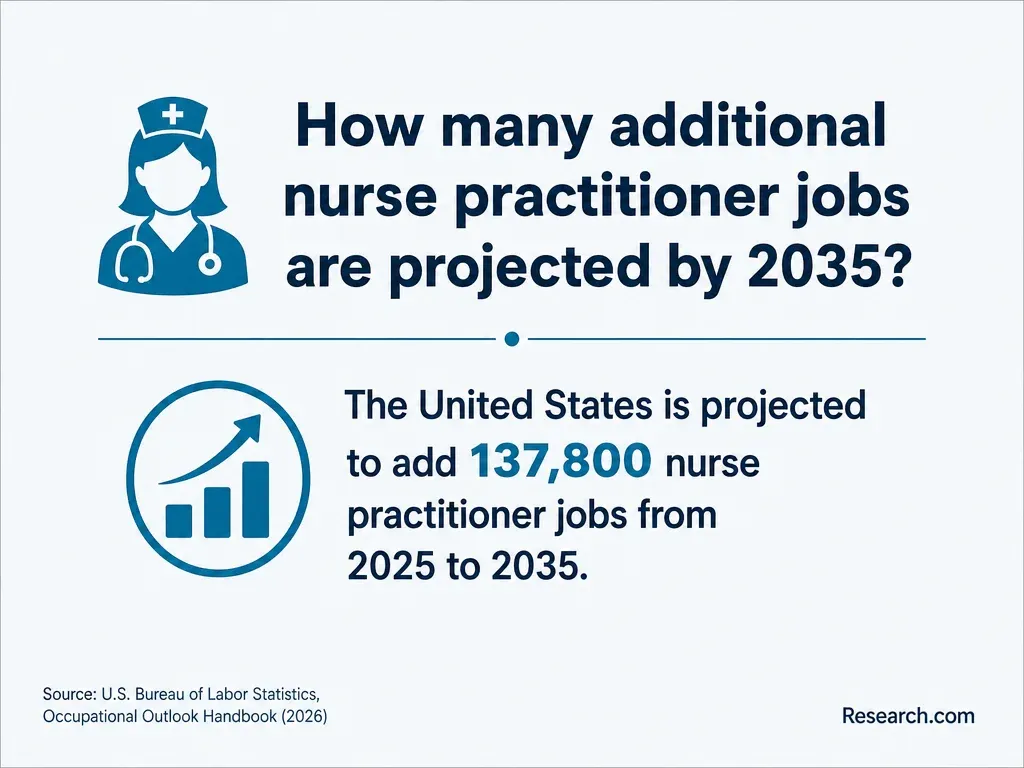
The U.S. Bureau of Labor Statistics reports wages and employment projections for the broader nurse practitioner occupation, not a separate national salary or growth figure for Wisconsin PNP-PC DNP graduates. Those occupation-wide figures can provide labor-market context, but they cannot predict a pediatric offer or show a DNP-specific pay premium. For an actual decision, compare local pediatric openings and compensation with the full cost of each qualifying educational route.
If your preferred work is primarily behavioral health rather than general pediatric primary care, compare the role itself before choosing a track. Online PMHNP tuition and fee considerations may inform a separate specialty decision, but PMHNP preparation is not interchangeable with PNP-PC preparation.
Other Things You Should Know About Nursing
Possibly, depending on the position, employer requirements, and Wisconsin scope rules. A school nursing job and an NP position can have different duties; the PNP-PC credential does not automatically qualify someone for every school-based role.
Potentially, but each credential has its own educational and clinical eligibility requirements. Ask the school for a written dual-track plan rather than assuming one track's hours satisfy the other.
It may, if the employer and school approve the project, data access, and oversight. Workplace access does not authorize use of identifiable patient information without the required permissions and safeguards.
Not automatically. Practice requirements depend on where the patient is located and the other state's applicable RN, APRN, and telehealth rules. Confirm authorization before providing cross-state care.
- Advanced Practice Registered Nurse (APRN) - DSPS https://dsps.wi.gov/a-z-professions-list/advanced-practice-registered-nurse-aprn/
- Dual Pediatric Primary and Acute Care PNP DNP Program | OHSU Admission Requirements and Application Process https://www.ohsu.edu/school-of-nursing/pediatric-primary-acute-nurse-practitioner-pnp
- Placement Process | CSUF - School of Nursing https://nursing.fullerton.edu/current/placementprocess.html
- Doctor of Nursing Practice | Nell Hodgson Woodruff School of Nursing https://www.nursing.emory.edu/degrees-programs/nursing/doctor-nursing-practice
- Is It Time for Dual Primary and Acute Care Preparation? | sciencedirect.com https://www.sciencedirect.com/science/article/pii/S0891524522002383
- Primary Care Pediatric Nurse Practitioner DNP Admissions | RUSH University https://www.rushu.rush.edu/college-nursing/programs-admissions/pediatric-nurse-practitioner-pc-pnp-program/pediatric-nurse-practitioner-pc-pnp-program-admission-guidelines
- Pediatric Primary Care Nurse Practitioner (DNP) | Rutgers Nursing https://nursing.rutgers.edu/pediatric/pediatric-primary-np-dnp/
- Doctor of Nursing Practice (DNP) | wisc.edu https://nursing.wisc.edu/dnp/
- Residency For Tuition Purposes - University of Wisconsin-Parkside https://www.uwp.edu/apply/admissions/residency/