2027 DNP Pediatric Primary Care NP Programs for Nurses in Arizona: BSN and MSN Entry Routes and Clinical Training
Audited and Verified:
Our Editorial and Data Verification Process
Research.com uses government datasets, official education statistics and primary institutional information to support its career and degree guides. Our review process checks factual accuracy, occupational definitions, source dates and the requirements associated with the credentials discussed.
How This Article Was Fact-Checked
Our editorial team verifies salary estimates, employment projections, education requirements and program information against original data providers and official organizations. Salary figures are checked against the relevant occupational definitions and reporting periods. Information about licensure, accreditation and required in-person training is reviewed separately.
Fact-checked and verified on:

Co-Founder and Chief Data Scientist
For an Arizona nurse who wants to provide primary care to children, choosing a DNP program means checking more than the degree name. The track must prepare graduates for the pediatric primary care nurse practitioner role, provide appropriate supervised clinical experiences, and fit the nurse's existing education.
This guide compares BSN and MSN entry routes, identifies Arizona programs to investigate, and explains the clinical, financial, and credentialing questions to settle before applying.
Key Things You Should Know
- A pediatric primary care DNP must include the pediatric NP population-focus track; a general or leadership DNP does not qualify a graduate for pediatric NP certification.
- BSN-entry students need full NP preparation, while MSN-prepared nurses need an individual review of their prior specialty coursework and supervised hours.
- The DNP practice-hour benchmark is at least 1,000 post-baccalaureate hours, but applicants must separately confirm the program's required pediatric direct-care hours and clinical placement arrangements.
What are pediatric primary care DNP programs in Arizona?
A pediatric primary care nurse practitioner (PNP-PC) DNP combines doctoral-level practice preparation with graduate education for assessing, diagnosing, treating, and coordinating care for infants, children, and adolescents in primary care settings. Its population focus is narrower than a family nurse practitioner (FNP) track and different from pediatric acute care preparation.
The distinction matters when comparing graduate specialties: accelerated online PMHNP MSN programs prepare nurses for a different population focus and role, not pediatric primary care. Likewise, a DNP in leadership may advance an existing NP's education but does not, by itself, provide new PNP-PC eligibility.
What are the BSN and MSN entry routes for Arizona pediatric DNP programs?
The right route depends on whether the applicant already has graduate NP preparation in pediatric primary care. These routes should not be treated as interchangeable merely because both can end in a DNP.
The comparison below shows what each applicant needs the school to evaluate before promising a degree plan or certification pathway.
| Starting point | Likely educational need | Critical question |
| BSN-prepared RN | A BSN-to-DNP PNP-PC track with graduate specialty courses and supervised pediatric primary care. | Does the current entry cohort admit directly to this specialty? |
| MSN-prepared RN without NP preparation | Full PNP-PC preparation despite the existing master's degree; some prior graduate courses may be reviewed. | Which courses and hours, if any, satisfy the new track? |
| Certified PNP-PC with an MSN | A post-master's DNP may address doctoral practice requirements without repeating initial NP preparation. | How are documented prior practice hours counted toward the DNP? |
| NP certified in another population focus | Formal pediatric primary care education and supervised experiences, potentially through a post-graduate certificate. | Will the proposed route establish PNP-PC certification eligibility? |
An ADN-prepared RN should not assume direct entry into a BSN-to-DNP track. Online ADN-to-MSN program comparisons can help identify bridge possibilities, but an eventual pediatric NP route still requires the receiving program to review nursing credentials and specialty preparation. For an already certified PNP-PC whose goal is doctoral practice leadership rather than a new clinical role, a post-master's DNP may avoid unnecessary duplicate NP training.
Which Arizona schools offer accredited pediatric primary care DNP programs?
Arizona State University and the University of Arizona are the most relevant Arizona-based universities to investigate for pediatric NP doctoral study. Program menus and admission cycles can change, so neither a university's DNP listing nor its nursing accreditation establishes that a PNP-PC track is admitting students for a particular term.
Use this comparison to narrow the inquiry, not as a substitute for written confirmation from each school.
| School to check | Specialty question | Accreditation and enrollment check |
| Arizona State University | Confirm that its current DNP offering explicitly includes pediatric nurse practitioner primary care and accepts your entry credential. | Check the current nursing program accreditation listing and whether your intended track and entry term are covered. |
| University of Arizona | If pediatric nurse practitioner is listed, confirm whether the available track is primary care and open to new students. | Check the current nursing program accreditation listing, track availability, and clinical-location rules. |
Verify institutional accreditation separately from nursing program accreditation, then request the current specialty plan of study. Neither form of accreditation guarantees an individual's Arizona APRN eligibility. Lists of accessible nursing school entry pathways address a different admissions decision and should not be used as evidence that a pediatric DNP track is available or less selective.
Applicants should expect the school to review an active RN license, nursing degree and transcripts, graduate-study readiness, professional experience, and materials such as recommendations or a statement of goals. Requirements for GPA, pediatric experience, interviews, and prerequisite courses vary by program and entry route; clinical sites may impose additional clearance requirements after admission.
Before applying, ask the track director to identify the exact entry route and review any prior advanced health assessment, pharmacology, pathophysiology, specialty courses, and supervised clinical-hour records. An MSN in education or leadership is not equivalent to an NP MSN, and pediatric bedside experience does not automatically replace graduate PNP-PC clinical training. DNP application options by selectivity may help frame an admissions search, but track fit and certification preparation matter more here than a general ease-of-entry label.
A BSN-entry route generally takes longer than a post-master's route because it must include initial graduate NP preparation as well as doctoral requirements. The actual time depends on each school's course sequence, full- or part-time options, clinical-site availability, and whether specialty courses admit students only in certain terms. An MSN alone does not establish a shorter route: the school must first determine what prior work applies.
Request a term-by-term plan that identifies clinical semesters, required on-site dates, and the DNP project sequence. A guide to shorter DNP programs can provide a scheduling comparison, but a short post-master's program that lacks PNP-PC education is not a shortcut to the pediatric NP role.
No single Arizona pediatric DNP price accurately represents both BSN-entry and post-master's study. Schools may charge by credit, term, or program, and an MSN-prepared applicant's total depends on the school's written credit and practice-hour evaluation. Compare official estimates for the same entry route, enrollment pace, and expected completion term rather than comparing headline tuition alone.
Build the budget around tuition and mandatory fees plus books, clinical clearance, travel to clinical sites or campus, certification and licensing expenses, and any reduction in paid work during rotations. Ask whether a delayed placement creates another billed term. Lower-cost online PMHNP programs can illustrate why specialty and degree level must be held constant in a cost comparison: their advertised prices do not estimate the cost of a PNP-PC DNP.
PNP-PC preparation typically connects advanced assessment, physiology and pathophysiology, pharmacology, and pediatric diagnosis and management with supervised care focused on children and families. Primary care experiences should support health promotion, developmental assessment, common illness management, and care coordination. Doctoral study also includes evidence appraisal and a practice-focused DNP project, which is distinct from a PhD dissertation.
The American Association of Colleges of Nursing's DNP benchmark is at least 1,000 post-baccalaureate practice hours. That total is not a promise that every hour is pediatric direct care: the program and certifier determine which supervised experiences meet specialty and examination requirements. Ask for the clinical-hour breakdown, approved site types, preceptor qualifications, and how faculty evaluate competence. Comparisons of family NP programs that help arrange clinical placements may sharpen questions about placement support, but an FNP site is not automatically suitable for pediatric primary care training.
Expect to distinguish online coursework from the location and schedule of hands-on requirements. A school may deliver lectures remotely while requiring campus intensives, simulation, synchronous meetings, and supervised clinical work at approved sites. Ask each Arizona program for its attendance calendar and whether it permits clinical placements in the county or state where you intend to practice.
Working nurses should check who secures preceptors, how many weekday clinical hours are expected, and whether a proposed site must be approved before enrollment or before a clinical term. Comparing online PMHNP certificate schedules offers a useful reminder that "online" does not mean self-paced, although its specialty requirements cannot stand in for a PNP-PC program's schedule.
Completing a qualifying PNP-PC educational track is a step toward, not a substitute for, certification and Arizona authority to practice. The Pediatric Nursing Certification Board offers the Certified Pediatric Nurse Practitioner-Primary Care (CPNP-PC) credential. Applicants must satisfy its current education and supervised-clinical eligibility rules and pass the examination; the Arizona State Board of Nursing separately determines APRN licensure requirements.
Before enrolling, obtain written confirmation that the proposed track prepares graduates for the CPNP-PC examination, then review the board's current APRN application requirements. Keep transcripts, specialty-course descriptions, and clinical-hour documentation. A 12-month FNP program option prepares for a different population focus; speed or an NP title alone does not establish pediatric primary care certification eligibility.
What careers, salaries, and job outlook can Arizona pediatric DNP graduates expect?
A licensed, certified PNP-PC may seek roles in pediatric practices, community clinics, and other ambulatory settings serving children. Employers may also consider pediatric experience, patient volume, mentorship, and the specific services they expect the NP to provide. A DNP can support practice improvement or leadership work, but it does not guarantee a leadership position or a higher salary than an MSN-prepared PNP-PC.
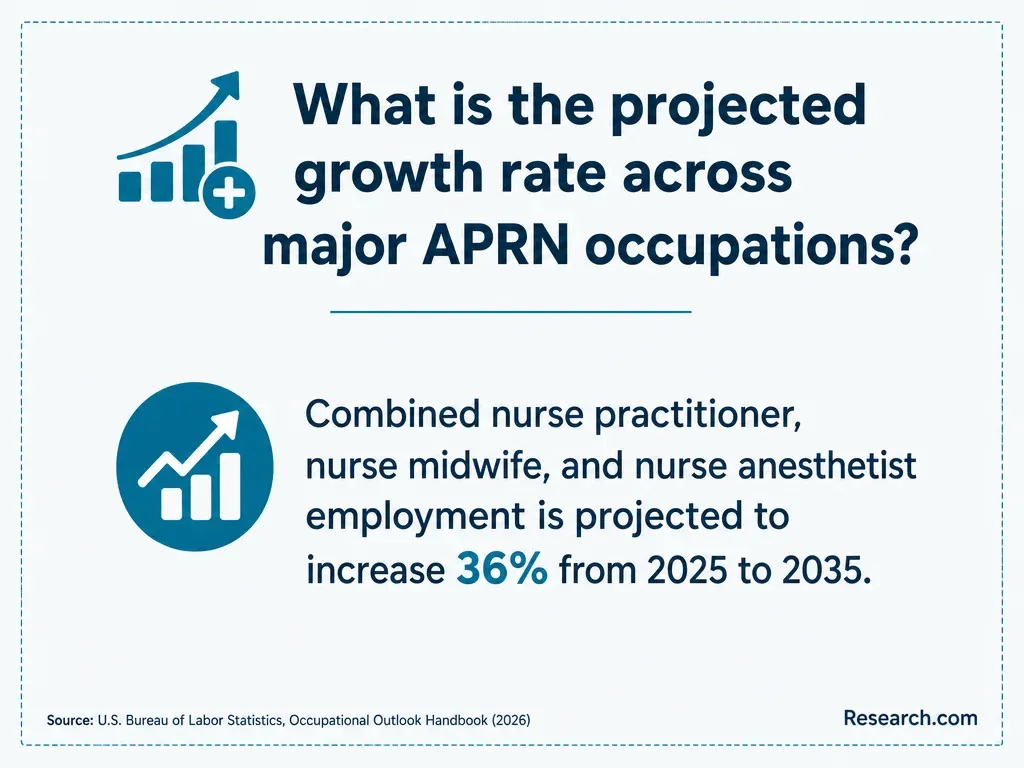
The U.S. Bureau of Labor Statistics reports wages and projected growth for nurse practitioners as an occupation, not separately for Arizona PNP-PCs or DNP graduates. Use its latest NP figures as broad labor-market context, then compare Arizona pediatric job postings and offers by setting, schedule, benefits, and scope of work. For someone who is not yet an RN, LPN-to-RN pathway options for working practical nurses concern an earlier licensing step; they do not provide direct entry to pediatric NP practice.
Other Things You Should Know About Nursing
PNP-PC education focuses on pediatric patients. Treating adults may require a different population-focus credential and appropriate state authorization; confirm boundaries with the licensing board and employer rather than relying on a job title.
No. School nursing and pediatric NP practice can overlap in the patients they serve, but their education, credentials, duties, and hiring requirements differ. Check the requirements for the specific school-based position.
Not automatically. The patient's location can trigger another state's licensure and practice rules. Confirm the requirements of the relevant state board and employer before providing care.
Yes. The Pediatric Nursing Certification Board sets renewal requirements for the CPNP-PC credential, while Arizona APRN and RN licenses have separate renewal rules. Track each deadline and requirement independently.
- Apply for a License | azbn.gov https://azbn.gov/licenses-and-certifications/apply-license
- Availability of Acute Care Pediatric Nurse Practitioner... - PMC https://pmc.ncbi.nlm.nih.gov/articles/PMC7483205/
- Online Student Placement Process | asu.edu https://clinicalpartnerships.asu.edu/online-student-placement-process
- Pediatric Primary Care Nurse Practitioner | Nell Hodgson Woodruff School of Nursing https://www.nursing.emory.edu/degrees-programs/nursing/pediatric-primary-care-nurse-practitioner
- Cost: Incoming First-Year and Transfer | University of Arizona Office of Scholarships & Financial Aid https://financialaid.arizona.edu/cost/incoming
- Primary Care Pediatric Nurse Practitioner Concentration, Advanced Nursing Practice Degree, DNP | ASU https://degrees.asu.edu/masters-phd/major/ASU00/NUANPPDNP/advanced-nursing-practice-primary-care-pediatric-nurse-practitioner-dnp
- How to Become a Nurse Practitioner - Arizona Online https://online.arizona.edu/programs/careers/nurse-practitioner
- Is It Time for Dual Primary and Acute Care Preparation? | sciencedirect.com https://www.sciencedirect.com/science/article/pii/S0891524522002383
- DNP Program Overview | University of Arizona College of Nursing https://nursing.arizona.edu/academics/doctor-nursing-practice-dnp
- Cost of Attendance - ASU tuition - Arizona State University https://tuition.asu.edu/cost