2027 DNP Adult-Gerontology Primary Care NP Programs for Nurses in Kentucky: BSN and MSN Entry Routes and Clinical Training
Audited and Verified:
Our Editorial and Data Verification Process
Research.com uses government datasets, official education statistics and primary institutional information to support its career and degree guides. Our review process checks factual accuracy, occupational definitions, source dates and the requirements associated with the credentials discussed.
How This Article Was Fact-Checked
Our editorial team verifies salary estimates, employment projections, education requirements and program information against original data providers and official organizations. Salary figures are checked against the relevant occupational definitions and reporting periods. Information about licensure, accreditation and required in-person training is reviewed separately.
Fact-checked and verified on:

Co-Founder and Chief Data Scientist
For a Kentucky RN who wants to provide primary care to adults and older adults, the crucial distinction is whether a DNP program includes adult-gerontology primary care nurse practitioner preparation - not simply whether it awards a doctorate. BSN-prepared nurses and MSN-prepared nurses may need different coursework and clinical experiences, especially if the MSN is in another specialty. This guide explains how to evaluate Kentucky options, confirm supervised training and credential eligibility, and compare the time and cost of each route before applying.
Key Things You Should Know
- A BSN-to-DNP AGPCNP track prepares an RN for a new advanced practice role; an MSN-to-DNP completion track may not include the NP coursework or clinical training needed for first-time AGPCNP certification.
- AGPCNP certification pathways generally require at least 500 faculty-supervised clinical hours in the role and population focus; a DNP program may require additional practice hours. Confirm the applicable certifier's and school's rules.
- Check the exact AGPCNP track, entry route, nursing accreditation, Kentucky practice eligibility, and clinical-placement plan before comparing tuition or advertised online flexibility.
What are DNP adult-gerontology primary care NP programs in Kentucky?
An adult-gerontology primary care nurse practitioner (AGPCNP) DNP is a postlicensure doctoral pathway that combines advanced nursing practice preparation with practice-focused doctoral study. AGPCNPs assess, diagnose, treat, and coordinate care for adolescents transitioning to adult care, adults, and older adults within their authorized scope. The focus is ongoing primary care, prevention, and chronic-condition management - not the acute-care AGNP role or all-ages family NP role.
The distinction matters when searching Kentucky catalogs: a school may offer a DNP, an adult-gerontology acute care track, and a post-master's DNP without offering an AGPCNP route for your entry status. Likewise, a guide to DNP programs without traditional clinicals may be useful for nurses pursuing leadership or another non-NP goal, but such a pathway should not be assumed to prepare a new AGPCNP.
Use the current specialty-track catalog, rather than a university-wide DNP description, to establish which credential the program awards and whether its graduates can seek initial AGPCNP certification.
What are the BSN and MSN entry routes for Kentucky AGPCNP DNP programs?
The right entry route depends on both your degree and your existing APRN preparation. An MSN is not automatically an NP qualification, and an NP certification in another population focus does not automatically extend to adult-gerontology primary care.
The comparison below identifies what each applicant must establish with the receiving program before assuming a shorter pathway.
| Starting point | Likely route to consider | Decisive question |
| BSN-prepared RN without NP preparation | BSN-to-DNP AGPCNP track, or an AGPCNP MSN followed by a DNP | Does the track include initial AGPCNP coursework and supervised clinical care? |
| MSN in education, leadership, or another non-APRN field | AGPCNP preparation plus any remaining DNP requirements | Which graduate courses count, and which NP competencies must be completed? |
| MSN-prepared NP in a different population focus | AGPCNP post-graduate preparation with a school-approved gap analysis; DNP study if desired | What new population-focused courses and clinical experiences are required? |
| Already-certified AGPCNP with an MSN | Post-master's DNP completion | Will the doctorate advance the intended role without repeating NP preparation? |
A BSN-prepared RN whose primary goal is AGPCNP practice should compare a direct DNP with an AGPCNP MSN followed, if useful, by doctoral study. A nurse considering the latter can review options for affordable graduate study after a nursing bachelor's, while confirming that the particular MSN track - not merely the degree - prepares graduates for AGPCNP certification.
Which Kentucky DNP adult-gerontology primary care NP programs are accredited?
The University of Kentucky and the University of Louisville are Kentucky institutions to investigate for DNP-level adult-gerontology primary care preparation. Do not treat an institution's DNP listing as proof that its AGPCNP track is admitting students through your intended BSN or MSN route. Specialty menus, cohorts, and entry options can change.
For each school, check the current Commission on Collegiate Nursing Education (CCNE) or Accreditation Commission for Education in Nursing (ACEN) directory for the nursing degree program's accreditation status and dates. Then obtain written confirmation from the nursing program that the current AGPCNP curriculum and your entry route fall within the accredited program, are accepting applicants, and are intended to meet Kentucky educational requirements for the role. Institutional accreditation, nursing program accreditation, state practice eligibility, and national certification eligibility answer different questions.
This distinction also applies earlier in a nurse's education: BSN completion programs using workplace-based projects can help an ADN-prepared RN earn a bachelor's degree, but that degree's accreditation does not establish the accreditation or AGPCNP eligibility of a later DNP track.
Applicants generally need an active RN license, an eligible nursing degree, graduate-study readiness, and the materials specified by the school. Programs may also assess GPA, statistics preparation, RN experience, recommendations, a statement of goals, or an interview. A clinical site may separately require background screening, immunizations, and other clearance before placement.
Ask admissions for a written evaluation of your exact entry status. Supply transcripts, course descriptions if requesting graduate credit, and - if already an APRN - certification details and documented supervised clinical hours. This is particularly important for an MSN in a non-NP field: prior graduate study may reduce some doctoral coursework without replacing AGPCNP-specific preparation.
An ADN-prepared RN should not assume direct BSN-to-DNP admission. Online ADN-to-MSN program comparisons may reveal an intermediate route, but the applicant must still confirm whether the eventual specialty curriculum is AGPCNP and how a DNP would follow.
Initial AGPCNP preparation ordinarily includes advanced health assessment, pathophysiology, pharmacology, and population-focused diagnosis and management. Clinical learning should provide supervised encounters across relevant adult and older-adult primary care needs. DNP study adds advanced evidence appraisal, systems leadership, and a practice-focused project; its scholarly work is not the same as a PhD dissertation.
Ask the program for separate accounting of AGPCNP direct patient-care hours and total DNP practice hours. Certification bodies generally require at least 500 faculty-supervised clinical hours for the NP role, while a school's DNP plan may call for additional practice experiences. RN employment, simulation, and a DNP quality-improvement project should not be presumed interchangeable with required, approved NP clinical encounters.
Clinical population focus also limits shortcuts. Short-format online PMHNP study addresses psychiatric-mental health preparation, not the adult primary care encounters and competencies an AGPCNP track must assess. Before enrolling, request the clinical-hour plan, acceptable site types, preceptor qualifications, and process for resolving a placement that falls through.
Online usually describes where didactic coursework occurs, not where NP training happens. An online or hybrid AGPCNP student still needs approved, supervised clinical experiences and may have scheduled live classes, skills assessments, intensives, or campus visits. A campus-based track may make in-person faculty contact easier but can require regular commuting; neither format guarantees a local preceptor.
Compare actual obligations for your entry term: required on-site dates, synchronous sessions, clinical-day scheduling, maximum travel radius, and whether the school secures placements or expects students to propose sites. The preceptor-provided FNP program comparisons illustrate a useful question to ask of any NP program, but FNP placement policies cannot be assumed to apply to a Kentucky AGPCNP track.
For an employed RN, the practical test is whether paid shifts can coexist with weekday clinical availability and any required campus attendance - not whether the marketing page says "online."
A BSN-to-DNP student generally faces more coursework and supervised preparation than an already-certified AGPCNP entering a post-master's DNP. An MSN in another field may still require substantial initial NP training. Because accepted credits, clinical sequencing, and part-time availability vary, a published "post-master's" completion time is not a reliable estimate for every MSN-prepared applicant.
Compare schools using an individualized degree plan and total-cost estimate, not a per-credit tuition figure alone. Account for required credits, university and course fees, books, clinical clearance, certification and licensing expenses, travel or lodging for campus visits, and reduced earnings if clinical days displace work. Ask whether tuition differs by residency or online enrollment and how many terms the quoted total assumes.
If cost is decisive, exploring less expensive nurse practitioner study can help frame an MSN-versus-DNP comparison. The lower-cost route is useful only if its specific AGPCNP preparation, clinical access, and certification eligibility meet your goal. Request a school-issued estimate before making a borrowing or employment decision.
Graduation does not itself grant NP certification or Kentucky APRN authority. A graduate must satisfy the eligibility rules of the chosen national certifier, pass an applicable AGPCNP examination, and meet Kentucky Board of Nursing requirements for APRN licensure. The American Nurses Credentialing Center and the American Academy of Nurse Practitioners Certification Board offer adult-gerontology primary care NP certification pathways; applicants should check their current eligibility instructions before choosing an exam.
Kentucky applicants should confirm how the board requires documentation of RN licensure, graduate preparation, national certification, and any other application items. An RN multistate privilege is not a substitute for verifying APRN authority. If an MSN-prepared nurse is changing population focus, the school must assess educational and clinical gaps; family NP certificate options for MSN-prepared nurses illustrate a different population-focus route, not automatic AGPCNP eligibility.
With the required certification and license, an AGPCNP may seek roles in adult primary care practices, geriatric services, community clinics, or other ambulatory settings serving adults and older adults. Work commonly combines assessment, treatment planning, prevention, chronic-condition follow-up, referrals, and care coordination. Employers may also expect experience with their patient population, documentation systems, and prescribing workflows.
The U.S. Bureau of Labor Statistics reports wages for nurse practitioners as an occupation, not separately for Kentucky AGPCNPs or DNP graduates. That makes a national NP median a broad benchmark, not an estimate of a particular offer or evidence of a DNP pay premium. For a useful comparison, request local offers or posted ranges and evaluate pay alongside patient volume, schedule, orientation, benefits, and supervision or collaboration arrangements applicable to the position.
Population focus should follow the job you want. If serving children as well as adults is essential, accelerated FNP education comparisons concern a different credential to investigate; an AGPCNP DNP should not be selected on the assumption that it confers an all-ages FNP scope.
How strong is demand for adult-gerontology primary care nurse practitioners?
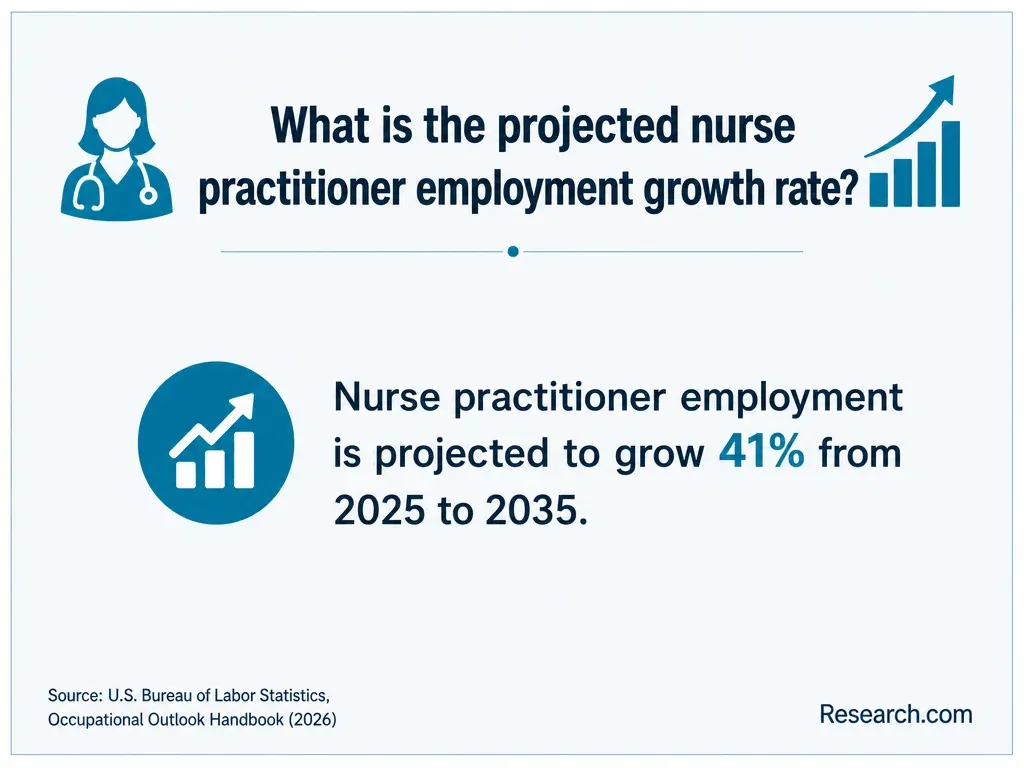
National BLS projections for nurse practitioners indicate growth in the broader occupation, but they do not isolate adult-gerontology primary care positions or predict openings in a particular Kentucky community. Demand for chronic-condition management and care for older adults makes the specialty relevant; actual hiring still depends on local practice needs, employer preferences, and a candidate's clinical fit.
Test demand before choosing a track: review Kentucky postings for the required certification, patient age range, experience, schedule, and location. Some positions accept several NP population certifications; others specify one. A mental-health-focused position may call for PMHNP preparation instead, so comparing budget-friendly psychiatric NP programs is relevant only if that is the role you intend to pursue - not as a substitute for AGPCNP training.
The strongest enrollment decision connects a verified AGPCNP pathway to the kinds of vacancies where you are willing to work, rather than relying on national NP growth alone.
Other Things You Should Know About Nursing
Not solely on the basis of a Kentucky license. Confirm the patient's location and that state's APRN practice and telehealth requirements before providing care.
No. Prescribing authority depends on applicable state law, the APRN's authorization, federal registration when required, and employer policies.
Only with appropriate organizational permission and privacy safeguards. The school and site must determine what data access and quality-improvement or research oversight the project requires.
Yes. Check both the certifier's renewal rules and Kentucky's APRN renewal requirements; maintaining one credential does not automatically renew the other.
- NCSBN/Compact License | ky.gov https://kbn.ky.gov/Licensure/Pages/nurse-licensure-compact.aspx
- DNP Admissions | College of Nursing | University of Kentucky https://nursing.uky.edu/graduate-programs/dnp/apply
- How AGPCNPs Provide Specialized Care for Older Adults | Nebraska Methodist College https://blog.methodistcollege.edu/how-agpcnps-provide-specialized-care-for-older-adults
- Adult-Gerontology Primary Care Nurse Practitioner Postgraduate Certificate | Purdue Global https://www.purdueglobal.edu/degree-programs/nursing/adult-gerontology-nurse-practitioner-certificate/
- Doctorate of Nursing Practice (BSN-DNP) | kysu.edu https://www.kysu.edu/academics/dist-ed/programs/bsn-to-dnp.php
- DNP: Adult-Gerontological Primary Care Nurse Practitioner | jhu.edu https://nursing.jhu.edu/programs/doctoral/msn-dnp/dnp-adult-primary/
- DNP - KYSU Online - Kentucky State University https://online.kysu.edu/programs/dnp
- Identifying Preceptors and Clinical Sites | Frontier Nursing University https://frontier.edu/identifying-preceptors-clinical-sites/
- Inside Penn Nursing's adult-gerontology programs | upenn.edu https://penntoday.upenn.edu/news/inside-penn-nursings-adult-gerontology-programs
- Adult-Gerontology Primary Care Nurse Practitioner DNP | University of Cincinnati https://www.nursing.uc.edu/academic-programs/dnp/adult-gerontology-primary-care.html