2027 Content Moderation Capstones: What to Look for in a Data Science Master's

Co-Founder and Chief Data Scientist
A content moderation capstone can show whether a data science master's program prepares you to work on real trust-and-safety problems - or merely gives you a model-building assignment. If you want to study harmful-content detection, appeals, or human review systems, the deciding factors are access to appropriate data, sound evaluation, and room to address privacy and policy trade-offs.
This guide explains what a credible project looks like and how to check whether a program can support one before you enroll.
Key Things You Should Know
- Look for a capstone that evaluates moderation decisions in context, including false positives, missed harms, human review, and policy changes - not just model accuracy.
- Confirm data access and permission to publish portfolio artifacts before choosing a sponsor; real platform data may be confidential or unsafe to share.
- The U.S. Bureau of Labor Statistics projects 35% growth in data scientist employment from 2025 to 2035, but that occupation-wide forecast does not measure demand for content moderation specialists.
What is a data science master's capstone project?
A capstone is a culminating project in which students apply methods from their degree to a defined problem and present their results. Its format varies by program: a student might deliver a research report, a working prototype, a client presentation, or some combination. A capstone is not necessarily an internship, and an industry partner is not necessarily required.
In content moderation, the project could assess a system that flags potentially abusive posts for review, estimates which appeals need urgent attention, or helps reviewers find relevant policy language. The strongest framing starts with a decision a moderation team actually makes. "Classify toxic text" is a starting task; "prioritize posts for human review while limiting incorrect removals" is a clearer operational problem.
What should a data science capstone project include?
A strong content moderation capstone connects its technical result to a policy and a workflow. The table distinguishes useful project components from a model demonstration that may look impressive but reveal little about real-world performance.
| Component | What a credible capstone demonstrates |
| Problem and policy | A defined content category, decision point, and explanation of how the applicable policy shapes labels. |
| Data provenance | Permission to use the material, a documented sampling process, and safeguards for personal or disturbing content. |
| Methods | A defensible baseline and an approach suited to the available data, which might include text classification, information retrieval, or human-in-the-loop prioritization. |
| Evaluation | Results beyond overall accuracy, including missed harmful content, incorrect flags, and performance on relevant subgroups or changing language. |
| Implementation | A plausible reviewer workflow, monitoring plan, or prototype rather than an unsupported claim of automated enforcement. |
| Reproducibility | Code, documentation, and appropriately shareable outputs that another authorized person could inspect. |
Moderation labels can be subjective, and harmful examples may be rare or context-dependent. A project should state who assigned labels, how disagreements were resolved, and whether its test data resembles the content a system would encounter. Precision and recall matter differently depending on whether the system recommends human review or removes content; neither metric alone establishes that a system is fair or safe.
A useful warning sign is a project built entirely around a public "toxicity" dataset with no discussion of its label definitions, permitted uses, or relevance to the intended policy. A smaller, well-documented study with a defensible baseline can be more valuable than a complex model evaluated on unsuitable data.
How do capstone projects prepare data science master's students for careers?
A well-run capstone gives students evidence of skills that are hard to show through coursework alone: turning an ambiguous request into a measurable question, explaining error trade-offs, working with stakeholders, and documenting limitations. For trust-and-safety work, the ability to explain why a system should escalate rather than automatically act can be as important as improving its score.
Portfolio value depends on what the student is allowed to disclose. If a sponsor's data and results are confidential, ask whether you can publish a sanitized problem statement, synthetic demonstration, evaluation methodology, or code that does not reveal protected information. Choose a project with a clear public-facing artifact if you need evidence for a job search; choose a confidential sponsor project if access to a realistic workflow is more important and you understand the disclosure limits.
A capstone can strengthen an application for data scientist, machine learning, or trust-and-safety analytics roles. It does not, by itself, establish production engineering experience or guarantee access to a moderation role.
Which data science master's programs offer industry-sponsored capstones?
Programs differ in whether they require a capstone, arrange external partners, allow students to propose sponsors, or offer only faculty-led projects. A published description of "industry projects" does not establish that a content moderation sponsor will be available in your term. Without a current program agreement or project roster, no particular school should be treated as a confirmed source of a trust-and-safety capstone.
Ask each program for recent project examples and a direct explanation of how sponsorship works. The answers should distinguish guaranteed access to a partner from an opportunity to compete for one. For this topic, sponsor quality also depends on whether the partner can provide legally usable data, a policy contact, and a way to evaluate the work without exposing reviewers or users to unnecessary harm.
If your main interest is building general-purpose generative AI rather than studying moderation decisions, compare the data science curriculum with AI degree programs for online students. The better choice is the program that supports the project and methods you actually want to pursue, not the one with the more appealing degree title.
How do online and campus-based data science capstones differ?
Neither format inherently produces a stronger moderation project. Online students may collaborate with a sponsor and teammates remotely; campus-based students may have more opportunities for in-person meetings. What matters is the program's actual process for securing a project, obtaining data, supervising group work, and presenting results.
For an online program, check whether sponsor meetings or presentations must occur live, whether teammates span time zones, and how restricted data can be accessed off campus. For a campus-based program, ask whether attendance at partner meetings or use of a particular lab is required. If you work full time, a predictable remote workflow may be the better fit; if a potential sponsor requires controlled, on-site data access, campus resources may matter more. Confirm these arrangements with the program rather than inferring them from the delivery label.
What coursework prepares students for data science capstones?
Preparation for content moderation spans statistics, machine learning, data management, and responsible data use. Natural language processing is relevant for text-heavy projects, while image or video work may require computer vision. Courses in experimental design and evaluation help students distinguish a promising prototype from a result that holds up under changing content and policies.
Inspect syllabi or course descriptions for substantial assignments, not just mentions of responsible AI. Useful preparation includes handling imbalanced labels, comparing models against baselines, auditing error patterns, and documenting data lineage. If the capstone involves continuously arriving content, review data engineering content in AI master's programs as a comparison point for pipelines and monitoring; verify the corresponding depth in any data science program you consider.
A student interested in moderation policy analysis may benefit more from causal inference and human-centered evaluation than from an additional advanced modeling elective. Match coursework to the decision your proposed project must support.
What admission requirements apply to data science master's programs?
Requirements vary by institution. Programs may ask applicants to demonstrate preparation in programming, statistics, linear algebra, or calculus, but the accepted courses and evidence are program-specific. Prior moderation or trust-and-safety employment should not be assumed to be an admissions requirement.
If your background is in policy, communications, or operations, identify any formal quantitative prerequisites separately from skills you could strengthen before the capstone. An application project about content policy can demonstrate motivation, but it does not automatically satisfy a required math course. Application materials vary as well; if an essay is a concern, information about finding machine learning master's programs without essays may help you frame questions for admissions offices, but confirm the current rules of each data science program directly.
How much do data science master's programs cost and how long do they take?
There is no reliable single price or completion time for a data science master's program. Tuition may be charged by credit or term, and total expense depends on required credits, fees, residency rules, enrollment pace, and any travel or campus requirements. Request a current, program-specific estimate rather than comparing one school's tuition-only figure with another school's full budget.
Capstone scheduling deserves particular attention. Ask whether the project runs in a fixed term, whether earlier courses must be completed first, and what happens if sponsor approval or data access is delayed. Compare published completion paths for your intended pace, including part-time study if you will keep working. Guides to online artificial intelligence master's timelines can provide a neighboring point of comparison, but they do not establish how quickly a data science capstone can be completed.
Include the potential cost of reduced work hours when weighing an intensive schedule against a slower one. A faster path is less attractive if it leaves too little time to secure appropriate data and complete a defensible project.
What careers and salaries can data science master's graduates expect?
Content moderation capstone experience may be relevant to data science, machine learning, trust-and-safety analytics, and policy measurement roles. Job titles and technical expectations vary by employer; a role centered on reviewer operations may require different evidence than one centered on model development.
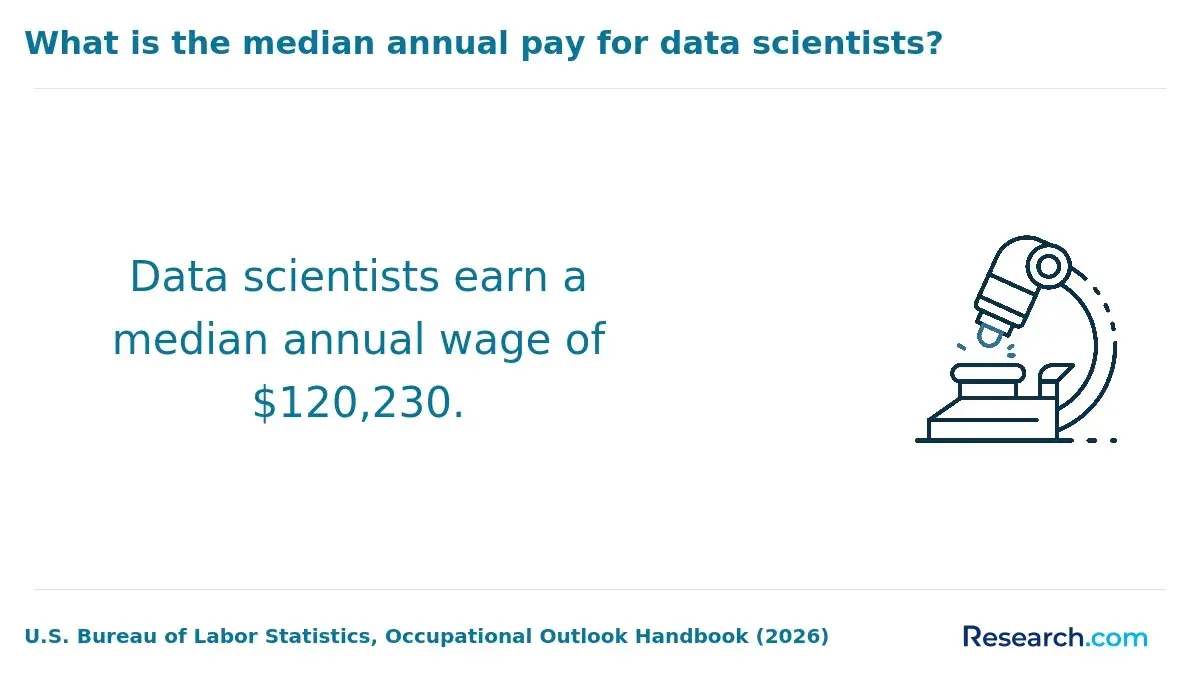
The U.S. Bureau of Labor Statistics reports a $120,230 median annual wage for data scientists in May 2025. That occupation-wide figure is useful context, not a starting-salary prediction for a new graduate or a salary estimate for a content moderation specialist. Experience, location, employer, and the role itself can change the comparison. For broader context when weighing target employers, see data science compensation across industries.
Before treating career outcomes as evidence for a program, ask whether its reports separate new graduates from experienced professionals and identify the jobs included. A capstone should be judged partly by the skills and work samples it enables you to demonstrate, not by an assumed salary increase.
How can students evaluate accredited data science master's programs?
Verify the institution's current accreditation through the accreditor or an official government or institutional listing, then evaluate the capstone separately. Institutional accreditation establishes an important baseline; it does not certify that a program offers a content moderation sponsor, usable data, or specialist supervision.
Before applying, request concrete answers to the questions most likely to determine whether your proposed capstone is feasible:
- Can students propose a content moderation topic or bring their own partner, and who approves the project?
- Which faculty can supervise moderation evaluation, privacy, or human-in-the-loop systems?
- What data-use, ethics review, security, and publication rules apply?
- Can the program share examples of completed projects and explain what those students were permitted to show employers?
Choose the program that can substantiate the support your project needs. If an admissions representative cannot confirm a sponsor or data arrangement, treat it as a possibility - not a promised feature - and have a viable project that uses appropriately licensed data.
Other Things You Should Know About Data Science
No general requirement applies across data science programs. Moderation experience can help you understand policies and reviewer workflows, but research, analytics, software, or related domain experience can also inform a project.
Ownership depends on the university's policies and the sponsor agreement. Ask for the applicable terms before accepting a project, particularly if you hope to publish code or use the result commercially.
It may be possible with qualified collaborators, but you need a credible way to assess meaning, context, and labeling errors. Machine-translated examples alone may not provide that evidence.
No. A simpler classifier, retrieval tool, statistical analysis, or workflow study may be a better match for the question and available data. The method should serve the moderation decision, not determine the project topic.
References
- Ethical Considerations and Data Protection Principles | WHO SMART Trust v1.7.4 https://smart.who.int/trust/ethical_principles.html
- Ethical Considerations for the Use of Social Media in... - PMC https://pmc.ncbi.nlm.nih.gov/articles/PMC12694948/
- Content Moderation Techniques | Value Sensitive Design @ Khoury College https://vsd.ccs.neu.edu/content_moderation/techniques/
- MSDS Capstone Projects - College of Information Science https://infosci.arizona.edu/ms-data-science/capstone-projects
- Capstone Projects - UVA School of Data Science https://datascience.virginia.edu/degrees/info/capstone-projects
- A large-scale audit of dataset licensing and attribution in AI | Nature Index https://www.nature.com/articles/s42256-024-00878-8
- Data Science Capstone Experience - Purdue Online https://www.purdue.edu/online/data-science/data-science-capstone-experience/
- Privacy-preserving Moderation of Illegal Online Content | turing.ac.uk https://cetas.turing.ac.uk/publications/privacy-preserving-moderation-illegal-online-content
- MDS Capstone Guidelines | U-M LSA Department of Statistics https://lsa.umich.edu/stats/masters_students/mastersprograms/data-science-masters-program/mdscapstoneguidelines.html
- Applied Data Science (MS) Student Capstone Projects | Bay Path University https://www.baypath.edu/academics/graduate-programs/applied-data-science-ms/student-capstone-projects/