2027 Computer Science Master's Degree Licensure Requirements by State

Co-Founder and Chief Data Scientist
A computer science master's degree can strengthen a technical career, but it does not automatically answer the harder regulatory question: whether a state requires licensure, certification, supervised experience, exams, or continuing education for the work you want to perform. This matters most for professionals moving into regulated consulting, government contracting, software engineering roles tied to public safety, cybersecurity work, or positions where employers ask for formal credentials beyond a degree.
Computer science is not licensed as uniformly as medicine, law, or traditional engineering. Recent data shows that only 27% of states have formal licensing or registration for computer science professionals, which can make credential planning confusing for graduate students, career changers, and early-career technologists. Requirements may depend on the state, job function, employer, project type, and whether the role overlaps with engineering, security, data governance, or public-sector systems.
This guide explains how computer science master's degree licensure requirements can differ by state, including education rules, coursework expectations, supervised hours, ethics standards, accreditation, exams, reciprocity, fees, continuing education, and specialty certifications. Use it as a planning framework, then confirm details with the appropriate state board before enrolling in a program, applying for licensure, accepting regulated work, or relocating.
Key Things to Know About Computer Science Master's Degree Licensure Requirements by State
- States vary in educational prerequisites, often requiring regionally accredited master's programs or specific coursework aligning with state standards for computer science licensure.
- Required supervised professional experience hours differ widely, with some states mandating up to 2,000 hours of industry-related practice before licensure.
- Licensure maintenance includes passing state-specific exams, completing tailored application procedures, and fulfilling continuing education credits, which can range from 10 to 40 hours annually.
Which States Require a Computer Science Master's Degree for Licensure?
Some states treat graduate education as a key eligibility requirement for computer science-related licensure, especially when the work involves advanced software systems, regulated consulting, public infrastructure, cybersecurity, or engineering-adjacent practice. Data shows that about 40% of states require graduate-level education as the minimum qualification in computer science-related fields. In these jurisdictions, a bachelor's degree alone may not be enough for full licensure, even if the applicant has substantial work experience.
The following states are commonly identified as requiring a master's degree or equivalent graduate preparation for licensure eligibility:
- California: Applicants need a master's degree in computer science or a closely related discipline. Before applying, candidates should confirm whether the program's curriculum, accreditation, and transcript documentation meet the licensing board's standards.
- New York: A master's degree in computer science is mandatory, although the state may consider equivalent graduate-level study in some cases. Applicants should verify program recognition before assuming their degree will satisfy the requirement.
- Texas: Candidates must complete a master's program focused on computer science or software engineering. Because accreditation and course content can matter, applicants should review state expectations before selecting a graduate program.
- Illinois: The licensing board requires a master's degree that includes both theoretical and applied computer science coursework. Early transcript review can help candidates avoid missing required content areas.
- Virginia: Applicants must hold a master's degree with attention to research components in the curriculum. Candidates should make sure their program documents graduate research, advanced technical study, and state-defined content standards.
If you are still building the academic foundation for graduate study, an online bachelor's degree in computer science may be a practical first step, but licensure-focused students should plan backward from the state where they expect to practice. The safest approach is to contact the licensing authority before enrolling, ask whether the degree must be from a specific type of accredited institution, and keep copies of syllabi, transcripts, and program descriptions.
Prospective licensees should also remember that a degree requirement is only one part of eligibility. Some states may also require exams, supervised experience, ethics review, fees, background checks, continuing education, or proof that the applicant's program meets state-defined technical standards. Students comparing graduate pathways can also review best online degrees while evaluating whether a program aligns with licensure goals.
What Coursework Is Typically Required for Computer Science Licensure in Different States?
Coursework requirements vary by state, but licensing boards generally look for evidence that a master's program covers advanced theory, applied software practice, systems knowledge, security, and professional responsibility. According to data from the National Center for Education Statistics, over 80% of states require at least five core advanced courses to ensure foundational knowledge and practical skills.
Applicants should not assume that a program title alone is enough. A master's degree labeled “computer science” may still be questioned if the transcript lacks required technical areas, if too many courses are managerial rather than computational, or if the curriculum does not document graduate-level rigor.
- Advanced Algorithms and Data Structures: This course develops the ability to analyze complex problems, design efficient algorithms, and evaluate trade-offs in performance, memory, scalability, and reliability. Licensing boards may view it as evidence of strong computational reasoning.
- Software Engineering Principles: Coursework in software engineering shows that candidates understand development lifecycles, requirements analysis, testing, quality assurance, maintainability, documentation, and project risk. This is especially important for professionals working on systems used by clients, agencies, or the public.
- Computer Systems Architecture: Systems architecture coursework demonstrates knowledge of hardware, operating systems, networks, memory, and the interaction between software and computing infrastructure. This background can matter in performance-sensitive or safety-sensitive environments.
- Machine Learning and Artificial Intelligence: AI and machine learning courses help candidates understand modeling, data preparation, algorithmic limitations, validation, bias, and responsible deployment. These topics are increasingly relevant where automated systems affect business, health, finance, security, or public services.
- Cybersecurity Fundamentals: Cybersecurity coursework covers risk assessment, encryption, secure design, access control, vulnerability management, and incident prevention. Boards and employers may weigh this training heavily for roles involving protected systems or sensitive data.
Many states also expect ethics or professional practice coursework. This may include privacy, data governance, intellectual property, responsible AI, conflicts of interest, secure handling of client information, and the limits of professional competence. These courses are not filler; they help show that the applicant can apply technical judgment responsibly.
Before applying for licensure, candidates should compare their transcripts against the state's published requirements and request course descriptions from the university if needed. Students considering further academic pathways can also review cheapest phd programs when weighing long-term education costs, but doctoral study should not be treated as a substitute for checking licensure-specific master's coursework rules.

How Many Supervised Hours Are Required for Computer Science Licensure?
Supervised experience requirements differ by state, but candidates are often expected to document structured practice before receiving full licensure. Typically, candidates must complete between 1,000 and 2,000 supervised hours to demonstrate sufficient hands-on experience before licensure. The purpose is not simply to accumulate time; it is to show that the applicant can apply advanced computer science knowledge in professional settings with appropriate oversight.
States may define qualifying supervised experience differently, so applicants should ask what counts before starting an internship, practicum, employment placement, or mentored project. In some cases, hours may need to be completed under a licensed professional, approved supervisor, employer sponsor, or board-recognized mentor.
- Practicum Hours: Generally spanning 300 to 600 hours, a practicum usually involves structured technical assignments under close review. These hours may focus on applying graduate coursework to controlled projects, documented deliverables, and supervised problem-solving.
- Internship Hours: Around 500 to 1,000 hours may be completed in corporate, government, nonprofit, or research environments. These placements expose candidates to production systems, team workflows, compliance expectations, deadlines, and real stakeholder needs.
- Mentored Projects: Approximately 200 hours may involve guided work with a licensed or otherwise approved professional. These projects often emphasize judgment, risk analysis, documentation, professional communication, and ethical decision-making.
- Supervised Coding Time: This category includes over 200 hours focused on code quality, testing, review practices, security, maintainability, and professional standards. Candidates should keep evidence of reviews, project scope, and supervisor feedback.
- Client or User Interaction Hours: Usually 100 to 300 hours involve direct work with users, clients, product owners, or stakeholders. These hours help demonstrate communication skills, requirements gathering, expectation management, and accountability.
Good documentation is critical. Applicants should track dates, hours, project descriptions, supervisor names, supervisor credentials, technologies used, and learning outcomes. Waiting until the end of a placement to reconstruct this information can create delays or disqualify otherwise valid experience.
When discussing how many supervised hours are required for computer science licensure, one professional who completed a master's degree described the process as demanding but useful. He explained that the practicum and internships were not just about “clocking hours,” but about learning how technical decisions affect users, clients, security, and long-term system reliability. He found the mentorship component especially valuable because it introduced ethical and professional issues that were difficult to understand from coursework alone.
What Ethical Standards Must Computer Science License Applicants Meet?
Ethical standards are central to licensure because computer science professionals often work with sensitive data, automated systems, security controls, infrastructure, and software that can affect real users. Surveys indicate that nearly 85% of licensing boards include formal ethics evaluations in the application process. These evaluations may appear as attestations, coursework requirements, exam content, background questions, professional references, or disciplinary disclosures.
Applicants should expect to show that they understand both technical competence and professional responsibility. The most common ethical standards include:
- Integrity: Applicants must provide truthful information throughout the licensing process. This includes accurate transcripts, work history, supervised hours, exam records, disciplinary disclosures, and employment documentation.
- Confidentiality: Licensees are expected to protect sensitive, proprietary, personal, and regulated information. This standard applies to source code, client data, system credentials, business information, health records, financial records, and user data.
- Conflict of interest avoidance: Professionals must disclose personal, financial, employment, or vendor relationships that could affect objective judgment. This is especially important in consulting, procurement, security audits, and system evaluation.
- Professional responsibility: Applicants must agree to follow applicable laws, state regulations, client obligations, security requirements, and professional standards. They should not accept work beyond their competence without appropriate support or supervision.
- Accountability: Licensees are responsible for their professional actions and may be required to cooperate with licensing boards during audits, complaints, or ethics investigations.
Ethics requirements are not limited to avoiding misconduct. They also shape how professionals document work, communicate risk, report vulnerabilities, protect users, and explain limitations in models, software, or systems. For graduate students comparing technical education costs, resources such as cheapest engineering degree online can be useful for broader budgeting research, but licensure applicants should prioritize programs that address ethics directly and clearly.
Do All States Require an Accredited Computer Science Program for Licensure?
No. Accreditation requirements are important, but they are not identical in every state. Approximately 75% of states require regional or programmatic accreditation to verify that an applicant's education meets regulatory standards. Other states may review degrees more flexibly, but applicants should not assume an unaccredited or poorly documented program will be accepted.
Accreditation matters because it gives licensing boards a way to evaluate institutional quality, curriculum controls, faculty standards, assessment practices, and academic legitimacy. It can also affect transfer credit, employer recognition, financial aid eligibility, and admission to further graduate study.
- Regional Accreditation: Many boards prefer or require degrees from regionally accredited institutions. Applicants should verify the school's accreditation status for the period when they attended, not just its current marketing language.
- Programmatic Accreditation: Some states may require or strongly prefer program-level accreditation such as ABET. Programmatic accreditation focuses more directly on curriculum, faculty qualifications, outcomes, resources, and discipline-specific standards.
- State Variability: Accreditation rules differ by jurisdiction. One state may accept a regionally accredited master's program, while another may ask for programmatic accreditation, course-by-course review, or additional documentation.
- Accreditation Changes: Accreditation status can change. Students should monitor their program's standing before enrollment, during the program, and before licensure application, especially if the school is undergoing review, restructuring, or ownership changes.
- Documentation Requirements: Licensing applications often require official transcripts, accreditation verification, catalog descriptions, syllabi, or letters from the institution. Gathering these materials early can prevent processing delays.
A practical way to reduce risk is to ask the state board three direct questions before enrolling: whether institutional accreditation is required, whether programmatic accreditation is required, and whether online or hybrid coursework is evaluated differently from on-campus coursework. Keep the board's response with your application records.
One computer science master's graduate described accreditation review as one of the most confusing parts of the licensure process. She contacted multiple boards, compared accepted accrediting bodies, and gathered detailed documentation from her university. Although the process took time, she said it prevented avoidable setbacks and helped her feel more confident that her degree would support her intended career path.
Do All States Require the Same Computer Science Licensing Exam?
No. Licensing exams and passing standards are not uniform across states. About 60% of states administer a nationally recognized exam, such as an adapted Fundamentals of Engineering (FE) test, while the remaining states use customized exams aligned with local laws, industry expectations, or regulatory priorities.
Applicants should identify the correct exam early because preparation strategy depends on the format, scope, and scoring rules. An exam that emphasizes theory will require a different study plan than one focused on applied software engineering, cybersecurity, ethics, or jurisdiction-specific regulations.
- Exam Type: Some states use broad national exams that test foundational computer science or engineering-adjacent knowledge. Others require state-specific exams that may include local professional rules, regulatory obligations, and applied technical scenarios.
- Competency Areas: Exam content can include algorithms, data structures, software engineering, systems architecture, cybersecurity, database systems, professional ethics, documentation, risk analysis, and problem-solving.
- Passing Scores: Minimum passing criteria vary. Certain states require scores exceeding 70%, whereas others set acceptable results at 60% or above. Candidates should verify the passing standard for the exact exam and jurisdiction.
- Exam Format: Formats may include multiple-choice questions, written responses, case analysis, coding tasks, design problems, or scenario-based professional judgment questions.
- Renewal and Recertification: Some states require ongoing testing or supplementary evaluations after initial licensure. These requirements may be tied to renewal, disciplinary remediation, scope expansion, or changes in state law.
Common mistakes include preparing for the wrong exam, missing registration deadlines, overlooking identification rules, assuming one state's passing score applies elsewhere, or failing to request accommodations on time. Candidates should use the licensing board's current exam bulletin rather than relying only on university advice or informal online forums.
Does Computer Science Licensure Transfer Between States?
Computer science licensure does not always transfer automatically between states. Less than 40% of states have formal reciprocity agreements recognizing licenses from other jurisdictions. As a result, professionals who relocate, consult across state lines, or work remotely for clients in multiple states may need to complete additional review before practicing under a regulated title or credential.
Reciprocity can be especially important for consultants, government contractors, cybersecurity specialists, software engineers working on regulated systems, and professionals whose work overlaps with engineering or public-sector infrastructure. Before accepting cross-state work, confirm where the work is legally considered to occur and which state's rules apply.
- Reciprocity Agreements: Reciprocity agreements allow one state to recognize another state's license, but the recognition may be limited. Some states still require an application, fee, background check, ethics attestation, or board review.
- State-Specific Standards: States may define scope of practice, supervised experience, educational requirements, exams, and professional conduct differently. A license in one state may not prove that all standards have been met in another.
- Verification Processes: Many boards require official verification that the original license is active, valid, and free from discipline. This step can take time, so applicants should start before a planned move or contract start date.
- License Endorsement: Some states offer endorsement rather than full reciprocity. Endorsement may permit limited practice or simplify review, but it is not always the same as unrestricted licensure.
- Duration Limits: Certain states allow temporary practice for a limited period before full state licensure is required. This can affect short-term projects, remote consulting, or transitional employment after relocation.
The best strategy is to create a licensure mobility file that includes transcripts, course descriptions, exam results, supervised hours, license verification, continuing education records, ethics disclosures, and employment documentation. Having these materials ready can shorten the review process if you apply in another state.
How Much Does Computer Science Licensure Typically Cost?
Computer science licensure costs vary widely by state and by application pathway. Across many states, total expenses can range from around $50 to several hundred dollars, depending on whether the applicant must pay for application processing, exams, background checks, initial license issuance, renewals, or continuing education. These costs are usually separate from tuition, textbooks, graduation fees, transcript fees, and professional association costs.
Applicants should build a realistic licensure budget before graduation. The lowest advertised fee may cover only the application, not the full process. Common cost categories include:
- Application fees: These fees cover initial processing and board review. They may be nonrefundable even if the applicant is later found ineligible.
- Examination fees: Some states require one or more exams. Fees may cover test registration, administration, scoring, retake attempts, or third-party testing services.
- Background check fees: Many jurisdictions require identity verification, fingerprinting, or criminal record screening. Processing times and costs can vary by state.
- Initial license fees: After approval, applicants may pay a separate fee for license issuance. The cost may depend on license type, timing within the renewal cycle, or practitioner category.
- Renewal fees: Licenses often require periodic renewal. Renewal costs may include board fees, late fees, continuing education costs, and documentation expenses.
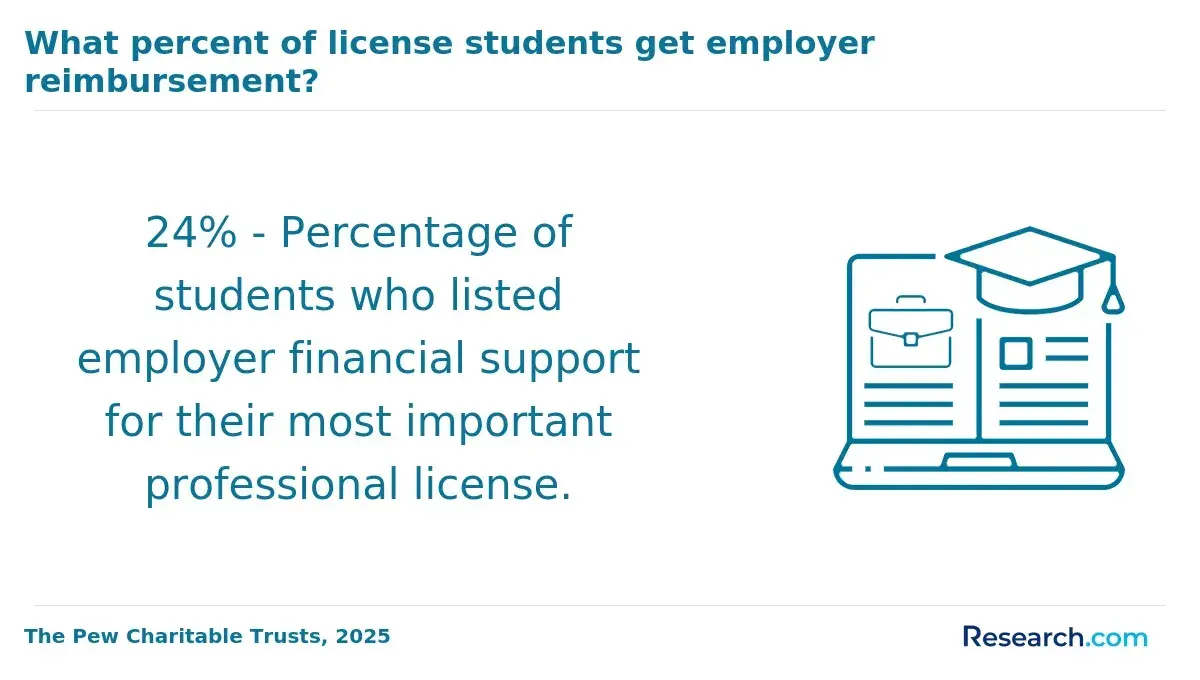
To avoid surprises, ask the licensing board for the complete fee schedule and note which costs are one-time, recurring, optional, or triggered by delays. If your employer benefits from your credential, it may be reasonable to ask whether the organization reimburses exam fees, continuing education, license renewal, or professional development.
Licensure cost should also be evaluated alongside career goals. Graduates of online computer science master's programs may use the credential to pursue roles in technology and software development firms, financial services, healthcare technology, government agencies, and consulting firms. According to the National Center for Education Statistics, employment in computer and information technology occupations is projected to grow 13% from 2020 to 2030, reflecting strong demand. That projection does not guarantee individual outcomes, but it helps explain why some professionals view licensure costs as part of a broader career investment.
Students comparing graduate expenses across fields may also review resources such as marriage and family masters programs for general insight into tuition planning, aid considerations, and cost comparison methods. However, computer science licensure applicants should rely on their own state board for exact fee requirements.
Do CE Requirements Differ by State for Computer Science Professionals?
Yes. Continuing education (CE) requirements differ by state, including the number of hours, accepted course topics, delivery formats, documentation rules, and renewal timelines. Typically, computer science professionals must complete between 20 and 40 CE hours per renewal cycle, although states may set different minimums or subject-specific mandates.
CE exists to help licensed professionals stay current as technology, security threats, regulations, and professional standards change. For computer science professionals, continuing education may be especially relevant in cybersecurity, AI governance, data privacy, software reliability, cloud infrastructure, and ethics.
- Required CE Hours: States mandate anywhere from 12 to 40 CE hours per renewal cycle. The renewal cycle, usually one to two years, affects how quickly those hours must be completed.
- Subject Mandates: Some states require coursework in cybersecurity, ethics, emerging technologies, privacy, or professional responsibility. Applicants should check whether general technical training counts or whether courses must match approved subject categories.
- Delivery Format: Some states accept fully online courses, while others require in-person workshops, live instruction, or board-approved providers. Professionals with remote or demanding work schedules should confirm delivery rules early.
- Reporting and Verification: Professionals may need to submit CE certificates at renewal or retain records for random audits. Failure to document CE can lead to renewal delays, suspension, or revocation.
- Renewal Cycle Length: Renewal periods differ by state, ranging from annual to biennial. Shorter renewal cycles may require more frequent tracking and reporting.
A practical CE system is simple: maintain a folder with certificates, dates, provider names, course descriptions, credit hours, and proof of completion. Do not rely on a provider to keep your records indefinitely. Professionals who prefer flexible learning formats may find it useful to compare how other online programs structure asynchronous coursework, including options such as an accelerated online construction management degree, but CE compliance must always follow the rules of the computer science licensing authority.
Are There Specialty Certifications Required for Advanced Computer Science Practice?
Specialty certifications are usually not the same as state licensure. A master's degree and state licensure may establish legal or regulatory eligibility to practice in certain roles, while specialty certifications demonstrate focused expertise in areas such as cybersecurity, project leadership, cloud platforms, data systems, or software engineering. These credentials can strengthen a résumé, satisfy employer preferences, or support advancement, but they generally do not replace licensure when licensure is required.
The relationship between specialty credentials and licensure depends on the state, employer, contract, and job function. In some advanced roles, a certification may be effectively required by an employer or client even if it is not required by statute.
- Certified Information Systems Security Professional (CISSP): This certification is optional and complements state licensure by validating cybersecurity expertise. It is especially valued in government and private-sector security roles, but it is not a universal licensure requirement.
- Project Management Professional (PMP): PMP certification demonstrates project leadership and management capability in software, systems, and technical initiatives. It may help professionals move into leadership roles, but it does not replace state licensure or technical eligibility rules.
- Licensed Professional Engineer (PE) in Software Engineering: Required in only a few states, this credential may represent a formal advanced license beyond a master's degree. Where available, it can involve specialty exams and statutory requirements, but it is not universally mandated for computer science professionals.
Before investing in a specialty certification, compare three things: whether the credential is legally required, whether employers in your target role request it, and whether it offers a clear return in credibility, compensation potential, client access, or promotion opportunities. Avoid collecting certifications without a role-specific reason.
What Graduates Say About Computer Science Master's Degree Licensure Requirements by State
- Benny: "Choosing a master's degree in computer science was a strategic move for me to meet licensure requirements in California, where the demand for specialized knowledge is high. The financial investment was considerable, but scholarships and employer support eased the burden. Ultimately, the degree significantly boosted my credibility and opened doors to leadership roles in the tech industry."
- Greyson: "Reflecting on my journey in Texas, earning a master's in computer science was essential for obtaining my professional license, given the state's emphasis on advanced technical competency. Although the cost of certification and coursework was steep, the long-term career growth it enabled made it worthwhile. This path helped me gain recognition as an expert and secure projects I hadn't imagined before."
- Cooper: "When I pursued licensure in New York, the choice to complete a computer science master's degree was driven by both passion and professional necessity. The expenses associated with coursework and exam fees were manageable compared to the benefits of licensure in such a competitive market. Earning my license after the degree was pivotal in establishing trust with clients and advancing my consultancy career."
Other Things You Should Know About Computer Science Degrees
In 2027, foreign-educated computer science graduates seeking licensure must have their academic credentials evaluated by an approved agency to ensure equivalency with U.S. standards. Additionally, proficiency in English and passing relevant state exams may be required, depending on the state.
Most states require applicants for computer science licensure to undergo a criminal background check as part of the application process. This is intended to ensure the integrity and trustworthiness of professionals practicing in the field.
Licensure renewal periods vary by state, commonly occurring every one to three years. License holders must check their specific state board requirements to meet renewal deadlines and maintain active status.
References
- Getting a Masters in computer science but I am without any undergraduate degree https://academia.stackexchange.com/questions/59387/getting-a-masters-in-computer-science-but-i-am-without-any-undergraduate-degree
- Computer Science Endorsement Program https://online.csuohio.edu/online-programs-and-courses-online-graduate-programs/computer-science-endorsement-program
- Is Continuing Education Necessary for an IT Professional? - Computer Science Degree Hub https://www.computersciencedegreehub.com/faq/continuing-education-professional/
- What certifications should I get for computer science? | edX https://www.edx.org/resources/certifications-computer-science
- How to Become a Software Engineer - Time & Steps Required https://www.onlineengineeringprograms.com/faq/how-do-i-become-a-software-engineer
- What Can You Do With a Master of Computer Science? | MCS@Rice https://csweb.rice.edu/academics/graduate-programs/online-mcs/careers
- Computer Science - University College of Enterprise and Administration https://en.wspa.pl/computer-science-graduate-program/
- How Much is a Computer Science Course? https://www.nobledesktop.com/learn/computer-science/how-much-is-a-computer-science-course
- Master’s Degree in Computer Science – Earn a Masters in Computer Science or Join a Top Computer Science Graduate Program at UT San Antonio https://future.utsa.edu/programs/master/computer-science/
- Make the Career Switch to Tech with a Master of Computer Science from Concordia University Texas https://www.concordia.edu/blog/make-career-switch-to-tech.html