2027 Choosing Public Health BS Coursework for Community Mental Health Prevention Programs

Co-Founder and Chief Data Scientist
A public health BS can prepare you to help prevent mental health problems in communities, but a course labeled "mental health" is not enough on its own. Effective prevention work also requires skills in identifying community priorities, designing programs, building trust, and evaluating results.
This guide is for students choosing courses or comparing bachelor's programs with that work in mind. It shows which classes and supervised experiences matter most, what entry-level roles they support, and when another educational pathway would fit better.
Key Things You Should Know
- Prioritize epidemiology, behavioral and social sciences, program planning, evaluation, and community-engaged fieldwork over a mental health elective taken in isolation.
- A public health BS supports population-level prevention work; it does not qualify a graduate to diagnose conditions or provide licensed psychotherapy.
- Compare the full degree audit and placement requirements, not just course titles: a conventional bachelor's degree commonly requires about 120 semester credits, but transfer decisions and program requirements determine your remaining time and cost.
What is a public health BS for community mental health prevention programs?
It is a bachelor of science curriculum used to prepare for population-level prevention: understanding factors that affect mental well-being and helping communities plan, deliver, and assess supportive programs. Examples include school-based prevention partnerships, stigma-reduction efforts, and initiatives that improve access to community resources. The work concerns groups and systems, not the diagnosis or treatment of an individual patient.
A BS may emphasize science and quantitative coursework, but degree labels vary. Check the actual catalog rather than assuming a BS includes a mental health concentration or more statistics than a BA. If your long-term goal is specialized public health leadership or research, comparing specialization fit across public health master's degrees can help you decide whether to build toward graduate study. If your goal is psychotherapy, investigate a licensure-qualifying clinical pathway instead.
Which public health BS courses prepare students for mental health prevention?
The strongest course combination connects evidence about mental health needs to an intervention a community could realistically use. The following subjects serve different purposes; a course title alone does not establish how deeply a program teaches them.
| Course area | Contribution to prevention work | What to look for in the syllabus |
| Epidemiology and biostatistics | Describe patterns, interpret estimates, and recognize uncertainty | Study design, denominators, data quality, and interpretation - not software alone |
| Social and behavioral sciences | Examine stressors, protective factors, behavior, and social context | Evidence-based frameworks without blaming communities for structural barriers |
| Community health and health communication | Develop messages and partnerships appropriate to an audience | Community input, accessibility, and culturally responsive communication |
| Program planning and evaluation | Connect a defined need to activities and measurable objectives | Logic models, implementation measures, and limitations of outcome data |
| Mental health or substance-use prevention elective | Apply public health methods to the intended setting | Prevention frameworks, referral boundaries, and ethical representation |
For a bachelor's-level prevention role, the aim is sound interpretation and basic evaluation, not independent advanced statistical research. Students who later need deeper quantitative training can consider biostatistics graduate education for employed adults rather than treating one undergraduate methods course as specialist preparation.
What careers can a public health BS lead to in community mental health?
Relevant entry-level openings may include prevention program assistant, community outreach coordinator, health education assistant, or community health worker. Duties can involve arranging workshops, supporting referrals, maintaining partner relationships, collecting approved program data, and preparing reports. Job titles are inconsistent: read the duties and required credentials in each posting.
Health education specialist positions may be accessible with a bachelor's degree, but employers can require particular coursework or experience. Community health worker requirements vary by employer and state.
Evaluation leads, program managers, and independent researchers generally need more experience or advanced preparation. A later practice-focused doctorate is a different decision: a public health doctoral admissions requirements guide is relevant to experienced applicants, not a prerequisite for starting community prevention work.
Before graduation, aim to show an employer what you did under supervision: for example, a redacted outreach plan, an accessible education resource, or an evaluation framework. Describe your contribution accurately and obtain permission before sharing partner materials.
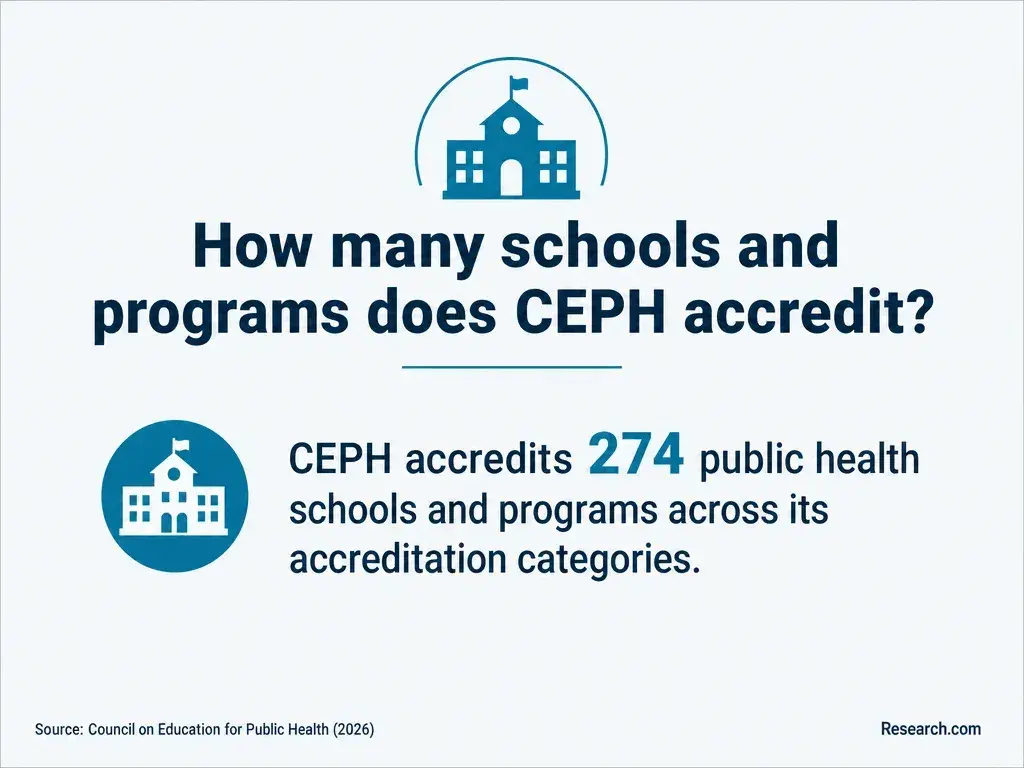
First, confirm that the institution holds recognized institutional accreditation. Then check whether the specific public health bachelor's program is within the Council on Education for Public Health (CEPH) accreditation scope. CEPH accreditation may cover a school, unit, or standalone program; an institution's accreditation or an accredited graduate degree does not automatically establish that its BS is covered.
Use the accreditor's directory and ask the program to identify the accredited entity, the bachelor's degree covered, and the status applicable to your intended enrollment term. Accreditation does not establish that a program offers a mental health elective, a suitable placement, or a particular certification pathway.
The same scope check matters if you later pursue advanced study; public health doctorate program selection involves checking the exact doctoral program rather than relying on a university-wide claim.
Beyond individual course names, examine the sequence and applied work. Foundational statistics and epidemiology should come before an evaluation project; behavioral science and community assessment should inform program design; and an internship or capstone should give you a chance to integrate those skills. A policy course can help you understand how schools, healthcare systems, and public agencies shape access to prevention services.
Ask whether a student can work with a community partner on a feasible deliverable, such as a needs-assessment brief or implementation-monitoring plan. Confirm who approves the site, supervises the work, and permits use of data or work samples. An internship that only involves observation may offer less preparation for program work than one with defined responsibilities and feedback.
Choose the BS for the undergraduate skills you need now, not on the assumption that graduate study is mandatory. If a future job specifically calls for an MPH, compare its added preparation and cost using affordable graduate public health career preparation before committing to that next step.
They can be, provided you can gain supervised community experience and practice collaborating with partners. Online coursework can teach methods and planning, but prevention work also involves listening, coordination, and adapting to a real organization's constraints. Compare online public health undergraduate education options against the same curricular and fieldwork standards you would apply on campus.
Check whether classes are asynchronous, whether group meetings have fixed times, and who secures internship sites. Ask whether a local organization can host your work and whether the school approves remote supervision. An online label does not eliminate placement hours, travel, or scheduled meetings.
Requirements depend on whether you apply as a first-year student, transfer student, or current student declaring the major. A school may admit you to the institution before admitting you to a capacity-limited major. Review its published rules for transcripts, general education, prerequisite courses, minimum grades, and application deadlines.
For transfer study, request a degree audit showing not only which credits are accepted but which satisfy statistics, major, fieldwork, and residency requirements. If you might pursue graduate education later, check that pathway separately; online public health master's entry requirements should not be mistaken for BS admission rules. The receiving institution has final authority over how prior coursework applies to its degree.
A conventional full-time bachelor's pathway often takes about four academic years, while transfer credit, part-time enrollment, course availability, and required fieldwork can change the timeline. Tuition alone is not the total cost: include mandatory fees, books, transportation, and any unpaid placement hours. Request a term-by-term degree plan and a written cost estimate for your enrollment status.
Compare online public health degrees for budget-conscious students using the credits you still need, not an advertised per-credit price by itself. Do not assume a future graduate award will offset today's bachelor's costs.
Population-level prevention jobs do not all require one credential. Some health education positions value or require Certified Health Education Specialist (CHES) eligibility; applicants should check the current certifying organization's coursework and examination rules. A Certified in Public Health (CPH) credential has its own eligibility routes. Neither follows automatically from earning a BS.
Clinical mental health counseling, social work, psychology, and nursing are regulated pathways with education and state-specific licensing requirements. A public health BS - even one with mental health electives - does not authorize diagnosis or psychotherapy. Likewise, comparing fast-paced online public health bachelor's courses may help with scheduling, but a faster course format does not change certification eligibility or clinical licensing rules.
What salaries and job outlook can public health BS graduates expect?
There is no reliable single salary or growth rate for "public health BS graduates." The US Bureau of Labor Statistics reports occupations, not outcomes for a particular degree. Its health education specialist and community health worker profiles are useful starting points, but they represent different duties and qualification patterns; neither occupation-wide median is an entry-level offer for a graduate entering mental health prevention.
For a realistic comparison, identify local postings with prevention-related duties, note their pay ranges and experience requirements, and compare those with the total cost and time of your remaining coursework. Assess whether the program gives you supervised experience for those openings.
If it does not, an internship, targeted training, or an adjacent entry-level role may be more useful than additional electives alone. A public health graduate scholarship eligibility guide addresses a separate degree and its own award conditions.
Other Things You Should Know About Public Health
It can complement prevention coursework, especially for understanding behavior and development. Check whether it leaves room for evaluation methods and fieldwork, which may be more directly useful for your target role.
Yes, if the project is carefully scoped and supervised. A resource review or communication plan may be appropriate; direct participant contact or sensitive data use requires additional permissions and safeguards.
Ask your instructor and data owner first. Consent, privacy, data-use restrictions, and institutional review requirements depend on how the information was collected and what you propose to do with it.
Ask what prevention tasks you would perform, who would supervise you, what deliverable is feasible, and whether the organization can meet your school's approval and confidentiality requirements.
- Learn about student intern program | Behavioral Health Services https://bhsd.santaclaracounty.gov/behavioral-health/learn-about-student-intern-program
- Core Intervention Components: Identifying and... - HHS ASPE https://aspe.hhs.gov/reports/core-intervention-components-identifying-operationalizing-what-makes-programs-work-0
- Social Determinants of Health - Healthy People 2030 - odphp https://odphp.health.gov/healthypeople/priority-areas/social-determinants-health
- Social Determinants of Health | Public Health Infrastructure Center | CDC https://www.cdc.gov/infrastructure/public-health-systems-emerging-practices/social-determinants-of-health.html
- A narrative review of the CEPH-accredited bachelor's public health programs' curricula in the United States | nih.gov https://pmc.ncbi.nlm.nih.gov/articles/PMC11371682/
- Student Opportunities in Public Health | ny.gov https://www.health.ny.gov/prevention/public_health_works/student_opportunities.htm
- Developing a Plan for Assessing Local Needs and Resources | ku.edu https://ctb.ku.edu/en/table-of-contents/assessment/assessing-community-needs-and-resources/develop-a-plan/main
- Bachelor of Science in Public Health | healthstudies | Chicago State University https://www.csu.edu/healthsciandpharm/publichealth/bachelors.htm
- CEPH Requirements - JHU catalogue https://e-catalogue.jhu.edu/public-health/ceph-requirements/
- School-Based Substance Use Disorder (SUD) Prevention Strategies & Programs - Evidence-to-Impact Collaborative https://evidence2impact.psu.edu/resources/school-based-substance-use-disorder-sud-prevention-strategies-programs/