2027 Choosing an Online Ed.D. in Leadership and Learning in Organizations for Leadership in International Development Agencies
Audited and Verified:
Our Editorial and Data Verification Process
Research.com uses government datasets, official education statistics and primary institutional information to support its career and degree guides. Our review process checks factual accuracy, occupational definitions, source dates and the requirements associated with the credentials discussed.
How This Article Was Fact-Checked
Our editorial team verifies salary estimates, employment projections, education requirements and program information against original data providers and official organizations. Salary figures are checked against the relevant occupational definitions and reporting periods. Information about licensure, accreditation and required in-person training is reviewed separately.
Fact-checked and verified on:

Co-Founder and Chief Data Scientist
Leading learning and change across international development agencies takes more than a senior title. Staff development, partner capacity-building, and program improvement all require sound judgment about people, evidence, and implementation. An online Ed.D. in Leadership and Learning in Organizations may help experienced professionals build those capabilities, but it is not a substitute for development-sector expertise. This guide helps US-based agency, nonprofit, and public-sector professionals assess the degree's career fit, compare programs, and decide whether doctoral study is the best next step.
Key Things You Should Know
- An Ed.D. can serve experienced development professionals who want to lead organizational learning, workforce development, or evidence-informed change - not applicants expecting a doctorate alone to open agency leadership roles.
- Look for applied research, adult learning, organizational change, and a feasible project involving a development organization; confirm data access and academic approval before relying on that project.
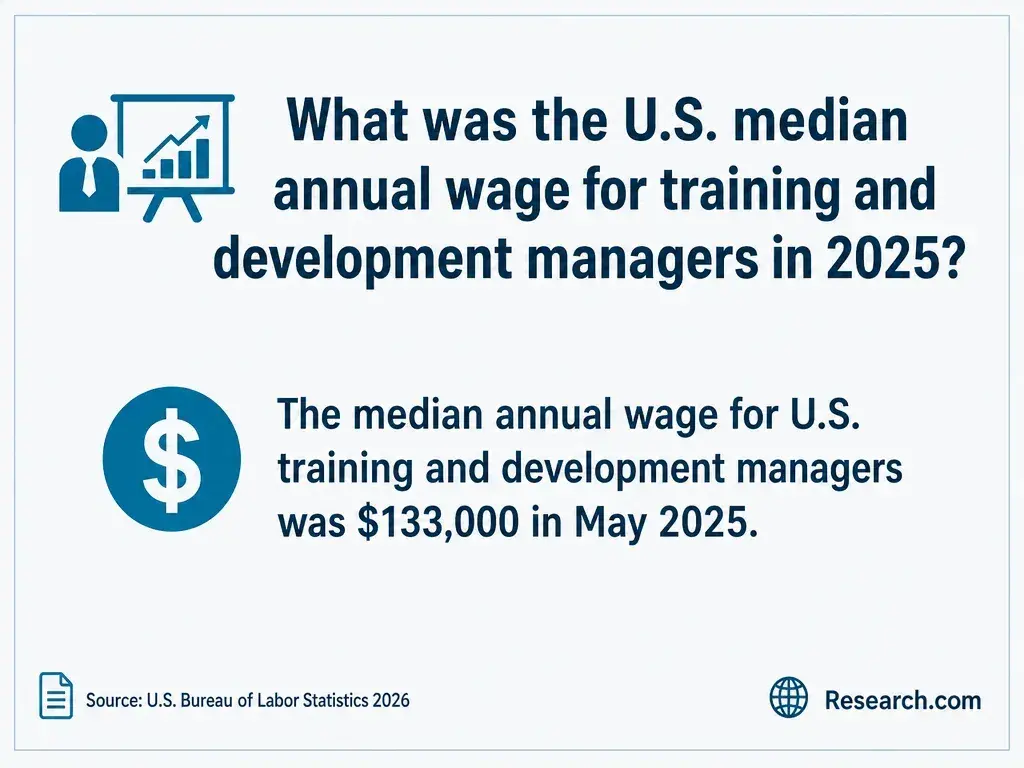
- The US median for training and development managers was $133,000 in 2025, but that occupational figure is not an Ed.D. graduate salary or a forecast for international agency jobs.
What is an online Ed.D. in Leadership and Learning in Organizations?
An Ed.D. is a practice-oriented doctorate. In a leadership and learning program, students typically examine how organizations develop people, use evidence, and implement change. "Online" describes where much of the instruction occurs; it does not necessarily mean self-paced study or no campus visits. The exact award name, curriculum, and completion project depend on the institution.
This focus differs from a doctorate built specifically for school administration. It also differs from a research-oriented PhD, which may better suit someone seeking a career centered on producing academic research.
For a development professional, the strongest fit is usually a program that lets them investigate a real organizational learning or implementation problem while strengthening their leadership practice. Compare understanding different Ed.D. degree formats and focuses before assuming programs with similar titles teach the same skills.
How can this Ed.D. prepare you for international development leadership?
International development agencies work through staff, local partners, funders, and public institutions with different priorities and decision-making authority. An Ed.D. can help a leader diagnose why knowledge is not being used, design professional learning, manage change, and evaluate whether an initiative is being implemented as intended.
Those skills are useful in agency operations and partner support; they do not, by themselves, establish expertise in public health, agriculture, humanitarian response, or another technical field.
For example, a professional responsible for partner training might examine whether staff can apply new guidance in their work, rather than count course completions alone. A doctoral project could inform that decision if the question is appropriately scoped and the organization permits access to relevant information.
Faculty approval, organizational permission, confidentiality protections, and any required ethics review must be resolved separately. A training intervention also cannot fix a problem caused primarily by funding rules, incentives, or governance.
Identify a decision you already influence, the evidence you can legitimately obtain, and the stakeholders who would use the findings. If your immediate gap is technical development expertise or experience managing programs and partners, field assignments, mentoring, or targeted study may be more useful than an Ed.D.
What accreditation should you look for in an online Ed.D. program?
Confirm that the university holds institutional accreditation from an accreditor recognized by the US Department of Education or the Council for Higher Education Accreditation. Check the accreditor's current directory and the university's own listing, including the institution that actually awards the degree. Accreditation applies to the institution within its stated scope; a program's leadership-oriented name does not establish a separate specialized endorsement.
Next, verify the degree designation, delivery format, and any programmatic recognition the school claims. A general organizational leadership Ed.D. need not hold the same specialized accreditation as an educator-preparation program, and institutional accreditation does not mean the degree meets school-administrator licensure requirements.
For international development hiring, also check whether a prospective employer recognizes the credential; academic recognition and qualification for a particular position are different questions.
Course titles vary, but a useful curriculum for agency leadership should connect adult learning and learning transfer with organizational diagnosis, change implementation, and research or evaluation methods.
Quantitative and qualitative methods can help a leader interpret staff feedback and program evidence without claiming more than the data supports. Leadership and ethics coursework should address whose priorities shape decisions - especially when an agency works with local partners.
Review the required sequence rather than the course catalog alone. Ask whether relevant electives are reliably available, whether evaluation is taught through applied assignments, and whether the final requirement is a dissertation, dissertation in practice, capstone, or another approved project. Non-dissertation Ed.D. program options may appeal to applicants seeking a different final deliverable, but "no dissertation" does not mean no substantial research or project work.
If your goal is to manage large grants or specialize in a technical development field, examine what the Ed.D. leaves uncovered. Coursework in learning and change complements those capabilities; it does not automatically provide them.
Programs set their own eligibility rules. Many seek graduate-level preparation and evidence of substantial professional practice, but applicants should verify acceptable degrees, transcripts, grades, references, statements, interviews, and any test policy for their intended entry term. Relevant experience may include leading staff development, partner learning, evaluation, or organizational improvement - not just holding a management title.
Use the application to show a specific problem you have encountered, the decisions you were responsible for, and why doctoral study would improve your practice. Do not imply that you already have permission to study agency staff or partner data unless that permission exists.
Applicants with an Ed.S. or other prior graduate coursework should distinguish credits that support admission from credits the school will actually apply to the doctorate; Ed.S. credit considerations for Ed.D. study can help frame questions for a written program evaluation.
Completion time depends on required credits, course sequencing, enrollment pace, and how long the final project takes. For a working development professional, travel, field assignments, and changing employers can also affect progress. Ask each program for its published time-to-completion rules, leave policy, and what happens if access to a proposed project site ends.
Calculate cost from the school's stated tuition structure and required credits or terms, then add fees, books, technology, any convening travel and lodging, and the cost of time away from paid work. Confirm whether employer assistance is guaranteed, reimbursed only after successful completion, or tied to continued employment. Affordable online doctorates in education are a useful starting point, not a substitute for an individualized written cost estimate.
A sensible financial comparison is the full cost of the Ed.D. against the specific responsibility you hope to take on. If a shorter evaluation course or an employer-sponsored leadership assignment would meet that need, the doctorate may not justify its cost.
Online study can let a professional remain with an agency while studying, but location flexibility is not the same as schedule flexibility. Live seminars, group work, and campus convenings may conflict with field travel or meetings across time zones. A campus-based program may offer easier in-person faculty contact and research collaboration, while requiring a move or a substantial reduction in work commitments.
Compare the actual timetable and research support of specific programs, not just their delivery labels. Intensive online education doctoral pathways may shorten the calendar only by increasing the pace; they can be difficult to combine with unpredictable agency work.
Before enrolling, request the live-class schedule, attendance rules, convening dates, group-project expectations, and faculty advising arrangements. Ask how students conduct an approved applied project when their employer or country assignment changes.
The degree is most relevant to professionals advancing from work they already know. Agency and nonprofit employers hire for sector knowledge, leadership record, language or regional expertise where needed, and the ability to deliver results - not a doctorate in isolation.
The examples below distinguish roles where an Ed.D. could add value from experience it cannot replace.
| Possible direction | Relevant Ed.D. contribution | Experience still needed |
| Learning and capacity-building leadership | Designing staff or partner learning and assessing its use in practice | Training delivery, partner relationships, and responsibility for implementation |
| Organizational development or change leadership | Diagnosing organizational barriers and guiding evidence-informed change | Cross-functional leadership and credibility with affected teams |
| Evaluation or learning leadership | Framing improvement questions and interpreting organizational evidence | Methodological depth, data stewardship, and relevant program knowledge |
| Advisory or consulting work | Translating research into feasible organizational recommendations | Client relationships, project delivery, and development-sector expertise |
An established development professional might use doctoral work to support an internal move into learning or organizational effectiveness. Someone entering the sector from outside it will usually need development experience first. An MPA, a field-specific master's, supervised evaluation work, or a shorter professional course may be a more direct route to their target job.
There is no reliable single salary for graduates of this degree working in international development. Pay depends on the employer, location, funding, job level, and the candidate's prior responsibilities.
As a US occupational reference, the Bureau of Labor Statistics reports a 2025 median annual salary of $133,000 for training and development managers. That describes people employed in the occupation across industries, not new Ed.D. graduates or staff at a particular agency.
For a more analytical route, the US median for management analysts was $101,860, with employment projected to grow 10.1% from 2025 to 2035. Neither figure predicts an individual's offer. Compare actual postings at the seniority and organization type you seek, then assess whether the doctorate is preferred, required, or not mentioned at all.
Do international development leaders need a license or professional certification?
There is generally no single professional license for leading organizational learning or change in an international development agency. Employers may value specific evaluation, project-management, or technical credentials, but their relevance depends on the job. An Ed.D. does not automatically award those certifications.
Check the requirements in target job postings before paying for either a degree or a credential. If you intend to move into a regulated occupation, such as a US school-administrator role, confirm its separate state licensing rules and whether the exact doctoral program is approved for that purpose. A broadly focused leadership Ed.D. should not be treated as a licensure pathway without that confirmation.
Other Things You Should Know About EdD Leadership
Not necessarily for admission, but field or partner-facing experience may matter greatly for the development roles you want. Check the program's experience rules and the qualifications in target job postings separately.
They depend on the region, employer, and role. Language ability can strengthen work with partners, but an Ed.D. does not replace the proficiency a particular position requires.
Possibly. Ask the university whether it permits enrollment from your location and check live-session times and required visits. Online enrollment does not itself provide US immigration or employment authorization.
Only within the permissions governing the project. Confirm the university's requirements and the organization's rules on confidential data, intellectual property, review, and public release before sharing findings.
- What Is Ethics in Research & Why Is It Important? | National Institute of Environmental Health Sciences https://www.niehs.nih.gov/research/resources/bioethics/whatis
- Locally driven development: Overcoming the obstacles | Brookings https://www.brookings.edu/articles/locally-driven-development-overcoming-the-obstacles/
- UNC EdD Online: Organizational Learning and Leadership https://online.unc.edu/online-doctoral-programs/online-edd-organizational-learning-and-leadership/
- Developing a dissertation research problem | sagepub.com https://journals.sagepub.com/doi/10.1002/nha3.20034
- Best Practices for Remote Teaching and Learning Internationally | georgetown.edu https://instructionalcontinuity.georgetown.edu/pedagogies-and-strategies/best-practices-for-remote-teaching-and-learning-internationally/