2027 Choosing an Online BA in Psychology - Addictions for a Future Social Psychology Graduate Application: Prerequisites to Compare
Audited and Verified:
Our Editorial and Data Verification Process
Research.com uses government datasets, official education statistics and primary institutional information to support its career and degree guides. Our review process checks factual accuracy, occupational definitions, source dates and the requirements associated with the credentials discussed.
How This Article Was Fact-Checked
Our editorial team verifies salary estimates, employment projections, education requirements and program information against original data providers and official organizations. Salary figures are checked against the relevant occupational definitions and reporting periods. Information about licensure, accreditation and required in-person training is reviewed separately.
Fact-checked and verified on:

Co-Founder and Chief Data Scientist
An addictions-focused psychology BA can lead toward social psychology graduate study - but only if it leaves room for the courses and research experience graduate programs expect. That distinction matters when an online program advertises applied learning but offers limited access to social psychology faculty or research projects.
This guide is for prospective and returning undergraduates choosing a degree with a future graduate application in mind. It shows which prerequisites to compare, how to test an online program's research opportunities, and when a broader psychology major may be the better investment.
Key Things You Should Know
- Prioritize statistics, research methods, social psychology, and documented research experience over the addictions label; graduate programs set their own prerequisites.
- A bachelor's degree commonly requires about 120 semester credits, but transferred credits reduce time and cost only when they apply to the new school's degree requirements.
- Institutional accreditation supports degree recognition; an addictions concentration does not provide counseling licensure or guarantee social psychology graduate admission.
What Is an Online BA in Psychology With an Addictions Focus?
It is a psychology bachelor's degree that pairs general study of behavior and psychological science with coursework on substance use, prevention, recovery, or service systems. Schools may call the focus a concentration, track, or set of electives. Check the transcript and catalog: an advertised focus is not necessarily a formally awarded concentration.
Online describes course delivery, not the entire experience. Research meetings, exams, internships, or other activities may have fixed times or locations. For help distinguishing degree names and curricular claims, see addiction psychology bachelor's degree planning.
Is an Addictions Psychology Bachelor's Degree Good Preparation for Social Psychology Graduate School?
Yes, if the student can connect addiction-related interests to social psychological questions and demonstrate research readiness. Social psychology examines how people think, feel, and behave in social contexts. An applicant might study stigma, group norms around substance use, social identity in recovery, or the effects of prevention messages. Knowledge of addiction is useful subject matter; it is not a substitute for experimental design or quantitative analysis.
For a research-oriented master's or PhD application, favor a BA offering faculty-guided projects, a substantial paper or thesis option, and instructors who can evaluate your research work. Ask whether online students can join research teams remotely and what tasks they actually perform. If the degree offers little research access, a general psychology BA with stronger methods training may be the better choice. An accelerated graduate psychology course sequencing comparison can inform a later decision, but a faster master's does not repair missing undergraduate preparation automatically.
What Prerequisites Should You Compare for Social Psychology Graduate Programs?
Build a shortlist of actual social psychology programs before committing to undergraduate electives. Their admissions pages - not the BA's marketing materials - control eligibility. Separate courses explicitly required for application from preparation that makes an applicant more competitive. This comparison identifies the most consequential items to verify.
| Item to compare | Why it matters | What to verify with the graduate program |
| Prior degree and GPA | Determines basic eligibility | Accepted majors, minimum GPA, and any policy for recent coursework |
| Statistics and research methods | Supports study design and analysis | Required course level, lab component, grades, and accepted equivalents |
| Social psychology and related study | Shows disciplinary preparation | Whether social psychology is required or merely recommended |
| Research experience and writing | Shows ability to investigate and communicate a question | Whether projects, a writing sample, or faculty recommendations are requested |
| Application policies | Can change the preparation timeline | Tests, deadlines, prerequisite-completion dates, and available waivers |
Send an admissions contact the course descriptions or syllabi for uncertain equivalents, particularly statistics or methods taken outside psychology. If a prerequisite is missing, ask whether it can be completed before enrollment rather than assuming a waiver. Compare the price of targeted courses with the cost of an additional degree; affordable MA and MS psychology programs online provide a separate starting point if a master's is under consideration.
Check that the degree-granting institution holds recognized institutional accreditation and that the status covers the period when you will study. Graduate schools commonly look for an appropriately accredited prior institution, but each school decides how it evaluates applicants and transfer or prerequisite coursework. Online delivery alone does not make a degree ineligible.
Do not look for APA accreditation of an ordinary psychology BA: APA accreditation applies to specified professional psychology programs and training, not general bachelor's majors. Nor does institutional accreditation prove that a particular concentration includes graduate prerequisites. This distinction matters across specialties; when reviewing forensic psychology program costs and entry requirements or addictions programs, check the recognition relevant to the exact degree and intended next step.
For a future social psychology application, the curriculum should preserve a strong psychology core: social psychology, statistics, research methods, and scientific writing. Useful additions include experimental or advanced methods, personality, cultural psychology, and courses addressing attitudes, groups, or health behavior. Addictions electives can then supply a focused topic for research rather than crowding out foundational work.
Check sequencing as carefully as course titles. A statistics prerequisite offered infrequently can delay a methods course and any subsequent research project. Compare required credits with elective space, and ask whether online students can take advanced methods and complete a supervised, nonclinical research project. Programs designed around service preparation may emphasize different skills; evaluating online addiction counseling programs can help clarify that curricular difference without treating counseling coursework as a research prerequisite.
First-year applicants generally submit evidence of secondary-school completion and meet the institution's undergraduate admission rules. Transfer applicants usually provide transcripts from every prior college; additional major-entry rules may apply. Requirements for tests, minimum grades, and previous coursework vary by school.
Returning students should request a written degree audit before enrolling. It should show not just which credits are accepted, but which satisfy psychology, statistics, general education, elective, and in-residence requirements. Undergraduate entry should not be confused with later graduate eligibility: a school comparing faster forensic psychology master's study for working professionals, for example, may publish entirely different entry rules from those of its bachelor's programs. Apply that same distinction to your intended social psychology programs.
A bachelor's commonly totals about 120 semester credits; full-time students starting without college credit often plan around four academic years. An individual timeline depends on accepted credits, required course order, term length, and whether research opportunities are offered regularly. An accelerated calendar is not necessarily faster if a required methods course or project is unavailable when needed.
Request a personalized estimate showing remaining credits, tuition, mandatory fees, books or software, and any travel or placement expenses. Compare the cost to finish, not just the advertised per-credit price. Federal aid eligibility and grants depend on the institution, program, and student's circumstances; FAFSA and grants for substance abuse counseling students offers related funding questions to investigate. Do not count a transfer-credit saving until the school confirms how those credits apply.
Not solely because you earned this degree. A psychology BA with addictions coursework does not authorize independent diagnosis or psychotherapy. Some states have substance-use counselor credentials with bachelor's-level routes or other educational routes, but their required coursework, supervised experience, exams, titles, and permitted duties differ. Check the licensing or certification authority in the state where you intend to work.
Licensed mental health counseling generally follows a distinct qualifying graduate and supervised-practice pathway. If counseling - not social psychology research - is your primary goal, compare programs designed for that credential before choosing the BA. A guide to shorter graduate counseling programs by cost and duration can frame the later time commitment, but eligibility still depends on the specific program and state.
Depending on the employer and local rules, graduates may seek nonclinical work in recovery-service support, community outreach, intake coordination, research support, or program assistance. These jobs involve different tasks: assisting with referrals or documentation is not counseling, and research support may require data skills that an addictions concentration alone does not establish.
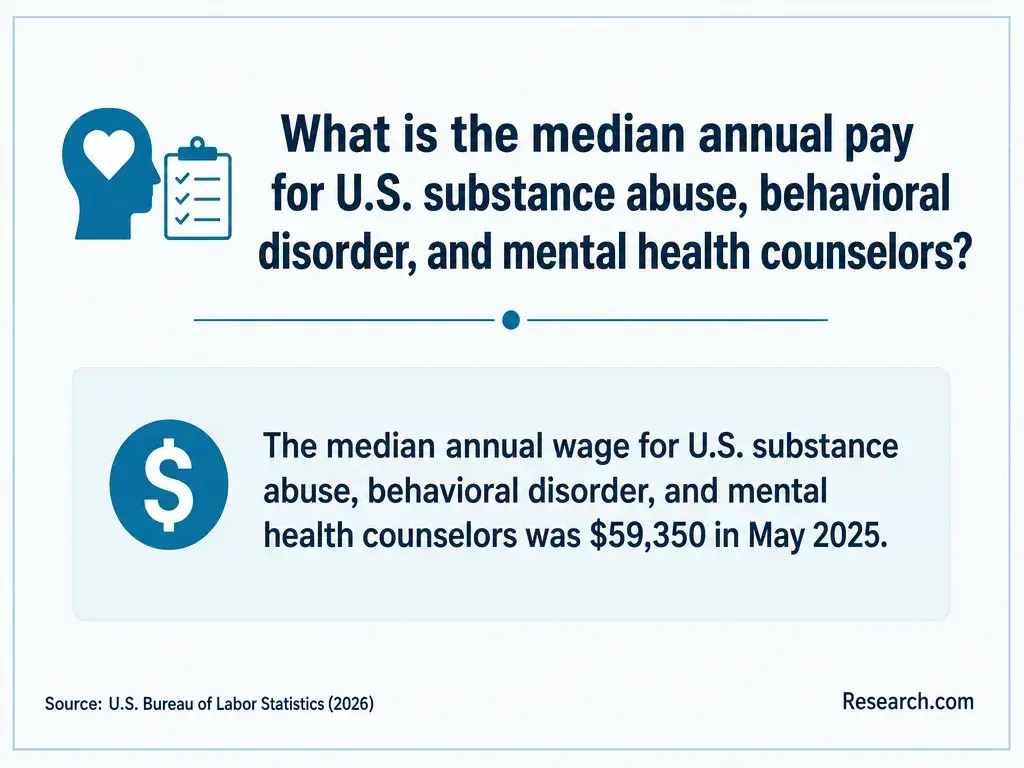
The U.S. Bureau of Labor Statistics reported a May 2024 median annual wage of $45,120 for social and human service assistants. That occupation includes workers with varied education and experience; its median is not a predicted salary for this BA's graduates. Compare local job postings for actual degree, experience, and credential requirements before estimating your return on education. For a separate cost-versus-occupation comparison, see comparing undergraduate substance use counseling costs and outcomes.
How Can You Choose a Reputable Online Psychology Program?
Choose backward from your likely graduate applications. A reputable institution is the starting point; the stronger fit is the program that lets you complete relevant prerequisites, do credible research work, and obtain informed recommendations without unexpected scheduling or cost barriers.
Before paying a deposit, ask the psychology department and graduate programs for answers you can document:
- Can online students enroll in social psychology and advanced methods, and when are those courses offered?
- What research tasks can online undergraduates perform, who supervises them, and are meetings or campus visits required?
- Will the department provide a degree audit showing remaining requirements and a realistic completion sequence?
- Do the graduate programs on my shortlist accept these courses as prerequisites?
If your aim changes from research to clinical counseling, redo the comparison rather than assuming the same next degree fits both goals. A clinical mental health counseling master's pacing guide can help you investigate scheduling, while the program and state board must confirm credential eligibility.
Other Things You Should Know About Psychology
Some programs accept applicants with a bachelor's degree; a psychology master's is not universally required. Check each program's admissions rules and research expectations.
Policies differ and can change by application cycle. Check the current admissions page for every program, including whether scores are optional or not accepted.
Possibly. Ask the graduate program whether it accepts the course's level and content, and ask your BA institution how the credit would apply to your degree.
Yes, when the work addresses a social psychological question and demonstrates sound reasoning and evidence use. Follow the target program's specific writing-sample instructions.
- VISION FOR THE FUTURE: A PUBLIC HEALTH APPROACH | nih.gov https://www.ncbi.nlm.nih.gov/books/NBK424861/
- Admissions Process | Broward College Catalog https://catalog.broward.edu/student-services/admissions-process/
- Curriculum | Social Psychology Graduate Program https://socialpsych.unc.edu/curriculum/
- FAQs for Graduate Program Applicants - GSU Psychology https://psychology.gsu.edu/faqs-for-graduate-program-applicants/
- Psychology Capstone | Department of Psychology | West Virginia University https://psychology.wvu.edu/undergraduate/advising/capstone
- FAQ for Applicants | Psychology Graduate Program https://grad.psychology.fas.harvard.edu/faq-applicants
- Psychology | 2026-2027 Graduate Catalog | SIU https://gradcatalog.siu.edu/programs/psyc/
- Social Psychology | virginia.edu https://psychology.as.virginia.edu/social-psychology
- Online Bachelor's Degree in Psychology in Addictions | Purdue Global https://www.purdueglobal.edu/degree-programs/psychology/bachelor-psychology-addictions/
- Master's in Psychology Requirements | louisiana.edu https://psychology.louisiana.edu/programs/masters/requirements