2027 Choosing a BS in Business Administration When You Are Returning to College After a Layoff
Audited and Verified:
Our Editorial and Data Verification Process
Research.com uses government datasets, official education statistics and primary institutional information to support its career and degree guides. Our review process checks factual accuracy, occupational definitions, source dates and the requirements associated with the credentials discussed.
How This Article Was Fact-Checked
Our editorial team verifies salary estimates, employment projections, education requirements and program information against original data providers and official organizations. Salary figures are checked against the relevant occupational definitions and reporting periods. Information about licensure, accreditation and required in-person training is reviewed separately.
Fact-checked and verified on:

Co-Founder and Chief Data Scientist
A layoff can make finishing a bachelor's degree feel urgent, but enrolling quickly is not always the fastest route back to stable work. If you have college credits or years of professional experience, the decision is whether a BS in Business Administration will help you reach a specific next role without taking on more cost or delay than necessary.
This guide shows you how to test career fit, get prior coursework evaluated, compare flexible programs, and plan around job searching and uncertain income.
Key Things You Should Know
- Choose the degree for a defined career goal, not as a general response to a layoff; a shorter skills course or direct job search may serve an adjacent move better.
- Ask for a degree audit showing where accepted credits apply. Credits counted as electives may not shorten the business core, and no advertised completion time is reliable without an evaluation.
- Compare the cost of finishing with your cash flow while unemployed. Even strong occupational demand, for example, the Bureau of Labor Statistics projects 18% growth for logisticians from 2025 to 2035, does not guarantee a job or a salary increase.
What Is a BS in Business Administration and Why Choose It After a Layoff?
A Bachelor of Science in Business Administration is an undergraduate degree combining general education with subjects such as accounting, finance, management, marketing, operations, and business analysis.
Its breadth can suit someone whose previous work involved customers, scheduling, purchasing, reporting, or team coordination and who wants to move into a related business function.
After a layoff, the strongest reason to enroll is a documented gap between your experience and the requirements of jobs you want. Review several relevant postings: if a bachelor's degree repeatedly appears and your existing credits can satisfy substantial requirements, completion may be worthwhile.
If employers mainly want a specific software skill or recent experience, targeted training and applications may have a faster payoff. An accelerated program can reduce calendar time but not necessarily weekly workload; compare accelerated study schedules for business majors against the time you need for interviews and paid work.
Is a BS in Business Administration Worth It for Career Changers?
It may be worth it when the degree removes a recurring hiring barrier and lets you build on experience you already have. A former retail supervisor, for example, may have evidence of staffing, inventory, and customer-service decisions that supports an operations application.
Moving from an unrelated field into finance or analytics usually requires more: relevant coursework, technical practice, and work samples or supervised experience.
Judge the investment against a specific target role and realistic entry point, not an eventual management title. Compare your remaining tuition and fees, borrowing, study time, and forgone earnings with the roles available in your area.
For another view of business administration degree cost versus career outlook, check the assumptions against your own credit evaluation and local job postings. If you already hold a bachelor's degree, first ask whether employer training, a certificate, or a specialized qualification would close the gap more directly; second-degree policies vary by school.
What Careers Can You Pursue With a BS in Business Administration?
The degree can support applications for operations coordinator, procurement assistant, HR specialist, marketing coordinator, project coordinator, or analyst roles, depending on your prior work and technical preparation.
These jobs differ: an operations coordinator may track schedules and process measures, while an HR specialist may handle recruiting or employee records. A management role generally also requires demonstrated responsibility and results.
Start with roles adjacent to your former industry when possible. Industry knowledge may make your experience more persuasive than a new degree alone.
If your goal is specifically logistics or procurement, compare a general business curriculum with fast-track supply chain bachelor's programs; the specialized route may teach more relevant tools, but only if your credits apply and its schedule works for you.
Confirm the institution's accreditation through the accreditor or the U.S. Department of Education's recognized-accreditor information, then verify the exact degree and delivery format with the school.
AACSB, ACBSP, and IACBE accreditation concerns the stated scope of business education; it is distinct from institutional accreditation and should not be assumed to cover every program.
For a returning student, the deciding document is a program-specific degree audit. Ask the transfer office how credits are accepted, an adviser where they apply, and the department when remaining courses are offered.
Also check career services for experienced students, leave and reentry policies, and whether any reported employment outcomes actually describe graduates like you. Use US rankings for accelerated business bachelor's degrees to identify candidates, not as proof that your personal completion timeline will match an advertised one.
Online study can make interviews, relocation, or a return to work easier to accommodate. It is not necessarily self-paced: courses may require live meetings, group presentations, proctored exams, or fixed weekly deadlines.
Campus study can offer easier access to face-to-face recruiting and support, but commuting and scheduled classes may conflict with a new job.
Ask for a recent course schedule and sample syllabi in the format you would actually take. Check required attendance, internship or campus visits, assessment times, and whether part-time enrollment interrupts course sequencing.
Compare those commitments with accelerated degree options for working adults only after estimating the weekly hours you can sustain while seeking work.
Requirements vary, but programs commonly combine general education with introductory accounting, economics, statistics or quantitative reasoning, marketing, management, finance, operations, and a strategy or capstone course.
A concentration adds a defined set of requirements; taking a few electives in one subject does not necessarily earn a formal concentration.
Look closely at prerequisite chains. If finance requires accounting, or an analytics course requires statistics, one missing class can delay later courses even when many transfer credits are accepted.
Compare your transcripts with the school's catalog and ask whether older or differently named quantitative courses satisfy requirements. This overview of prior education requirements for business administration applicants can help you prepare questions, but the enrolling school decides equivalencies.
Schools commonly request transcripts from every college attended, and some separately assess admission to the institution and admission to the business major. GPA rules, academic-renewal options, deadlines, and prerequisite requirements differ. An enrollment gap or a non-business background does not by itself establish ineligibility.
Request official transcripts early, gather descriptions or syllabi for courses whose equivalency is unclear, and ask admissions about readmission if you previously attended that school.
If you left during a difficult academic period, ask which current policy governs your application rather than assuming the old record cannot be addressed. Where application costs matter, fee-free applications for online college can narrow your search, but compare degree requirements before applying.
Your remaining requirements - not your total prior credits - determine the likely timeline. A school may accept a course as an elective without applying it to the business core.
Residency rules, course availability, part-time enrollment, and prerequisite sequences can extend completion. Ask for a term-by-term plan based on an official evaluation before treating any estimate as dependable.
Compare programs using the same cost categories: tuition for remaining courses, mandatory fees, books and software, travel or proctoring, and the effect of studying on earnings.
If income fell after your layoff, contact the financial-aid office about its process for reviewing changed financial circumstances; an adjustment is not automatic. Review aid eligibility and loan obligations before enrolling. Lists of lower-priced accredited business administration study options are a starting point, not a substitute for a personalized total-cost estimate.
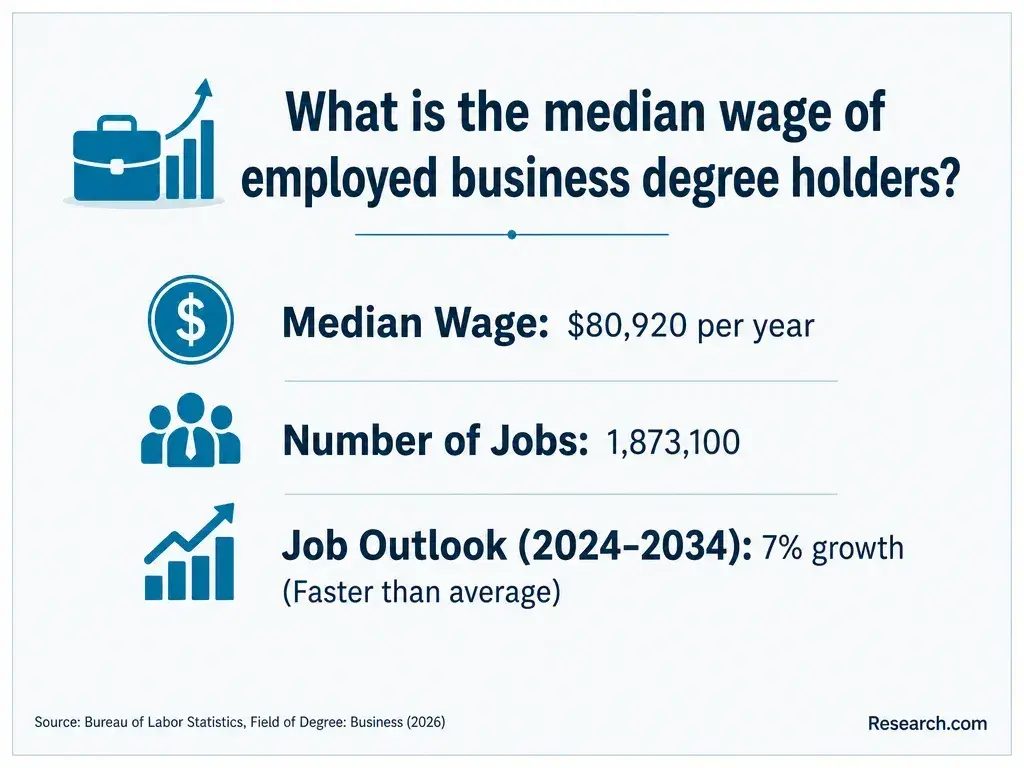
There is no single salary for BS in Business Administration graduates. Earnings depend on the occupation, location, experience, and responsibilities.
For context, the U.S. Bureau of Labor Statistics reports a May 2025 median annual wage of $75,940 for human resources specialists. That is an occupation-wide midpoint, not an expected starting salary or a return promised by the degree.
Use salary data only after identifying jobs you could realistically enter. Compare local postings' pay ranges and requirements with your current earning options, then weigh the difference against completion costs and time out of work. Even among lower-priced college options for business majors, a program that applies fewer of your credits may cost more to finish.
Do Business Administration Graduates Need Licenses or Certifications?
A general business administration degree does not itself require an occupational license, and graduation does not confer one. Requirements depend on the work: regulated accounting or financial-services activities can have separate state or industry rules, while employers may prefer voluntary credentials for some HR or project roles.
Check the exact credential named in target job postings, then consult its issuer or regulator for education and experience rules before paying for preparation. A project management course or concentration is not the same as professional certification.
If project coordination is your goal, compare the business degree with project management degrees with prior-credit pathways and choose based on applicable credits, relevant assignments, and the work you want to do.
Other Things You Should Know About Business Administration
Possibly. Eligibility and training exceptions depend on your state and circumstances. Ask your state unemployment agency before changing your availability for work or relying on benefits to fund school.
Only if it helps explain your goals or academic timeline. Keep the explanation brief and focus on your experience, preparation, and reason for choosing the program.
Check your separation agreement and benefit documents. Coverage, deadlines, and repayment terms vary; do not assume an employee benefit continues after employment ends.
Before accepting a demanding course load, ask the school about part-time study, withdrawal deadlines, and leave policies. Plan for a schedule you could maintain after returning to work.
- Cost of Attendance (Budget) | 2025-2026 Federal Student Aid Handbook https://fsapartners.ed.gov/knowledge-center/fsa-handbook/2025-2026/vol3/ch2-cost-attendance-budget
- 15 to Finish | dhewd.mo.gov https://dhewd.mo.gov/initiatives/fifteen-to-finish
- Special Programs Frequently Asked Questions | ny.gov https://dol.ny.gov/special-programs-frequently-asked-questions
- Military Training Evaluation Program (MTEP) | dantes.mil https://www.dantes.mil/credit4training/
- Training & Education Programs | nj.gov https://myunemployment.nj.gov/jobseekers/training/
- Outplacement assistance - Office of Financial Management https://ofm.wa.gov/hr-resources/furloughs-layoffs/outplacement-assistance/
- How to Choose an Accredited Online MBA Program | University of Fairfax https://ufairfax.edu/how-to-choose-an-accredited-online-mba/
- Regional vs. National Accreditation: Which is Better? | Drexel University Online https://www.online.drexel.edu/news/national-vs-regional-accreditation.aspx
- Worker Retraining Program | sbctc.edu https://www.sbctc.edu/paying-for-college/worker-retraining-student.aspx
- Types of Accounting Degrees You Can Specialize In | Edison State Community College https://www.edisonohio.edu/blog/types-of-accounting-degrees-you-can-specialize-in