2027 Can a BS in Business Administration Prepare You for a Customer Experience Analyst Role? Skills and Entry Requirements
Audited and Verified:
Our Editorial and Data Verification Process
Research.com uses government datasets, official education statistics and primary institutional information to support its career and degree guides. Our review process checks factual accuracy, occupational definitions, source dates and the requirements associated with the credentials discussed.
How This Article Was Fact-Checked
Our editorial team verifies salary estimates, employment projections, education requirements and program information against original data providers and official organizations. Salary figures are checked against the relevant occupational definitions and reporting periods. Information about licensure, accreditation and required in-person training is reviewed separately.
Fact-checked and verified on:

Co-Founder and Chief Data Scientist
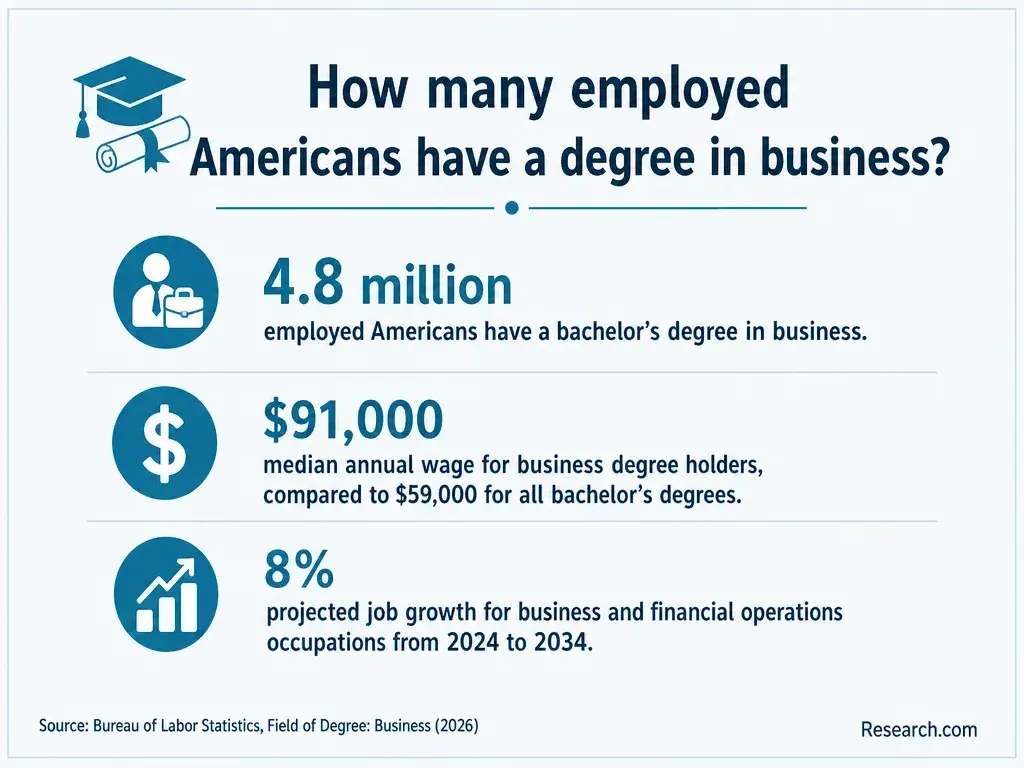
If you want to turn customer feedback into better products and services, a BS in Business Administration can be a starting point - but employers will also want evidence that you can analyze data and recommend useful changes. This article is for students and career changers weighing that degree against more specialized preparation. It explains what customer experience analysts do, which courses and projects matter most, what entry-level hiring may require, and how to judge whether a full degree is worth your time and cost.
Key Things You Should Know
- A BS in Business Administration can prepare you for customer experience (CX) analysis when you pair marketing and operations coursework with statistics, data tools, and a relevant work sample.
- Customer experience analyst is not a licensed occupation; employers set their own degree and experience requirements, and customer-facing work can provide useful evidence of readiness.
- The closest broad federal pay benchmark, market research analyst, had a $78,760 median annual wage in May 2025; that occupation-wide figure is not an entry-level CX salary.
Can a BS in Business Administration prepare you for a customer experience analyst role?
Yes, if the program gives you opportunities to connect customer research, quantitative analysis, and business operations. A customer experience analyst examines how people interact with an organization across channels such as websites, stores, support teams, and billing. The job is to identify friction, explain its likely causes, and help teams decide what to improve - not simply collect favorable survey scores.
The degree supplies business context, but readiness depends on what you can demonstrate. The table shows the difference between classroom exposure and evidence an employer could assess.
| Typical CX task | Relevant BS preparation | Stronger evidence of readiness |
| Interpret customer feedback | Marketing research and statistics | A documented analysis that explains sampling limits and recurring themes |
| Locate service bottlenecks | Operations and process management | A process map tied to a clearly defined customer problem |
| Recommend changes | Business communication and finance | A concise recommendation with measures, costs, and assumptions |
If your goal is to coordinate implementations rather than investigate customer behavior, project management may be a closer fit. Students bringing prior college credits can examine project management bachelor's completion using existing credits before committing to a general business pathway.
What skills do customer experience analysts need to succeed?
CX analysts need to combine qualitative evidence - such as complaints and interview notes - with quantitative evidence, including survey responses, repeat-contact rates, or task-completion measures. Spreadsheet proficiency is a practical starting point; some employers also seek dashboard, database-query, or customer relationship management (CRM) skills. Tool requirements vary by posting.
Analytical judgment matters as much as software. A rise in complaints might reflect a worse process, a larger customer base, or a change in how complaints are recorded. Analysts must check definitions, missing data, and alternative explanations before recommending action. They also need to present findings to colleagues who can change a process, while protecting customer information.
Some roles emphasize coordinating fixes across teams rather than conducting research. If that describes your preferred work, compare the skills and education costs of project management degree tuition comparisons with the CX-focused courses available in a business program.
What degree and education requirements do customer experience analysts typically have?
There is no universal degree requirement for a job titled customer experience analyst. Employers may prefer a bachelor's degree in business, marketing, analytics, psychology, or a related field, while others place more weight on experience with customer research, service operations, or reporting. Read the duties alongside the degree line: two jobs with the same title can demand very different analytical depth.
For an early-career applicant, a BS in Business Administration is most persuasive when paired with an internship, supervised project, or customer-facing role that produced analyzable work. Someone who already holds a bachelor's degree and relevant experience may be better served by targeted statistics or analytics training than by earning a second bachelor's. Conversely, a role centered on employee experience or HR data may call for different preparation; transfer-friendly human resources bachelor's degrees offer one route for students whose prior credits and career goal point toward HR rather than CX.
Prioritize marketing research, statistics, business analytics, operations management, information systems, and professional communication. Marketing courses help frame customer questions; statistics helps assess whether a pattern is meaningful; operations courses help trace friction through a service process. An analytics course is especially valuable if it requires students to clean data, explain measures, and present a decision - not just operate software.
Check the actual catalog before choosing a concentration. A marketing concentration may offer more customer research, while an analytics concentration may offer deeper quantitative work. Neither name guarantees both. Ask whether relevant electives have prerequisites, run regularly, and can count toward graduation without adding credits.
Choose an applied assignment you can discuss without revealing private customer records: for example, a clearly labeled analysis of public reviews or an approved, de-identified workplace process. If you are more interested in fulfillment and delivery systems than the broader customer journey, compare supply chain degrees by cost and length alongside the business curriculum.
Customer experience analysis generally does not require a professional license. Voluntary training in analytics platforms, survey methods, or CX practices can help you learn a tool, but a certificate is not a substitute for showing how you defined a question, evaluated evidence, and made a defensible recommendation. Check job postings before paying for a credential: a named platform may matter to one employer and not another.
Match further study to the work you want to do. If your goal is eventually to lead a service team, that is a different experience-dependent path from entering an analyst role. Shorter study timelines for leadership bachelor's students may be worth comparing, but a leadership degree or certificate alone does not confer supervisory responsibility.
They can be. CX work often involves digital records, remote collaboration, and written presentations, so online assignments can provide relevant practice. What matters is whether the program teaches research and analysis, offers feedback on applied work, and connects students to internships or approved projects - not whether classes are online or on campus.
Check the schedule rather than assuming online means self-paced. Live presentations, group meetings, proctored exams, and internship hours can affect students who work. If faster scheduling is a priority, business degree options with shorter sessions are a comparison point; verify course availability and weekly workload before treating a shorter session as a quicker path to graduation.
Requirements vary by institution and by whether you are entering as a first-year or transfer student. Schools commonly review prior academic records and may require specific general education or quantitative preparation. Admission to the university, entry to the business major, and satisfaction of major prerequisites are separate decisions.
Before applying, ask admissions which transcripts are required, then ask a business adviser how previous mathematics, statistics, economics, or accounting courses would apply. Transfer students should request a degree audit: credits a school accepts may still count only as electives. For a closer look at common variations, review the prerequisites for a business administration degree, then confirm the rules for your intended enrollment term with the school.
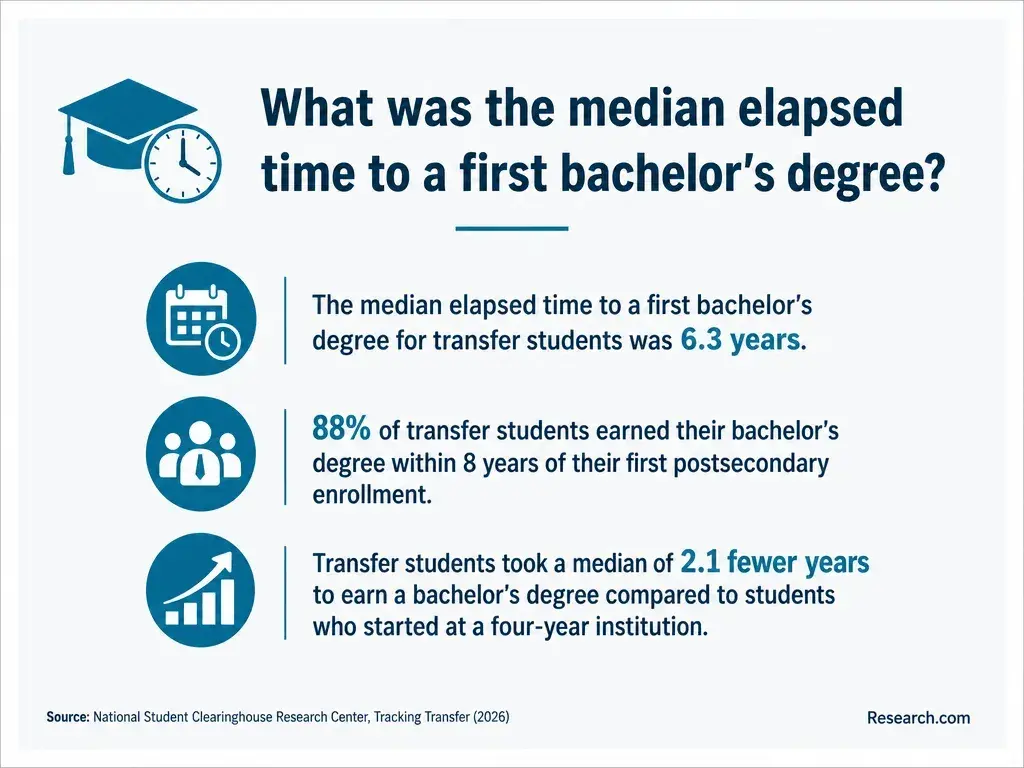
A bachelor's degree typically takes about four years of full-time study from the start, but a transfer student's remaining time depends on which credits satisfy the program's requirements and when required courses are offered. Part-time attendance can make work more manageable while extending the calendar timeline. An accelerated course format does not necessarily reduce the total coursework.
There is no reliable single price for a BS in Business Administration. Compare each school's tuition and mandatory fees against the credits you would still need, then account for books, software, possible travel, and borrowing. Request a written degree audit and a program-specific cost estimate before deciding that a lower per-credit price means a lower completion cost. You can compare lower-cost business degree options, but verify the final cost and any financial aid directly with each institution.
For a CX goal, plausible starting points include customer experience coordinator, customer insights assistant, marketing research assistant, and service operations coordinator. Customer support or account-service work can also be an entry route if it provides exposure to recurring problems and opportunities to contribute to reporting. An analyst title may require more independent data work than a coordinator title; the duties are more informative than the label.
A general business degree also supports applications to other entry-level business functions, but switching functions can require different coursework and evidence. For example, employee experience roles often sit closer to HR than to customer research. If that distinction matches your interests, explore the costs of an HR degree before choosing CX-focused electives. Neither route makes a new graduate automatically qualified to manage a department.
What salary and job outlook can customer experience analysts expect?
The U.S. Bureau of Labor Statistics does not publish a separate national wage and employment projection for the customer experience analyst title. Its market research analysts occupation is a useful but imperfect comparison for CX jobs centered on customer research: the median annual wage was $78,760 in May 2025, and employment is projected to grow 7% from 2025 to 2035. That median covers workers across experience levels and research settings; it is not a starting salary or a forecast for every CX position.
Use the duties in local postings to judge whether that comparison fits. A service-reporting role may be priced differently from a research-intensive analyst role, and location, industry, and experience also matter. Before taking on education costs based on a potential salary, compare actual entry-level postings with your likely remaining tuition. Shorter online business administration degrees with cost details can help frame the school comparison, but confirm transfer credit and the full completion price yourself.
Other Things You Should Know About Business Administration
No. Customer service handles individual requests and problems. Customer experience work examines patterns across interactions and recommends improvements to the broader journey. The functions often collaborate.
Not without permission and appropriate privacy protections. Use public information, synthetic examples, or employer-approved, de-identified material, and state the limits of what your analysis can show.
Yes, especially if you can explain patterns you observed and how you documented or investigated them. Avoid claiming that an informal observation proves a business-wide trend.
Look for the balance of survey analysis, reporting, process improvement, and frontline support. That mix tells you which work samples and transferable skills to emphasize.
- Students & Recent Graduates | U.S. Office of Personnel Management https://www.opm.gov/policy-data-oversight/hiring-information/students-recent-graduates/
- What Does a Data Analyst Do? Roles, Skills & Tools Explained | Syracuse University https://ischool.syracuse.edu/what-does-a-data-analyst-do/
- 7 Essential Data Analyst Skills to Advance Your Career | jhu.edu https://ep.jhu.edu/news/7-essential-data-analyst-skills-to-advance-your-career/
- Analysis for Consumer & Shopper Insights Jobs | The University of Texas at Dallas https://jindal.utdallas.edu/blog/marketing-career-focus-customer-insights/
- What is Business Analytics? | Michigan Technological University https://www.mtu.edu/business/undergraduate/business-analytics/what-is/
- How to Become a Business Analyst: Steps, Skills, and Salary | Touro University Worldwide https://www.tuw.edu/business/how-to-become-a-business-analyst/
- Becoming a Business Analyst: What You Need to Know | Georgia Tech Professional Education https://pe.gatech.edu/blog/industry-trends/how-to-become-a-business-analyst
- Business Analyst Communication & Stakeholder Skills Guide | William & Mary Mason https://online.mason.wm.edu/blog/skills-for-a-successful-career-in-business-analytics
- Customer Experience Metrics: The Essential Guide for 2025 | gainsight.com https://www.gainsight.com/blog/customer-experience-metrics-the-essential-guide-for-2025/
- What Do You Learn in a Business Administration Degree? | Rowan Blog https://rowanblog.com/2026/07/what-do-you-learn-in-business-administration-degree/