2027 BS in Business Administration Math Planning: Comparing Different Business Statistics Course Descriptions
Audited and Verified:
Our Editorial and Data Verification Process
Research.com uses government datasets, official education statistics and primary institutional information to support its career and degree guides. Our review process checks factual accuracy, occupational definitions, source dates and the requirements associated with the credentials discussed.
How This Article Was Fact-Checked
Our editorial team verifies salary estimates, employment projections, education requirements and program information against original data providers and official organizations. Salary figures are checked against the relevant occupational definitions and reporting periods. Information about licensure, accreditation and required in-person training is reviewed separately.
Fact-checked and verified on:

Co-Founder and Chief Data Scientist
"Business statistics" can mean a general introduction to data, a calculus-supported course in statistical inference, or a software-heavy class built around business decisions. That difference matters when you are choosing a BS in Business Administration, checking a transfer course, or planning the math you need before enrollment.
This guide shows you how to read course descriptions alongside prerequisites, degree requirements, and assignments. You will be able to identify the preparation a course expects - and confirm whether it advances your degree and the business skills you want to build.
Key Things You Should Know
- A matching course title does not establish equivalence: compare prerequisites, learning outcomes, credit hours, and the department's transfer decision.
- Business statistics commonly covers data summaries and statistical inference, but courses differ substantially in regression, forecasting, software, and business applications.
- Plan backward from your required statistics course: algebra, quantitative reasoning, or calculus may come first, and an accepted transfer credit may still count only as an elective.
What Is Business Statistics in a BS in Business Administration?
Business statistics is the study of how to describe data, estimate what is uncertain, and assess evidence for a business decision. A student might use a sample of customer orders to estimate typical delivery time or test whether an observed difference between two groups is likely to reflect more than random variation. The aim is not just to calculate an answer, but to explain what the data can - and cannot - support.
In a BS in Business Administration, statistics may be a business-core requirement, a general education math option, or a prerequisite for analytics, finance, marketing research, or operations courses. Those placements are not interchangeable. If you are bringing in prior quantitative coursework - including credits from another business field - ask the receiving school which requirement it satisfies. Students considering a more specialized route can also examine how schools handle credits when they finish project management studies with transferred college credits; the receiving institution must still determine each course's applicability.
What Topics Do Business Statistics Courses Cover?
Most introductory descriptions mention descriptive statistics, probability, sampling, confidence intervals, and hypothesis tests. The differences appear in how far the course goes and what students must produce. A course may stop at interpreting statistical output, while another requires students to build spreadsheet models, run regression, or present a recommendation from a dataset.
The following topic comparison helps distinguish foundational coverage from material that may be especially useful for a concentration.
| Topic in the description | What students may learn | Why the distinction matters |
| Descriptive statistics and visualization | Summarize distributions, variation, and unusual values | Useful for reporting; does not by itself establish why a result occurred |
| Sampling and statistical inference | Use samples, confidence intervals, and tests to assess uncertainty | Relevant when a decision relies on incomplete data |
| Regression and forecasting | Examine relationships or project values under stated assumptions | Check whether the course teaches model limitations, not just calculations |
| Applied assignments and software | Clean data, use spreadsheets or statistical tools, and explain findings | Provides practice, but the tool and assignment depth vary by course |
For example, a supply chain exercise might compare variation in delivery times rather than just average delivery time. That application is particularly relevant if you are comparing general business study with supply chain undergraduate programs with shorter terms: inspect the actual course sequence before assuming a faster calendar offers the same analytical depth.
How Do Business Statistics Course Descriptions Differ Across Programs?
Descriptions often differ along four dimensions: entry preparation, statistical depth, tools, and business context. "Introduction to business statistics" might require only placement into college-level math; another similarly named course might require algebra and expect students to manipulate formulas. Likewise, "analytics" in a description might mean interpreting a spreadsheet chart or completing a substantial data analysis.
A useful comparison requires more than catalog titles. Request the current syllabus or learning outcomes, then compare the assessment methods and prerequisite chain. The following sequence keeps the decision tied to your degree plan:
- Find the exact statistics requirement in your catalog and note its course number, credits, and prerequisites.
- Compare candidate courses for inference, regression, software, datasets, and graded assignments.
- Ask the department or transfer office for a written determination of whether another course satisfies the required slot.
- Check when the required course runs and which later courses depend on it.
This matters when evaluating online colleges with accelerated business programs. Shorter terms change the pace, not necessarily the scope; verify whether statistics, its prerequisite, and the next required course are offered in a workable sequence.
There is no universal BS in Business Administration math sequence. Depending on the school, students may need quantitative reasoning, college algebra, finite math, business calculus, introductory statistics, or a designated business statistics course. A finance or analytics concentration may add courses beyond the general business core. The authoritative answer is the degree audit for your catalog year, read alongside current course prerequisites.
For planning purposes, separate admission preparation from graduation requirements. A school may admit a student before they finish a required math course, but that course can still block enrollment in statistics or a later business class. Transfer students should also distinguish credits the school accepts from credits it applies to the math requirement.
Compare the entire remaining sequence when reviewing affordable school choices for online business students. A lower advertised tuition rate may not produce the lower completion cost if placement rules or unmatched transfer courses add classes or terms.
Some do; others accept a placement score, quantitative reasoning course, equivalent transfer credit, or another prerequisite. A description that does not name college algebra is not proof that no algebra skills are needed. Working with formulas, percentages, graphs, and spreadsheet functions can still be part of the course.
If algebra is a concern, check both the catalog prerequisite and a recent syllabus. Ask whether the requirement is enforced before registration, whether a qualifying alternative exists, and whether tutoring or a preparatory module is available. The business administration admissions preparation guide can help you frame broader prerequisite questions, but the specific school decides its own eligibility and course-placement rules.
Either format can teach the same outcomes, but the experience depends on assessments and support. An online section may offer recorded instruction yet require timed exams, live meetings, group analysis, or fixed weekly deadlines. A campus section may offer immediate help during class but require travel at set times. Neither format is inherently easier.
Ask for a sample weekly schedule and assessment policy, particularly if you work while studying. Confirm how students obtain software, get help with calculations, collaborate on projects, and take exams. If scheduling is the main constraint, compare business administration programs for studying around work commitments against those actual course obligations - not just an "online" label.
First, verify the institution's recognized accreditation with the accreditor and confirm that it covers the school awarding the degree. Then check whether any claimed business-specific accreditation - such as AACSB, ACBSP, or IACBE - covers the relevant business unit or program. Institutional and business accreditation answer different questions; neither tells you whether a particular statistics course will meet your requirement or transfer elsewhere.
Accreditation is also distinct from financial-aid participation. When comparing business administration colleges participating in federal aid programs, confirm the institution's current aid eligibility and your own eligibility with its financial-aid office. Do not infer accreditation scope, aid eligibility, or course equivalence from a program's marketing description.
Requirements vary by institution and by applicant type. First-year applicants typically submit evidence of secondary-school completion; transfer applicants generally provide college transcripts. A school may have separate standards for admission to the university and entry into the business major. Math placement or prerequisites can affect when you take statistics even if they do not prevent initial admission.
Before applying, ask admissions what records and deadlines apply to you, then ask an academic adviser how prior math and statistics work would fit the degree. If application expenses affect your choices, you can explore fee-free online university applications; verify each school's current fee policy and business degree offerings before applying.
Statistical reasoning supports work in market research, operations, procurement, human resources, and project coordination. In an entry-level role, that may mean checking data quality, summarizing results, maintaining a dashboard, or explaining why a small sample cannot justify a firm conclusion. More specialized analysis usually calls for deeper coursework, relevant tools, and demonstrated work - not merely a business statistics credit.
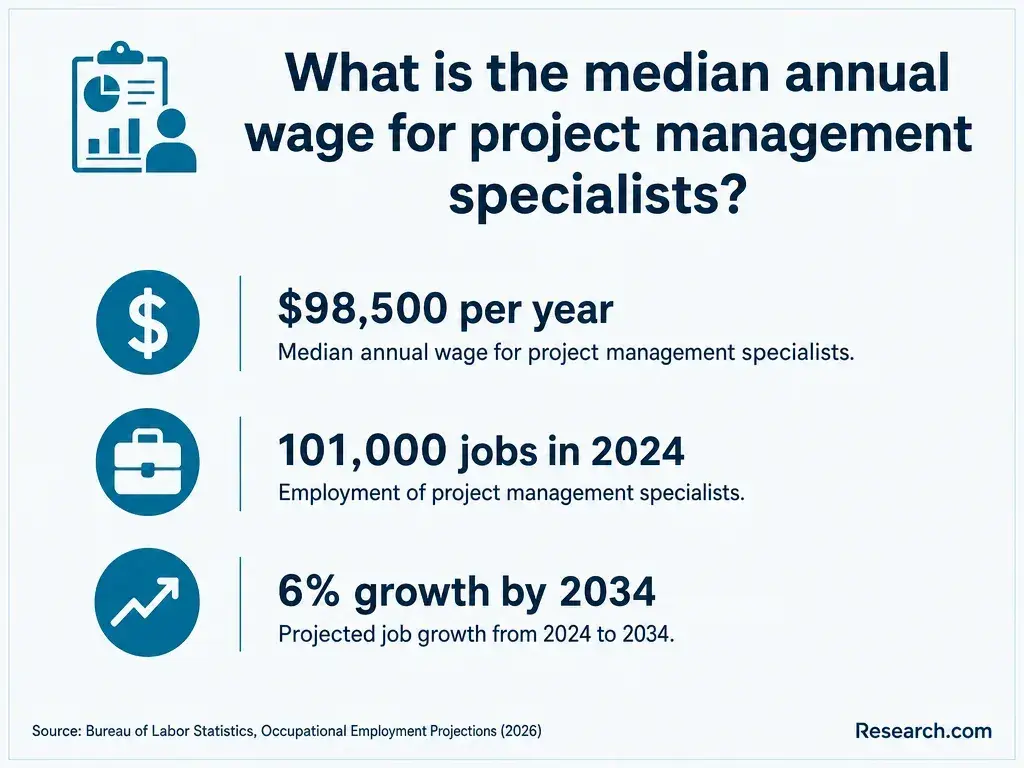
Match the course to the work you want to do. If you are drawn to project schedules, budgets, and performance measures, affordable online study routes in project management may be worth comparing with a general business degree. Examine the actual statistics and project assignments in each route; a project management title alone does not establish stronger quantitative preparation.
What Salary and Job Outlook Can Business Administration Graduates Expect?
There is no single salary or employment projection for everyone with a BS in Business Administration. Occupation data describes workers in a role - not graduates of a particular degree. For a statistics-related example, the U.S. Bureau of Labor Statistics reports a $78,760 median annual wage for market research analysts in May 2025 and projects 7% employment growth from 2025 to 2035. Those figures include workers with varied education and experience; they are not an expected starting salary or a job guarantee for a business graduate.
Judge the education investment against a specific target role, your existing experience, and the remaining courses you must pay for. If comparing a general business degree with project-focused study, include project management study costs beyond tuition - such as required fees, software, and time to completion - rather than relying on a posted tuition figure alone.
Other Things You Should Know About Business Administration
No. A calculator can perform computations, but assignments and exams may require you to choose an appropriate method, interpret the result, and explain its limitations. Check the instructor's calculator policy.
Not automatically. Compare the next course's expected skills with what you can currently do, then ask an adviser about tutoring, a refresher, or a retake. Check repeat-course and financial-aid policies before enrolling again.
Possibly, if the institution accepts that exam or assessment for the specific requirement. Obtain a written equivalency decision before assuming it replaces the business statistics course.
Follow the course's academic-integrity and data-use rules. Verify any generated calculations or interpretations yourself, and do not upload confidential workplace, customer, or employee data without authorization.
- Stats 506: Other Statistical Software | umich.edu https://dept.stat.lsa.umich.edu/~jerrick/courses/stat506_f25/11-other-software.html
- Mathematics Pathways | University System of Georgia https://www.usg.edu/curriculum/mathematics-pathways/
- Full article: How Much Math Do Students Need to Succeed in Business and Economics Statistics? An Ordered Probit Analysis https://www.tandfonline.com/doi/full/10.1080/10691898.2009.11889532
- Overview - Statistical Software - LibGuides at MIT Libraries https://libguides.mit.edu/stat
- Undergraduate Course Descriptions - Wharton Statistics https://statistics.wharton.upenn.edu/programs/undergraduate/course-descriptions/
- Statistics-STAT (STAT) | Colorado State University Catalog https://catalog.colostate.edu/general-catalog/courses-az/stat/
- Course Synopses - Statistics! - Rutgers University https://statistics.rutgers.edu/course-descriptions/course-synopses
- Statistics Major | UC Template 2014 https://statistics.uconn.edu/undergraduate/statistics-major/
- Overview of Quantitative Courses for 2026-2027 | uchicago.edu https://voices.uchicago.edu/qrmeth/courses/
- Descriptive Statistics - an overview | ScienceDirect Topics https://www.sciencedirect.com/topics/economics-econometrics-and-finance/descriptive-statistics