2027 BS in Business Administration and Healthcare Administration: Questions to Ask About Faculty and Applied Projects
Audited and Verified:
Our Editorial and Data Verification Process
Research.com uses government datasets, official education statistics and primary institutional information to support its career and degree guides. Our review process checks factual accuracy, occupational definitions, source dates and the requirements associated with the credentials discussed.
How This Article Was Fact-Checked
Our editorial team verifies salary estimates, employment projections, education requirements and program information against original data providers and official organizations. Salary figures are checked against the relevant occupational definitions and reporting periods. Information about licensure, accreditation and required in-person training is reviewed separately.
Fact-checked and verified on:

Co-Founder and Chief Data Scientist
A healthcare administration concentration can look compelling on a program page, but its value depends on who teaches it and what students actually do. For prospective and returning BS in Business Administration students, the key decision is whether faculty can connect business methods to healthcare operations—and whether projects provide credible, ethical evidence of those skills.
This guide gives you questions to ask about instructors, supervision, data access, and project assessment, then puts those answers in context with accreditation, scheduling, cost, and career options.
Key Things You Should Know
- Ask who teaches healthcare-specific courses, what relevant work they have done, and who will give feedback on your project—not just whether the school advertises industry-experienced faculty.
- Prefer an assessed project with a defined healthcare decision, feasible data, faculty supervision, and clear privacy rules over an impressive-sounding assignment with no accessible evidence.
- Use salary figures as occupation-wide context, not a graduate earnings forecast: the U.S. median for project management specialists was $102,320 in May 2025, and many such roles require relevant experience.
What Is a Business Administration and Healthcare Administration Degree?
Schools may offer a BS in Business Administration with a healthcare administration concentration, a healthcare management major, or a separate healthcare administration bachelor's degree. Those labels are not interchangeable. A business-core degree typically emphasizes finance, operations, management, and analysis before adding healthcare electives; a specialized degree may devote more coursework to healthcare organizations, policy, and service delivery.
Start with the catalog: confirm the exact credential awarded, whether healthcare administration is an official concentration, and which courses appear on the degree audit. If your goal is general team leadership rather than healthcare operations, compare accelerated organizational leadership degrees as a separate option. The better fit is the curriculum that builds evidence for your intended work, not the more appealing degree label.
What Accreditation Should a Business and Healthcare Administration Program Have?
First, verify that the institution holds recognized institutional accreditation. Then check whether its business school or the specific business program is covered by AACSB, ACBSP, or IACBE accreditation; the accreditor's name on a university website does not establish that every degree or concentration is included. If a school advertises healthcare-specific programmatic accreditation, confirm the accreditor, degree level, and named program directly rather than assuming it applies to your bachelor's pathway.
Accreditation is a screening tool, not proof that projects are well supervised. Ask for the current catalog, sample healthcare course syllabi, and the capstone rubric. You can compare ranked accelerated undergraduate business schools to identify possibilities, but verify each candidate's accreditation scope and healthcare coursework before treating it as a match.
How Do Faculty Qualifications Affect Business and Healthcare Administration Programs?
Strong teaching can combine academic expertise in business methods with current knowledge of healthcare settings. A finance instructor may teach budgeting effectively without having run a hospital; a healthcare practitioner can illuminate operational constraints without necessarily teaching analysis well. The useful question is how those perspectives meet in required courses and student feedback.
Request names or typical qualifications for instructors in healthcare operations, finance, quality improvement, and the capstone. These questions reveal more than a general faculty biography:
- Who teaches required healthcare courses, and what healthcare or applied research experience informs their assignments?
- Who approves a project's scope and methods, and how often does the student receive substantive feedback?
- Can students obtain a faculty mentor if their project involves a clinic, insurer, public agency, or community organization?
- How are instructors prepared to address privacy, uncertain findings, and the limits of a student's analysis?
For employed students, ask whether feedback and office hours are accessible around shifts. When reviewing business administration programs supporting continued employment, confirm actual instructor availability rather than assuming online access means timely mentoring.
A worthwhile project uses business tools to inform a bounded healthcare decision. Examples include mapping a hypothetical appointment workflow, comparing publicly available quality measures, or preparing an operating-budget scenario using clearly labeled assumptions. The deliverable should identify its decision-maker, data source, measure of success, and limitations—not claim improved patient outcomes without implementation and evidence.
Use this sequence to assess a proposed capstone or workplace assignment before enrolling:
- Define a decision, such as how an outpatient service might evaluate scheduling options, rather than promising to "fix access."
- Confirm whether the course permits a simulated case, public data, or an approved employer project—and who must authorize each option.
- Check the deliverable and rubric: look for a baseline, alternatives, costs or operational trade-offs, uncertainty, and a defensible recommendation.
- Ask what information may be collected, stored, discussed in class, or shown in a portfolio. Patient information and internal records require appropriate permissions and safeguards.
An internship, prior work experience, and an assessed capstone are different requirements; none automatically substitutes for another. If your preferred work is primarily coordinating projects across industries, compare transfer policies at online project management colleges before choosing healthcare-specific electives. A transferable project plan may serve that goal better than a narrowly clinical case.
Expect to compare two layers: the business core and the healthcare-specific requirements. The core may cover accounting, finance, statistics, management, information systems, and operations. Healthcare coursework may address organizational finance, reimbursement concepts, quality, regulation, or service delivery. Check actual course descriptions and prerequisites: an elective titled "healthcare management" may offer less applied depth than a sequence ending in a supervised project.
Look for assignments that connect methods to healthcare decisions—for example, interpreting a service budget or explaining why a staffing metric does not, by itself, demonstrate better care. If your target is workforce administration, transfer pathways into online human resources programs offer another comparison. General HR study may fit cross-industry roles, while healthcare-specific coursework may better address the setting in which you want to work.
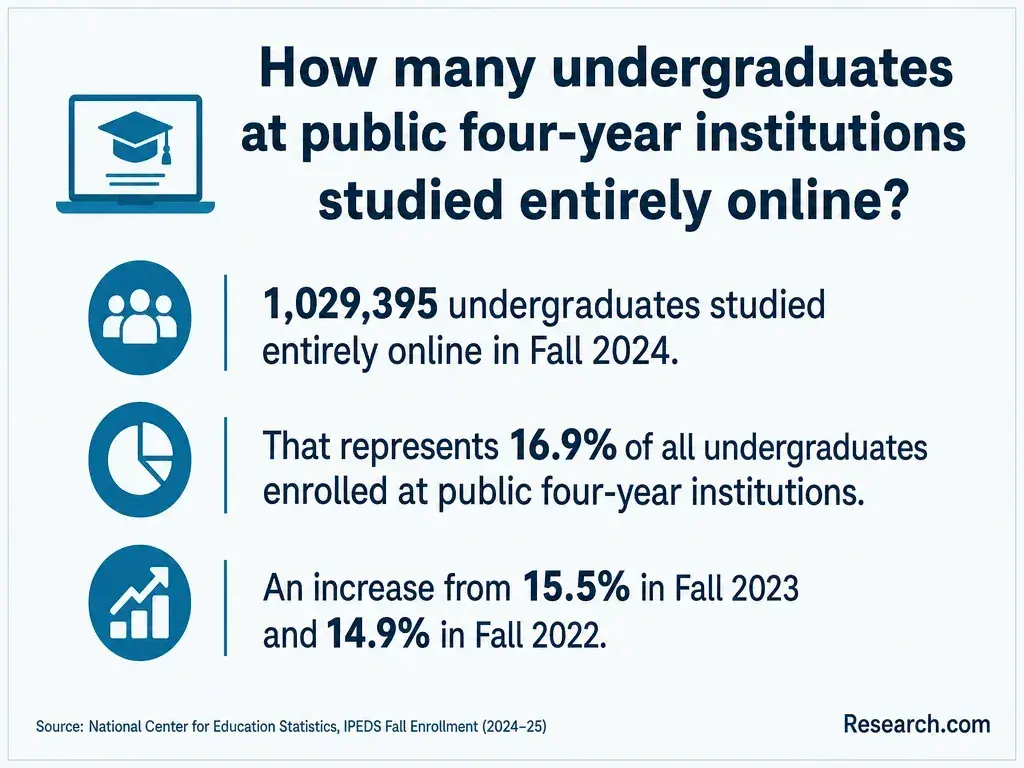
Yes, if the delivery format still gives you access to qualified instructors, meaningful feedback, and a feasible project. Online does not necessarily mean self-paced: live presentations, group meetings, proctored exams, fixed deadlines, or a site-based experience can conflict with work shifts or caregiving.
Ask for a recent syllabus from a healthcare course and the capstone. Confirm weekly participation expectations, required meetings, software, project-site rules, and whether a public-data or simulated project is allowed when workplace access is unavailable. If a shorter calendar is important, a guide to accelerated bachelor's study can help frame the pacing question; faster terms do not reduce the work a supervised project requires.
Admission rules vary by institution and may differ between entry to the university and entry to the business major or healthcare concentration. Schools may review prior transcripts, academic standing, and preparation in mathematics or introductory business subjects. A previous health-related course or job can strengthen your context without necessarily replacing a required accounting or statistics course.
Before applying, request a written evaluation showing which prior courses satisfy general education, the business core, healthcare requirements, and electives. Ask who approves substitutions and whether a prerequisite delays access to the capstone. For a broader preparation check, review prerequisites for a business administration degree, then use the prospective school's current catalog as the authority.
Completion time depends on applicable transfer credits, course sequencing, enrollment pace, and when required healthcare courses and projects are offered. A school may accept credits that count only as electives; that does not shorten a healthcare concentration or its prerequisites. Project approval or a required placement can also affect the final term.
Compare written degree audits and full remaining-cost estimates, not advertised tuition alone. Include required fees, materials, software, possible travel, and the cost of staying enrolled if a course is offered infrequently. Explore affordable colleges for business study as a starting point, then ask each school to price your own remaining requirements. A less expensive credit rate may not produce the lowest completion cost if fewer credits apply.
Potential entry routes include healthcare operations support, administrative coordination, scheduling analysis, and project coordination. Relevant employment, internships, and a well-documented project can help show what you can do. Supervising staff, directing a major budget, or managing a healthcare service generally calls for experience beyond introductory degree coursework.
For context, the U.S. Bureau of Labor Statistics reports a May 2025 median annual wage of $102,320 for project management specialists and projects 7% employment growth for that occupation from 2025 to 2035. That occupation-wide median is not an expected starting salary for a new graduate or a healthcare-only figure. If project coordination across sectors is your main goal, affordable online study routes in project management may be more directly aligned; compare their required projects and total cost with the healthcare pathway.
Do Healthcare Administration Graduates Need Licenses or Certifications?
A general healthcare administration graduate does not receive a clinical license simply by completing the degree. Requirements depend on the job: clinical practice, certain regulated administrative positions, and particular professional credentials have separate rules. Ask employers or the relevant state authority about your target role rather than relying on a program's broad career list.
Voluntary credentials can be useful later, but their eligibility requirements may include experience or other education. If you are considering a different project-management bachelor's to pursue that career direction, project management bachelor's aid application planning can inform the financing comparison; paying for another degree does not itself establish certification eligibility.
Other Things You Should Know About Business Administration
Usually you can describe your methods and conclusions, but check course, employer, and data-use rules first. Remove restricted information and label simulated work clearly.
Ask whether the instructor accepts a public-data analysis or simulated case. Confirm that option before enrolling in a course that requires an external site.
Request a sample rubric and ask when students submit a proposal, draft analysis, and final revision. Specific feedback milestones are more informative than a promise of faculty support.
Choose a project that demonstrates portable skills, such as budgeting or process analysis, while explaining its healthcare-specific constraints. If you cannot connect it to your target roles, ask about a different approved topic.
- Health Insurance Portability and Accountability Act (HIPAA) Compliance - StatPearls - NCBI Bookshelf https://www.ncbi.nlm.nih.gov/books/NBK500019/
- Summary of the HIPAA Security Rule | hhs.gov https://www.hhs.gov/hipaa/for-professionals/security/laws-regulations/index.html
- Privacy & Security - Health IT Playbook - HealthIT.gov https://playbook.healthit.gov/playbook/privacy-and-security/
- Bachelor's (BS) in Health Administration Degree Online | North Carolina Central University https://online.nccu.edu/programs/undergraduate-degrees/bachelors-in-health-administration/
- Health Care Management - Business Administration, B.B.A. | Mississippi University for Women https://www.muw.edu/business/bba/hcm/
- Health Administration - Henry W. Bloch School of Management https://programs.umkc.edu/undergraduate/henry-w-bloch-school-of-management/business-administration-health-administration
- Master of Health Administration (MHA) Capstone Projects | kgi.edu https://www.kgi.edu/degrees-and-programs/healthcare/master-of-health-administration/capstone-projects.html
- Case Studies for Collaborative, Project-Based Learning | Bass Connections https://bassconnections.duke.edu/news/case-studies-collaborative-project-based-learning/
- Bachelor of Science in Healthcare Administration | NU.edu https://www.nu.edu/degrees/healthcare-leadership/programs/bachelor-science-healthcare-administration/
- A Handbook for Community Partnerships: Internship | High Tech High Graduate School of Education https://hthgse.edu/a-handbook-for-community-partnerships-internship/