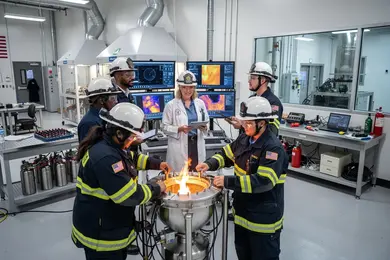
2027 Best Online Fire Science Doctorate Programs for Mid-Career Professionals

Co-Founder and Chief Data Scientist
Fire chiefs, emergency managers, investigators, and safety leaders often reach a point where experience alone is not enough for executive, policy, research, or teaching roles. NFPA's fire department profile published in 2024 estimated about 1.04 million U. S. firefighters, showing how large and competitive the public safety leadership pipeline remains.
This guide explains how online fire science-related doctorates work, who they fit, what they cost, and how to compare programs so working professionals can decide whether a doctoral investment supports their next career move.
Key Things to Know About Online Fire Science Doctorate Programs for Mid-Career Professionals
- Pure online doctorates formally titled "fire science" are rare in the U.S.; the strongest options are usually doctorates in fire and emergency management, public safety, emergency management, homeland security, public policy, or criminal justice with fire-focused research.
- BLS May 2024 wage data lists emergency management directors at a median annual wage of $86,130, so the doctorate is best evaluated as a leadership, research, academic, or policy credential rather than a guaranteed pay raise.
- Most working professionals should expect a post-master's doctoral path of roughly 3 to 6 years, depending on transfer credit, dissertation pace, residency requirements, and whether the program is full-time, part-time, online, or hybrid.
Is earning an online Fire Science doctorate worth it for mid-career professionals?
An online fire science doctorate can be worth it for mid-career professionals when the credential connects directly to a higher-level role: fire administration executive, emergency management director, college faculty member, public safety researcher, consultant, or policy leader. It is less likely to be worth the cost if the goal is simply to qualify for line-level firefighter, inspector, or investigator roles, where certifications, state requirements, command experience, and a master's degree may carry more immediate value.
The key is to define the return before enrolling. A doctorate does not replace operational credibility; it adds advanced research, strategy, and systems-level leadership skills to a professional record that is already strong.
This comparison shows where the degree tends to create value and where another credential may be more practical:
| Professional situation | Doctorate fit | Better alternative if the doctorate is not the right fit |
| Fire officer seeking executive command, municipal leadership, or public safety administration roles | Strong fit if the program emphasizes public administration, budgeting, labor relations, risk governance, and emergency operations leadership | Executive fire officer training, MPA coursework, chief officer credentials, or targeted leadership certificates |
| Fire investigator moving toward research, arson policy, intelligence analysis, or cross-agency leadership | Good fit when paired with criminal justice, homeland security, law, or forensic policy research | Advanced investigation certifications or a focused graduate certificate |
| Emergency manager leading regional planning, resilience, mitigation, or disaster policy | Strong fit, especially in emergency management or public safety doctorates with applied research | Graduate certificates in emergency management, continuity planning, or homeland security |
| Safety, prevention, or code professional targeting risk consulting or teaching | Good fit if dissertation support exists in risk analysis, fire prevention, life safety, or occupational safety | Board certifications, safety management master's coursework, or technical code credentials |
| Professional seeking a fast salary increase without changing responsibilities | Weak fit because doctoral ROI depends heavily on role, employer, and promotion structure | Employer-sponsored certifications, supervisory training, or a shorter graduate credential |
A useful rule is simple: pursue the doctorate when your next role requires original research, executive-level decision-making, teaching, or policy influence. If your next step is operational advancement inside a department, ask whether your employer values a doctorate in promotion scoring before committing to several years of study.
Which online Fire Science doctorate programs are the best for mid-career professionals?
The best online fire science doctorate for a working professional is usually not the program with the most recognizable name. It is the program that lets you study fire service leadership, emergency management, public safety systems, prevention, disaster resilience, or investigation while maintaining full-time employment.
Because dedicated online fire science doctorates are limited, the strongest choices are often adjacent doctoral programs that allow fire-focused dissertations or applied projects. Prospective students should confirm current delivery format, residency expectations, faculty fit, and dissertation options before applying.
| Program | Best fit for mid-career fire science professionals | Why it stands out | Important caution |
| Oklahoma State University, PhD in Fire and Emergency Management Administration | Fire service leaders, emergency management professionals, and researchers seeking the closest doctoral match to fire science | Directly connects fire administration and emergency management, making it highly relevant for dissertation topics in fire service systems, disaster response, and public safety leadership | Applicants should verify current online, hybrid, and residency requirements because doctoral delivery can vary by cohort and adviser expectations |
| Jacksonville State University, Doctor of Science in Emergency Management | Working emergency managers, fire officers, homeland security professionals, and public safety administrators | Applied doctoral structure aligns well with professionals who want to solve agency-level preparedness, response, mitigation, and recovery problems | It is an emergency management doctorate rather than a fire science-only doctorate, so fire-specific research fit should be confirmed early |
| Capella University, PhD in Public Safety with emergency management or public safety leadership focus | Professionals who need flexible online doctoral study while working in public safety leadership | Online structure and public safety framing can support topics in leadership, risk, emergency planning, and interagency coordination | Students should compare total cost, doctoral support, and dissertation faculty match carefully before enrolling |
| Walden University, PhD in Criminal Justice with emergency management-related study options | Fire investigators, emergency management personnel, and public safety professionals interested in policy, justice systems, and interagency response | Can fit professionals whose work overlaps with arson investigation, homeland security, public policy, and disaster response systems | It may be less ideal for highly technical fire protection engineering or combustion science research |
| Liberty University, PhD in Public Policy with a national security or related policy concentration | Fire service professionals moving into policy, homeland security, emergency preparedness, or government leadership | Public policy lens can support research on resilience, emergency governance, public safety funding, and intergovernmental response | Students seeking a fire science-specific curriculum may need to shape electives and dissertation topics carefully |
Mid-career applicants with fire investigation or homeland security experience may also compare adjacent public safety pathways, including an online criminal justice degree, before deciding whether a doctoral program is necessary for their goals.
A practical shortlist should include no more than three to five programs. For each one, ask whether at least two faculty members can support your intended research area, whether the dissertation process is structured for working adults, and whether graduates commonly move into the type of role you want.
What specializations are available in Fire Science doctorate programs?
Fire science doctoral studies are usually interdisciplinary. Instead of choosing from a long menu of "fire science" concentrations, students often build a fire-related research agenda inside emergency management, public safety, policy, occupational safety, criminal justice, or engineering-adjacent programs.
The table below summarizes common specialization paths and when each one makes sense:
| Specialization area | What it focuses on | Best for |
| Fire and emergency services administration | Leadership, staffing, budgeting, labor issues, incident command systems, department performance, and community risk reduction | Fire chiefs, deputy chiefs, battalion chiefs, and public safety administrators |
| Emergency management and disaster resilience | Preparedness, mitigation, response, recovery, continuity planning, climate-related hazards, and regional coordination | Emergency managers, fire officers in regional planning roles, and public agency leaders |
| Fire prevention, code, and community risk reduction | Inspection systems, prevention policy, code compliance, public education, and loss reduction strategies | Fire marshals, prevention officers, code officials, and municipal risk leaders |
| Fire investigation and public safety intelligence | Arson policy, investigative systems, evidence-based enforcement, interagency coordination, and threat analysis | Fire investigators, law enforcement partners, and homeland security professionals |
| Occupational safety, health, and responder wellness | Line-of-duty injury prevention, behavioral health, exposure reduction, safety culture, and organizational risk | Training officers, safety chiefs, union leaders, and occupational safety professionals |
| Public policy and homeland security | Funding, regulation, public safety governance, disaster policy, infrastructure protection, and intergovernmental response | Professionals targeting policy, consulting, academia, or senior government roles |
Professionals whose interests lean more toward workplace safety, compliance, environmental risk, or industrial fire prevention may want to compare doctoral options with the best online environmental health and safety programs. In some cases, an EHS pathway provides a better fit than a public safety doctorate.
What admission requirements should professionals prepare for Fire Science doctorate programs?
Admissions requirements vary by school, but online fire science-related doctorates usually expect applicants to show graduate-level preparation, professional maturity, and a clear research direction. Mid-career professionals should treat the application as a leadership portfolio, not just a transcript review.
Most programs will ask for a combination of academic documents, professional evidence, and writing samples. Preparing these materials early helps working applicants avoid rushed, generic applications.
- Master's degree from a regionally accredited institution, often in fire service administration, emergency management, public administration, criminal justice, homeland security, occupational safety, public health, engineering, or a related field
- Official transcripts showing graduate-level academic readiness; some programs state minimum GPA expectations, while others review the full record holistically
- Professional resume or curriculum vitae documenting fire service, emergency management, public safety, military, law enforcement, safety, or administrative experience
- Statement of purpose explaining why the doctorate is needed, what problem the applicant wants to study, and how the program's faculty and structure support that goal
- Writing sample, research paper, policy analysis, thesis excerpt, or applied project showing the applicant can write analytically at the doctoral level
- Letters of recommendation from supervisors, faculty members, senior public safety leaders, or agency partners who can speak to leadership ability and research readiness
- Interview or advising conversation, especially in programs that match applicants with dissertation mentors before admission
Common mistakes include submitting a broad personal statement, choosing a topic that no faculty member can support, and assuming operational rank alone will compensate for weak writing. A stronger application connects experience to a researchable problem, such as firefighter retention, community risk reduction, lithium-ion battery fire response, post-disaster coordination, or responder health policy.
How much does an online Fire Science doctorate program cost?
The cost of an online fire science doctorate depends on credit length, tuition model, residency travel, dissertation extension fees, technology fees, books, and how long the student remains enrolled. NCES graduate tuition tables released in 2024 show that average graduate tuition and required fees differ sharply by institution type, with public institutions generally costing far less than private nonprofit institutions on an annual basis. For doctoral students, however, annual averages are less useful than total program cost because part-time enrollment can spread the bill over more years.
When comparing programs, separate direct tuition from the expenses that often surprise working adults. The most important price items are listed below:
- Per-credit tuition multiplied by the required doctoral credits
- Mandatory university fees, technology fees, graduation fees, and dissertation continuation fees
- Residency, intensive, or campus visit costs, including travel, lodging, meals, and time away from work
- Books, software, research tools, transcription, data analysis support, and professional association memberships
- Opportunity costs, such as reduced overtime, fewer side contracts, or unpaid leave for residencies and dissertation milestones
Students comparing public safety and investigation pathways should also examine broader tuition patterns, including resources on criminal justice degree price, because many fire science-adjacent doctorates sit inside criminal justice, emergency management, public administration, or public safety schools.
Financial aid can reduce upfront cost, but it should not hide weak program fit. Working professionals should ask employers about tuition reimbursement, professional development funds, union education benefits, state agency scholarships, military or veteran education benefits, and whether a promotion pathway recognizes doctoral study.
What is the typical timeline for online Fire Science doctorate programs?
Most online fire science-related doctorates take several years because the hardest part is not completing courses; it is defining, approving, researching, writing, and defending a dissertation or doctoral project while maintaining professional responsibilities. The NSF Survey of Earned Doctorates released in 2024 shows that doctoral completion across U.S. fields commonly takes more than seven years from graduate school entry, which is a reminder that doctoral timelines are highly sensitive to research progress and life circumstances.
The table below gives a practical planning view for working professionals comparing full-time, part-time, and extended doctoral pacing:
| Study pace | Typical structure | Approximate planning horizon | Best for |
| Full-time or near full-time | Heavier course load, faster comprehensive exam progress, earlier dissertation proposal | About 3 to 4 years when the student has strong support and a focused topic | Professionals with flexible schedules, education leave, retirement transition plans, or strong employer support |
| Part-time while working full-time | One or two courses at a time, slower research development, dissertation work spread across multiple terms | About 4 to 6 years for many working adults | Fire officers, emergency managers, investigators, and safety leaders who cannot reduce work responsibilities |
| Extended completion | Coursework completed, but dissertation delayed by job changes, family demands, data access issues, or topic redesign | More than 6 years, depending on school limits and continuation policies | Students in unpredictable command, disaster response, deployment, or rotating shift environments |
Before enrolling, ask whether the program has structured dissertation milestones, regular adviser contact, writing support, and realistic policies for students who face emergency deployments or major incident assignments. A flexible online format helps, but it does not eliminate the need for protected weekly research time.
What skills can professionals learn from online Fire Science doctorate programs?
An online fire science doctorate should move professionals beyond tactical competence into evidence-based leadership. The best programs teach students how to evaluate systems, design research, interpret data, lead agencies, and translate technical fire and emergency problems into policy decisions.
These skills are especially valuable as public safety agencies use more data analytics, geospatial tools, risk modeling, body-worn and sensor data, AI-assisted planning, and community risk dashboards. The doctorate helps professionals judge whether those tools are valid, ethical, and useful rather than simply adopting new technology because it is available.
- Applied research design, including how to frame a fire service, emergency management, safety, or public policy problem as a study that can produce usable evidence
- Quantitative and qualitative analysis, including survey design, interviews, incident data interpretation, performance measurement, and program evaluation
- Strategic leadership, including organizational change, succession planning, labor-management issues, budgeting, ethics, and public accountability
- Risk communication, including how to explain fire prevention, disaster preparedness, evacuation, resilience, and community risk decisions to elected officials and the public
- Policy analysis, including how laws, codes, funding formulas, mutual aid systems, and emergency declarations shape outcomes
- Teaching and curriculum design, especially for professionals who want to move into college instruction, command training, executive education, or academy leadership
The most useful doctoral skills are transferable. A dissertation on community risk reduction, for example, can strengthen a professional's ability to justify staffing, design public education, evaluate prevention programs, and communicate with municipal leaders.
What career opportunities open up for online Fire Science doctorate degree holders?
Doctorate holders in fire science-related fields often move toward roles that require strategic judgment, research literacy, public communication, and cross-agency leadership. The degree can strengthen competitiveness, but it does not override civil service rules, state certification requirements, local promotion processes, or the importance of command experience.
BLS May 2024 wage data lists emergency management directors at a median annual wage of $86,130. That figure is useful because many doctoral-level fire service professionals target emergency management, resilience, and public safety administration roles, but actual compensation depends on jurisdiction size, union rules, budget authority, prior rank, and sector.
The table below connects common career goals with the kind of doctoral preparation that tends to matter most:
| Career direction | How the doctorate may help | What employers may still require |
| Fire chief, deputy chief, or public safety executive | Supports executive decision-making, budgeting, strategic planning, labor relations, and evidence-based policy | Command experience, state or local certifications, civil service eligibility, and political or municipal leadership skills |
| Emergency management director or resilience leader | Builds expertise in preparedness, mitigation, continuity planning, disaster policy, and interagency coordination | Emergency management experience, planning credentials, incident command training, and local government knowledge |
| College instructor, professor, or training academy leader | Meets or strengthens doctoral expectations for teaching, curriculum leadership, and research supervision | Teaching experience, publications, subject expertise, and institutional hiring requirements |
| Public safety consultant or policy analyst | Signals advanced research ability and can support consulting in risk reduction, organizational assessment, and program evaluation | Client network, specialized expertise, writing samples, and demonstrated project outcomes |
| Fire prevention, code, or safety executive | Helps connect prevention strategy, compliance systems, safety culture, and community-level outcomes | Code credentials, inspection experience, regulatory knowledge, and stakeholder communication skills |
Professionals should also consider their career stage. A doctorate may be most valuable when paired with a defined transition: moving from operations to administration, from agency leadership to teaching, from local response to regional emergency management, or from practice to consulting.
How can Fire Science doctorate students balance their time between studies and work?
Balancing doctoral study with fire service, emergency management, investigation, or safety work requires more than motivation. Shift schedules, incident callouts, deployments, overtime, family responsibilities, and dissertation uncertainty can all disrupt progress.
Working students should build a repeatable system before the first term begins. These steps help make the workload realistic:
- Block fixed weekly study hours and treat them like command staff meetings, not optional free time.
- Choose a dissertation topic connected to your professional environment, but confirm that you can access data ethically and without employer conflict.
- Tell supervisors early about residency dates, major deadlines, and research needs so work coverage can be planned.
- Use slower terms strategically during promotion cycles, wildfire seasons, hurricane seasons, budget season, or known deployment windows.
- Create a writing routine before dissertation coursework begins, because doctoral delays often come from inconsistent writing rather than difficult reading.
- Build a support group of classmates, mentors, and agency peers who understand both doctoral expectations and public safety work demands.
Professionals mentoring earlier-career colleagues may also distinguish doctoral preparation from entry-level education. For example, the best online associate degree programs in criminal justice can fit people entering investigation or public safety support roles, while a doctorate is designed for advanced leadership, research, and policy impact.
What should professionals evaluate when choosing an online Fire Science doctorate program?
Choosing an online fire science doctorate is a fit decision, not a ranking exercise. The best program should be accredited, affordable enough to finish, flexible enough for your work schedule, and academically aligned with the problem you want to study.
Use the following questions to evaluate programs before applying or enrolling:
- Is the institution regionally accredited, and does the degree come from a credible school or department related to public safety, emergency management, criminal justice, policy, safety, or engineering?
- Does the program allow a fire service, emergency management, prevention, investigation, or public safety dissertation topic?
- Which faculty members have research interests that match your proposed topic, and are they currently supervising doctoral students?
- Is the program fully online, hybrid, or online with required residencies, and how often must students travel?
- How are doctoral students supported through comprehensive exams, proposal approval, Institutional Review Board review, data collection, and dissertation defense?
- What is the total program cost if you study part-time, including continuation fees and residency travel?
- How many credits can transfer from a master's degree, and does transfer credit shorten cost or only reduce elective requirements?
- What are the school's policies on leave of absence, deployment, emergency response duties, and maximum time to completion?
- Do graduates move into roles similar to your goal, such as executive fire administration, emergency management leadership, teaching, consulting, or policy work?
Several red flags should slow down your decision. Be cautious if a program cannot identify faculty who support fire-related research, avoids clear answers about dissertation timelines, advertises fast completion without explaining research requirements, lacks transparent tuition and fee information, or pressures you to enroll before you understand the workload.
The strongest applicants often contact programs with a short research concept, a current resume, and a direct question: "Can this program support a doctoral study on this fire or emergency services problem?" The answer will tell you more than a brochure.
Other Things You Should Know About Fire Science
Possibly, but dedicated online doctorates titled "Fire Science" are uncommon. Many professionals choose online or hybrid doctorates in fire and emergency management, emergency management, public safety, criminal justice, homeland security, or public policy and then complete fire-focused research.
Not always. Programs may accept emergency managers, safety professionals, investigators, military personnel, public administrators, homeland security professionals, and educators. However, applicants should show relevant public safety experience and a clear research purpose.
A PhD is usually better for research-intensive academic or scholarly careers. A professional doctorate, such as a DSc or applied doctorate, may fit professionals who want to solve agency, policy, leadership, or emergency management problems in practice.
A doctorate usually does not replace state fire certifications, inspector credentials, investigator requirements, emergency management credentials, or local promotion rules. Always check the requirements of your state, employer, civil service system, and professional credentialing body.
References
- Best Online PhD Programs for Working Professionals in the USA https://www.euroamerican.eu/best-online-phd-programs-usa-for-working-professionals
- Getting Your Fire Science Associate Degree Online | Become With Lantern https://www.learnhowtobecome.org/best-online-associates-in-fire-science-degree-programs/
- Do You Need Work Experience for a Master in Management in Europe? — MiM in Europe https://www.mimineurope.com/blog/do-you-need-work-experience-for-a-mim
- Online Fire Science Degree Programs | www.firescience.org https://www.firescience.org/online-firescience-degrees-and-programs/
- Best Online PhD Programs With Flexible Learning Options 2026 - GTR Blogs | Career Guidance Articles https://gtracademy.org/blog/online-phd-programs-with-flexible-learning/
- Best Online Fire Science Degrees https://www.onlineu.com/degrees/fire-science
- KC online Fire Science degree program named best in Texas, No. 3 in nation - Kilgore College https://www.kilgore.edu/news_and_events/kc-online-fire-science-degree-program-named-best-in-texas-no-3-in-nation/
- Mid-Career Professionals https://www.forumea.org/mid-career-professionals.html