2027 Best Certificate Programs With Easy Admission Requirements

Co-Founder and Chief Data Scientist
Choosing a short program is difficult when "easy admission" can mean anything from open enrollment to a program with prerequisites and licensing rules. Certificate programs can offer a faster, lower-cost route into practical skills: the National Center for Education Statistics reported that average published tuition and fees at public two-year colleges were $4,050 for 2024-25.
This guide helps prospective career changers, recent graduates, and working adults compare accessible certificate paths, understand what each credential does, and does not, qualify them for, and vet programs before paying.
Key Things You Should Know
- Many community-college and career-training certificates use open or rolling admission, but healthcare and licensed-trade programs may still require placement testing, immunizations, background checks, or prerequisite courses.
- A certificate is an educational credential; a professional certification is usually awarded by an industry body after an exam or experience requirement. Check which one employers or state regulators actually require.
- For 2024-25, average published tuition and fees at public two-year colleges were $4,050, but books, tools, exams, uniforms, commuting, and licensing costs can materially change the total.
Top 10 Best Certificate Programs With Easy Admission Requirements
Popular Trade School Programs
Accessible trade certificates often include welding, HVAC/R, electrical technology, plumbing, automotive service, diesel technology, and commercial driving. Many schools accept applicants with a high school diploma or GED and do not require a competitive GPA, although electrical and HVAC pathways may expect basic algebra.
Choose a credit-bearing community-college certificate if you may later pursue an associate degree; choose a short workforce program when a local employer recognizes its training. Apprenticeships can be a stronger alternative for regulated trades because they combine paid work with supervised learning.
Healthcare Programs
Common entry routes include medical assisting, pharmacy technician, dental assisting, medical billing and coding, phlebotomy, nursing assistant, and practical nursing certificates. Admission is often straightforward, but clinical programs can be capacity-limited and may require drug screening, vaccinations, CPR training, physical exams, and criminal-background clearance.
A school certificate may prepare a learner for a separate national certification exam; it is not automatically that certification. Confirm state rules before enrolling, especially for nursing, pharmacy, and other patient-care roles.
Criminal Justice / Law Programs
Criminal justice, legal studies, paralegal, court reporting, and security certificates can have flexible admission, especially when offered as introductory academic certificates. They suit learners exploring public safety, compliance, legal support, or administrative work.
However, a certificate alone does not make someone a lawyer, police officer, or licensed private investigator. Law-enforcement agencies set their own hiring standards, while paralegal employers may prefer an associate or bachelor's degree and formal paralegal education. Review local employer requirements before choosing a specialization.
Arts & Design Programs
Graphic design, digital media, web design, photography, animation, interior design, and UX-related certificates commonly have open admission and may not require a portfolio for entry. They are best for people who want targeted software, production, and portfolio-building practice. The trade-off is that employers usually assess work samples more closely than the certificate name.
Ask whether tuition includes software access, equipment, studio time, portfolio review, and internships. For careers subject to title or practice rules, such as interior design in some jurisdictions, verify state requirements separately.
What Are the Easiest Certificate Programs To Get Into?
The easiest programs to enter are usually open-enrollment, entry-level certificates with no limited clinical placements, audition, portfolio review, or selective cohort. "Easy" should describe entry, not academic workload or job readiness.
Programs in office administration, bookkeeping, customer service, basic IT support, welding fundamentals, medical billing, and digital design often fit this profile.
The comparison below separates low-barrier enrollment from programs that are accessible but have nonacademic clearance requirements. Use it to avoid confusing simple admission with automatic eligibility for a job or license:
| Program type | Typical entry barrier | Best fit | Important limitation |
| Open-enrollment academic certificate | High school diploma, GED, or placement process | Learners seeking college credit and a possible degree pathway | Course availability can extend completion time |
| Noncredit workforce certificate | Usually basic identity and age requirements | Adults seeking a focused, short skills course | May not transfer for college credit |
| Healthcare support certificate | Academic entry may be simple; clinical clearance is often required | Learners prepared for patient-facing requirements | May require a separate certification exam |
| Licensed-trade pre-apprenticeship | Often diploma/GED and basic math | People preparing for an apprenticeship | Usually does not replace apprenticeship hours |
If your eventual goal is a degree, compare the certificate's credits with an online associate degree before enrolling. A longer credential can be the better value when employers in your target field consistently expect broader general education or supervised training.
Are Online Certificate Programs Easier To Enter?
Online certificate programs can be easier to enter because many use rolling starts, asynchronous coursework, and remote document submission.
They are not inherently easier to complete. Self-paced delivery demands time management, reliable technology, and prompt access to instructors. Online delivery also cannot replace required labs, clinical rotations, shop practice, or state-mandated supervised hours.
For a credit-bearing online program, confirm whether the school participates in federal student aid and whether the particular certificate is eligible. Learners comparing aid-eligible options can review accredited online colleges that accept FAFSA, then verify the certificate's own aid status with the financial-aid office.
Online study works best for administrative, business, technology, coding, and design foundations. Hybrid or campus formats are usually safer for hands-on technical work and clinical training because they provide equipment access, direct skills assessment, and required placement support.
Which Certificate Programs Lead To Good Jobs?
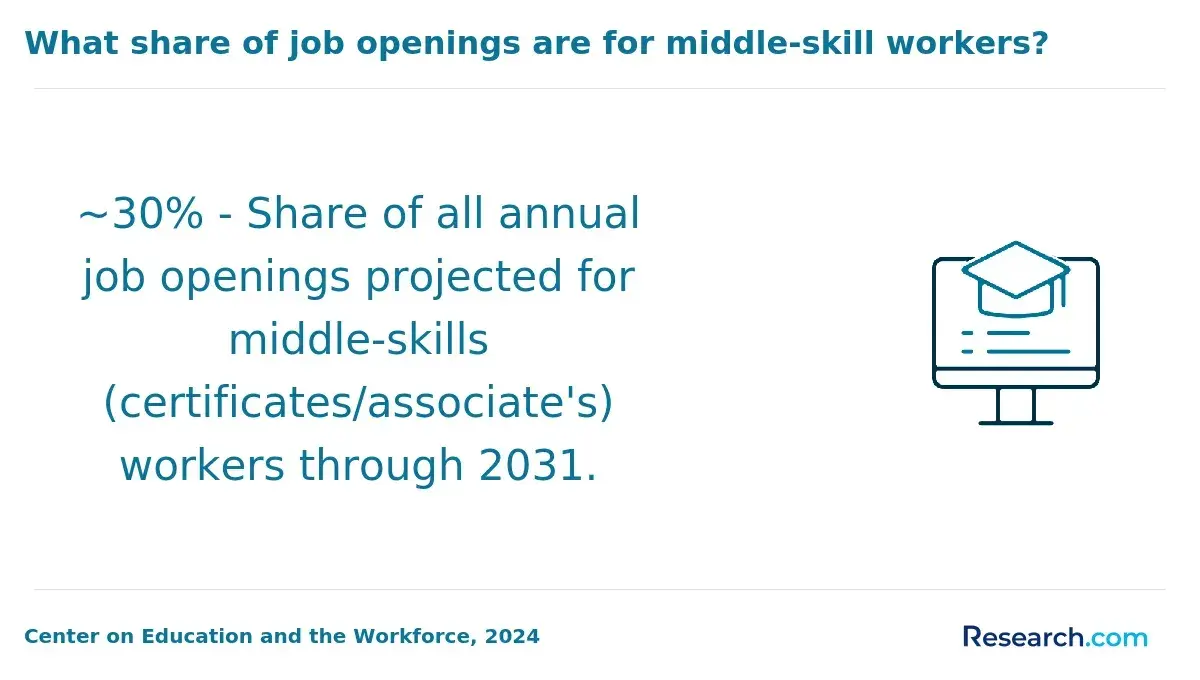
Certificates lead to good job opportunities when they teach a skill employers recognize, match a local hiring need, and meet the occupation's actual entry rules.
Strong options often include HVAC/R, welding, electrical and industrial maintenance pathways, medical assisting, practical nursing, pharmacy technician, bookkeeping, IT support, and commercial driving. The best choice depends on whether the job requires a license, a national certification, a degree, or an apprenticeship after training.
Occupational data provides context rather than a salary guarantee. The U.S. Bureau of Labor Statistics reported a 2024 median annual wage of $59,810 for heating, air conditioning, and refrigeration mechanics and installers; a short HVAC certificate can build relevant knowledge, but employers and states may still require supervised experience or licensing.
Compare career relevance using these questions before applying:
- Does the program publish the exact credential awarded and whether it is credit-bearing?
- Does it prepare you for a named licensing or certification exam, and are exam fees included?
- Do local job postings request this credential, related experience, or a higher degree?
- Does the curriculum include the equipment, software, lab work, or clinical hours used on the job?
What Are the Admission Requirements for Certificate Programs?
Admission requirements vary more by program type than by the word "certificate." Community-college certificates may request an application, proof of high school completion or equivalent, residency information, and placement steps.
Noncredit professional certificates may require only registration and payment. Advanced certificates can require prior coursework, a degree, or work experience.
Programs with patients, public safety responsibilities, expensive equipment, or limited placements often add requirements after general admission. Treat those requirements as part of admission planning, not minor paperwork:
| Requirement | Where it is common | What to verify |
| High school diploma or GED | College and trade certificates | Whether alternatives or adult-education pathways are accepted |
| Placement or prerequisite course | Technical and college-credit programs | Math, reading, anatomy, or software prerequisites |
| Background check and health clearance | Clinical healthcare programs | Timing, cost, placement eligibility, and appeal policies |
| Portfolio or audition | Some advanced arts programs | Whether it is required for entry or only for course placement |
| Prior degree or experience | Graduate or advanced professional certificates | Minimum credential and whether experience can substitute |
Do not assume a stated "no GPA requirement" means every applicant is admitted into a limited cohort. Ask whether the school has separate college admission and program admission decisions.
How Long Do Certificate Programs Take?
Many short certificates take a few months to one year when studied continuously, while academic and clinical certificates may take one to two years because courses follow a sequence or require placements. Completion time is affected by start dates, prerequisite gaps, part-time enrollment, course availability, and whether required exams are scheduled separately.
A compressed format is worthwhile only when you can keep pace and the curriculum includes enough supervised practice for your goal. Working adults should ask for a term-by-term plan showing weekly workload, required live sessions, campus dates, and the latest possible completion date if a course is unavailable.
For people who need broader training and can commit more time, an associate degree may offer a clearer progression route than stacking unrelated short courses. A certificate is most efficient when it directly closes a specific skills gap.
How Much Do Certificate Programs Cost?
Cost should be evaluated as total cost, not tuition alone. The College Board's 2024-25 average published tuition and fees for public two-year colleges was $4,050, but local tuition, residency status, program length, and supplies can produce very different totals. Private career schools and third-party training providers may price programs differently and may not participate in federal aid.
Build a written estimate that includes the following common expenses:
- Tuition and mandatory institutional fees.
- Books, digital access codes, software, tools, uniforms, and safety equipment.
- Exam, background-check, immunization, fingerprinting, and licensing fees when applicable.
- Transportation, parking, childcare, and unpaid clinical or practicum time.
Ask whether the certificate is eligible for federal aid, state workforce funding, Veterans Affairs education benefits, employer tuition assistance, or an installment plan. If an advanced degree is your actual destination, compare this expense with a cheapest masters degree option rather than accumulating credentials that do not advance your goal.
Which Certificate Programs Offer the Best Salary Potential?
The highest salary potential usually appears in fields where the certificate is one step in a regulated or technical progression - not a standalone promise of employment.
Examples include practical nursing, HVAC/R, electrical work, industrial maintenance, commercial driving, and advanced manufacturing. A program's value rises when it leads to an employer-recognized exam, apprenticeship, or clearly defined next credential.
Use occupational wage data carefully. The Bureau of Labor Statistics reported a 2024 median annual wage of $62,350 for electricians, but electricians typically complete an apprenticeship and meet state or local licensing requirements; an introductory electrical certificate alone generally does not confer electrician status.
Compare local wages, required experience, shift expectations, and licensing rules before treating wage figures as a return-on-investment estimate.
A lower-cost certificate can be a better investment than a high-priced one when both lead to the same recognized next step. Conversely, a cheap program is poor value if it lacks required clinical hours, equipment practice, or exam preparation.
How Do You Check Accreditation and Licensing?
Accreditation evaluates an institution or program against standards; licensing is legal permission issued by a government authority; certification is a credential issued by a professional body.
These are different checks. A school can be institutionally accredited while a particular program does not meet a profession's specialized approval expectations.
Use this sequence before paying a deposit:
- Confirm the school's institutional accreditation directly through the accreditor or the U.S. Department of Education database.
- Check your state licensing board if the occupation is licensed, including rules for online or out-of-state programs.
- Ask whether the exact curriculum meets educational eligibility for any required certification or licensing exam.
- Get the answer in writing, including the program name, campus or online format, and anticipated completion date.
For noncredit training, institutional accreditation may not apply in the same way. Focus instead on transparent provider identity, instructor qualifications, employer recognition, and whether an independent certifying organization recognizes the training.
How Do You Choose a Reputable Certificate Program?
A reputable program gives clear, verifiable answers about curriculum, total cost, admissions, outcomes, and what the credential permits you to do. It does not imply that a certificate automatically creates a license, job offer, or salary.
For graduate-level career advancement, a short certificate may complement experience, but it is not equivalent to a doctorate; learners researching that route can compare a PhD without dissertation option based on the career's actual degree expectations.
Before enrolling, compare written answers from at least two providers on the points below:
- Exact credential title, number of credits or clock hours, and whether credits can transfer or stack into a degree.
- Total out-of-pocket cost, refund policy, equipment fees, and costs due after completion.
- Required in-person sessions, clinical placements, internships, apprenticeships, or proctored exams.
- Graduate outcomes reported with definitions and timeframes, rather than vague employment claims.
- Licensure or certification exam eligibility for your state and the provider's support if a placement fails.
Red flags include pressure to sign immediately, unclear refund terms, vague claims about accreditation, unusually high wages without source details, and a refusal to state whether credits transfer. Choose a program only after its training format and recognition match the job you want.
Other Things You Should Know About
Often, yes. Open-enrollment community colleges and many noncredit workforce providers may not use a competitive GPA. Selective healthcare, clinical, and limited-seat programs can still require prerequisite grades or rank applicants.
Most entry-level certificate programs do not require SAT or ACT scores. A college may use placement measures to determine whether you need foundational coursework, particularly in math or English.
No. A certificate is awarded for completing education or training. Professional certification is awarded by an industry or professional organization after meeting its standards, which may include an exam, work experience, or continuing education.
It can only do so if the program meets your state's educational requirements and includes any required clinical, lab, practicum, or supervised hours. Confirm eligibility with the relevant state licensing board before enrolling.
References
- 2025's Best Online Graduate Certificate Programs in the U.S. https://www.onlinemastersdegrees.org/graduate-certificate-programs/
- Certificate Programs: Programs, Costs, Duration & Are They Worth It? - University of the Potomac https://potomac.edu/certificates-programs-costs-duration-are-they-worth-it/
- Certificate Programs https://cod.edu/academics/areas/career-technical-programs.html
- Degrees and Certificates - Salt Lake Community College https://catalog.slcc.edu/content.php
- Online Certificate Programs, Online Certificate Courses https://www.onlinedegrees.com/best-online-certificate-programs/
- Certificates - Nashville State Community College https://www.nscc.edu/admissions/how-to-apply/certificates-and-non-degree-seeking.php
- New research questions the value of certificates pushed... https://hechingerreport.org/new-research-questions-value-certificates-pushed-colleges-policymakers/
- The Value of Certifications: Employers Weigh In! - Career Horizons https://www.career-horizons.com/the-value-of-certifications-employers-weigh-in/
- Explore Top IT Certificate Programs | CyberDegrees.org https://www.cyberdegrees.org/listings/best-it-certificate/
- The Top 5 Certificate Programs for Jobs With Growth Potential | CourseStorm https://www.coursestorm.com/blog/top-certificate-programs-for-jobs