2027 Best Associate Degree Completion Programs for Career Growth

Co-Founder and Chief Data Scientist
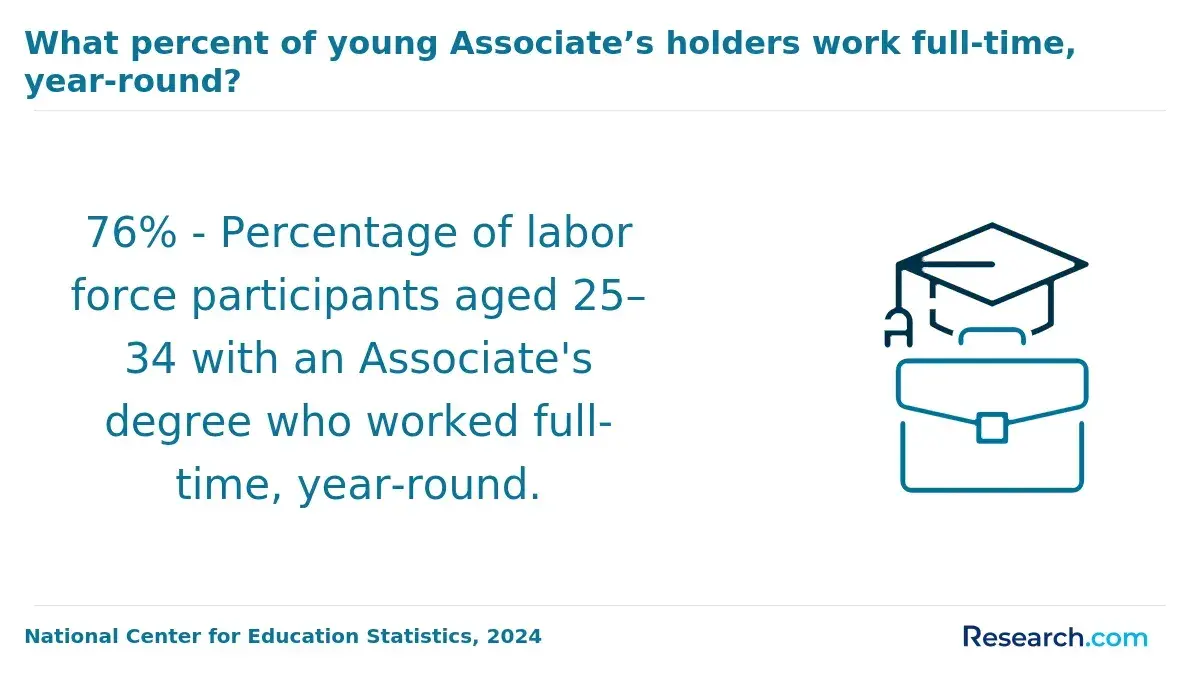
If you have college credits but no degree, the best path forward depends on which credits count and what career you want next. U.S. Bureau of Labor Statistics data for 2024 show median weekly earnings of $1,099 for workers whose highest credential was an associate degree.
That is a broad workforce measure, not a predicted payoff from finishing a particular program. This guide compares six fields, explains the limits of their career opportunities, and shows how to check remaining requirements, cost, and accreditation before enrolling.
Key Things You Should Know
- For immediate career preparation, compare occupation-specific healthcare and nursing programs first; business, IT, criminal justice, and psychology programs may offer broader entry points but different advancement requirements.
- Ask for a written degree audit: accepted credits may reduce coursework, but residency rules and unfinished major requirements determine the actual time and cost.
- Use occupational pay as context, not a promise. For example, the 2024 median annual wage for registered nurses was $93,600, but nursing graduates must also meet licensure requirements.
Top 10 Best Associate Degree Completion Programs for Career Growth
Business Programs
A business AA or AS can suit students planning to transfer into accounting, finance, or management studies. A business AAS may emphasize workplace skills such as bookkeeping, operations, and office technology. For career growth, compare the actual accounting and software courses with local job requirements rather than relying on the broad "business" label. Previous general education credits may transfer while major courses remain. An associate degree can support entry-level administrative or operations work, but management roles generally require experience and may favor a bachelor's degree.
Healthcare Programs
Healthcare completion paths vary substantially. Health information or medical administrative programs may accommodate online coursework and previous credits; clinical allied-health programs often have sequenced labs, placements, and separate admissions requirements. Choose a named occupation before comparing degrees: its certification, accreditation, and state requirements should guide your shortlist. A general health sciences degree can be useful for transfer, but it should not be mistaken for a credential that qualifies you for a licensed clinical role. Confirm which required science courses will transfer.
Information Technology Programs
IT associate programs can cover networking, cybersecurity fundamentals, programming, or technical support. Students with previous college credit should check whether older technical courses still satisfy current major requirements. A portfolio, hands-on labs, internships, or relevant certifications may strengthen an entry-level application, but the degree alone does not establish experience. Choose a specialization based on the jobs you can realistically pursue now: a broad IT degree is less useful if it lacks the tools and practical work those jobs request.
Nursing / Pre-Nursing Programs
These are different paths. An associate degree in nursing can prepare eligible graduates to seek registered nurse licensure after meeting state requirements and passing the required exam; admission, clinical placements, and prerequisite science courses may be selective. A pre-nursing AA or AS usually prepares students to apply to a nursing program and does not itself qualify them for RN licensure. Previous credits may clear general education requirements without shortening the clinical sequence. Verify nursing-program accreditation, state board approval, and clinical scheduling before committing.
Criminal Justice Programs
Criminal justice AA and AS programs often support transfer, while some AAS programs emphasize workplace preparation. Coursework may address courts, corrections, investigation, and report writing. For career growth, check the hiring rules of the agency or occupation you want: police, corrections, and other public-safety roles can have separate academy, physical, background, or certification requirements. A degree is not a substitute for those steps. Students aiming for specialized or supervisory work should also investigate experience expectations and bachelor's pathways.
Psychology / Counseling Programs
A psychology AA or AS is primarily a transfer foundation, not a counseling license. It can introduce research methods, human development, and statistics while preserving a route to bachelor's study. Some entry-level human-services jobs may be accessible with an associate degree, depending on the employer and duties. Licensed counseling and psychologist roles require substantially more education and state-specific qualifications. If that is your goal, prioritize a transfer agreement and confirm that previous courses will satisfy the intended bachelor's major, not merely count as electives.
What Are Associate Degree Completion Programs?
An associate degree completion program is a pathway for someone who has already earned college credit but has not finished an associate degree. It applies accepted prior coursework toward a school's current degree requirements. Most associate degrees require about 60 semester credits, although program requirements vary; the relevant number for a returning student is the remaining credits after evaluation.
An AA or AS commonly supports transfer, while an AAS commonly emphasizes workforce preparation, but the curriculum and transfer agreement matter more than the abbreviation. A school may accept a course as transfer credit yet apply it only as an elective. Before enrollment, request a written evaluation showing completed general education and major requirements, credits still needed at that institution, and any limits involving course age, grades, source institution, or residency. Military training, exams, industry credentials, and documented prior learning earn credit only when the school evaluates and approves them under its policy.
Which Associate Degrees Offer the Strongest Career Opportunities?
For the clearest direct route to a defined occupation, start with nursing or a specific allied-health program. Their advantage comes with selective admission, in-person training, and licensure or certification steps. IT can be a strong fit for students who can demonstrate practical skills; business offers versatility but less direct access to a single occupation. Criminal justice depends heavily on employer hiring rules, while psychology is usually strongest as the first stage of a longer education plan.
The comparison below separates potential entry points from roles that require additional qualifications. Use it to match a program with your target job, not to infer a guaranteed outcome.
| Field | Potential direction | Career-growth consideration |
| Nursing and clinical healthcare | RN or a defined allied-health occupation | Check program approval, clinical access, and occupation-specific licensure or certification. |
| IT | Technical support or junior technology roles | Practical skills and experience matter alongside the degree. |
| Business | Administrative, bookkeeping, or operations support | Specialization and experience become more important for advancement. |
| Criminal justice | Public-safety or related support roles | Agency hiring standards may extend well beyond education. |
| Psychology | Some human-services support roles or bachelor's transfer | Licensed counseling requires further education and credentials. |
If a specific entry-level skill - not an associate degree or transfer pathway - is your immediate goal, compare targeted 6 month certificate programs as well. Check whether the certificate is recognized for the job you want and whether its credits can later count toward a degree.
How Do Online and Campus-Based Associate Programs Compare?
Online study can make it easier to keep working, but it is not automatically self-paced. Courses may require live sessions or fixed deadlines, and nursing and other clinical programs require hands-on components. Campus study provides more direct access to labs and in-person support but adds travel and scheduling constraints. Hybrid programs combine both and may be the most practical option for students pursuing clinical or laboratory work.
Delivery format also affects which school is realistic for a returning student. When comparing top online universities with local community colleges, confirm that the specific associate program accepts your credits and offers every remaining required course in a workable format. Ask where exams, labs, orientations, and placements take place before treating a program as fully remote.
What Do Associate Degree Completion Programs Teach?
Most associate programs combine general education - such as writing, mathematics, and communication - with courses in a major. Career-focused programs may add labs, simulations, internships, or clinical practice. Transfer-focused programs may instead emphasize foundational courses intended to satisfy a bachelor's program's lower-division requirements.
For a completion student, course content matters in two ways: it determines the skills you leave with, and it determines whether old credits meet current requirements. An earlier general education course might still apply while an outdated technology course does not. Ask an advisor to identify remaining courses by requirement and term offered, especially when a prerequisite must be completed before a lab or clinical sequence.
What Are the Admission Requirements for Associate Programs?
Colleges generally ask returning students for an application and official transcripts from every previous institution. They may assess placement or prerequisites when prior coursework does not establish readiness. Admission to the college is not necessarily admission to a major: nursing and some allied-health programs may separately review grades in required courses, applications, and placement availability.
Send transcripts before relying on an estimated transfer total. Ask when the school will issue an official evaluation and whether courses must meet minimum grades, subject matches, or age limits. If your target major is selective, find out whether you can finish missing prerequisites before applying and what happens to your credits if you are not admitted.
How Long Do Associate Degree Completion Programs Take?
Completion time is determined by accepted credits and the order in which remaining courses can be taken. A student with most general education completed may still need several terms if major courses have prerequisites or are offered infrequently. Part-time enrollment, clinical placement schedules, and a school's minimum residency-credit requirement can extend the timeline.
Ask for a term-by-term plan based on your evaluated transcript, intended course load, and earliest available start. Treat an advertised short completion time as a scenario with assumptions - not an estimate for you - until the school confirms your remaining courses and when each is offered.
How Much Do Associate Degree Completion Programs Cost?
Compare the cost of the credits you still need, not the published price of a full two-year degree. As a benchmark, the College Board reported average published tuition and fees of $4,050 per year for in-district students at public two-year colleges in 2024-25. That is a national sticker-price average, not a quote for a completion pathway or the amount a student pays after aid.
Build a school-specific estimate from the following charges and offsets. This helps reveal when a higher per-credit price may still produce a lower total bill because more of your previous coursework applies.
- Remaining tuition and mandatory fees, including any difference for out-of-district or out-of-state enrollment.
- Books, software, equipment, transportation, and required clinical or lab expenses.
- Potential grants, scholarships, employer assistance, and other aid for which you qualify.
Ask the financial aid office whether your intended program and enrollment level qualify for aid; eligibility is not automatic. If your main goal is a bachelor's degree, compare the full associate-to-bachelor's route with cheap online degrees that might accept your existing credits directly. The lowest associate tuition is not necessarily the lowest-cost path to your final credential.
What Jobs and Salaries Can Associate Degree Graduates Expect?
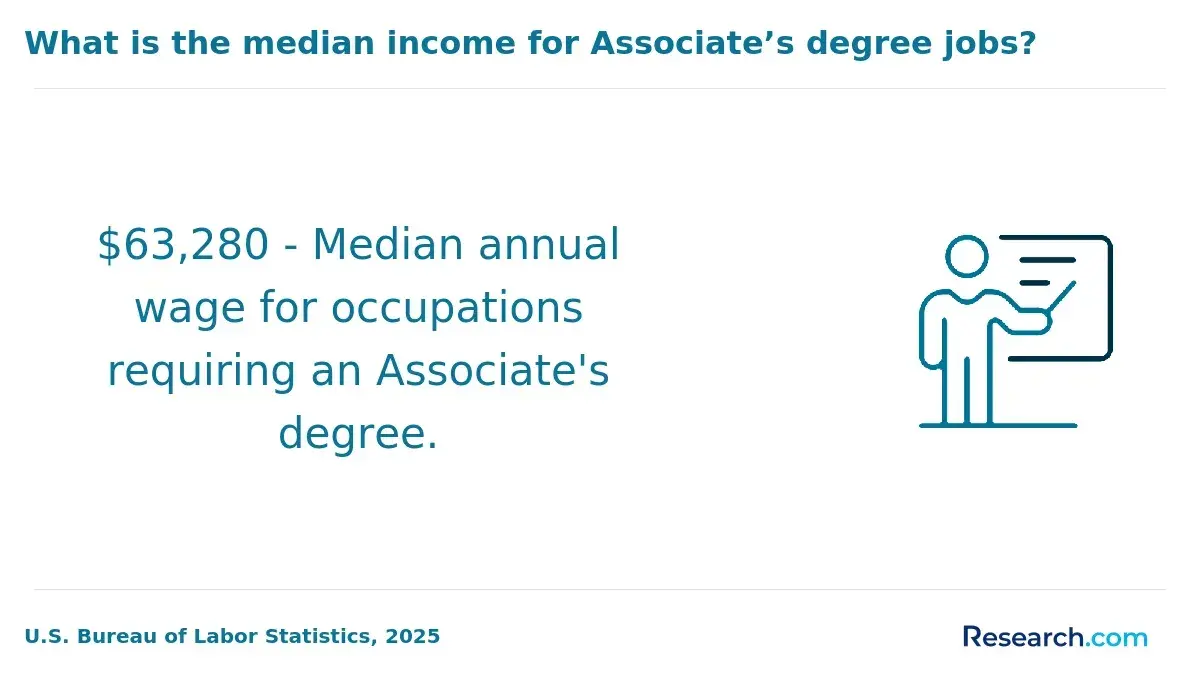
Possible roles range from administrative or technical support to regulated healthcare occupations, but they do not share one salary range or set of entry requirements. The U.S. Bureau of Labor Statistics reports a 2024 median annual wage of $93,600 for registered nurses. That figure describes employed RNs across experience and education levels; it is not the typical starting salary of associate nursing graduates. Graduates must also meet state licensure requirements before practicing as RNs.
For other fields, search the exact occupations you would apply for rather than assigning a broad major's graduates an occupational median. Compare local openings, stated education requirements, entry-level duties, and opportunities to advance. A psychology associate degree, for example, does not qualify someone to practice as a licensed counselor; an IT associate degree may open applications for support roles without qualifying someone for an advanced cybersecurity position.
How Can You Choose an Accredited Associate Degree Program?
Start by confirming that the institution holds accreditation recognized by the U.S. Department of Education or the Council for Higher Education Accreditation. Then check the program: nursing and other regulated fields may require particular programmatic accreditation or state approval for a student's intended licensing route. Institutional accreditation alone does not settle that question.
Before accepting an offer, request a written degree audit and compare the remaining courses, total cost, schedule, and career or transfer fit across schools. Confirm with the intended bachelor's institution that credits will satisfy major requirements, or with the relevant licensing board that the program meets its rules. Red flags include an unverified "fully online" clinical program, an unusually short timeline without stated transfer-credit assumptions, and a promised job or salary. If your long-term plan eventually reaches graduate study, apply the same accreditation scrutiny when considering affordable online doctoral programs.
Other Things You Should Know About
Often, yes. The receiving school decides which courses transfer, how they apply to the degree, and how many credits you must complete there. Request an official evaluation before estimating your finish date.
Choose a program tied to a specific entry-level occupation and verify its hiring or licensing requirements. Nursing and some allied-health programs offer defined routes but can require selective admission and clinical training.
It depends on the program. Ask about labs, clinical placements, exams, orientations, and live classes; "online" does not necessarily mean fully remote or self-paced.
Compare both routes. Finishing the associate degree may provide a useful credential and transfer pathway, but direct transfer into a bachelor's program may save time if more of your existing credits satisfy its requirements.
References
- College Affordability and Transparency Center | ed.gov http://collegecost.ed.gov/
- Education pays, 2024: Career Outlook: U.S. Bureau of Labor Statistics https://www.bls.gov/careeroutlook/2025/data-on-display/education-pays.htm
- Cost of Attendance (Budget) | 2025-2026 Federal Student Aid Handbook https://fsapartners.ed.gov/knowledge-center/fsa-handbook/2025-2026/vol3/ch2-cost-attendance-budget
- .16 Graduation Requirements. | Library of Maryland Regulations https://regs.maryland.gov/us/md/exec/comar/13B.02.02.16
- DAPIP | Homepage - Office of Postsecondary Education (OPE) https://ope.ed.gov/dapip/
- Evaluation of Transfer Credit | Cal Poly Academic Catalog https://catalog.calpoly.edu/academic-standards-policies/evaluation-transfer-credit/
- Earn College Credit for Prior Learning - Shawnee State University https://www.shawnee.edu/admissions/requirements/prior-learning-credits.html
- Regional vs. National Accreditation: Which is Better? | Drexel University Online https://www.online.drexel.edu/news/national-vs-regional-accreditation.aspx
- Brookdale Community College Catalog https://catalog.brookdalecc.edu/pages/NN2gMvtk1Ub9qVyqW8Hz
- 2026-2027 Direct Costs and Cost of Attendance | University of Connecticut https://financialaid.uconn.edu/cost/