2027 Are Online Radiology Technician Degrees Respected by Employers?

Co-Founder and Chief Data Scientist
Choosing an online radiology technician degree is not just a question of convenience. It is a career decision that affects clinical eligibility, certification, licensure, hiring, salary growth, and long-term credibility with healthcare employers. Online study has become more common in healthcare education, with recent data showing that over 40% of healthcare-related program graduates now earn their credentials through online study. Even so, radiologic technology remains a hands-on field, so employers look closely at more than the word “online.”
The strongest online radiology technician programs usually combine online coursework with supervised in-person clinical training. Hiring managers tend to respect these degrees when they come from properly accredited institutions, prepare students for recognized certification, and document real clinical competency. They are far less impressed by programs that are vague about accreditation, lack clinical placements, or promise a fully remote path into a patient-care role.
This guide explains how employers evaluate online radiology technician degrees, which accreditors matter, how school reputation and certification affect credibility, and what students should look for before enrolling. It is designed for prospective students, working healthcare employees, and career changers who want a flexible program without weakening their employment prospects.
Key Benefits of Online Radiology Technician Degrees Respected by Employers
- Employers increasingly recognize online radiology technician degrees when accredited by agencies like JRCERT, with over 70% of healthcare facilities considering these credentials equivalent to traditional degrees.
- Graduates gain hands-on clinical skills through mandatory in-person lab components, ensuring practical experience that meets employer expectations for competency in imaging technology and patient care.
- Completing a respected online program correlates with improved career outcomes, including a 15% higher job placement rate within six months compared to non-degree holders in the field.
Which Accrediting Bodies Make an Online Radiology Technician Degree Legitimate?
Accreditation is the first credibility test for an online radiology technician degree. Employers, certification bodies, licensing agencies, and transfer institutions use accreditation to determine whether a program meets accepted academic and professional standards. If a school or program is not properly accredited, students may face problems with financial aid, credit transfer, certification eligibility, and employment.
For radiology technician students, two kinds of accreditation matter: institutional accreditation and programmatic accreditation. They are not interchangeable.
| Accreditation type | What it reviews | Why it matters to students | Why employers care |
| Regional Accreditation (Institutional) | The college or university as a whole | Supports federal financial aid eligibility, transfer credit, and graduate school recognition | Shows the degree comes from a recognized institution with broader academic oversight |
| Programmatic Accreditation (Specialized) | The radiologic technology or radiologic science program itself | Helps confirm that the curriculum, clinical training, and outcomes align with professional standards | Signals that graduates were trained against standards relevant to imaging practice |
Regional Accreditation (Institutional) applies to the entire school. Agencies such as HLC (Higher Learning Commission), SACSCOC (Southern Association of Colleges and Schools Commission on Colleges), and NWCCU (Northwest Commission on Colleges and Universities) are major regional accreditors. This accreditation is important because it affects federal financial aid eligibility, credit transfer, and general employer confidence in the institution.
Programmatic Accreditation (Specialized) is especially important in radiologic technology. The Joint Review Committee on Education in Radiologic Technology (JRCERT) is the primary accrediting body for these programs. A jrcert accredited online radiology technician program is more likely to align with national expectations for curriculum quality, clinical education, and preparation for the ARRT (American Registry of Radiologic Technologists) exam. Many healthcare employers treat this type of accreditation as a baseline requirement or a strong preference.
Students should verify accreditation directly with the accrediting agency, not only on a school’s marketing page. Before enrolling, confirm the exact program name, credential level, campus or online format, clinical requirements, and whether the program supports certification and licensure goals in the state where you plan to work.
- Do not rely on institutional accreditation alone. A regionally accredited school can still offer a program that lacks the specialized recognition employers expect.
- Check clinical placement details. A credible online program should explain how students complete supervised hands-on training.
- Ask about certification eligibility. The program should clearly state how it prepares graduates for ARRT-related requirements.
- Consider flexibility carefully. Students comparing flexible routes, such as a fast online bachelor's degree for working adults, should still make accreditation and clinical training nonnegotiable.
Does University Reputation Affect Employer Views of Online Radiology Technician Degrees?
Yes. University reputation can influence how employers initially view an online radiology technician degree, but it rarely outweighs accreditation, certification, and clinical competence. A respected school can help a resume get a closer look. It cannot make up for weak clinical preparation or lack of recognized credentials.
Hiring managers are generally more comfortable with online degrees from established, accredited universities that have a track record in health sciences. For example, East Tennessee State University is often viewed favorably because of its online radiologic science program and broader institutional recognition. A school with a clear healthcare focus, experienced faculty, and transparent outcomes gives employers more confidence that online coursework was rigorous rather than superficial.
Institutional reputation also matters when alumni outcomes are visible. Boise State University's online radiology program, ranked in the top 11% for online bachelor's degrees and eighth for online imaging sciences, illustrates how reputation can strengthen employer confidence. When graduates from a program move into advanced practice, leadership, education, or specialized imaging roles, employers are more likely to see the degree as professionally useful.
Still, reputation works best as a supporting factor. Employers usually make final decisions based on whether the candidate can safely perform imaging procedures, communicate with patients, follow protocols, and meet credentialing requirements.
| Factor | How it affects employer perception |
| Institutional reputation | Can improve first impressions, especially when the school is known for health sciences or online academic quality |
| Programmatic accreditation | Provides stronger evidence that the radiology program meets professional education standards |
| Clinical experience | Shows whether the graduate has practiced in real healthcare environments, not only completed online coursework |
| ARRT registration and related credentials | Gives employers a standardized way to assess readiness and professional knowledge |
| Alumni outcomes | Helps demonstrate whether graduates succeed in imaging roles, leadership, or specialized practice |
Strong industry partnerships and local clinical placements can make an online program much more credible. Programs that help students train in hospitals, imaging centers, or approved clinical sites give employers concrete evidence of practical readiness. Boise State’s hands-on local clinical placement model is an example of the kind of structure employers value.
Prospective students should not choose a program based on name recognition alone. A lesser-known accredited program with strong clinical placements may be more useful than a better-known school with unclear radiologic technology outcomes. Students considering broader academic options, including easy online masters, should apply the same principle: reputation helps, but accreditation, outcomes, and career fit matter more.
Do Employers Treat Online and On-campus Radiology Technician Degrees Equally?
Employers often treat online and on-campus radiology technician degrees similarly when the programs are accredited, clinically rigorous, and lead to the same professional credentials. The delivery format matters less than whether the graduate can meet patient-care standards, pass credentialing requirements, and perform competently in clinical settings.
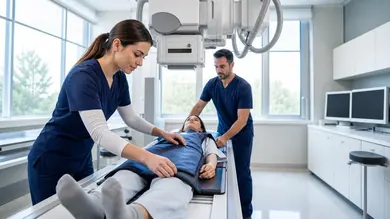
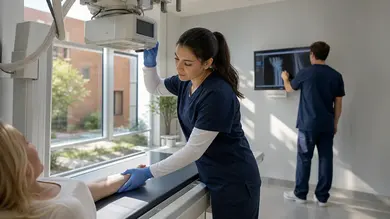
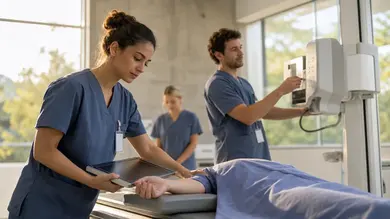
Radiologic technology is not a field where a fully academic, no-clinical online degree is enough. Employers expect hands-on training because graduates must position patients, operate imaging equipment, follow radiation safety protocols, produce usable images, and work as part of a healthcare team. For this reason, the strongest online programs use a hybrid model: online lectures and assignments combined with in-person clinical rotations or labs.
| Employer question | What a strong online graduate should be able to show |
| Was the program accredited? | Institutional accreditation and, when applicable, programmatic accreditation such as JRCERT |
| Was the training hands-on? | Completed clinical rotations, lab experience, and supervised practice in approved settings |
| Is the graduate credential-ready? | Preparation for professional certification, including ARRT-related expectations |
| Can the graduate work safely with patients? | Evidence of patient communication, radiation safety knowledge, positioning skills, and protocol adherence |
| Does the degree come from a credible school? | A recognized institution with transparent program requirements and outcomes |
Some employers may still be cautious about online education, especially if a candidate cannot explain the clinical portion of the program. Graduates can reduce that concern by clearly listing clinical sites, imaging modalities practiced, patient-care responsibilities, certifications, and any supervised competencies on their resume.
The key is not to hide the online format but to frame it correctly. A strong answer is: the academic coursework was online, the clinical training was completed in person, and the program met recognized accreditation and certification standards. That distinction is what makes an online radiology technician degree competitive with an on-campus credential.
Do Employers Trust Online Radiology Technician Degrees from AI-powered Virtual Classrooms?
Employers may trust online radiology technician degrees that use AI-powered virtual classrooms, but only when the technology supports—not replaces—accredited instruction and supervised clinical training. AI tools can strengthen learning, but they do not remove the need for real patient interaction, equipment practice, and documented clinical competency.
AI-powered classrooms can be useful in radiologic technology education because they give students more ways to practice decision-making before entering clinical settings. Adaptive learning systems can help identify knowledge gaps. Virtual simulations can expose students to imaging scenarios, anatomy review, radiation safety decisions, and procedural workflows. AI tutors and feedback tools can help students review errors and reinforce protocol-based thinking.
These tools can make online learning more interactive and measurable. For employers, the most valuable benefit is not that a program uses AI, but that the program can document what students practiced, how they were evaluated, and how those activities prepared them for supervised clinical work.
| AI feature | Potential value | Employer concern if used poorly |
| Adaptive learning | Targets weak areas in anatomy, imaging principles, safety, or procedures | May not prove hands-on competence by itself |
| Virtual simulations | Allows repeated practice with scenarios before clinical rotations | Cannot fully replace patient positioning, equipment handling, or real clinical pressure |
| AI feedback tools | Gives students faster correction and case-based reinforcement | Quality depends on faculty oversight and assessment standards |
| Digital case review | Builds image evaluation and clinical reasoning skills | Must be connected to formal competencies and instructor evaluation |
Employer confidence is strongest when AI-enhanced coursework is part of a program with recognized accreditation, faculty supervision, robust clinical placements, and preparation for ARRT-related certification. A program that advertises advanced technology but avoids explaining clinical requirements should be treated cautiously.
Students should ask direct questions before enrolling: Who evaluates simulation performance? How are clinical skills documented? Where do students complete in-person training? Does the program prepare graduates for certification and state requirements? The answers matter more than the presence of AI itself.
What Skills Do employers Value from Online Radiology Technician Graduates?
Employers value online radiology technician graduates who can prove both technical readiness and patient-care maturity. Completing coursework online may show independence and digital fluency, but hiring managers still want evidence that the graduate can work safely, communicate clearly, and follow imaging protocols in real clinical environments.
The most competitive graduates connect their online education to concrete workplace skills. A resume should not simply say “completed online degree.” It should show clinical rotations, imaging modalities, patient volume when appropriate, certifications, equipment familiarity, and teamwork experience.
- Technical expertise: Employers look for graduates who understand imaging equipment, positioning, exposure factors, safety procedures, and image quality standards. Training may include X-ray, CT, and MRI concepts, depending on the program and credential path.
- Attention to detail: Radiology work leaves little room for careless mistakes. Employers value graduates who can follow protocols, verify patient information, position accurately, and recognize when an image may need correction.
- Radiation safety awareness: Candidates should understand protection principles, patient shielding where applicable, dose awareness, and safe practice standards. This is central to patient safety and professional trust.
- Communication skills: Radiology technicians often work with anxious, injured, elderly, or medically fragile patients. Employers want graduates who can explain procedures clearly, give instructions calmly, and coordinate with nurses, physicians, and imaging teams.
- Clinical judgment: Strong graduates know when to ask for help, when to repeat an image, how to respond to patient limitations, and how to adapt without ignoring protocol.
- Problem-solving and adaptability: Imaging departments can be busy and unpredictable. Employers value candidates who can troubleshoot routine workflow issues, adjust to different clinical environments, and remain calm under pressure.
- Compassion and professionalism: Patient-centered care matters. Employers notice whether a candidate respects privacy, maintains composure, and treats patients with dignity during uncomfortable or stressful procedures.
- Organization and documentation: Online study can help build self-management habits, but employers need those habits to translate into accurate records, timely workflow, and dependable follow-through.
Students comparing shorter academic routes, including the fastest way to get associate's degree, should remember that speed is useful only if the program still develops the clinical and professional skills employers require.
Do Professional Certifications Help Validate Online Radiology Technician Degrees?
Yes. Professional certifications are one of the strongest ways to validate an online radiology technician degree. They give employers an external measure of competence beyond the school’s transcript. In a clinical field, that outside validation can be especially important for graduates whose academic coursework was delivered online.
Certification does not erase the need for accreditation or clinical training. Instead, it works with them. A credible pathway usually includes an accredited education program, supervised clinical experience, and professional certification or registration that aligns with employer and state requirements.
- American Registry of Radiologic Technologists (ARRT) Certification: ARRT certification is the most widely recognized credential in radiologic technology and is often tied to state licensure requirements. It helps employers verify that a graduate has met defined expectations in radiologic procedures, patient care, ethics, and professional knowledge.
- Specialized Certifications: Credentials in areas such as mammography, MRI, or CT scanning can help graduates demonstrate focused expertise beyond entry-level imaging. These certifications may improve competitiveness for specialized departments or advanced imaging roles.
- Career Mobility: Certifications can make it easier to apply across employers, departments, and regions because they provide a recognizable standard. They may also support advancement into higher-responsibility roles.
- Employer Confidence: A candidate with an accredited degree, clinical experience, and recognized certification is easier for a hiring manager to evaluate. This combination reduces uncertainty about whether the online program produced job-ready skills.
Before choosing an online program, students should ask which certifications the curriculum is designed to support and whether graduates meet eligibility requirements. They should also review state licensure rules, because requirements can vary by location and role.
Do Online Radiology Technician Graduates Earn the Same Salaries as On-campus Graduates?
Online radiology technician graduates can earn the same salaries as on-campus graduates when they hold equivalent credentials, meet the same employer requirements, and have comparable clinical experience. Employers generally base pay on role, certification, modality, experience, location, shift, and employer type—not simply whether classroom instruction was online.
The better salary question is not “online or on campus?” It is “Does this program lead to the same professional opportunities?” If an online program is accredited, includes strong clinical training, and prepares students for recognized certification, its graduates can compete for the same jobs and pay ranges as graduates of traditional programs.
- Accreditation and Certification: Employers prioritize candidates who graduate from accredited programs and hold valid credentials such as ARRT registration. An online degree from a program with the same recognized standards as an on-campus program should not automatically limit salary potential.
- Employer Perception: The ASRT Wage and Salary Survey highlights that most healthcare employers focus on skills, credentials, and professionalism instead of whether a degree was earned online or on-campus. Strong clinical experience can also support better job offers and negotiation outcomes.
- Geographic Location: Radiology technician salaries vary by region. Metropolitan areas and states such as California and Massachusetts typically offer higher wages. These location-based differences apply to both online and on-campus graduates.
- Experience and Specialization: Work history and advanced credentials in modalities such as CT or MRI can have a meaningful effect on earning potential. Both online and traditional graduates can pursue these specializations if they meet the required prerequisites.
- Clinical Training Quality: Employers may pay more attention to the quality of clinical preparation than to the course delivery format. Graduates who can document strong hands-on experience are better positioned for competitive roles.
Students researching salary outcomes should compare programs by certification eligibility, clinical placement strength, graduate employment patterns, and modality options. Broader career research into quick degrees with high pay can be helpful, but radiologic technology students should not sacrifice accreditation or clinical training for speed.
How Do Online Radiology Technician Degrees Impact Career Growth and Promotions?
An online radiology technician degree can support career growth when it adds credentials, specialization, leadership preparation, or a higher academic credential without forcing the student to leave the workforce. This is one of the main advantages of online study for working imaging professionals: it can make advancement possible while maintaining income and clinical experience.
For entry-level students, the degree’s career value depends on whether it leads to certification eligibility and a first clinical role. For current radiology professionals, an online degree may help with promotion into supervisory, educational, administrative, or specialized imaging positions.
- Higher Earning Potential: Graduates with an online bachelor's degree in radiologic technology often command salaries well above those with only associate degrees. The degree may support eligibility for roles that require broader knowledge, leadership ability, or advanced clinical preparation.
- Access to Leadership and Specialized Roles: Online programs may include coursework in leadership, healthcare systems, advanced imaging, quality improvement, or education. These areas can prepare graduates for roles such as department managers or imaging supervisors.
- Career Flexibility and Specialization: Online study can help working professionals pursue concentrations or additional preparation in areas such as MRI, CT, or sonography. Specialization can improve marketability and open doors to different clinical settings.
- Improved Job Market Competitiveness: An accredited online degree can signal initiative and advanced training, especially when paired with strong certifications and recent clinical experience.
- Foundation for Continuous Advancement: Radiologic technology changes as imaging systems, protocols, and patient-care expectations evolve. Completing an online degree can build a foundation for future certifications, graduate study, or leadership development.
Promotions are not automatic. Employers still evaluate performance, dependability, communication, patient-care quality, and departmental needs. The degree helps most when it fills a specific gap between the role a graduate has now and the role they want next.
What Companies Actively Hire Graduates from Online Radiology Technician Programs?
Graduates from accredited online radiology technician programs can find opportunities across the same healthcare settings that hire traditionally trained graduates. Employers usually focus on licensure or certification eligibility, clinical readiness, and experience with relevant imaging modalities. The diploma format is typically secondary if the graduate meets the role’s requirements.
The most common hiring environments include hospitals, outpatient imaging centers, travel healthcare agencies, telehealth-related imaging operations, and medical technology companies.
- Hospitals and health systems: Large hospital networks, regional medical centers, and community hospitals hire radiology technician graduates for diagnostic imaging, CT scan, MRI, and interventional radiology support roles. These employers often have structured credentialing processes, so accreditation and certification are especially important.
- Outpatient imaging centers: Standalone diagnostic clinics and imaging facilities hire graduates to support X-ray, MRI, ultrasound, and other imaging workflows. These settings may value candidates who are efficient, patient-focused, and comfortable with digital systems.
- Travel healthcare agencies: Staffing firms that place travel and per diem healthcare workers may hire radiology technician graduates for short-term assignments. These roles usually require strong clinical independence, complete credentials, and the ability to adapt quickly to new facilities.
- Telehealth and remote radiology providers: Remote radiology organizations may need professionals who understand imaging workflows, patient scheduling, image transfer, documentation, or clinical coordination. Online graduates may be comfortable with digital communication tools, but clinical knowledge remains essential.
- Medical device and imaging technology firms: Companies involved in imaging equipment, software, sales, applications training, and clinical support may hire radiology technician graduates for roles outside direct patient imaging. These positions can be attractive for professionals who want to use clinical knowledge in a technical or business-facing environment.
Graduates exploring online radiology technologist jobs in Texas or in other states should review local licensure rules, employer credential requirements, and modality-specific expectations. Those still comparing paths may also benefit from guidance on choosing a trade career that fits their long-term goals.
What Future Trends Will Shape Online Radiology Technician Degrees' Credibility?
The credibility of online radiology technician degrees will depend on how well programs prove student competence, maintain clinical quality, and align with employer expectations. Online delivery is becoming more accepted, but healthcare employers will continue to demand evidence that graduates can work safely with patients and imaging systems.
The following trends are likely to shape how employers judge online radiology technician programs:
- AI-Driven Learning Validation: Artificial intelligence may help programs assess student progress through simulation-based learning, scenario review, and real-time feedback. Its credibility will depend on faculty oversight, transparent evaluation standards, and connection to clinical competencies.
- Global Accreditation Collaboration: More programs may align curricula with standards connected to organizations such as the American Registry of Radiologic Technologists (ARRT) and international bodies. This can help employers compare preparation across programs and regions.
- Increased Employer Partnerships: Partnerships with hospitals, imaging centers, and radiology networks can strengthen online programs by securing practical clinical placements. Employer-linked training also helps keep coursework aligned with real workplace needs.
- Skill-Based Hiring: Healthcare employers are increasingly focused on demonstrated competencies, valid certifications, professionalism, and clinical readiness. This trend can benefit online graduates who can show measurable skills rather than relying only on a transcript.
- Simulation and Remote Clinical Training: Tools such as virtual DICOM systems and remote imaging simulations can help students practice with digital cases and imaging workflows. These tools may improve preparation, but they are strongest when paired with supervised in-person clinical experience.
The programs likely to gain the most employer trust will be transparent about accreditation, clinical hours, certification outcomes, faculty qualifications, and employer partnerships. Programs that rely heavily on technology but provide little detail about hands-on training will remain harder for hiring managers to trust.
Here's What Graduates of Respected Online Radiology Technician Programs Have to Say About Their Degree
- Harlow: "Completing my radiology technician degree online allowed me to balance work and study while supporting my family. The flexibility of the program meant I could immediately apply what I learned in clinical settings, which helped me secure a job at a top hospital within months of graduating. Being an online graduate hasn't slowed me down; instead, it has opened doors to advanced certifications and leadership roles that I might not have pursued otherwise. I'm proud to contribute positively to my community's healthcare with the skills I gained."
- Brielle: "Choosing an online radiology technician program was a turning point in my career. It gave me access to cutting-edge technology and expert instructors from across the country, preparing me for a competitive job market. After completing the program, I was able to work in diverse clinical environments and quickly advance to a supervisory position. The experience boosted my confidence and passion for helping patients while fostering my professional growth every day."
- Chen: "The online degree provided me with incredible career advancement opportunities by allowing me to study alongside a full-time job in a rural area. This balance was crucial in building my skills without sacrificing income. Upon graduation, I found stable employment at a regional imaging center where I'm valued for my dedication and tech-savvy approach-qualities nurtured through the program. My journey has inspired others in my community to pursue healthcare careers despite geographic barriers."
Other Things You Should Know About Respectable Online Radiology Technician Degree Programs
Yes. Accredited radiologic technology programs require supervised clinical training in medical settings, usually through affiliated hospitals or imaging centers. Students complete hands-on rotations in patient care, positioning, radiation safety, and equipment use. The Joint Review Committee on Education in Radiologic Technology requires clinical competencies before graduation.
Graduates of accredited online programs are eligible to take national certification exams like the ARRT exam. Passing these exams is necessary to obtain licensure in most states and is a requirement for employment.
In 2027, the primary barriers to employer respect include skepticism about the quality of hands-on training, inconsistent program accreditation, and potential technological limitations. Ensuring proper accreditation and supplementing online education with clinical experiences can help overcome these challenges.
References
- Online Radiologic Technology - Associate of Applied Science Degree Completion Program https://www.chcp.edu/degrees-certificates/online/radiologic-technology-aas-completion-program/
- Superagency in the workplace: Empowering people to unlock AI’s full potential https://www.mckinsey.com/capabilities/mckinsey-digital/our-insights/superagency-in-the-workplace-empowering-people-to-unlock-ais-full-potential-at-work
- Insights from the Job Demands–Resources Model: AI's dual impact on employees’ work and life well-being - ScienceDirect https://www.sciencedirect.com/science/article/pii/S0268401225000192
- Online Radiology Tech Programs: Finding the Right School https://www.edumed.org/online-schools/radiology-tech-programs/
- Current Status of Radiology Education Online: a Comprehensive Update https://pmc.ncbi.nlm.nih.gov/articles/PMC9366813/
- Top 10 Online Radiology Tech Programs 2025 https://nurse.org/healthcare/radiology-technician-programs/
- How to Advance Your Career in Radiologic Technology https://online.lsu.edu/newsroom/articles/how-to-advance-your-career-in-radiologic-technology/
- Radiology Career Trends, Skills & Global Scope | OC Academy https://www.ocacademy.in/blogs/future-in-radiology-heres-what-every-doctor-must-know-to-excel/
- Radiologic Technology (BS) | KPSAHS Programs https://kpsahs.edu/academics/all-programs/radiologic-technology-bs
- Right Radiologic Technologist School: Choosing the Right One | Cleveland University-Kansas City https://www.cleveland.edu/choosing-the-right-radiologic-technologist-school/