2027 A Second BS in Business Administration After a Bachelor's in Early Childhood Education: Credits, Cost, and Alternatives
Audited and Verified:
Our Editorial and Data Verification Process
Research.com uses government datasets, official education statistics and primary institutional information to support its career and degree guides. Our review process checks factual accuracy, occupational definitions, source dates and the requirements associated with the credentials discussed.
How This Article Was Fact-Checked
Our editorial team verifies salary estimates, employment projections, education requirements and program information against original data providers and official organizations. Salary figures are checked against the relevant occupational definitions and reporting periods. Information about licensure, accreditation and required in-person training is reviewed separately.
Fact-checked and verified on:

Co-Founder and Chief Data Scientist
An early childhood education degree can prepare you to teach and support children without necessarily preparing you to manage budgets, analyze operations, or move into a business role.
A second BS in Business Administration could fill those gaps, but its value depends on which credits meet the new degree's requirements and what you want to do next. This guide explains how to obtain a usable credit evaluation, estimate the full cost and timeline, and compare the degree with more targeted ways to build business skills.
Key Things You Should Know
- A completed education bachelor's may satisfy many general education requirements, but the receiving school decides which credits apply to its business core, electives, and second-degree requirements.
- Compare the cost of remaining required courses, not the advertised price of a full bachelor's; prerequisites, residency rules, and course scheduling can change the total.
- A second business degree is most compelling when your target role calls for broad business preparation. For an adjacent education-sector role, targeted coursework and relevant experience may be more direct.
Is a second business administration bachelor's degree worth it after early childhood education?
Start with the work you want to do. Your education background may already demonstrate communication with families, staff coordination, documentation, and program planning. A business degree adds more value if the roles you want require sustained work with accounting, finance, operations, marketing, or organizational decisions - and you need a structured way to learn several of those functions.
For example, someone aiming to run the administrative side of a childcare organization may benefit from budgeting and operations courses paired with experience handling enrollment or staffing. Someone seeking an HR support role might instead compare a few relevant courses and work experience with the more focused pathway described in a human resources program selection guide. A specialized certificate, employer training, or graduate program may be worth investigating if it meets your goal with less repeated undergraduate study.
Do not assume a second bachelor's is required simply because a job posting says "bachelor's degree." You already have one. Check whether employers require a business-related degree, particular technical skills, or experience you could gain without another full credential.
How many credits transfer toward a second bachelor's degree in business administration?
There is no reliable universal credit count. A school may recognize your entire first degree for admission or general education purposes while still requiring its business core, upper-level courses, and a minimum amount of study at that institution. Accepted credit is not the same as credit that satisfies a specific requirement.
The distinction below helps explain why two schools can accept the same transcript yet quote different completion plans.
| Credit category | How education coursework might apply | What can still remain |
| General education | Writing, mathematics, sciences, and humanities may already be covered. | School-specific requirements or an unmet quantitative course. |
| Business foundation | Relevant prior economics, statistics, or accounting courses may receive review. | Business prerequisites without an approved equivalent. |
| Major and concentration | Education courses may count as electives but seldom replace unrelated business requirements. | Upper-level business courses and any official concentration requirements. |
| Residency and second-degree rules | Previously earned credits remain on your record. | Credits the new institution specifically requires you to complete there. |
Send official transcripts and, where a match is unclear, course descriptions or syllabi to each prospective school's transfer office. Request a written second-degree audit showing accepted credits, requirements satisfied, remaining prerequisites, and residency credits. If your goal is specifically supply chain work, compare that audit with one for a specialized program, including any accelerated undergraduate supply chain programs you are considering. The program with the most accepted credits is not necessarily the one with the fewest courses left.
How much does a second business administration bachelor's degree cost?
Calculate cost from the official audit: remaining billable credits or terms, mandatory fees, books and software, and any travel or proctoring charges. Then account for time away from paid work and the cost of borrowing. A low per-credit price can lose its advantage if a school requires substantially more coursework.
Compare schools using the same categories rather than mixing an advertised tuition rate with an all-in estimate.
| Cost component | Information needed for a comparable estimate |
| Tuition | Remaining required credits or terms and the applicable rate. |
| Mandatory expenses | Program, technology, books, software, assessment, and travel charges. |
| Financing | Confirmed aid eligibility, employer reimbursement terms, and likely borrowing. |
| Opportunity cost | Work hours or income you would give up to complete the program. |
Ask each financial-aid office how a prior bachelor's affects your eligibility and whether your proposed enrollment meets its aid requirements. If you are comparing business administration with project management, review financial aid packages for online project management bachelor's students separately; aid for one program should not be assumed to apply to another.
Schools commonly request an application and official college transcripts, but admission to the institution may be separate from admission to the business major. A prior non-business degree does not, by itself, make you ineligible. GPA rules, mathematics preparation, and when business prerequisites must be completed depend on the program.
Ask admissions whether it has a distinct second-bachelor's application route. Ask the business department whether your prior statistics, economics, or other quantitative courses meet its prerequisites - and whether missing courses can be taken after admission. For a broader checklist of questions, see academic eligibility for business administration degree study. Obtain written answers for both admission and degree applicability; approval for one does not establish the other.
A general BS in Business Administration typically builds across accounting, economics, finance, marketing, management, operations, and quantitative decision-making. Your education degree may cover communication or general education, but teaching methods and child development courses usually serve different purposes from the business core. The actual requirements depend on the school's catalog and your audit.
Pay particular attention to course sequences: an introductory accounting or statistics requirement may have to precede finance or analytics. Also distinguish a formal concentration from a collection of electives. If you want project coordination rather than broad business preparation, compare the relevant courses and remaining credits with accredited project management programs with low tuition. Neither a business course nor a project management course automatically awards a professional certification.
Yes, some institutions offer online business bachelor's programs and accept applicants who already hold a degree. Online delivery does not settle whether the program accepts second-degree students, how your credits apply, or whether every required course is available when you need it.
When using a nationwide comparison of online business programs to identify possibilities, verify the current catalog and ask about live sessions, group projects, exam proctoring, internships, and campus visits. This matters especially if you work in a classroom during the day: an online class with fixed evening meetings may be less workable than an asynchronous class with predictable weekly deadlines.
The timeline depends on remaining requirements, enrollment pace, prerequisite chains, and how frequently required courses run. A short credit list does not ensure a short calendar timeline if a required course is offered infrequently or must follow another course.
Ask an adviser to map every remaining course by term under a pace you can sustain while working. Confirm whether summer enrollment, part-time study, or short-term classes toward a bachelor's degree would actually move your graduation date forward. An accelerated calendar may compress deadlines without reducing required work or total tuition.
First, confirm the institution's recognized accreditation and that the specific degree and delivery format are available to second-degree applicants. Then check whether any claimed AACSB, ACBSP, or IACBE accreditation covers the relevant business school or program; business-specific accreditation and institutional accreditation have different scopes.
Request the current second-degree policy, an official audit, a course-availability plan, and an itemized cost estimate before comparing offers. A list of affordable accredited business administration programs accepting FAFSA can help you build a shortlist, but FAFSA acceptance does not establish your personal aid eligibility or final net cost. Prefer the program that provides a feasible, documented route to graduation over one advertising the largest transfer allowance without showing where those credits apply.
The strongest initial opportunities often connect business tasks with your existing education experience: childcare program administration, enrollment or family-services coordination, staff training support, and operations roles at education organizations. You could also pursue entry-level HR, project, or administrative roles outside education, but those transitions may require function-specific skills and examples of relevant work.
Match applications to tasks you have actually performed. For an operations role, that might mean explaining how you coordinated schedules or tracked resources; for training support, how you developed materials and assessed learning needs. Do not present classroom teaching as proof that you have managed a business budget or supervised an organization. If your main goal is organizational leadership, compare the curriculum and requirements of undergraduate leadership programs with shorter timelines rather than assuming a general business degree is the only route. Managerial positions still generally depend on relevant responsibility and demonstrated results.
What salaries and job outlook can business administration graduates expect?
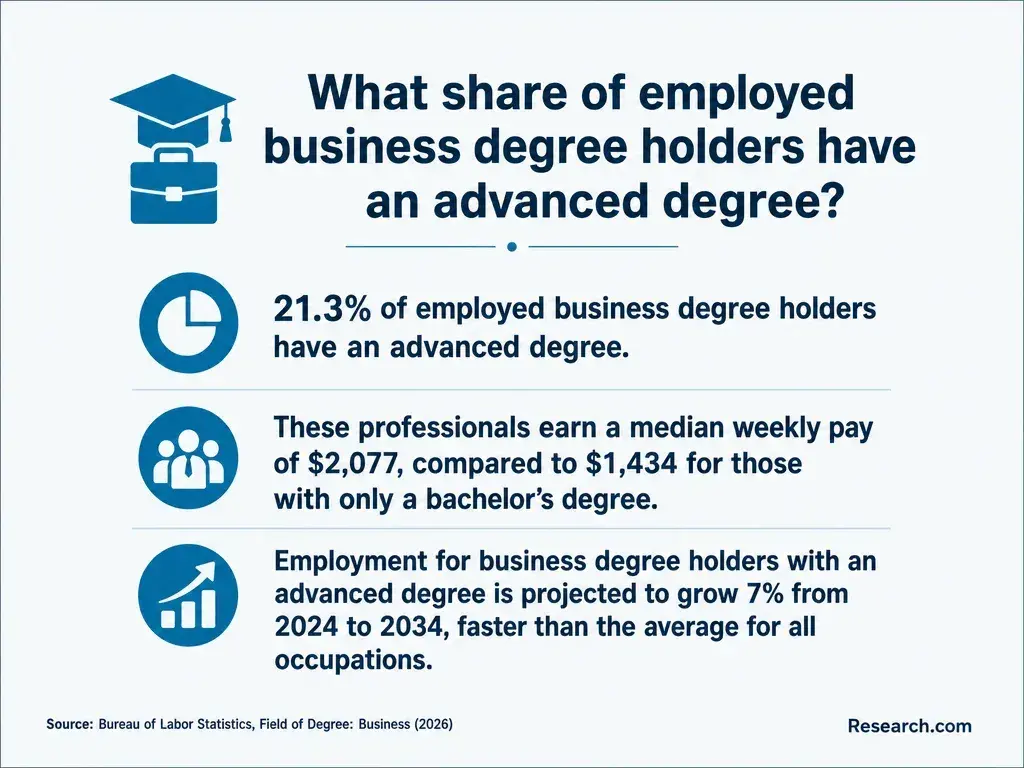
There is no single salary or growth rate for people with a BS in Business Administration: labor data describes occupations, not graduates of a particular major. One education-adjacent example is training and development specialist. The U.S. Bureau of Labor Statistics reports a May 2025 median annual wage of $69,280 for that occupation and projects 11% employment growth from 2025 to 2035. The figures cover workers across experience levels and education backgrounds; they are not a starting-salary offer or a prediction that a second degree will secure the job.
Use pay information for the specific role and location you want, alongside actual job requirements. Compare that opportunity with the remaining cost of your degree; a guide to compare tuition for online business colleges can help identify programs to investigate, but your individual audit determines what you would pay. A worthwhile return may include access to suitable roles or stronger skills, not necessarily an immediate salary increase.
Other Things You Should Know About Business Administration
No. A business degree does not itself replace an existing educator credential. Check your state's renewal and continuing-education rules if you want to keep your license active while changing roles.
Not automatically. State and local rules may govern facility licensing, staffing, director qualifications, and health and safety requirements. Check the requirements for the location where you plan to operate.
Some MBA programs admit graduates from non-business fields. Compare their admissions criteria, prerequisite coursework, cost, and career fit before committing to a second undergraduate degree.
Not by itself. CPA eligibility depends on state-specific education, examination, and experience rules. If accounting licensure is your goal, evaluate those rules before selecting a general business curriculum.
- Accreditation in the U.S. | ed.gov http://www.ed.gov/laws-and-policy/higher-education-laws-and-policy/college-accreditation/accreditation-in-the-us
- Types of Financial Aid: Grants, Work-Study, and Loans | studentaid.gov https://studentaid.gov/understand-aid/types
- What Is a Bachelor of Arts in Early Childhood Education? | UAGC https://www.uagc.edu/blog/what-is-a-bachelor-of-arts-in-early-childhood-education
- Tuition and Fees - Niner Central - UNC Charlotte https://ninercentral.charlotte.edu/billing-payments-refunds/tuition-and-fees
- What kind of aid am I eligible for as a second-degree student? | unc.edu https://studentaid.unc.edu/faq/what-kind-of-aid-am-i-eligible-for-as-a-second-degree-student/
- Second Bachelor's - UF Online - University of Florida https://ufonline.ufl.edu/apply/admissions-requirements/second-bachelors/
- Tuition and Required Fees - Bursar's Office | University of South Carolina https://sc.edu/about/offices_and_divisions/bursar/tuition_and_required_fees/
- Early Childhood Administration, A.A.S. | cod.edu https://catalog.cod.edu/programs-study/early-childhood-education-care/early-childhood-administration-aas/
- Earned a Bachelor's Degree - Undergraduate Admissions https://admissions.charlotte.edu/apply/transfer-students/transfer-requirements/earned-a-bachelors-degree/
- 17 types of business degrees and the jobs they can lead to | ASU Online https://asuonline.asu.edu/newsroom/online-learning-tips/types-business-degrees-jobs/