
#1 Best Nursing College in California, 98% NCLEX-RN Pass Rate, and a Carnegie Opportunity College Designation: Inside Stanbridge University’s Approach to Healthcare Education

Co-Founder and Chief Data Scientist
California’s healthcare system is facing massive labor shortages, creating highly lucrative opportunities for new nurses. However, earning a nursing degree does not automatically guarantee you a job. The real hurdle—and the ultimate test of any nursing school—is the NCLEX-RN licensure exam. If you fail this test, your expensive degree is virtually useless. While many traditional universities offer a classic college experience with sprawling campuses and football teams, they sometimes leave students to navigate this high-stakes exam on their own.
Stanbridge University takes a radically different approach. Rather than operating as a generalist university, Stanbridge functions as a specialized, hyper-focused workforce pipeline. For prospective students, the university’s primary value proposition is simple: it is structurally designed to get you licensed and employed in Southern California’s competitive healthcare market as reliably as possible.
Academic Identity: A Reputation Well-Earned
When evaluating a college as a financial investment, students should look for external proof that a school delivers on its promises. Stanbridge’s reputation is currently anchored by three converging credentials that validate its effectiveness as a nursing pipeline.
Prospective nurses should weigh these specific outcomes:
- The Ultimate Safety Net (98% NCLEX-RN Pass Rates): Between 2023 and 2025, Stanbridge’s Bachelor of Science in Nursing (BSN) graduates achieved exceptional pass rates on the California Board of Registered Nursing (BRN) exams. The program hit a perfect 100% pass rate in 2023/2024 and maintained a 95.18% rate for a massive cohort of 332 testers in 2024/2025. This proves the curriculum effectively mirrors the brutal reality of the state licensure exam.
- The "Opportunity College" Distinction: In 2025, the Carnegie Classification system recognized Stanbridge as an "Opportunity College," a designation awarded to only 479 of the 2,994 colleges nationwide. This metric measures a school's ability to admit underrepresented students and produce exceptional graduate earnings, demonstrating that the school serves as a genuine engine of upward economic mobility.
- The Top 5% ROI Recognition: In a 2025 ranking from Georgetown University's Center on Education and the Workforce, Stanbridge ranked in the top 5% of 4,600 colleges nationwide for return on investment. This ranking is based on a comprehensive analysis of earnings data, tuition costs, and opportunity costs. This recognition points directly to the long-term, 10-year financial benefits of investing in a Stanbridge degree.
- The Gold Standard "Gatekeeper" Accreditations: Accreditation provides an important independent measure of an institution’s educational quality and academic standards. Stanbridge holds institutional accreditation from ACCSC and programmatic accreditations including CCNE for nursing, ACOTE for occupational therapy, and CAPTE for physical therapy. These accreditations reflect the university’s commitment to meeting established standards for institutional and programmatic quality.
When evaluating a specialized workforce pipeline, a common concern is whether students become highly technical "robots" who lack bedside manner. Nursing requires complex synthesis, empathy, and crisis communication. Stanbridge addresses this "soft skills gap" aggressively by integrating professional development directly into its nursing curricula.
Students build competencies that extend beyond clinical knowledge, including communication, teamwork, critical thinking, ethical practice, leadership, professional identity, and lifelong learning. In the Bachelor of Science in Nursing program, these principles are incorporated alongside clinical reasoning, nursing skills, evidence-based practice, and professional values. The Associate of Occupational Science in Vocational Nursing program similarly connects theory, skills laboratory experiences, simulation, clinical practice, reflection, and professional role development.
The Geographic and Technological Engine
A nursing school's effectiveness is heavily dictated by its location and classroom resources. You cannot learn to save a life strictly from a textbook. Stanbridge strategically operates campuses in Orange County, Los Angeles, Riverside, and San Marcos. These are not just convenient locations; they are deliberate nodes plugged directly into Southern California, one of the largest and most talent-starved healthcare labor markets in the United States.
This footprint allows students to complete their clinical rotations within massive, complex hospital systems where they intend to eventually work. However, before a student ever touches a real patient, they must prove their competency. This is where Stanbridge justifies its tuition costs.
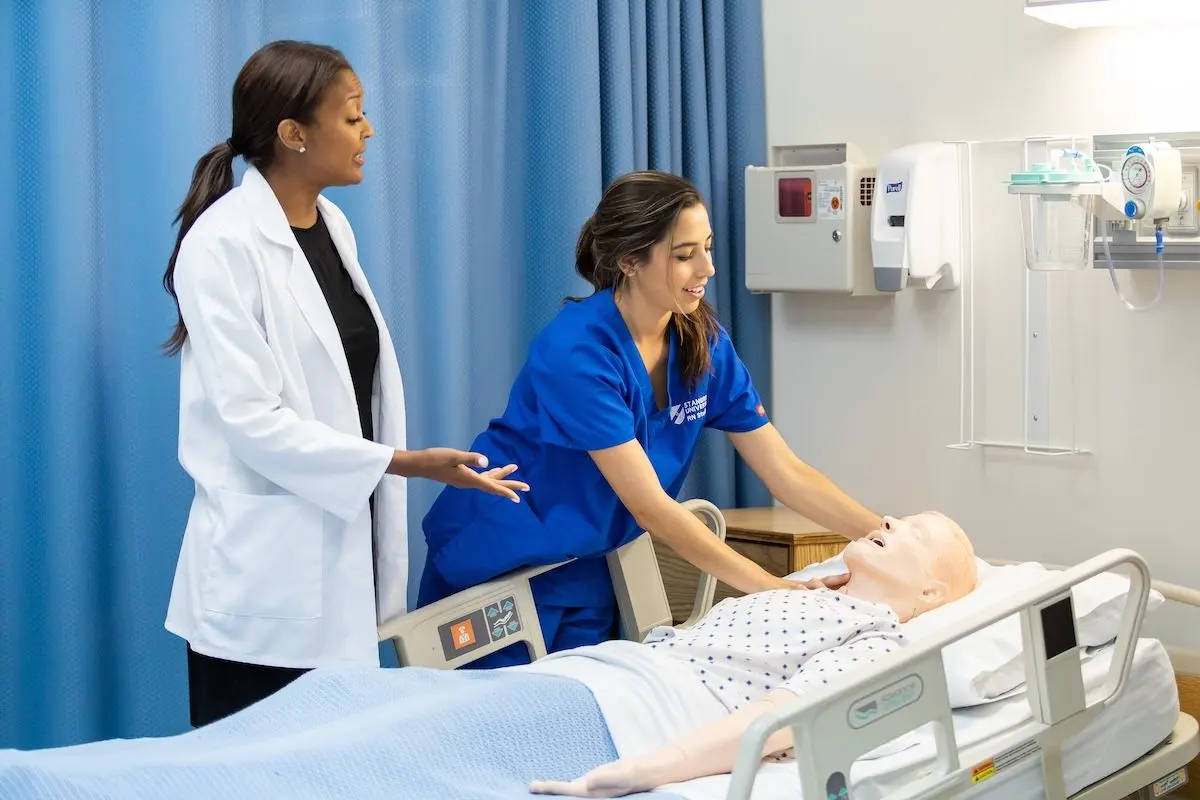
The university heavily funds its innovation and technology integration, utilizing high-fidelity simulation labs. Students practice critical scenarios—like cardiac arrest or respiratory failure—on advanced synthetic patients that breathe, bleed, and react to medication. This tech-forward approach removes the fear of initial clinical errors and builds sheer muscle memory before the stakes become real.

The Built-In Exit Strategy: The Free MSN-Ed Pathway
Perhaps the most unique structural advantage of Stanbridge is its long-term financial commitment to its graduates. Nursing is physically demanding, and many bedside nurses look for a career "exit strategy" into administration or teaching as they get older. Usually, this requires taking on another $30,000 to $60,000 in graduate school debt.
Stanbridge completely disrupts this model. The university offers a tuition-free Master of Science in Nursing Education program is available to eligible Stanbridge University Bachelor of Science in Nursing graduates who began their program in August 2024 or later and meet applicable enrollment and licensure requirements.
For eligible graduates, this pathway adds another dimension to the value of the undergraduate nursing program. Beyond eliminating additional tuition costs, the program provides a pathway for nurses interested in developing expertise in nursing education and contributing to the preparation of future nurses—particularly relevant amid the nationwide need for qualified nursing educators.
Protecting the Investment: How Stanbridge Engineers Success
Nursing school is notorious for its brutal pacing and high attrition rates. Stanbridge recognizes that admitting a student is only the first part of the equation, which is why their retention infrastructure is so aggressive. To consistently hit a 98% NCLEX-RN licensure pass rate (2023-2025), the university cannot afford to let struggling students slip through the cracks.
This is where the Carnegie "Opportunity College" designation becomes practically visible on campus. Stanbridge builds a structured safety net around each student, starting with a dedicated Student Services Officer (SSO) assigned at orientation. Instead of acting as passive advisors, SSOs function as active project managers who track academic progress and intervene before a student fails a class.
When academic metrics begin to slip, the university deploys free academic interventions to support course correction. These heavily funded, mandatory safety nets include:
- Targeted NCLEX Tutoring: Students receive one-on-one and virtual tutoring from faculty to ensure classroom concepts translate directly to board exam competency.
- The Learning Resource Center: An academic hub where an on-campus librarian and writing specialist help students master the complex research skills required in modern healthcare.
- Hands-On Skills Labs: Nursing skills labs provide students with opportunities to practice and reinforce clinical skills in structured, hands-on settings. Students work in smaller groups at each lab bed, supporting focused practice, faculty guidance, and active participation as they develop their clinical competencies.
Preventing Attrition: Logistics and Mental Health
For many nursing students, the biggest threat to graduation is not the rigorous coursework, but unpredictable life logistics. For students balancing the demands of nursing school with responsibilities outside the classroom, unexpected challenges related to childcare, finances, family, or personal well-being can create additional stress during their education. Stanbridge actively protects its pipeline against these external threats through the Stanbridge Student Assistance Program.
By treating mental health and life stability as critical academic metrics, the university dramatically reduces its dropout rate. This free, confidential program ensures students can stay enrolled even when life becomes chaotic. Professional counseling and guidance are immediately available to help students navigate:
- Mental Health Crises: Immediate clinical support for severe anxiety, depression, and academic burnout.
- Logistical Hurdles: Professional navigation for sudden daycare issues, family conflicts, and substance abuse recovery.
- Financial Emergencies: Guidance on handling highly disruptive life events, such as identity theft or housing insecurity.
Fostering Leadership and Professional Development
Stanbridge University extends professional development beyond clinical and academic preparation by creating structured opportunities for students to develop as leaders within their professions and communities. Leadership development is integrated into the student experience through student organizations, campus programming, community service, and the university’s biannual Student Leadership Summit. Together, these experiences are designed to strengthen communication, collaboration, professional identity, time management, and other competencies that support students beyond the classroom.
Program-specific student organizations give students opportunities to take on elected leadership positions, participate in committees, plan events, engage in community service, advocate for their professions, and build relationships with faculty and peers. Through these activities, students gain practical experience in teamwork, organizational management, professional communication, and networking while connecting their academic preparation with broader professional and community engagement.
A centerpiece of these efforts is the Student Leadership Summit, held twice each year for student leaders from academic programs and campuses across the university. The summit combines educational workshops, keynote presentations, panel discussions, and interactive networking opportunities focused on leadership and professional identity, emotional intelligence and resilience, communication and executive presence, career readiness, mental wellness and self-care, and emerging trends in healthcare.
Students also have opportunities to connect with alumni, industry professionals, and healthcare leaders who share perspectives on leadership, career development, and changes within the healthcare landscape. These interactions complement students’ academic preparation while helping them develop professional relationships and a broader understanding of leadership.
Evaluating Educational Value
The cost of a college education is an important consideration for prospective students, but evaluating a nursing program involves more than tuition alone. Students may also consider factors such as licensure examination outcomes, clinical and simulation experiences, academic and student support resources, opportunities for continued professional development, and accreditation.
Stanbridge University’s approach brings these elements together through nursing curricula focused on clinical preparation, hands-on skills and simulation experiences, academic support resources, and opportunities for leadership and professional development. The university’s nursing programs also have a record of strong NCLEX licensure examination outcomes, providing prospective students with measurable information to consider as they evaluate their educational options.
For eligible Stanbridge BSN graduates, the MSN-Ed program is available at no cost, providing an opportunity to continue their education in nursing education. Together, these resources and opportunities give prospective students several factors to consider when assessing the overall value of their educational investment.
A major factor in this opportunity cost calculation is the university's direct-entry admissions structure. Because Stanbridge does not require prior prerequisite courses, students are not forced to spend additional time and money completing general education requirements at another institution. By beginning the nursing curriculum immediately, students effectively shorten their timeline to licensure and workforce entry.
Stanbridge University has been ranked among the top 5% of 4,600 colleges nationwide for 10-year return on investment (ROI) in the Ranking Colleges by ROI (2025) report by Georgetown University’s Center on Education and the Workforce, based on a comprehensive analysis of earnings data, tuition costs, and opportunity costs.
Next Steps for Prospective Nurses
Gaining entry into this pipeline requires precision. Because clinical space is fiercely competitive in Southern California, prospective students must treat the admissions process like a job application.
To initiate the process, candidates should follow a structured checklist:
- Review Admissions Requirements: Explore the admissions requirements for the Vocational Nursing and Bachelor of Science in Nursing programs to understand the application process and what is required for consideration.
- Calculate the Investment: Meet with financial aid officers to map out federal grants, loans, and potential out-of-pocket costs against projected starting salaries.
- Tour the Tech: Schedule an in-person visit to the Orange County, Los Angeles, Riverside, or San Marcos campus specifically to evaluate the high-fidelity simulation labs.
A Calculated Career Investment
For prospective nursing students in California, choosing a nursing program involves considering academic quality, student support, licensure outcomes, and opportunities for continued professional development. Stanbridge University brings these elements together through focused healthcare education, hands-on learning experiences, student support resources, and nursing programs designed to prepare students with the knowledge and skills required for professional practice.
By surrounding students with an aggressive retention matrix, Stanbridge virtually eliminates the guesswork from nursing school. Their 98% NCLEX-RN licensure pass rate (2023-2025) pass rates, the rare Carnegie "Opportunity College" designation, and the immense financial advantage of a free MSN-Ed pathway prove that the university delivers on its core promise. Ultimately, Stanbridge is not built for the undecided college student; it is explicitly engineered for those who want the most reliable, data-backed route into one of America's most lucrative healthcare markets.


