2027 AP Art: Complete Student Guide

Co-Founder and Chief Data Scientist
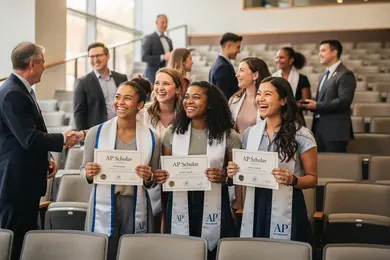
AP Art can shape how a student applies to college, earns possible credit, and builds a serious creative portfolio. College Board reported more than 5 million AP Exams and portfolio submissions in its 2024 AP Program Results, showing how common AP evidence has become in admissions and placement conversations.
This guide is for students, parents, counselors, and aspiring artists comparing AP Art options. You'll learn how the portfolios work, what colleges may value, what careers connect to these skills, and how to make a smarter academic and financial plan.
Key Things You Should Know
- AP Art and Design is portfolio-based, not a traditional written exam; students submit a Sustained Investigation and Selected Works portfolio scored on the AP 1-5 scale.
- The three portfolio choices are AP 2-D Art and Design, AP 3-D Art and Design, and AP Drawing, and the best choice depends on the student's medium, process, and college portfolio goals.
- Creative career outcomes vary widely: BLS data updated in 2024 reports median pay of $58,910 for graphic designers, $99,060 for special effects artists and animators, and $106,500 for art directors, making portfolio quality and skill specialization important.
What is AP Art and how does the AP Art and Design program work?
AP Art and Design is the College Board's advanced high school studio art program. Instead of sitting for a multiple-choice exam, students create, document, refine, and submit a portfolio that demonstrates artistic inquiry, technical skill, experimentation, and visual decision-making.
The program is designed to approximate an introductory college-level art or design course. Students typically work over a full school year, develop a sustained visual question or theme, and select finished pieces that show their best execution. A strong AP Art experience is not just about making attractive work; it is about showing how ideas evolve through practice, revision, research, materials, and critique.
The AP Art and Design program matters because it can serve several purposes at once. For some students, it is a way to earn college credit or placement. For others, it is a structured path toward a stronger admissions portfolio for art, architecture, design, animation, game art, fashion, or visual communication programs. It can also help students test whether they actually enjoy the workload, feedback cycle, and ambiguity of serious creative study before committing to a college major.
Students should also understand what AP Art is not. It is not a shortcut to becoming a professional artist, and a high AP score does not automatically replace a college portfolio review. Many competitive art and design schools still require their own portfolio submission, written artist statement, interview, or foundation-year review. AP Art is best viewed as preparation and evidence, not a guarantee.
What AP Art and Design portfolio options are offered, and how do they differ?
The three AP Art and Design portfolio options differ mainly by how students use space, materials, mark-making, and visual communication. Choosing the right portfolio matters because the scoring criteria reward work that fits the selected category clearly.
The table below compares the options in practical terms so students can match their strongest work to the most appropriate AP portfolio.
| AP portfolio option | Best fit | Common media and examples | When it may be the wrong choice |
| AP 2-D Art and Design | Students focused on design principles such as composition, hierarchy, typography, color, image-making, and visual communication | Graphic design, photography, digital illustration, collage, printmaking, web or interface mockups, poster systems | If the work depends mainly on observational drawing skill rather than design relationships, AP Drawing may fit better |
| AP 3-D Art and Design | Students making work with physical or spatial form, volume, structure, installation, or product-like objects | Ceramics, sculpture, jewelry, fashion forms, architectural models, installation, 3-D digital forms documented through images | If the work is mostly flat imagery photographed for submission, AP 2-D or Drawing is usually more appropriate |
| AP Drawing | Students emphasizing mark-making, light and shade, line quality, rendering, observation, abstraction, or expressive drawing processes | Graphite, charcoal, ink, pastel, painting, mixed media drawing, figure studies, observational or conceptual drawing | If the work is primarily branding, layout, photography, or design systems, AP 2-D is usually a stronger match |
Students should choose based on the work they can sustain for months, not simply the course title available at school. A student interested in animation, for example, might choose AP Drawing if the portfolio centers on character gesture and mark-making, or AP 2-D if it centers on storyboards, layouts, visual development, and digital compositions.
A common mistake is trying to make one portfolio satisfy every interest. Colleges and AP readers usually respond better to focused investigation than to scattered samples. If a student loves both photography and sculpture, they should choose the portfolio where they can show the strongest development, then save the other work for a separate admissions portfolio if needed.
What are the eligibility and prerequisites to enroll in AP Art courses?
There is no universal national prerequisite that every student must complete before taking AP Art and Design, but schools often set their own requirements. Many high schools expect students to complete introductory art, drawing, ceramics, photography, or digital design before enrolling because AP Art requires independence and a large body of work.
Students are usually ready for AP Art when they can handle sustained studio time, accept critique, document their process, and revise work without being told exactly what to make. Technical perfection is not required at the start, but curiosity, consistency, and openness to experimentation are essential.
Before enrolling, students should ask their school or teacher these practical questions because policies and resources vary by campus:
- Does the school offer AP 2-D, AP 3-D, AP Drawing, or a combined AP studio section?
- Are there prerequisite courses, teacher approval requirements, or summer assignments?
- What materials, software, cameras, kilns, studio space, or printing resources are provided by the school?
- How often will students receive formal critique before the AP submission deadline?
- Does the course support college portfolio preparation in addition to AP scoring requirements?
Homeschooled students, online learners, and students at schools without AP Art may still be able to prepare independently, but they need to confirm submission logistics with the College Board and an authorized school or AP coordinator. Students with disabilities should ask early about accommodations, especially if documentation, access to tools, or production time may be affected.
AP Art is most often associated with high school students, but planning creative education is not limited to teenagers. Families comparing later-life or nontraditional study options can also review online degree programs for seniors to understand how flexible creative and general education pathways may work for adult learners.
What skills and techniques do students learn in AP Art and Design coursework?
AP Art and Design coursework teaches students how to think and work like developing artists and designers. The course combines studio production, research, critique, writing, documentation, and revision, which makes it different from a casual art class.
The most valuable skills usually fall into several categories. Students should look for evidence that their course builds all of these, not just one favorite medium:
- Concept development: forming a visual question, theme, problem, or investigation that can support multiple works over time.
- Composition and design: using balance, contrast, rhythm, scale, space, color, hierarchy, and unity intentionally.
- Technical control: improving craft, material handling, digital workflow, construction, drawing accuracy, or photographic quality.
- Experimentation: testing unfamiliar materials, formats, viewpoints, processes, or visual strategies before deciding what works.
- Critique and revision: explaining choices, listening to feedback, and making meaningful changes rather than minor cosmetic edits.
- Documentation: photographing work accurately, recording process stages, writing concise statements, and organizing files for submission.
Current creative education is also being influenced by artificial intelligence and digital production tools. AP Art students should treat AI carefully: it may help with brainstorming, reference organization, or workflow planning if the teacher allows it, but submitted work must still represent the student's own creative decisions and making. For college admissions, process evidence is becoming more important because schools want to see how a student thinks, not only what the final image looks like.
A practical way to improve is to keep a process archive. Students should photograph sketches, tests, failed versions, material experiments, critique notes, and revised outcomes. This archive helps with the AP Sustained Investigation and can later support college portfolio statements, scholarship applications, or interviews.
How is the AP Art and Design portfolio scored, and what makes a strong submission?
AP Art and Design portfolios are scored on the AP 1-5 scale, with 5 indicating the strongest college-level performance. The score is based on portfolio evidence rather than a timed exam, so the student's planning and selection decisions matter as much as the number of hours spent making work.
The portfolio has two major parts. The Sustained Investigation shows a body of related work developed through inquiry, practice, experimentation, and revision. The Selected Works section highlights the student's strongest finished pieces and emphasizes skillful synthesis of materials, processes, and ideas.
Strong submissions usually share a few recognizable qualities. Students should use this checklist during the course, not just near the deadline:
- Define a focused investigation that can grow visually over multiple pieces rather than a broad topic such as "nature" or "identity" with no specific angle.
- Show visible development from one work to the next through experiments, failures, revisions, and increasingly intentional choices.
- Select images that are clear, well lit, cropped appropriately, and accurate to the actual work.
- Write concise explanations that connect materials, processes, and ideas without overexplaining or using vague art vocabulary.
- Include only work that fits the chosen portfolio category and strengthens the reader's understanding of the investigation.
One major mistake is saving documentation until the end. If a ceramic piece breaks, a mural is painted over, or a digital file is lost, the student may lose important evidence. Another mistake is choosing the most time-consuming piece rather than the most effective piece. AP readers evaluate visual evidence and decision-making, not how emotionally attached the student is to a work.
Students should also avoid copying images from the internet, celebrity photos, copyrighted characters, or another artist's style without transformation and proper learning context. Reference use can be part of art education, but a college-level portfolio needs original decisions, not imitation.
How do AP Art credits transfer to college art, design, or studio programs?
AP Art credit transfer depends on the college, the student's score, the major, and the department's placement policy. Some colleges award elective credit for a qualifying AP Art score, while others use it for placement into a higher studio course. Highly selective art schools may value the experience but still require students to complete their own foundation sequence.
The table below summarizes common transfer outcomes. Students should use it as a planning guide, then verify the exact policy on each college's AP credit or registrar page.
| College policy type | Possible outcome | What students should check |
| General elective credit | The AP score may count toward total credits needed for graduation | Whether the credit applies to the degree or only to free electives |
| Studio course equivalency | The AP score may replace an introductory drawing, design, or studio course | Whether the department accepts AP Art for majors, minors, or non-majors |
| Placement without credit | The student may start in a higher-level studio course but receive no credit hours | Whether placement affects tuition, timeline, or foundation requirements |
| No AP credit for studio majors | The school may require all art and design majors to complete its foundation curriculum | Whether AP work still supports admissions or scholarship review |
AP credit can reduce costs only when it applies to graduation requirements or allows a student to avoid taking extra courses. Because college pricing is complex, families should compare tuition, fees, supplies, housing, transportation, and aid before assuming AP credit will create major savings. Students asking what online college gives the most financial aid should also check whether art, design, or studio courses have additional material and technology fees.
The smartest approach is to build a college-by-college spreadsheet. Include the required AP score, type of credit, course equivalent, portfolio review requirements, and whether the credit applies to the intended major. If the student is applying to Bachelor of Fine Arts programs, ask the department directly because studio-major policies may differ from general university AP policies.
How can AP Art strengthen applications to competitive art and design schools?
AP Art can strengthen applications to competitive art and design schools because it gives students a structured way to produce a coherent body of work. Admissions reviewers often look for creative range, technical growth, risk-taking, and evidence that the student can complete demanding studio assignments. AP Art can support all of those signals when the portfolio is thoughtfully built.
However, AP Art should not be the entire admissions strategy. Competitive programs may ask for observational drawings, design prompts, sketchbook pages, personal work, written statements, interviews, or school-specific portfolio formats. A student with a high AP score but a narrow or poorly documented admissions portfolio may still be at a disadvantage.
Students applying to selective programs should take these steps alongside AP Art coursework:
- Review each school's portfolio requirements at least six months before the deadline, because required media and file formats vary.
- Separate AP scoring needs from admissions needs; some works may be excellent for one purpose but not the other.
- Include process evidence where allowed, especially sketches, iterations, material tests, and problem-solving notes.
- Ask for critique from more than one person, ideally an AP teacher, college art instructor, working designer, or portfolio reviewer.
- Prepare a short explanation of why the student chose specific materials, themes, and revisions.
AP Art can also help students compete for scholarships, especially when the scholarship committee requests creative samples. Still, scholarship decisions may consider grades, essays, financial need, leadership, and program fit, so students should avoid relying on portfolio strength alone.
A red flag is choosing AP Art only because it "looks good" on an application. Students who do not want to revise, document, or discuss their work may be better served by a different AP course, dual-enrollment course, or local studio class that matches their goals more closely.
What education pathways lead from AP Art to art, design, or creative degrees?
AP Art can lead into several education pathways, from highly specialized studio degrees to broader majors that combine creativity with technology, business, communication, or education. The best path depends on whether the student wants to become a practicing artist, designer, teacher, creative technologist, or creative manager.
The table below compares common college pathways for students who begin with AP Art experience. It focuses on fit and trade-offs rather than ranking one option as universally better.
| Pathway | Typical credential | Best for | Main trade-off |
| Fine art or studio art | BA, BFA, or MFA later | Students focused on drawing, painting, sculpture, installation, printmaking, or interdisciplinary studio practice | Often requires strong self-direction and may need business or teaching skills for stable income |
| Graphic design or visual communication | BA, BFA, BS, or certificate | Students interested in branding, layout, typography, digital campaigns, publication, or user-facing communication | Requires portfolio quality plus software fluency, client communication, and deadline management |
| Animation, game art, or motion design | BFA, BS, or specialized diploma | Students who enjoy storytelling, character, movement, 3-D modeling, visual development, or interactive media | Can be competitive and software-intensive, with rapid technology changes |
| Architecture, interior design, or industrial design | Professional bachelor's or master's degree in some fields | Students who like spatial thinking, drawing, model-making, systems, and human-centered design | May involve accreditation, licensure, math, building codes, or professional exams depending on the field |
| Art education or museum education | Bachelor's degree plus state teaching requirements for public schools | Students who want to teach, mentor, curate learning experiences, or work in community arts | Licensure and job requirements vary by state and employer |
Students comparing colleges should look beyond the major name. Review faculty work, studio access, internship pipelines, senior exhibition requirements, software labs, critique culture, transfer credit, career services, and alumni portfolios. A less famous program with strong mentoring and affordable pricing may be a better fit than a prestigious program that creates unsustainable debt.
Cost is a major decision factor because art and design programs may require supplies, printing, software, hardware, studio fees, or travel. Students trying to reduce upfront barriers can compare online universities with no application fee, but they should confirm that any online creative program offers enough critique, portfolio review, and instructor feedback for their goals.
A good next step is to create two shortlists: one for dream programs and one for financially safer programs. Then compare portfolio requirements, net price estimates, scholarship opportunities, AP credit policies, and career outcomes. This keeps students from making the common mistake of choosing a school based only on reputation or campus aesthetics.
What careers can AP Art students pursue, and what roles use these skills?
AP Art skills connect to many creative careers, but the pathway is rarely automatic. Most roles require a portfolio, technical tools, communication skills, and evidence that the applicant can solve visual problems for a client, audience, user, gallery, classroom, or organization.
The table below shows examples of careers that can build on AP Art experience. It is not a promise of direct entry from AP Art; rather, it shows how early portfolio skills can connect to later education and work.
| Career direction | Typical responsibilities | Skills from AP Art that transfer | Common next preparation |
| Graphic designer | Create visual assets for brands, publications, campaigns, packaging, and digital platforms | Composition, hierarchy, color, typography awareness, critique, revision | Design degree, certificate, internships, Adobe or equivalent software portfolio |
| Illustrator or concept artist | Develop images for books, games, products, editorial media, advertising, or entertainment | Drawing, visual storytelling, style exploration, ideation, process documentation | Focused portfolio, anatomy or perspective study, digital painting, freelance experience |
| Animator or motion designer | Create moving visuals for film, games, advertising, interfaces, or social media | Sequencing, gesture, character or form development, experimentation | Animation degree or training, demo reel, software specialization |
| Fine artist or craft artist | Create original work for exhibitions, commissions, public art, galleries, or direct sales | Concept development, material exploration, critique, artist statements | Studio degree or independent practice, exhibitions, grants, business skills |
| Art teacher or community arts educator | Teach visual art, design thinking, studio methods, and creative problem-solving | Process explanation, critique language, technique demonstration, portfolio organization | Education degree, state licensure for public schools, teaching practicum |
| UX/UI or digital product designer | Design user flows, screens, prototypes, visual systems, and user-centered digital experiences | Visual hierarchy, iteration, user awareness, critique, problem framing | Design degree, UX certificate, case studies, prototyping tools |
Students should pay attention to how technology is changing these roles. AI image generation, template-based design platforms, and automation can reduce demand for basic production tasks, but they also increase the value of concept development, art direction, ethical judgment, user research, branding strategy, and original visual systems. AP Art students who learn to explain their decisions will be better prepared than students who only learn to produce polished images.
Not every creative career requires a four-year art degree. Some students move through community college, certificates, apprenticeships, freelance work, or software-focused training. Students comparing shorter routes can explore certificate jobs that pay well, then evaluate whether the certificate actually builds a portfolio employers will review.
The common mistake is assuming that "being good at art" is enough. Professional creative work usually involves deadlines, client needs, revisions, budgets, accessibility, production constraints, and collaboration. AP Art is useful because it introduces critique and iteration early, but students should keep building real-world communication and project-management skills.
What salary ranges and job outlook can AP Art-related creative careers expect?
Creative salaries vary by role, location, industry, portfolio strength, software skill, experience, and whether the person is employed, freelance, or self-employed. Students should use salary data as a planning tool, not as a guaranteed outcome.
The table below uses U.S. Bureau of Labor Statistics Occupational Outlook Handbook figures updated in 2024. These national medians are helpful for comparison, but local markets and individual portfolios can differ substantially.
| Occupation | Median annual pay reported in BLS data updated in 2024 | Planning takeaway for AP Art students |
| Graphic designers | $58,910 | Design students should build a portfolio that shows branding, layout, typography, digital production, and client-style problem-solving. |
| Special effects artists and animators | $99,060 | Animation and visual effects paths can pay more, but they usually require specialized software skills, demo reels, and competitive portfolios. |
| Art directors | $106,500 | Art direction is usually an advanced role that requires experience, leadership, taste, strategy, and the ability to guide other creatives. |
| Craft and fine artists | $52,910 | Income can be less predictable, especially for self-employed artists, so business, grant-writing, teaching, or design-adjacent skills can matter. |
| Web developers and digital designers | $92,750 | Students who combine visual design with user experience, code literacy, or digital product skills may access broader technology-related roles. |
Job outlook also differs by field. BLS projections updated in 2024 show faster growth for web developers and digital designers than for many traditional art roles, which suggests that students interested in stable demand may benefit from combining visual creativity with technology, accessibility, user experience, or interactive media.
For college ROI, students should compare likely debt with realistic entry-level opportunities. An expensive art school may make sense if it offers strong placement, scholarships, industry access, and a portfolio culture that fits the student. It may be a poor choice if the student is unsure of the major, would need heavy borrowing, or could build a similar portfolio through a lower-cost route. Students comparing creative study with other fields can also review highest paying majors to understand the earnings trade-offs before committing.
A practical decision rule is to choose the least expensive program that still gives the student serious critique, strong facilities or software access, portfolio development, internships, and credible outcomes in the intended field. For many students, that may mean starting at a community college, using AP or dual-enrollment credit carefully, applying for scholarships, or choosing a university with a strong design department rather than the most famous art school.
Other Things You Should Know About
AP Art can be demanding because it requires sustained independent work, documentation, critique, and revision over many months. Students who manage time well and enjoy developing ideas usually handle it better than students who wait until the deadline.
Many colleges value AP Art as evidence of rigor and creative commitment, but its impact depends on the college and major. Art and design programs often care more about the full admissions portfolio than the AP score alone.
Choose AP 2-D for design, photography, and flat visual communication; AP 3-D for sculpture, ceramics, installation, and spatial work; and AP Drawing for mark-making, rendering, painting, and drawing-based investigation.
Yes, but policies vary. Some colleges award elective or studio credit for qualifying scores, while others use AP Art for placement or require studio majors to complete the school's own foundation courses.
References
- 25 careers for creatives - SEEK New Zealand https://nz.seek.com/career-advice/article/25-careers-for-creatives
- Take AP Art and Design Online - iArt Institute https://www.iartusa.com/about-ap-art-and-design/
- CCS Advanced Placement (AP) Equivalency Chart https://www.ccsdetroit.edu/advance-placement-credit/
- A Palette of Possibilities and Diverse Career Paths for Art Degree https://www.ucumberlands.edu/blog/diverse-career-paths-for-art-degree
- How AP Art and Creativity Can Strengthen Your College Applications https://www.parktutoring.com/blog/ap-art-for-college-applications
- Is AP Art & Design Hard? Portfolio Difficulty and Worth It Guide | Fiveable https://fiveable.me/ap-art-design/ap-art-design-exam/ap-art-design-is-it-hard/study-guide/ap-art-design-is-it-hard
- How to Easily Break Down AP Art and Design Portfolios https://theartofeducation.edu/2022/02/feb-how-to-easily-break-down-ap-art-and-design-portfolios/
- Transfer Students https://handbooks.artcenter.edu/artcenter-catalog/transfer-students
- 8 unexpected careers you can pursue with an art degree https://pcad.edu/pcad_news/8-unexpected-careers-you-can-pursue-with-an-art-degree/
- How the AP Art and Design Program Works https://www.savemyexams.com/learning-hub/subject-guides/ap-art-and-design-program-guide/