2027 2 7 GPA: What Students Need to Know for Admissions

Co-Founder and Chief Data Scientist
A 2.7 GPA can feel limiting, but it does not automatically close the door on college. Common App's 2024 end-of-season report showed applications through its platform rose 10%, which means students need a smarter admissions strategy, not just a higher number. This guide is for high school students, transfer students, and adult learners who want realistic options. You will learn what a 2.7 GPA means, which schools may consider it, how online and accredited programs evaluate applicants, and how to build a stronger application.
Key Things You Should Know
- A 2.7 GPA is usually around a B-/C+ average; it is below the typical cutoff for highly selective colleges but can meet or come close to requirements at many open-admission, community college, transfer-friendly, online, and regional programs.
- College Board's 2024 pricing data listed average published tuition and fees at $4,050 for public two-year colleges and $11,610 for in-state public four-year colleges, so starting at a community college can reduce risk while improving transfer options.
- Admissions offices rarely evaluate GPA alone; course rigor, grade trend, essays, recommendations, test scores when submitted, work experience, and transfer credits can make a 2.7 GPA application more competitive.
What does a 2.7 GPA mean for college admissions?
A 2.7 GPA generally means your grades average between a B- and a C+ on a 4.0 scale. In admissions, that number is not just a grade summary; it is a signal of academic consistency, readiness for college-level work, and risk. The important question is not whether 2.7 is "good" or "bad," but whether it matches the academic expectations of the programs you are targeting.
Admissions teams also look at how the GPA was earned. A 2.7 in honors, Advanced Placement, International Baccalaureate, dual enrollment, or technically demanding courses may be read differently from a 2.7 in a lighter schedule. A rising GPA can also help because it suggests you are building stronger study habits before college.
The table below shows how a 2.7 GPA is commonly interpreted across admissions contexts. Use it to understand where your application may be competitive and where you may need a stronger supporting strategy.
| Admissions context | How a 2.7 GPA may be viewed | What it means for your strategy |
| Open-admission community college | Usually acceptable if you have a high school diploma or equivalent | Strong option for rebuilding GPA and transferring later |
| Regional public university | May be within range, especially for less selective majors | Apply broadly and show a positive grade trend |
| Test-optional four-year college | Possible, but other materials must be strong | Use essays, recommendations, and activities to explain readiness |
| Selective university | Usually below the competitive range | Consider transfer pathways, bridge programs, or a different initial school |
| Competitive major such as nursing, engineering, or computer science | May fall short even if the school admits you generally | Check major-specific GPA rules before applying |
One common mistake is assuming that a college's general minimum GPA applies to every major. A school may admit students with a 2.7 GPA to the university but require a higher GPA for direct entry into nursing, education, engineering, business, or health science programs.
Can you get accepted with a 2.7 GPA?
Yes, you can get accepted with a 2.7 GPA, but your best options depend on the type of institution, your academic record, and the program you want. A 2.7 GPA is more likely to work for community colleges, open-admission schools, many online programs, transfer-entry pathways, and some regional universities than for highly selective colleges.
The strongest applications with a 2.7 GPA usually explain readiness in more than one way. Before applying, focus on the factors that can reduce an admissions office's concern about academic risk.
- Show an upward grade trend, especially in junior and senior year or in recent college coursework if you are a transfer student.
- Choose a balanced school list that includes likely, target, and reach options instead of applying only to selective colleges.
- Submit test scores only when they strengthen your profile and the school allows optional submission.
- Use your essay to explain growth, responsibility, obstacles overcome, or a clear academic goal without making excuses.
- Ask for recommendations from teachers, counselors, supervisors, or instructors who can speak directly to your work ethic and improvement.
- Consider a semester or year of community college if your desired university or major is currently out of reach.
Conditional admission is also worth watching for. Some colleges admit students below the usual GPA range if they agree to advising, summer bridge programs, tutoring, reduced first-term course loads, or academic success seminars. These options can be useful, but you should ask whether they affect financial aid, housing, course registration, or progress toward your major.
Which colleges accept students with a 2.7 GPA?
Colleges that may accept students with a 2.7 GPA are usually less selective, access-focused, or transfer-friendly institutions. These can include community colleges, public regional universities, some private nonprofit colleges, career-focused colleges, and online programs attached to accredited institutions.
If you are unsure where to start, begin with schools that publish minimum GPA ranges, open admission policies, or transfer pathways. Students who want a lower-risk starting point may also compare easiest associate degrees, especially if the goal is to earn college credits, improve grades, and transfer into a bachelor's program later.
The table below summarizes common college options for students with a 2.7 GPA. It is not a guarantee of admission, but it can help you decide where your application energy is most likely to pay off.
| College option | Typical fit for a 2.7 GPA | Best for | Potential drawback |
| Community college | Strong fit | Students who want affordability, transfer credits, or a GPA reset | May require a second admissions process for transfer or selective majors |
| Regional public university | Possible fit | Students who want a four-year campus with moderate selectivity | Some majors may have higher internal GPA requirements |
| Private nonprofit college with holistic review | Possible fit | Students with strong essays, activities, recommendations, or special circumstances | Sticker price can be high before institutional aid |
| Online bachelor's program | Possible fit | Adult learners, working students, and students needing flexibility | Requires self-management and careful accreditation checks |
| Certificate or career diploma | Varies by provider | Students seeking faster workforce entry | Credits may not transfer into a degree |
A practical search strategy is to look for terms such as "minimum GPA," "holistic admission," "conditional admission," "transfer admission," and "open admission" on each school's admissions page. If the program page lists a higher GPA than the general admissions page, follow the program rule.
Do online programs have different GPA requirements?
Online programs do not automatically have lower academic standards, but they often serve a wider range of students, including working adults, transfer students, parents, military-affiliated learners, and students returning after time away. Many accredited online programs use the same diploma, curriculum, faculty standards, and credit requirements as campus programs.
The main difference is flexibility. Some online associate degree programs are designed for open access or broad access, making them a practical starting point for students with a 2.7 GPA who want to prove college readiness before transferring or advancing.
When comparing online and campus options, pay attention to admissions model, support services, and learning format. The table below shows the practical differences that matter most for students entering with a modest GPA.
| Factor | Online programs | Campus programs | Decision point |
| Admissions flexibility | Often rolling, transfer-friendly, or adult-learner focused | May follow fixed application cycles | Online can be better if you need a faster start date |
| Academic support | May include virtual tutoring, advising, writing help, and success coaching | May include in-person tutoring, labs, and faculty access | Choose the format where you will actually use support |
| Schedule | Often asynchronous or evening-friendly | Usually more structured | Online fits working students; campus may fit students needing routine |
| Accountability | Requires strong time management | Provides more built-in structure | A 2.7 GPA student should be honest about study habits |
| Program availability | Strong for business, IT, psychology, criminal justice, health administration, and general studies | Better for programs needing labs, clinicals, studios, or fieldwork | Check whether your major requires in-person components |
Do not choose online learning only because admission looks easier. Choose it if the format matches your schedule, motivation, technology access, and learning style. A flexible program can help you succeed, but flexibility can also make it easier to fall behind if you do not have a weekly study plan.
What admission factors matter besides GPA?
GPA is important, but it is not the whole application. NACAC's 2024 State of College Admission report continued to emphasize grades in college-preparatory courses as a leading factor, yet many colleges also weigh context, rigor, essays, recommendations, extracurriculars, and demonstrated readiness. For a student with a 2.7 GPA, the goal is to give the admissions office credible evidence that you can handle college work.
The most useful supporting factors are those that directly answer the question admissions readers are asking: "Will this student persist and succeed here?" Focus on evidence that is recent, specific, and connected to your academic goals.
- Course rigor: A challenging schedule can help if your grades show you attempted serious preparation, but do not overload your senior year if it risks another GPA drop.
- Grade trend: Improvement over time can matter more than one weak semester, especially if the lower grades came earlier.
- Personal statement: A strong essay explains maturity, direction, and readiness without blaming teachers, schools, or circumstances.
- Recommendations: The best letters describe specific behaviors, such as attendance, revision, persistence, leadership, or improved study habits.
- Work, family, or military responsibilities: These can show discipline and maturity when connected clearly to your college goals.
- Test scores: In test-optional admissions, submit scores only when they add positive evidence compared with the school's typical range.
- Major fit: A realistic major choice can improve your odds if your first-choice field has selective prerequisites.
A common red flag is writing an essay that focuses only on why grades were low. A better approach is to briefly explain the challenge, then spend most of the essay showing what changed and how you now manage schoolwork differently.
How do accredited schools evaluate a 2.7 GPA?
Accredited schools evaluate a 2.7 GPA within formal admissions policies and quality standards. Institutional accreditation means the college has been reviewed for academic quality, financial stability, student support, and educational integrity. Programmatic accreditation may also matter in fields such as nursing, education, counseling, business, engineering technology, and allied health.
For students with a 2.7 GPA, accreditation matters because it affects transfer credit, financial aid eligibility, employer recognition, and graduate school options. A school that accepts you quickly is not automatically a good choice if its credits do not transfer or its program does not meet licensure expectations.
Use this checklist before enrolling, especially if the admissions process seems unusually easy or aggressive.
- Confirm that the institution is accredited by an accreditor recognized by the U.S. Department of Education or the Council for Higher Education Accreditation.
- Ask whether your specific degree program has required programmatic accreditation for your intended career or state license.
- Check whether credits transfer to public universities or partner institutions, not just within the same college system.
- Request graduation, retention, licensure pass rate, or job placement information when available.
- Review the school's satisfactory academic progress policy, because low grades after enrollment can affect financial aid.
- Avoid schools that pressure you to enroll immediately, refuse to disclose total cost, or promise employment outcomes.
Accredited schools may accept students with a 2.7 GPA, but they still expect academic progress after enrollment. If you enter on probation, conditional admission, or a success plan, ask exactly what GPA you must earn, how many credits you must complete, and what happens if you miss the benchmark.
What degree paths fit students with a 2.7 GPA?
A 2.7 GPA can fit several degree paths, but the right choice depends on your goal, budget, timeline, and academic confidence. The smartest path is often the one that gives you room to build momentum rather than placing you immediately into a highly competitive major with strict progression rules.
If you later complete a bachelor's degree with stronger grades, graduate study can become more realistic; some working adults eventually compare accelerated options such as one-year masters programs. For now, the immediate goal is to choose an entry path where you can succeed and keep future options open.
The table below compares common degree paths for students starting with a 2.7 GPA. It can help you match your academic profile with a practical next step.
| Path | Typical timeline | Why it may fit a 2.7 GPA | Best next step |
| Associate degree | About two years full time | Often accessible, affordable, and transfer-friendly | Choose a transfer pathway if a bachelor's degree is the goal |
| General studies or liberal arts transfer program | One to two years before transfer | Lets students improve GPA while completing core requirements | Confirm articulation agreements with target universities |
| Applied associate degree | About two years full time | Connects more directly to workforce skills | Ask whether credits transfer into a bachelor's program |
| Four-year bachelor's at a regional university | About four years full time | Possible if the school uses holistic or moderate admissions standards | Apply to majors with realistic entry requirements |
| Certificate program | Several months to one year, depending on field | Can build skills quickly without a full degree commitment | Check accreditation, transferability, and employer recognition |
Students who are unsure about their major should avoid locking into an expensive or highly specialized program too early. A lower-cost associate or transfer pathway can give you time to improve grades, explore interests, and reduce debt before committing to a bachelor's major.
What can you do to strengthen a 2.7 GPA application?
The best way to strengthen a 2.7 GPA application is to show recent proof of academic readiness. Admissions offices know that students change, but they need evidence. That evidence can come from stronger senior-year grades, college-level coursework, better recommendations, a focused essay, or a realistic academic plan.
If you need to demonstrate improvement quickly, carefully chosen online classes may help you build credits or show readiness, but only if they are offered by accredited institutions and fit your transfer goals.
Use the following steps to build a stronger application before you submit or reapply. Each step is designed to reduce the perceived risk of admitting a student with a modest GPA.
- Request an unofficial transcript and identify whether your GPA problem is overall weakness, one bad semester, or low grades in specific subjects.
- Prioritize current grades because admissions offices often care more about recent performance than old mistakes.
- Retake only courses where a higher grade will clearly help your transcript or meet a prerequisite.
- Ask admissions offices whether they recalculate GPA using core academic courses, weighted grades, or all attempted credits.
- Build a college list with at least several schools where your GPA is within or close to the published range.
- Write an essay that connects your academic growth to a specific major, career goal, or learning plan.
- Ask recommenders early and give them examples of your improvement, responsibilities, and goals.
- Compare transfer policies before enrolling anywhere, especially if your plan is to start at one school and finish at another.
The biggest mistake is waiting until after rejection letters arrive to create a backup plan. A stronger strategy is to apply to a mix of options from the beginning, including at least one affordable and realistic pathway where you would be willing to enroll.
How much do programs with 2.7 GPA entry cost?
Programs that may admit students with a 2.7 GPA can vary widely in cost. College Board's 2024 Trends in College Pricing data listed the following average published tuition and fees for the 2024-25 academic year, which helps explain why many students use community college or in-state public options as a lower-cost starting point.
- Public two-year college, in district: $4,050 per year
- Public four-year college, in state: $11,610 per year
- Public four-year college, out of state: $30,780 per year
- Private nonprofit four-year college: $43,350 per year
Those figures are published tuition and fees, not your final net price. Your actual cost may change after grants, scholarships, state aid, institutional aid, employer tuition assistance, military benefits, transfer credits, housing choices, books, transportation, and online course fees.
The table below shows the cost factors students with a 2.7 GPA should compare before enrolling. This is especially important if you are choosing between an affordable transfer route and a more expensive direct-entry bachelor's program.
| Cost factor | Why it matters | Question to ask |
| Net price | Sticker price can be very different from what you pay after aid | What is my estimated cost after grants and scholarships? |
| Transfer credits | Lost credits can add semesters and increase total cost | Which credits are guaranteed to transfer into my intended major? |
| Housing and transportation | Living costs can exceed tuition for some students | Can I commute, study online, or live at home without hurting completion? |
| Program fees | Health, technology, lab, or clinical fees can raise costs | Are there course-specific or program-specific fees? |
| Financial aid renewal | A low college GPA can put aid at risk | What GPA must I maintain to keep aid? |
Federal Student Aid lists the maximum Pell Grant for the 2025-26 award year at $7,395. That does not mean every student receives the maximum, but it shows why completing the FAFSA can be especially important for students considering lower-cost public or community college pathways.
What careers can a 2.7 GPA support after graduation?
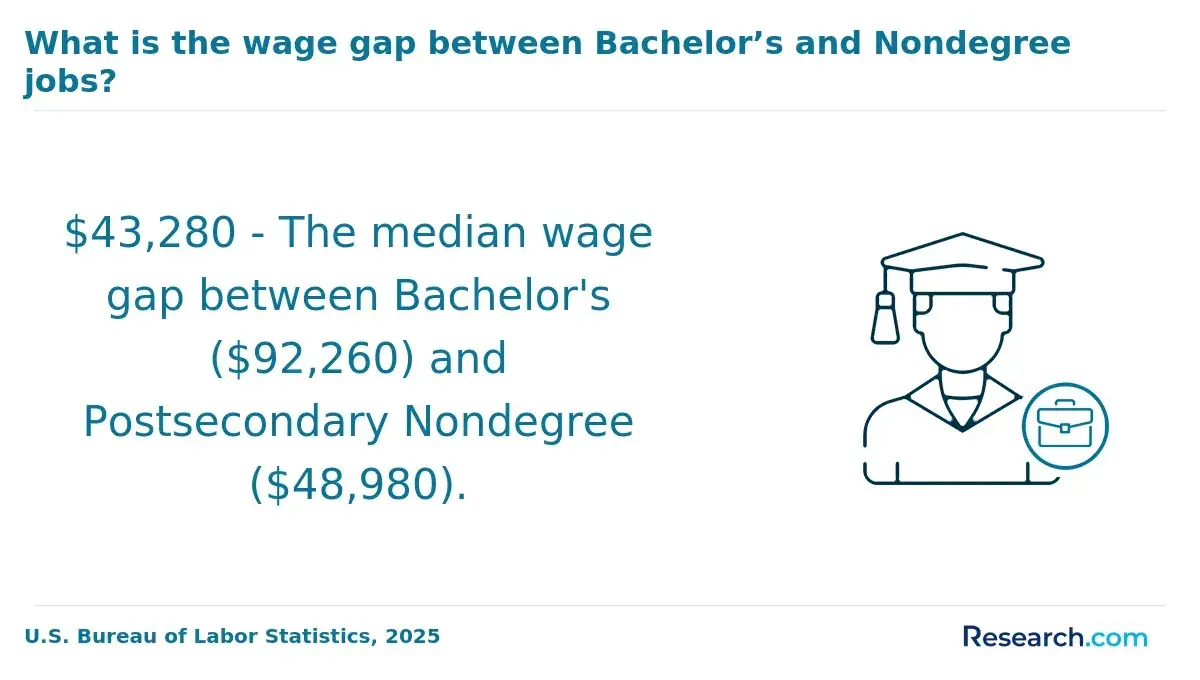
A 2.7 GPA does not define your career outcomes. Employers usually care more about the completed credential, skills, experience, portfolio, certifications, internships, references, and interview performance than your high school GPA. Some graduate programs and selective employers may ask for college GPA, but many entry-level roles focus on whether you can perform the work.
Students who want flexible career options may compare majors connected to digital, administrative, technical, business, and support roles, including programs listed among the best degrees for work from home jobs. Remote-friendly careers can be attractive, but they still require strong communication, self-management, and technical skills.
The table below uses U.S. Bureau of Labor Statistics May 2024 wage data to give salary context for careers that may be reachable through associate or bachelor's pathways. These are national medians, not promises, and actual pay varies by location, employer, experience, and industry.
| Career area | Common education path | Relevant responsibilities | Median annual wage, May 2024 |
| Computer support specialist | Associate degree, bachelor's degree, or IT certifications | Help users solve hardware, software, network, and access issues | $61,550 |
| Paralegal or legal assistant | Associate degree or bachelor's degree with legal studies coursework | Support attorneys with research, documents, case files, and client communication | $61,010 |
| Medical records specialist | Certificate or associate degree in health information | Manage patient records, coding, compliance, and health data accuracy | $50,250 |
| Bookkeeping, accounting, or auditing clerk | Certificate, associate degree, or business coursework | Maintain financial records, invoices, payroll entries, and account reconciliations | $49,210 |
| Human resources specialist | Bachelor's degree in business, HR, psychology, or related field | Assist with recruiting, employee records, benefits, training, and workplace policies | $72,910 |
To improve career outcomes, build skills while earning the degree. Internships, part-time work, volunteer projects, industry certificates, software skills, writing samples, and a strong portfolio can help offset a modest academic record. For technical fields, hands-on proof of ability may matter more than GPA after the first job.
Other Things You Should Know About
A 2.7 GPA is below the range expected by many selective colleges, but it is not disqualifying everywhere. It can be workable for community colleges, some regional universities, online programs, and transfer pathways, especially if your recent grades are stronger.
Yes, but how much it changes depends on how many credits or semesters you have left. Focus on earning higher grades in current core classes, retaking key courses if allowed, and showing an upward trend that admissions officers can see.
Explain it only if there is meaningful context, such as illness, family responsibility, disruption, or a clear turning point. Keep the explanation brief and spend most of the essay showing growth, readiness, and specific plans for succeeding in college.
Often, yes. Community college can lower costs, help you rebuild your GPA, and create a transfer route to a four-year degree. Before enrolling, confirm transfer agreements and major prerequisites so your credits count toward your long-term goal.
References
- How Much Does GPA Matter When Applying to College? | SoFi https://www.sofi.com/learn/content/does-gpa-matter-for-college-admission/
- 10 Ways to Stand Out to Colleges Besides Your GPA https://kdcollegeprep.com/what-do-colleges-look-for-besides-grades/
- What is a 2.7 GPA? What colleges accept a 2.7 GPA? https://www.prepscholar.com/sat/s/gpa/2.7-GPA-is-this-good-for-colleges
- From a 2.7 Undergrad GPA to First-Year Medical Student https://medicalschoolhq.net/pmy-261-from-a-2-7-undergrad-gpa-to-first-year-medical-student/
- How To Get Into Grad School With A Low GPA https://www.affordablecollegesonline.org/college-resource-center/grad-programs-that-accept-low-gpa/
- Grades Matter in College Admissions | Blog | Admissions Angle https://www.admissionsangle.com/blog/how-much-do-grades-matter-in-college-admissions
- The Inspiring Story of How an “Average Student” Got Admitted to 19 Colleges with Merit Offers! https://www.road2college.com/how-a-student-with-a-2-7-gpa-got-into-19-colleges/
- Do High Schools Grades Matter in College? https://www.ivywise.com/blog/do-high-school-grades-matter-in-college/
- Can You Get Into Online College With a Low GPA? 2026 Guide https://www.collegetransitions.com/blog/can-you-get-into-online-college-with-a-low-gpa/
- 2.7 GPA: Decoding 80–82% as a B– Grade https://gpacalculator.net/gpa-scale/2-7-gpa/