2027 Street-Level Bureaucracy in Social Work: Frontline Decisions in Public Services
Audited and Verified:
Our Editorial and Data Verification Process
Research.com uses government datasets, official education statistics and primary institutional information to support its career and degree guides. Our review process checks factual accuracy, occupational definitions, source dates and the requirements associated with the credentials discussed.
How This Article Was Fact-Checked
Our editorial team verifies salary estimates, employment projections, education requirements and program information against original data providers and official organizations. Salary figures are checked against the relevant occupational definitions and reporting periods. Information about licensure, accreditation and required in-person training is reviewed separately.
Fact-checked and verified on:

Co-Founder and Chief Data Scientist
A housing caseworker may have clear eligibility rules but too few appointments, incomplete records, and a family facing eviction. The decisions made under those conditions are the substance of street-level bureaucracy: public policy as people experience it at the service counter, in the field, or during a case review. This article is for social work students, early-career practitioners, and public service professionals. It explains where discretion exists, how to use it responsibly, and what to look for in jobs and education programs that prepare people for these decisions.
Key Things You Should Know
- Street-level bureaucracy describes how frontline workers translate policy into services; discretion operates within law, eligibility rules, agency procedures, and professional scope - not outside them.
- Staffing, caseloads, appointment access, and documentation systems can shape outcomes alongside individual judgment. Compare workplaces on supervision and resources, not job titles alone.
- A BSW or MSW can prepare workers for these decisions, but roles and licensing rules vary. The BLS reports a May 2025 median annual wage of $61,780 for social workers overall and projects 6% employment growth from 2025 to 2035; neither figure predicts an individual public-sector offer.
What is street-level bureaucracy in social work?
Street-level bureaucracy is a framework associated with political scientist Michael Lipsky. It examines public-facing workers who implement policy while responding to individual circumstances, limited resources, and competing demands. In social work, a worker may need to apply a benefits rule, assess a safety concern, arrange a referral, or decide which case needs prompt attention. Those choices affect what a policy means in practice.
Discretion is not unrestricted authority. Some decisions are prescribed by statute or regulation; others leave room to interpret evidence, explain options, set priorities, or seek supervisory review.
A useful distinction is between deciding what the rule requires and deciding how to serve a person fairly within that rule. Workers should not invent an exception they cannot authorize, but they may be able to obtain missing information, request an accommodation, or escalate an unclear case.
The framework also looks beyond individual behavior. If an agency offers too few appointments or measures success mainly by cases closed, even conscientious staff may develop routines that limit access.
Understanding those pressures can help students evaluate whether direct service, policy implementation, or agency improvement best fits their goals; exploring professional opportunities after MSW study can put those different functions in context.
What are examples of street-level bureaucracy in public social services?
The examples below show where a frontline decision may shape access to a public service. They are illustrative, not instructions for making eligibility, reporting, or safety determinations.
| Setting | Frontline decision | Constraint to examine |
| Public benefits office | How to help an applicant resolve missing documentation | Verification rules, deadlines, language access, and appointment availability |
| Child welfare agency | How to organize a response and communicate with a family | Applicable safety procedures, reporting law, supervision, and workload |
| Public school | How to connect a student and family with supports | Consent, education-record rules, school resources, and role qualifications |
| Housing services | How to explain options when demand exceeds available assistance | Eligibility, prioritization rules, referral capacity, and appeal procedures |
Two workers may encounter similar needs but have different authorized options because their programs, jurisdictions, and agency roles differ. A student interested in this work should seek field learning that includes policy application, documentation, and supervised discussion of constrained choices - not just observation of client meetings.
When comparing placements, MSW programs with organized practicum resources may be worth examining for how they identify and support suitable public-service sites.
How do social workers use discretion while navigating ethical dilemmas?
Ethical discretion starts by identifying which parts of a decision are fixed and which are genuinely open. A client's self-determination matters, but it does not remove legal reporting duties, confidentiality restrictions, or a worker's scope limits.
The NASW Code of Ethics offers professional guidance; applicable law, regulation, licensing rules, and agency policy may impose separate requirements. Workers should check the governing rules rather than assume that one source answers every question.
When a decision is difficult, the following sequence helps make the reasoning reviewable without turning judgment into a mechanical checklist:
- Identify the decision, the client's stated goals, and any immediate safety or deadline concerns.
- Separate mandatory requirements from available options, including accommodations, referrals, and authorized exceptions.
- Consult a supervisor or appropriate specialist when authority, confidentiality, reporting, or professional scope is unclear.
- Explain the decision and any review options in accessible language, then document relevant facts, consultation, and the basis for action.
Documentation should record a defensible process, not portray a disputed interpretation as certain. Repeated dilemmas caused by an inaccessible form or an unmanageable caseload also warrant agency-level review.
For students pursuing clinical work, this judgment develops alongside - but is distinct from - post-degree, board-approved supervision; social work clinical hour requirements and completion planning address that separate licensing step.
The right qualification depends on the job's actual duties and hiring rules. A BSW provides generalist social work preparation and may fit entry-level direct-service or casework positions. A traditional MSW includes foundational and specialized study and can admit graduates of other disciplines under program-specific criteria.
An advanced-standing MSW is a separate route for applicants with a qualifying social work background, typically a BSW meeting the program's requirements; relevant employment or another bachelor's degree alone does not establish eligibility.
An MSW may be useful for positions requiring graduate-level social work preparation or for a later clinical licensing pathway. It is not automatically necessary for benefits administration, outreach, or every case-management job.
If the target position accepts a human services degree and offers strong onboarding, additional social work education may not be the most direct next step. Conversely, a role requiring a protected social work title or license calls for careful review of its education and regulatory requirements.
A DSW or PhD is generally not the entry credential for frontline decisions. Those degrees may serve later practice-leadership or research aims, depending on the program. Someone considering that move should first identify the intended role and then assess comparing social work doctorate completion timelines rather than assuming a doctorate expands frontline legal authority.
What are social workers' salary expectations and job outlook?
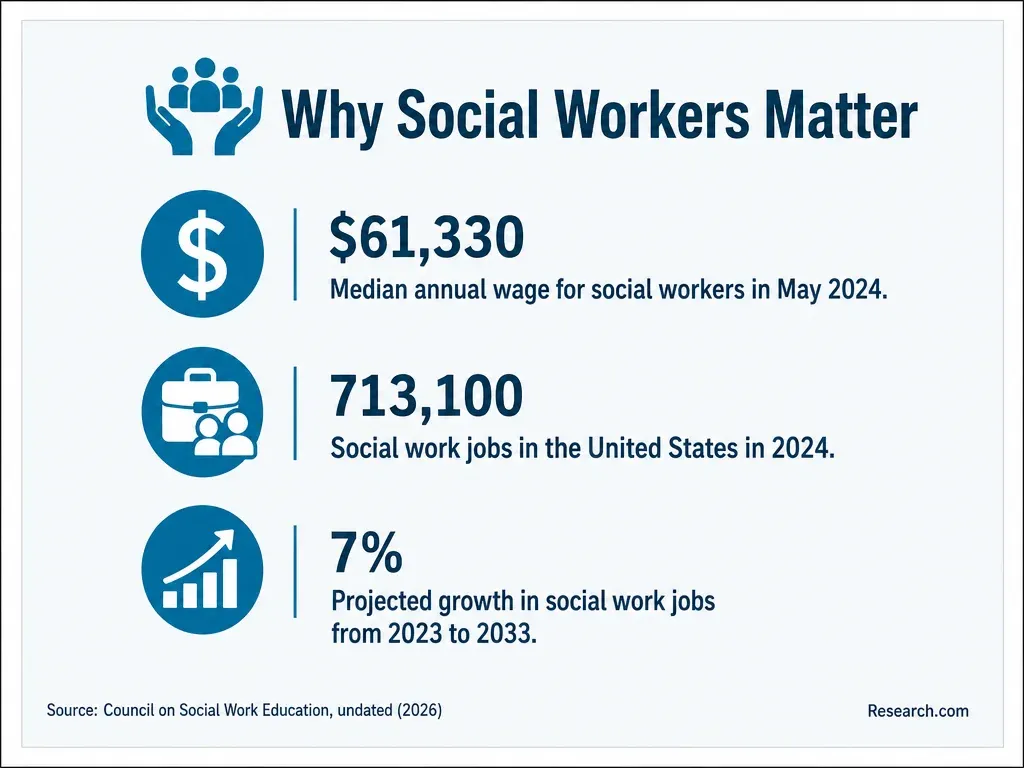
U.S. Bureau of Labor Statistics figures provide occupation-level context, not starting salaries or public-agency pay scales. These May 2025 median annual wages and 2025-2035 projections cover workers across settings and experience levels:
| BLS occupation | Median annual wage, May 2025 | Projected employment growth, 2025-2035 |
| Social workers, all specialties | $61,780 | 6% |
| Child, family, and school social workers | $59,550 | 4% |
| Healthcare social workers | $67,880 | 8% |
| Mental health and substance abuse social workers | $60,280 | 10% |
These categories do not map neatly onto every benefits specialist, housing coordinator, or civil-service title. For a realistic decision, compare local postings, pay grades, benefits, required licenses, and advancement rules with the full cost of qualifying. Planning MSW study with career outcomes in mind is most useful when paired with evidence from the jobs you would actually seek - not an assumption that an occupation-wide median will follow from graduation.
Other Things You Should Know About Social Work
It can. A nonprofit worker delivering publicly funded services may implement eligibility or referral rules much like a government employee. The worker's authority still depends on the contract, program rules, role, and applicable law.
Not entirely. A system may standardize parts of a decision, while staff still address missing information, accessibility, explanations, and reviews. Agencies should examine whether system design creates barriers or shifts discretion into less visible steps.
It can review patterns across comparable cases, instructions, staffing levels, and review requests while protecting client privacy. Differences may reflect legitimate circumstances, unclear rules, uneven training, or resource constraints; a pattern alone does not establish misconduct.
Many programs provide notice and review or appeal procedures, but deadlines and processes vary. Workers should explain the applicable procedure accurately and direct clients to the program's official notice or designated review office.
- Street-level bureaucracy: an underused theoretical model for general practice? - PMC https://pmc.ncbi.nlm.nih.gov/articles/PMC4484940/
- NASW Standards for Social Work Case Management | nycourts.gov https://www.nycourts.gov/reporter/webdocs/nasw_standards_socialwork_casemgt.htm
- Full article: Street-level bureaucrats as policymakers in the implementation of information system in social services https://www.tandfonline.com/doi/full/10.1080/14719037.2024.2362247
- Five Ways High Caseloads Hinder Social Work | Walden University https://www.waldenu.edu/online-masters-programs/master-of-social-work/resource/five-ways-high-caseloads-hinder-social-work
- Social Worker Decision-Making (Chapter 42) | Cambridge Core https://www.cambridge.org/core/books/cambridge-handbook-of-psychology-and-legal-decisionmaking/social-worker-decisionmaking/E4BB01A61694D0FA0316EEE2F38D9164
- The flaws of policies requiring human oversight of government algorithms - ScienceDirect https://www.sciencedirect.com/science/article/pii/S0267364922000292