2027 SSI vs SSDI in Social Work Resource Navigation: Understanding the Distinction
Audited and Verified:
Our Editorial and Data Verification Process
Research.com uses government datasets, official education statistics and primary institutional information to support its career and degree guides. Our review process checks factual accuracy, occupational definitions, source dates and the requirements associated with the credentials discussed.
How This Article Was Fact-Checked
Our editorial team verifies salary estimates, employment projections, education requirements and program information against original data providers and official organizations. Salary figures are checked against the relevant occupational definitions and reporting periods. Information about licensure, accreditation and required in-person training is reviewed separately.
Fact-checked and verified on:

Co-Founder and Chief Data Scientist
A client can meet Social Security's disability standard yet qualify for SSI, SSDI, both programs, or neither. For social workers and benefits navigators, that distinction affects which records to gather, what income and assets to review, and how to plan for health coverage. This guide explains the programs side by side, shows how to support an application without making eligibility promises, and puts relevant education and career choices in perspective. It is designed for students and early-career practitioners as well as community-service professionals deciding whether they need a social work credential for this work.
Key Things You Should Know
- SSI is needs-based; SSDI generally depends on a qualifying disability and sufficient work history. Some people qualify for both.
- SSI generally limits countable resources to $2,000 for an individual or $3,000 for a couple; SSDI has no comparable resource limit, although work activity can affect eligibility.
- Benefits navigation requires careful records, consent, and follow-up - not necessarily a social work license. SSI commonly connects eligible recipients to Medicaid, while SSDI generally leads to Medicare after a waiting period.
What is the difference between SSI and SSDI?
Supplemental Security Income (SSI) provides federally administered payments to people with limited income and resources who are disabled, blind, or at least 65. Social Security Disability Insurance (SSDI) pays eligible people who meet Social Security's disability rules and have sufficient covered work history. Social Security Administration (SSA) rules determine both awards; a social worker can help assemble an application but cannot approve one.
The comparison below identifies the first facts to check in a resource-navigation conversation.
| Question | SSI | SSDI |
| What is the financial basis? | Limited countable income and resources | Insured status based on covered work; benefit amount reflects earnings history |
| Is prior work required? | No | Generally yes, with work-credit rules that vary by age |
| Is there a resource limit? | Generally $2,000 for an individual or $3,000 for a couple, with exclusions | No SSI-style resource limit |
| Can older adults qualify without a disability finding? | Yes, at age 65 or older if other conditions are met | No; SSDI is a disability benefit that converts to retirement benefits at full retirement age |
SSI and SSDI are separate from workers' compensation, private disability insurance, and Social Security retirement benefits. Students comparing online social work degree programs should look for policy and case-management coursework that teaches these distinctions rather than assuming a program's clinical emphasis covers public benefits.
Who qualifies for SSI, SSDI, or both?
For disability-based SSI and SSDI, SSA generally applies a strict disability standard involving a medically determinable condition expected to last at least 12 months or result in death, and an inability to perform substantial gainful activity under its rules. Children have a different SSI disability standard. An applicant's diagnosis alone does not establish eligibility, and earnings limits used in disability decisions can change.
SSI: The applicant must meet applicable income, resource, residency, and citizenship or eligible noncitizen rules, as well as the age, blindness, or disability condition. Some property and other resources are excluded, so a bank balance alone is not an eligibility determination. SSDI: The applicant generally needs enough recent covered work and an insured status that meets SSA's rules; younger workers can qualify with fewer credits. Disability benefits based on a family member's work record have additional rules.
A person with a modest SSDI payment may also qualify for SSI if the SSI financial and other requirements are met. Conversely, someone can be medically eligible for disability benefits but receive neither payment - for example, if they lack sufficient covered work for SSDI and have too much countable income for SSI. For students building this assessment skill, a guide to accredited undergraduate social work study can help identify generalist programs that include policy and service-system learning.
How do social workers help clients apply for SSI and SSDI?
A social worker's contribution is usually practical coordination: helping a client understand the two programs, access the application, identify treatment sources, respond to SSA requests, and maintain contact information. The client directs the process where able; assistance with records or communication should follow consent, confidentiality rules, agency policy, and any requirements for an authorized representative.
A workable navigation sequence helps prevent delays without treating the social worker as an SSA decision-maker:
- Ask about age, work history, income, resources, household circumstances, and existing benefits; identify which programs SSA should evaluate.
- Help the client gather treatment-provider information, medication and functional-history details, employment records, and requested financial documents without inventing or overstating evidence.
- Support timely submission, record confirmation numbers and notices securely, and help the client respond to requests or an examination appointment.
- If SSA denies the claim, review the stated reason and appeal deadline with the client; refer legal questions or complex representation needs to a qualified advocate or attorney.
SSA generally allows 60 days to appeal a decision, but the notice and applicable rules control the deadline. In homelessness services, trained staff may use the SSI/SSDI Outreach, Access, and Recovery (SOAR) approach where available; training does not guarantee approval. Students seeking relevant supervised experience can compare social work master's programs with field education support and ask whether placements actually include benefits navigation.
Health coverage can be as important as the cash payment. SSI eligibility is linked to Medicaid in many states, but enrollment processes and Medicaid rules vary by state. SSDI generally brings Medicare eligibility after 24 months of entitlement to disability benefits, with exceptions for certain conditions, including amyotrophic lateral sclerosis and end-stage renal disease. The Medicare clock is tied to entitlement, not simply the date an application is filed.
A person receiving both SSI and SSDI may have both Medicaid and Medicare; Medicaid may help with costs Medicare does not fully cover. Other people may qualify for Medicaid through a separate state eligibility pathway even without SSI. Before a client changes coverage or assumes a gap is unavoidable, confirm the benefit start dates and ask the state Medicaid agency or an authorized health-insurance counselor to review the person's circumstances.
Benefits navigation in healthcare is not the same as providing clinical treatment. Practitioners considering a licensed clinical role should check MSW licensure alignment before enrollment; that credential decision is separate from learning Medicare and Medicaid coordination.
A BSW can prepare a generalist practitioner for service coordination, policy-informed assessment, documentation, and supervised field work. A traditional MSW adds foundation and specialized study and can admit applicants whose bachelor's degree is outside social work. An advanced-standing MSW is a shorter route for applicants with a qualifying social work bachelor's degree who meet the program's criteria; related work experience alone is not a substitute.
For SSI and SSDI navigation, useful learning includes social welfare policy, disability and aging services, human behavior, ethics and confidentiality, interviewing, case management, and interpreting agency rules. A field placement at a hospital, housing organization, disability service agency, or legal-aid partner can turn that knowledge into observed practice - but only if the school approves the learning activities and supervision.
A degree may be unnecessary if the goal is a benefits navigator or community outreach job that accepts relevant experience and employer training. An MSW becomes more relevant when the target position requires it or when broader social work responsibilities are the goal. A DSW or PhD is generally not a direct route into application assistance; readers considering leadership study for separate career goals can examine affordable advanced social work degree options without treating a doctorate as a benefits-navigation requirement.
What are the salary and job outlook for social workers?
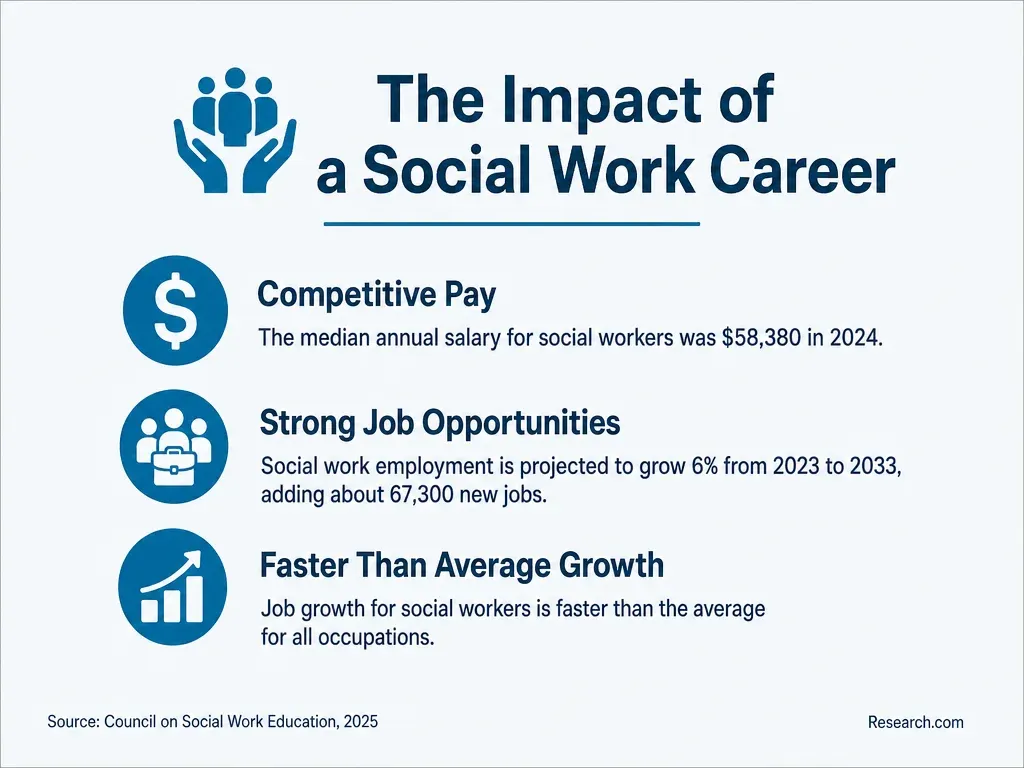
The U.S. Bureau of Labor Statistics reports a May 2025 median annual wage of $61,780 for social workers across specialties and projects 6% employment growth from 2025 to 2035. Healthcare social workers - one occupation that can involve benefits coordination - had a $67,880 median and projected 8% growth. Mental health and substance abuse social workers had a $60,280 median and projected 10% growth.
These are occupation-wide figures, not expected pay for an SSI/SSDI navigator or a guaranteed return on an MSW. Some navigation positions fall under different occupational categories altogether. Compare local postings for the intended job title with program cost, foregone earnings, and credential requirements. Prospective online MSW students can also consider comparing assistantship opportunities for online social work students, while verifying whether any award is available, funded, and compatible with field hours.
Other Things You Should Know About Social Work
Possibly. SSI and SSDI have different rules for when payments can begin, and SSDI has a disability-benefit waiting period. SSA's award notice identifies the dates and amounts; do not estimate back payments from the application date alone.
Yes, but earnings must be reported and can change payments or eligibility. The programs have different work rules and incentives, so check the person's benefit type and obtain individualized benefits counseling before relying on a projected paycheck.
No. SSA determines eligibility. A representative payee, when SSA appoints one, manages benefit payments for a recipient who needs that assistance; the role is not the same as being an attorney or benefits advocate.
Use official SSA communication channels, verify unexpected requests, and avoid sending Social Security numbers or medical records through unapproved email or messaging tools. Follow agency privacy procedures and let the client know what information will be shared.
- Medicaid | Medicare https://www.medicare.gov/basics/costs/help/medicaid
- Overview of our Disability Programs | The Red Book https://www.ssa.gov/redbook/eng/overview-disability.htm
- Social Security Work Incentives | ssa.gov https://yourtickettowork.ssa.gov/resources/work-incentives
- Effects of Medicaid expansion on insurance coverage... - PMC https://pmc.ncbi.nlm.nih.gov/articles/PMC9660429/
- SSDI and SSI benefits for people with disabilities | usa.gov https://www.usa.gov/social-security-disability
- Tracking Federal Impact: Medi-cal Eligibility - DHCS https://www.dhcs.ca.gov/tracking-federal-impact-medi-cal-eligibility/
- About Georgia Pathways to Coverage https://pathways.georgia.gov/about-pathways