2027 Social Workers and Emergency Responders: Multidisciplinary Crisis Team Preparation
Audited and Verified:
Our Editorial and Data Verification Process
Research.com uses government datasets, official education statistics and primary institutional information to support its career and degree guides. Our review process checks factual accuracy, occupational definitions, source dates and the requirements associated with the credentials discussed.
How This Article Was Fact-Checked
Our editorial team verifies salary estimates, employment projections, education requirements and program information against original data providers and official organizations. Salary figures are checked against the relevant occupational definitions and reporting periods. Information about licensure, accreditation and required in-person training is reviewed separately.
Fact-checked and verified on:

Co-Founder and Chief Data Scientist
A crisis team works only when its members know who can assess needs, who controls scene safety, and how they will coordinate without compromising a person's rights. For social work students, new graduates, and responders considering this work, preparation involves more than a crisis-intervention course. This guide explains team models, education and licensing boundaries, shared training, and supervised experience. It also shows how to judge whether a social work degree, targeted training, or an existing qualification is the most direct route to your intended role.
Key Things You Should Know
- Multidisciplinary crisis teams pair behavioral health or social service expertise with emergency response capabilities; duties, dispatch rules, and scene-safety authority depend on the local model.
- A BSW can support generalist crisis-service roles, while many clinical positions require an MSW and state-specific licensure; neither degree alone grants independent clinical authority.
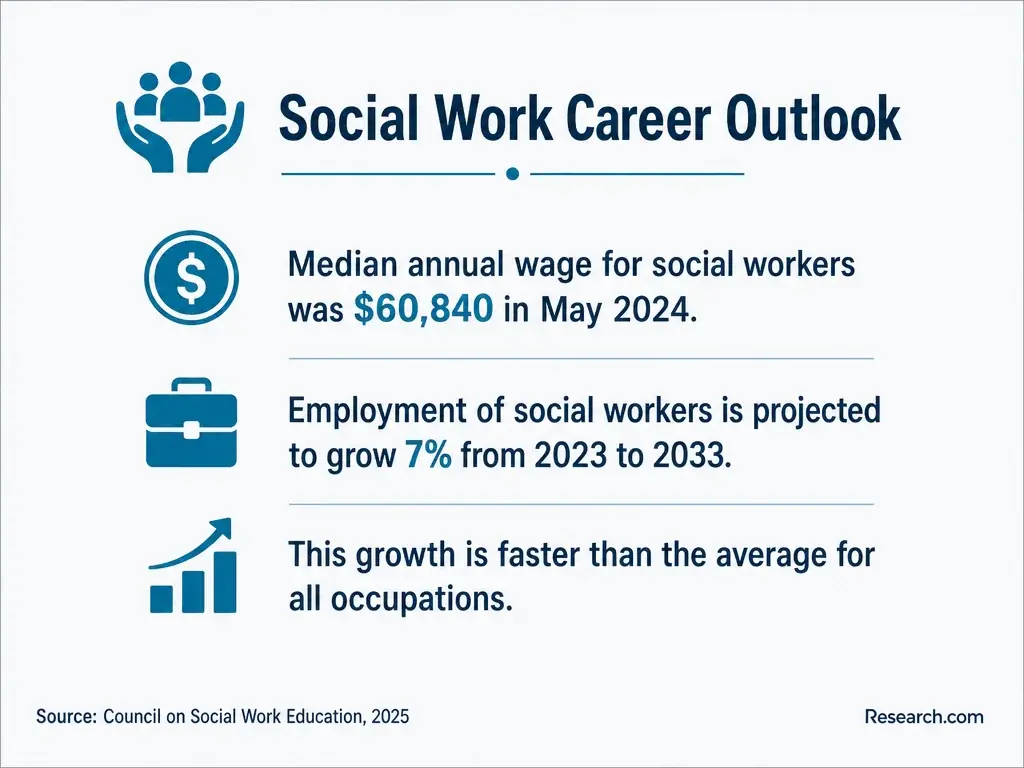
- For relevant labor-market context, the U.S. Bureau of Labor Statistics reports a $60,280 median annual wage for mental health and substance abuse social workers in May 2025 and projects 10% employment growth from 2025 to 2035 - not a guaranteed crisis-team salary.
How do social workers and emergency responders work together on crisis teams?
A multidisciplinary crisis team brings together professionals whose authority and skills differ. Depending on local design, a social worker may accompany emergency medical services or law enforcement, respond with a mobile behavioral health team, advise a dispatcher, or arrange follow-up after an emergency. These are distinct assignments: a clinician riding with police does not have the same safety responsibilities as a clinician dispatched independently.
Social workers typically contribute engagement, assessment of social and behavioral health needs, attention to housing or family circumstances, collaborative safety planning within their scope, and connections to ongoing care. Emergency responders handle duties assigned to their profession and agency, such as medical stabilization, transport, or scene security. A useful team agreement specifies who leads at each stage, when a response is redirected, what information may be shared, and who documents follow-up. Consent, confidentiality, mandatory reporting, and emergency exceptions require applicable law and agency policy - not an assumption that everyone on the team may access the same records.
If you are comparing this work with other roles, social work master's career options can help distinguish frontline response from longer-term clinical and service-coordination work.
What social work degrees prepare you for crisis response?
Choose education for the duties you want to perform, not for the phrase "crisis response" in a program description. A BSW develops generalist assessment, ethics, referral, and systems skills that can fit outreach and service coordination. An MSW adds specialized coursework and field learning that many employers expect for clinical crisis positions; independent clinical practice requires separate state authorization. Some dispatcher, peer-support, emergency response, and human services jobs instead accept other qualifications plus employer training.
A traditional MSW generally admits applicants with bachelor's degrees in other fields. Advanced-standing MSW entry is typically reserved for applicants with a qualifying social work bachelor's education under the program's rules; relevant work alone does not establish eligibility. Compare social work master's entry routes explained before assuming a shorter sequence is available. A DSW or PhD is usually unnecessary for frontline entry; those degrees are more relevant to particular leadership, education, or research goals.
What licenses and certifications do crisis social workers need?
Requirements depend on the state, job duties, and employer. Some crisis coordination positions may accept a BSW or MSW without an independent clinical license; positions involving independently provided clinical services may require one. State boards - not universities or employers - determine social work license categories, qualifying education, examinations where required, supervised experience, and authorized scope. An MSW, clinical concentration, passed exam, or completed field placement does not itself confer a license.
Before accepting a role, compare its posting with the issuing state board's current rules and ask the employer which tasks require a particular license. Voluntary crisis-intervention certificates and agency training may strengthen preparation but generally do not replace licensure or expand legal scope. For online study, check online MSW program eligibility by intended state against the board's current requirements rather than relying on a program's general licensure statement.
Ask the field office about approved placements in mobile crisis services, hospital emergency departments, behavioral health agencies, shelters, or related settings. The best match is not necessarily the site with the most urgent calls: it is one that can provide appropriate tasks, qualified field instruction, supervision, safety orientation, and evidence of progress toward the program's competencies. Students should not be treated as substitute on-call staff.
Before committing, establish how shifts, travel, personal safety, and exposure to distressing events will be managed. The school and site must approve the learning agreement and determine which activities and hours count. Paid work, volunteering, and simulations do not automatically count as field education; academic field hours are also distinct from post-degree clinical supervision. If speed matters, assess shorter online Master of Social Work pathways against the placement schedule you can actually sustain.
What are the salary and job outlook for crisis social workers?
There is no single Bureau of Labor Statistics occupation called "crisis social worker." The following U.S. occupational categories provide context for different crisis-related settings; their medians include workers in many jobs outside crisis teams.
| BLS occupation | May 2025 median annual wage | Projected employment growth, 2025-2035 |
| Mental health and substance abuse social workers | $60,280 | 10% |
| Healthcare social workers | $67,880 | 8% |
| Child, family, and school social workers | $59,550 | 4% |
Use the category closest to a prospective job's actual work, not the one with the highest median. Pay also varies with location, employer, schedule, experience, and license requirements; projected occupation-wide growth does not guarantee openings on a particular team. For geographic context, see exploring regional pay patterns for MSW careers, then compare current local postings with the cost and time of the qualification they require.
Other Things You Should Know About Social Work
Workers should follow their agency's safety and escalation procedures and raise concerns promptly with the designated supervisor or incident lead. Employment obligations and emergency procedures vary; a team should establish these expectations before dispatch.
They may be, depending on the program. Peer specialists bring a distinct perspective and role; agencies should define their training, supervision, compensation, and boundaries rather than treating peer work as interchangeable with licensed clinical practice.
Follow agency procedures for incident documentation, operational review, and worker support. A useful debrief addresses communication and safety without unnecessarily sharing identifiable client information.
No. Some positions focus on telephone or dispatch support, care coordination, or follow-up. Confirm whether a posting requires field response, travel, night shifts, or direct contact before applying.
- Responding to Individuals Experiencing Mental Health Crises | Illinois Criminal Justice Information Authority https://icjia.illinois.gov/researchhub/articles/responding-to-individuals-experiencing-mental-health-crises-police-involved-programs/
- Knowledge and Skills for Social Workers on Mobile Crisis... - PMC https://pmc.ncbi.nlm.nih.gov/articles/PMC8591592/
- Tool: Handoff | Agency for Healthcare Research and Quality https://www.ahrq.gov/teamstepps-program/curriculum/communication/tools/handoff.html
- Co-Response Models in Policing - LEB https://leb.fbi.gov/articles/featured-articles/co-response-models-in-policing
- Suicide Prevention Practice | health.qld.gov.au https://www.health.qld.gov.au/public-health/topics/mhaod/for-healthcare-providers/clinical-guidelines-policies-and-resources/guidelines-frameworks/suicide-prevention-practice-queensland-health-guideline
- The Crisis System of Georgia https://dbhdd.georgia.gov/crisis-system-georgia
- Trauma-Informed Approaches and Programs | samhsa.gov https://www.samhsa.gov/mental-health/trauma-violence/trauma-informed-approaches-programs
- Crisis Care Workers Core Competencies | wisconsin.gov https://www.dhs.wisconsin.gov/crisis/care-worker-competencies.htm
- Behavioral Health | Baltimore Police Department https://www.baltimorepolice.org/transparency/consent-decree-basics/behavioral-health
- Typology | Vera Institute of Justice https://www.vera.org/behavioral-health-crisis-alternatives/typology