2027 Social Workers and Community Organizers: Individual Services and Collective Action
Audited and Verified:
Our Editorial and Data Verification Process
Research.com uses government datasets, official education statistics and primary institutional information to support its career and degree guides. Our review process checks factual accuracy, occupational definitions, source dates and the requirements associated with the credentials discussed.
How This Article Was Fact-Checked
Our editorial team verifies salary estimates, employment projections, education requirements and program information against original data providers and official organizations. Salary figures are checked against the relevant occupational definitions and reporting periods. Information about licensure, accreditation and required in-person training is reviewed separately.
Fact-checked and verified on:

Co-Founder and Chief Data Scientist
Helping one family secure housing and organizing residents to change housing policy address the same problem at different levels. Social workers and community organizers may do either kind of work, but their roles, qualifications, and authority are not interchangeable. For students and human services professionals, that distinction matters before choosing a degree or job. This guide compares individual services with collective action, then explains the education, licensing, earnings, and program features that can help you choose a route suited to the work you want to do.
Key Things You Should Know
- Direct social work centers on services to individuals and families; community organizing builds collective power to pursue changes in institutions, resources, or policy. Some jobs deliberately combine both.
- A social work degree does not itself grant a license, and community organizing roles generally do not require social work licensure. Check the duties and your state's rules before choosing a credential.
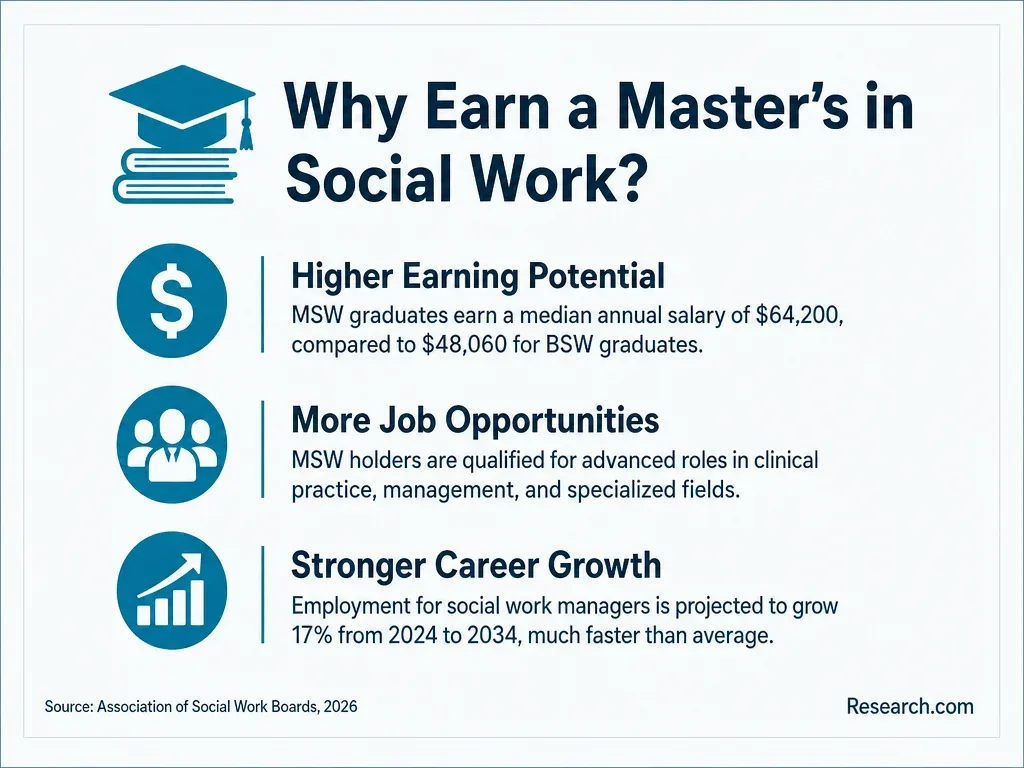
- The U.S. Bureau of Labor Statistics reports a $61,780 median annual wage for social workers in May 2025 and projects 6% employment growth from 2025 to 2035; neither figure describes community organizers as a separate occupation.
How do social workers and community organizers differ?
Direct social work usually starts with a person or family: assessing needs, coordinating services, supporting decisions, documenting work, and evaluating progress. Community organizing starts with people acting together: listening to residents, identifying shared priorities, developing leaders, building coalitions, and pressing decision-makers for change. The distinction is the primary unit of action, not whether a worker cares about systemic problems.
A housing-agency social worker might help a tenant navigate benefits and referrals. An organizer might bring tenants together to negotiate repairs or advocate for a policy change. A social worker in a community-practice role could do both, provided the activities fit the job, their competence, and applicable professional rules. Organizers should not present outreach or advocacy as licensed clinical care.
If you want to provide psychotherapy rather than coordinate services or mobilize a community, investigate exploring clinical social work master's degrees. Clinical preparation is a different decision from choosing an organizing role, and a clinical concentration alone does not authorize independent treatment.
What degrees prepare you for social work or community organizing?
Start with the duties in the jobs you want, not the broad appeal of a degree title. The routes below differ most in whether they provide social work preparation, qualify graduates to seek a regulated credential, or develop skills for collective action.
| Route | Best fit | Important limit |
| BSW | Generalist social work and entry-level direct or community practice | Job titles and license eligibility depend on state and employer rules |
| Traditional or foundation MSW | Graduate social work preparation for applicants with a qualifying bachelor's degree in another field | Requires foundational study and field education; it is not automatically a clinical license |
| Advanced-standing MSW | Eligible graduates of qualifying social work bachelor's programs who can enter an abbreviated sequence | A related major or service experience alone does not establish eligibility |
| Public health, public administration, or related study | Organizing, policy, program, or government roles that do not require a social work credential | Does not substitute for required social work education or licensure |
A DSW may suit experienced practitioners pursuing practice leadership, while a PhD generally emphasizes research preparation; neither is a standard prerequisite for organizing or entry-level direct service.
If a later leadership role makes doctoral study relevant, compare the work you expect to do with social work doctoral tuition comparisons before assuming another degree is necessary. For many organizing jobs, community experience and targeted training are a more direct investment.
Do social workers and community organizers need licenses or certifications?
Community organizing is generally not a licensed social work activity. A nonprofit may hire organizers with experience in outreach, facilitation, advocacy, or local issues rather than a social work degree. Its requirements can still include agency training or qualifications tied to a particular setting.
Social work is different: states set their own license categories, protected titles, examinations where applicable, and scopes of practice. Some direct-service jobs require a license; others accept a BSW, MSW, or another qualification.
Independent clinical practice typically requires additional, board-approved post-degree supervised experience and a clinical license. Academic field placement, ordinary employment, and post-degree licensing supervision are not interchangeable.
If clinical practice is the goal, review your state board's current rules and keep the records it requires. Clinical social work experience documentation questions can help you identify what to ask before accepting a supervised position. Voluntary certificates may demonstrate training, but they do not expand legal scope or replace a required license.
The Bureau of Labor Statistics (BLS) reports the following May 2025 U.S. median annual wages for social work occupations. These are occupation-wide medians, not starting salaries or predicted earnings from a particular degree.
| BLS occupation | Median annual wage, May 2025 |
| Social workers, all specialties | $61,780 |
| Child, family, and school social workers | $59,550 |
| Healthcare social workers | $67,880 |
| Mental health and substance abuse social workers | $60,280 |
There is no single BLS wage category for "community organizer," so using the social worker median as an organizer salary would be misleading. Compare actual organizer postings by employer, location, travel expectations, and benefits. For social work offers, license level, setting, and geography also matter; social work master's salary geography offers another lens, but local job postings remain more useful for an individual offer.
What are the admission requirements, costs, and timelines for social work degrees?
BSW admission rules vary by school, and entry to the university may be separate from entry to its social work major. Traditional MSW programs can admit applicants with bachelor's degrees outside social work, subject to program-specific requirements.
Advanced standing generally requires a qualifying prior social work bachelor's education and additional program review; a psychology or human services degree does not automatically qualify. Applications may ask for transcripts, references, a statement, and evidence of relevant preparation, but requirements and deadlines must be checked with each program.
A BSW usually follows an undergraduate course sequence; a traditional MSW includes foundation and specialized study, while an approved advanced-standing route omits some foundation work. Actual completion time depends on enrollment pace, course availability, and placement scheduling.
Compare the full cost - not just tuition - including fees, books, field travel, screening, caregiving, and wages forgone during placement. Ask whether paid or employment-based field work is permitted and how approval works. If funding is offered, verify duties, hours, and renewal terms for MSW assistantship work expectations and funding before counting it in your budget.
Before applying, collect several target job postings. If they require a social work degree or license, work backward from that credential and your state board's rules. If they primarily seek organizing experience, compare the degree's total cost with a more direct route through relevant employment, training, or community-led work.
When weighing an MSW against an organizing job you could enter now, compare the full educational cost with the qualifications employers actually request. Affordable online Master of Social Work options may be worth examining, but lower advertised tuition does not eliminate field-placement travel, reduced paid hours, or other costs.
Other Things You Should Know About Social Work
Yes, when advocacy fits the worker's role and ethical obligations. They should protect client confidentiality and avoid assuming that one client's experience represents an entire community.
The people affected should have meaningful authority over goals and tactics. Staff can provide facilitation and resources without substituting the agency's priorities for residents' choices.
It can help you learn local issues, build relationships, and demonstrate reliable participation. It does not automatically count as accredited field education or licensed-practice supervision.
It can examine service-access patterns alongside feedback from affected people and the progress of community-defined goals. Any use of client information must follow consent, privacy, and agency requirements.
- Defining Service Coordination: A Social Work Perspective - PMC https://pmc.ncbi.nlm.nih.gov/articles/PMC2992332/
- Barriers to Immigrants' Access to Health and Human Services Programs | ASPE https://aspe.hhs.gov/reports/barriers-immigrants-access-health-human-services-programs-0
- NASW Standards for Social Work Case Management | nycourts.gov https://www.nycourts.gov/reporter/webdocs/nasw_standards_socialwork_casemgt.htm
- From isolation to inclusion: community-based mental health care | who.int https://www.who.int/news-room/commentaries/detail/from-isolation-to-inclusion---community-based-mental-health-care
- Community organizing | Civic Theory and Practice | Data Lab at Tufts https://sites.tufts.edu/civicstudies/major_topics/community-organizing/
- Types of Social Work | socialworkers.org https://www.socialworkers.org/News/Facts/Types-of-Social-Work
- CHW vs. social worker vs. case manager: What's the difference? | chwtraining.org https://chwtraining.org/chw-vs-social-worker/