2027 Social Work with Families After a New Disability Diagnosis: Support Roles and Boundaries
Audited and Verified:
Our Editorial and Data Verification Process
Research.com uses government datasets, official education statistics and primary institutional information to support its career and degree guides. Our review process checks factual accuracy, occupational definitions, source dates and the requirements associated with the credentials discussed.
How This Article Was Fact-Checked
Our editorial team verifies salary estimates, employment projections, education requirements and program information against original data providers and official organizations. Salary figures are checked against the relevant occupational definitions and reporting periods. Information about licensure, accreditation and required in-person training is reviewed separately.
Fact-checked and verified on:

Co-Founder and Chief Data Scientist
A new disability diagnosis can leave a family managing unfamiliar services, financial pressures, and decisions about care at the same time. Social workers can help, but their responsibilities depend on the setting, their qualifications, and what the person with the disability wants.
This guide is for students, career changers, and early-career professionals considering disability-focused work. It explains what support looks like in practice, where professional boundaries lie, and how to judge whether a BSW, MSW, license, or more targeted experience fits the role you want.
Key Things You Should Know
- Social workers help families understand options, coordinate services, and address barriers; they do not make medical decisions or take decision-making authority away from the person with the disability.
- Many navigation and case-management jobs do not require an independent clinical license. Psychotherapy and other regulated clinical services require the authority specified by the state.
- Pay depends heavily on the job setting: the U.S. Bureau of Labor Statistics reports May 2025 median annual wages of $59,550 for child, family, and school social workers and $67,880 for healthcare social workers - not disability-specialty salaries.
How do social workers support families after a disability diagnosis?
The first task is usually to learn what the diagnosis means to this person and family, rather than assume every family needs the same resources. A social worker may ask about daily routines, communication preferences, caregiving capacity, income, transportation, school or work, and existing sources of support. With permission, they can help the family make sense of next steps described by the clinical team.
Support may include explaining how to contact early-intervention services, a school district, a hospital team, a state disability agency, or a community organization; helping gather documents for a benefits application; and coordinating referrals. A social worker can also advocate for an accessible meeting or help family members prepare questions for providers. They should explain that a referral is not a promise of eligibility, funding, or immediate service.
The setting changes the work. A hospital social worker may focus on discharge and follow-up care, while a school social worker works within educational procedures and a community case manager may concentrate on ongoing service access. Readers exploring those differences can use connecting a social work master's degree to career goals to compare potential MSW roles.
What are social workers' professional boundaries in disability support?
A social worker should be clear about who the client is, what services they can provide, and how information may be shared. This matters when a parent, partner, clinician, or agency requests information that the person with the disability has not agreed to disclose. Capacity, guardianship, consent, and parental rights can complicate these decisions; workers must follow applicable law, agency policy, and supervision rather than presume a diagnosis removes someone's authority to choose.
Professional support is not the same as diagnosing a condition, prescribing treatment, promising benefits approval, or acting as the family's lawyer. Social workers can discuss concerns and coordinate with qualified professionals, but clinical assessment or psychotherapy is appropriate only when the worker's license, supervision, competence, and setting permit it. Comparing social work clinical experience expectations helps distinguish education from the post-degree experience required for independent clinical practice.
Families may seek informal contact outside work hours or ask a worker to intervene personally with a provider. A helpful response is to explain the agency's communication channels, document the request, and arrange an appropriate referral or consultation. Confidentiality, mandated reporting, records access, and safety duties have jurisdiction-specific exceptions; a general ethical principle is not a substitute for checking the governing rules.
What degree do you need to work with families affected by disability?
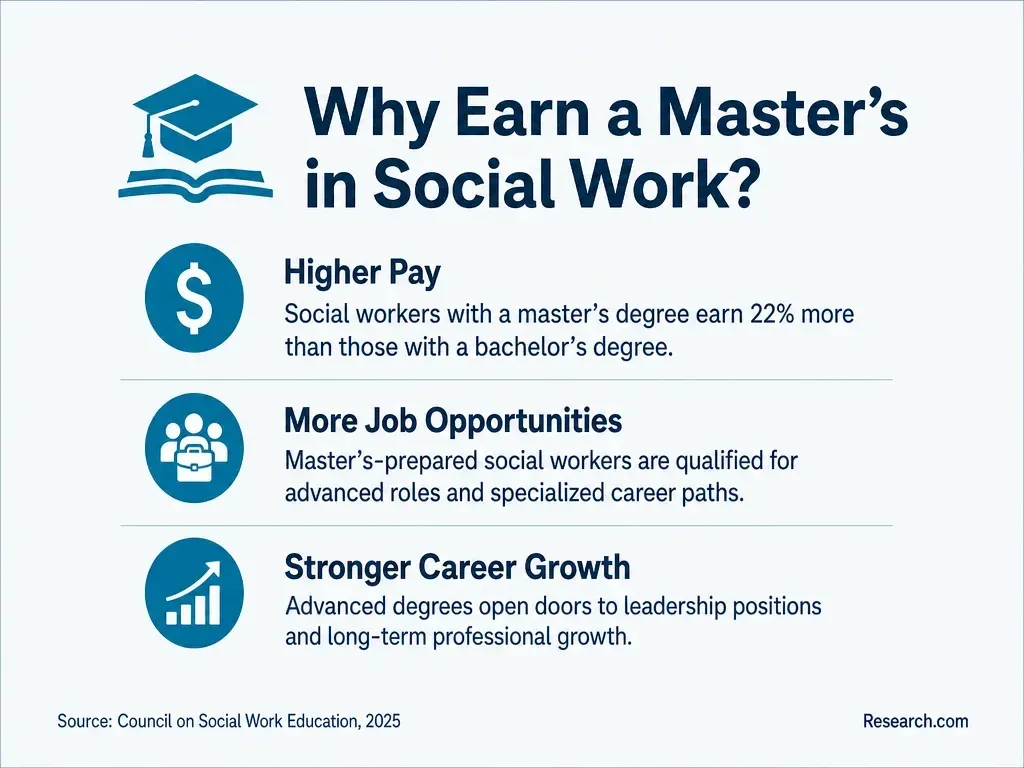
Start with the job duties, not the diagnosis. Some resource-navigation, advocacy, and human-services positions accept related degrees and relevant experience. BSW graduates may qualify for generalist social work roles, subject to employer and state requirements. MSW programs add advanced practice preparation and may be required for hospital social work, specialized clinical positions, or a path toward clinical licensure.
A traditional or foundation MSW can admit applicants whose bachelor's degree is in another field; advanced-standing MSW entry generally requires a qualifying BSW and satisfaction of the program's rules. Comparing formats through comparing online social work education pathways is useful only after confirming that the award and entry route match the target job.
A DSW or PhD is ordinarily unnecessary for helping families navigate a recent diagnosis. Those degrees may fit practice leadership, teaching, or research goals, but neither substitutes for a state license. If a prospective worker already has a suitable qualification for a navigation role, disability-specific training, supervised experience, or agency onboarding may be more direct than another degree.
Job titles do not reliably describe either duties or credentials. The comparison below shows where a worker may encounter families after a diagnosis; an individual posting and the applicable state rules determine eligibility.
| Role or setting | Common focus | Qualification to check |
| Hospital or rehabilitation social worker | Discharge planning, adjustment, and service coordination | Often an MSW; license requirements vary by position and state |
| School social worker | Student and family support within the school system | State education and employer requirements, which may include a specific credential |
| Community case manager or navigator | Benefits referrals, service access, and follow-up | May accept a BSW or related degree; check the posting |
| Clinical social worker | Permitted mental health assessment or treatment | Applicable clinical license, competence, and any required supervision |
For an early-career applicant, a supportive supervisor, manageable caseload, accessible referral network, and clear escalation procedures can matter as much as the title. If a community navigation job does not require a BSW, accredited bachelor's pathways into social work are worth comparing against the faster option of entering the role with an already accepted degree and training on the job.
What are the admission requirements, costs, and timelines for social work degrees?
BSW programs set their own requirements for entry to the major, which may differ from university admission. Traditional MSW programs commonly consider a completed bachelor's degree, academic record, written application materials, and relevant experience; advanced-standing applicants must meet additional BSW-based criteria. Ask for the exact sequence and placement schedule rather than assuming a degree label guarantees a particular completion date.
Compare total cost across tuition, fees, books, screening, placement travel, and any reduced earnings during field education. An online program can save commuting to classes while still requiring travel to a placement. For applicants weighing MSW offers, lower-cost options for future MSW students are a starting point; request a program-specific cost estimate and confirm what financial aid or employer assistance actually applies.
The practical decision is whether the target job requires a social work degree or license at all. If it does, choose an eligible program whose field schedule and total cost are workable. If it does not, compare the degree's added opportunities against entering a disability-services role now and building relevant skills under supervision.
Other Things You Should Know About Social Work
Start by establishing whose preferences and legal decision-making authority apply. Facilitate accessible communication, seek supervision when needed, and follow governing consent rules rather than treating the loudest family member as the decision-maker.
A worker may help someone understand notices, organize records, or find an approved advocate. Whether they can represent the person in an appeal depends on the benefit program, their role, and applicable rules.
Not necessarily. When the role and agency allow it, follow-up can reveal inaccessible services or missed connections. The worker should agree on a realistic follow-up plan rather than imply that every referral will result in care.
Ask the person about preferred communication and approved supports, arrange appropriate accommodations or interpretation, and address the person directly whenever possible. Do not assume a family member's account replaces the person's own views.
- Social Determinants of Health - Healthy People 2030 https://odphp.health.gov/healthypeople/priority-areas/social-determinants-health
- NASW Standards for Social Work Case Management | nycourts.gov https://www.nycourts.gov/reporter/webdocs/nasw_standards_socialwork_casemgt.htm
- Informed Consent - StatPearls - NCBI Bookshelf - NIH https://www.ncbi.nlm.nih.gov/books/NBK430827/
- Improved professional practices in social services through Emotional Labor strategies - PMC https://pmc.ncbi.nlm.nih.gov/articles/PMC10149824/
- OPWDD/SANYS Rights, Responsibilities and Advocacy Booklet | ny.gov https://opwdd.ny.gov/access-supports/opwddsanys-rights-responsibilities-and-advocacy-booklet
- Communicating with families in difficult situations | Social Care Wales https://insightcollective.socialcare.wales/evidence-summaries/communicating-with-families-in-difficult-situations
- Social Workers' Ethical Responsibilities to Clients https://www.socialworkers.org/About/Ethics/Code-of-Ethics/Code-of-Ethics-English/Social-Workers-Ethical-Responsibilities-to-Clients