2027 Social Work Supervisor vs Program Manager: Clinical and Operational Responsibilities
Audited and Verified:
Our Editorial and Data Verification Process
Research.com uses government datasets, official education statistics and primary institutional information to support its career and degree guides. Our review process checks factual accuracy, occupational definitions, source dates and the requirements associated with the credentials discussed.
How This Article Was Fact-Checked
Our editorial team verifies salary estimates, employment projections, education requirements and program information against original data providers and official organizations. Salary figures are checked against the relevant occupational definitions and reporting periods. Information about licensure, accreditation and required in-person training is reviewed separately.
Fact-checked and verified on:

Co-Founder and Chief Data Scientist
A move into leadership can take a social worker in two different directions: guiding practitioners' work with clients or running the systems that make services possible. The distinction matters when evaluating a promotion, choosing training, or deciding whether another degree is worth its cost.
This guide compares social work supervisors' clinical responsibilities with program managers' operational responsibilities, then examines pay evidence, qualifications, experience, and education. It is intended to help practicing social workers and human services professionals identify the role that fits their credentials and the work they want to do.
Key Things You Should Know
- A clinical supervisor guides case decisions, practitioner development, and client-safety oversight; a program manager is chiefly accountable for staffing, budgets, service delivery, and results.
- Neither title alone establishes clinical authority: supervision toward licensure depends on the state board's rules, while many nonclinical management jobs do not require a clinical license.
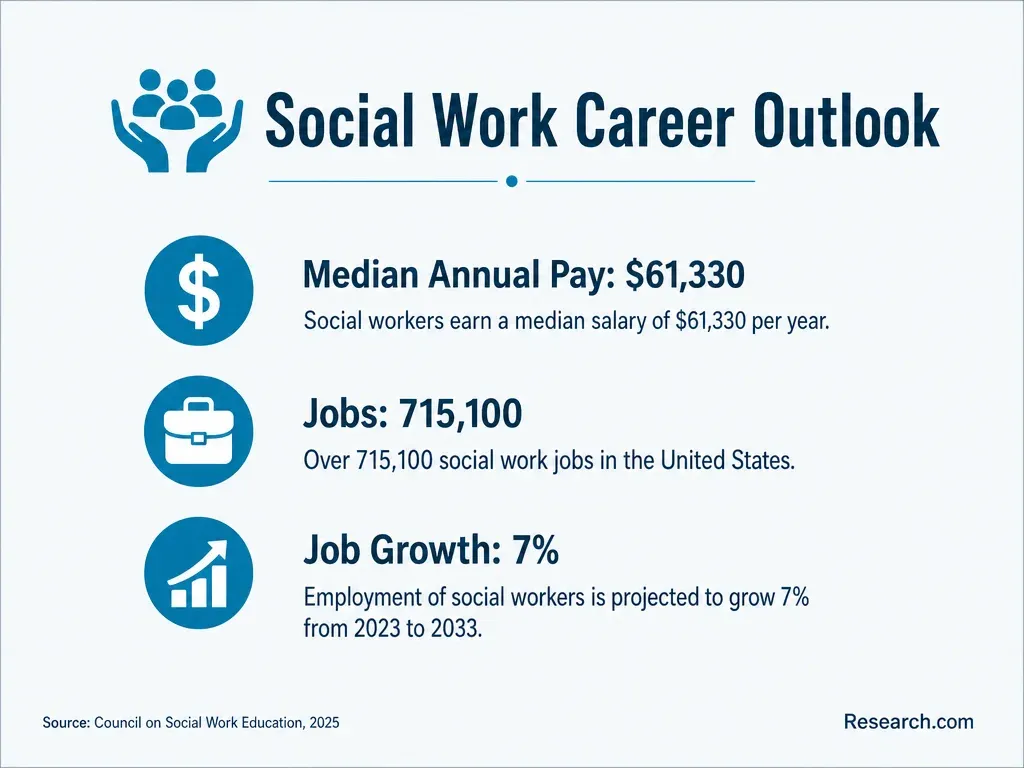
- The Bureau of Labor Statistics reports a May 2025 median annual wage of $61,780 for social workers overall and projects 6% employment growth from 2025 to 2035; neither figure describes supervisor or manager pay specifically.
How do social work supervisors' clinical duties differ from program managers' operational responsibilities?
A social work supervisor develops and oversees practitioners' work. In a clinical setting, that can include reviewing assessments and treatment plans, discussing ethical concerns, monitoring documentation, and helping staff recognize when a case needs consultation or escalation. A program manager is accountable for how a service operates: staffing, schedules, budgets, contracts, reporting, access to services, and improvement plans. Agencies sometimes combine the jobs, so the written scope of responsibility matters more than the title.
This comparison shows where each role's main decisions and accountability usually sit.
| Responsibility | Clinical social work supervisor | Program manager |
| Primary focus | Practitioner competence and the quality of client-facing work | Program capacity, delivery, resources, and results |
| Typical decisions | Case consultation, supervision priorities, documentation feedback, and referrals for higher-level review | Staffing plans, workflows, spending, partnerships, and performance measures |
| Accountability | Practice oversight within applicable license, agency, and supervision rules | Agency goals, funder obligations, personnel processes, and operational controls |
| Common pressure point | Protecting time for meaningful supervision amid high caseloads | Balancing service quality with limited funding and staffing |
For example, a supervisor may help a practitioner examine an assessment and document the reasoning behind a referral. A manager may address a program-wide referral backlog by changing staffing or intake procedures. Both need ethical judgment and respect for confidentiality, but they act at different levels. The guide to professional pathways after an MSW can help place these roles alongside other direct-practice and leadership options.
How do salaries compare for social work supervisors and program managers?
There is no reliable national wage figure for the exact job title "social work supervisor." The Bureau of Labor Statistics (BLS) reports a May 2025 median annual wage of $61,780 for social workers across specialties, but that figure mixes roles and experience levels. Social and community service managers are a separate BLS occupation that may include some program managers; it does not capture every social work agency manager. Comparing the two occupational medians as though they were offers for these exact jobs would be misleading.
For a useful comparison, request the posted pay range and ask how each employer values an independent clinical license, responsibility for licensure supervision, budget size, number of direct reports, and on-call duties. A hospital supervisor, a nonprofit program manager, and a civil-service manager can fall under very different pay structures. Compare benefits and predictable hours alongside salary, especially if a supervisory post adds clinical accountability without protected supervision time. MSW earnings and geographic career planning offers broader location context, not a substitute for local job postings and pay scales.
What licenses or supervisor credentials do these roles require?
Requirements depend on the work being supervised, the state, and the employer. A manager overseeing outreach, housing services, or grants may not need a social work license, although a particular posting may require one. A clinical supervisor generally needs the license and authority appropriate to the clinical work involved. Supervising someone's hours toward independent clinical licensure is a separate question: the state board determines which licensees and supervision arrangements qualify and what records must be kept.
Before accepting a supervision assignment, check the applicable board's current rules for supervisor eligibility, any required training or approval, the supervisee's license status, permitted services, and documentation. Then confirm the agency will provide a workable caseload, scheduled supervision time, and an escalation process. A voluntary supervisor certificate or an MSW concentration cannot override board rules. The distinctions in social work clinical hour requirements are particularly important if the employee expects the work to count toward licensure.
BLS projects 6% employment growth for social workers overall from 2025 to 2035. That indicates demand across the occupation, not a forecast for supervisor openings or a promotion rate. Program managers may appear under the separate social and community service managers occupation or under other classifications, depending on their duties. Agency funding, turnover, service contracts, and public-sector hiring rules can matter more to an individual leadership search than a national projection.
Look at openings in your target setting for evidence of demand: whether employers seek clinical supervision authority, grant management, staff leadership, or all three. Also check whether jobs are replacements for departing managers or newly funded posts, since the latter may depend on continuing support. If you need an MSW to meet a stated qualification, planning a shorter MSW pathway can help you examine legitimate program options; a faster degree will not eliminate post-degree licensing steps or guarantee a leadership vacancy.
Clinical supervision calls for demonstrated practice judgment as well as the license and experience required for the specific assignment. Employers may look for sound case documentation, consultation skills, ethical decision-making, and the ability to give constructive feedback. Program management relies more heavily on evidence that you can coordinate staff, improve a workflow, manage resources, report results, and work with partners or funders. Years of service alone do not show readiness for either set of responsibilities.
Build a record of work that matches your target role. A prospective supervisor might seek a qualified mentor and take responsibility for case consultation or onboarding within their permitted scope. A prospective manager might lead a bounded scheduling, referral, or reporting improvement and document what changed without disclosing client information. If you already have a BSW and are considering an MSW, MSW pathway differences by prior degree can inform your education plan; professional experience alone does not establish advanced-standing eligibility.
How long do social work degrees take, and what do they cost?
A BSW typically follows a four-year undergraduate plan, although transfer credit and course sequencing affect completion. A traditional MSW commonly takes about two academic years of full-time study; an advanced-standing track may be shorter for eligible BSW graduates. Part-time enrollment, placement availability, and required course order can extend either route. Doctoral timelines vary substantially by program and project.
For this career decision, compare the total cost of reaching the job requirement, not tuition alone. Include fees, books, travel to field sites, possible reduced paid hours, and - if seeking clinical authority - later supervision, examination, and licensing costs. Request a written program-specific cost estimate and an honest field schedule before projecting a return on investment. If a doctorate is genuinely relevant to an established leadership goal, review lower-cost doctoral pathways for social workers; otherwise, targeted management development may be the less costly step.
Other Things You Should Know About Social Work
Yes, if their qualifications and agency role permit both. Ask how supervision time, budget decisions, and staff performance evaluations are separated so clinical consultation is not crowded out or treated solely as personnel oversight.
Ask who you will supervise, whether the role includes signing licensure-hour records, how much case responsibility remains, and who handles staffing, budgets, and after-hours escalation. The answers reveal more than the title.
Use agency-approved, appropriately limited measures such as referral wait times or service completion. Follow privacy rules and internal data-access policies; aggregate reporting does not automatically make every use of client records permissible.
Usually the supervisor, particularly if they retain a caseload or participate in case consultation. Some supervisors have no caseload, while managers may occasionally handle escalations, so confirm the expected weekly duties with the employer.
- Superior Qualifications and Special Needs Pay-Setting Authority | U.S. Office of Personnel Management https://www.opm.gov/policy-data-oversight/pay-leave/pay-administration/fact-sheets/superior-qualifications-and-special-needs-pay-setting-authority/
- Professional Licensure | U.S. Department of Education http://www.ed.gov/about/initiatives/international-affairs/professional-licensure
- NYS Social Work: Social Work Licensure & Practice FAQs | nysed.gov https://www.op.nysed.gov/professions/licensed-master-social-worker/faq-licensure-practice
- Program Supervisor | yamhillcounty.gov https://www.yamhillcounty.gov/DocumentCenter/View/842/Program-Manager-I---Program-Supervisor-PDF
- Enablers and barriers to effective clinical supervision in... - PMC https://pmc.ncbi.nlm.nih.gov/articles/PMC8479981/
- South Carolina Board of Social Work Examiners | sc.gov https://llr.sc.gov/sw/faq.aspx
- Care Coordination | Agency for Healthcare Research and Quality https://www.ahrq.gov/ncepcr/care/coordination.html
- What Can You Do With a Healthcare Management Degree | Missouri Baptist University (Mobap) https://www.mobap.edu/news/healthcare-management-careers/
- Public Health Program Manager Career Guide | News & Updates from the Antioch University Community https://commonthread.antioch.edu/public-health-program-manager-career-guide/
- Best Practice Standards in Social Work Supervision | socialworkers.org https://www.socialworkers.org/Practice/NASW-Practice-Standards-Guidelines/Best-Practice-Standards-in-Social-Work-Supervision