2027 Social Work Resource Research Skills: Checking Program Information and Eligibility Sources
Audited and Verified:
Our Editorial and Data Verification Process
Research.com uses government datasets, official education statistics and primary institutional information to support its career and degree guides. Our review process checks factual accuracy, occupational definitions, source dates and the requirements associated with the credentials discussed.
How This Article Was Fact-Checked
Our editorial team verifies salary estimates, employment projections, education requirements and program information against original data providers and official organizations. Salary figures are checked against the relevant occupational definitions and reporting periods. Information about licensure, accreditation and required in-person training is reviewed separately.
Fact-checked and verified on:

Co-Founder and Chief Data Scientist
A social work program can look like a good fit until you discover that its field schedule conflicts with your job or its degree does not meet the rules for your intended license. For prospective students and early-career social workers, research skills mean more than finding a program page: they mean identifying who has authority over each claim and checking the version that applies to you. This guide shows you how to verify education, eligibility, cost, and career information before you apply, enroll, or plan a move.
Key Things You Should Know
- Check the program, accreditor, and licensing board separately: none can make every decision about admission, accreditation, and permission to practice.
- Match every rule to your degree, entry term, state, and intended license; a traditional MSW and an advanced-standing MSW have different entry conditions.
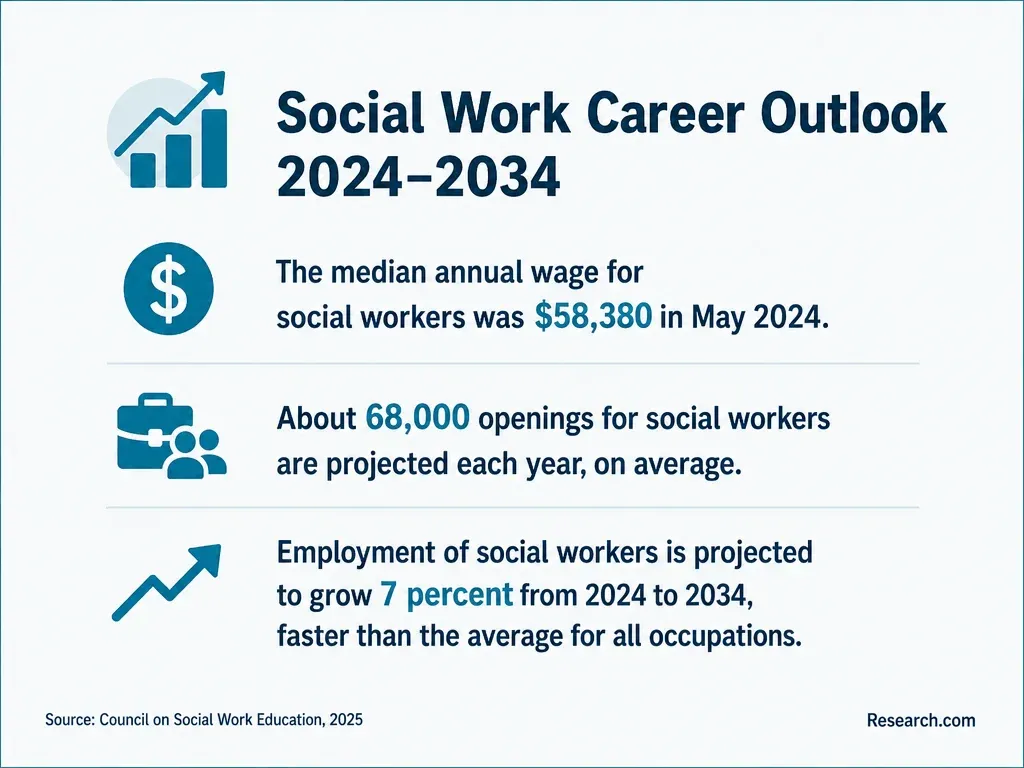
- Use occupation-specific labor data as context, not a personal earnings forecast: the U.S. Bureau of Labor Statistics reports a $61,780 median annual wage for social workers overall in May 2025.
Where can you find reliable social work program and eligibility information?
Start with the organization that makes the decision you need answered. A university controls its admission and graduation rules; the Council on Social Work Education (CSWE) reports programmatic accreditation; a state licensing board determines eligibility for its licenses. A directory or comparison page can help you discover options, but it cannot replace those authorities.
This source map separates useful discovery tools from decision-making authorities. Use it to decide where to confirm a claim before relying on it.
| Claim to check | Best primary source | Detail to record |
| Entry route, curriculum, tuition | Program catalog, admissions office, registrar, financial aid office | Degree, track, entry term, published policy date |
| BSW or MSW program accreditation | CSWE program directory or accreditation records | Exact institution, program, status, relevant dates |
| Field placement arrangements | Program field office and current field handbook | Location, scheduling, approval and supervision rules |
| License or protected practice rights | State social work licensing board and governing rules | License category, education, exam and supervision conditions |
| Wages and employment projections | U.S. Bureau of Labor Statistics (BLS) | Occupation, geography and reference period |
When using social work degree planning for prospective students to identify possibilities, build a short verification file for each school. Save the catalog year, source title, date accessed, and the exact question you sent to the responsible office. This makes conflicting answers easier to resolve later.
How can you verify a social work program's CSWE accreditation?
Search CSWE's official directory or accreditation records for the specific BSW or MSW program, not just the university name. Check its status and relevant dates against your expected enrollment and graduation period. Institutional accreditation and CSWE programmatic accreditation answer different questions; neither alone establishes that a state board will approve your individual license application.
Use this sequence when a school's wording is unclear:
- Record the institution, campus or delivery option, exact degree, and anticipated entry term from the program catalog.
- Compare that program with CSWE's official listing, including any status or date information shown there.
- Ask the program and your intended state board how that status applies to your cohort if the listing, program name, or dates raise questions.
"Accreditation pending," institutional accreditation, and an accredited MSW at the same university are not substitutes for confirming the BSW you intend to enter. If you are exploring recognized online BSW education, verify the exact award rather than assuming its delivery format determines accreditation.
How do you check social work licensing requirements in your state?
Go to the licensing board for the state where you intend to practice and identify the license category matching your intended work. Read its current application instructions and governing rules for qualifying education, examinations where required, supervised experience, supervisor qualifications, documentation, and any additional conditions. State license names and requirements differ.
For checking professional eligibility when choosing an MSW, send the board a precise question: name the degree and program, expected graduation date, proposed license category, and any unusual circumstance such as an out-of-state placement. Keep its response with the applicable rules. A school can explain its curriculum, but the board makes licensing decisions.
Separate each milestone: graduation is not license issuance; passing an exam, when one is required, may not complete an application; and MSW field education does not automatically count as post-degree clinical supervision. If you plan to move or provide remote services across state lines, check authorization in the relevant jurisdiction rather than assuming another state's license transfers.
Requirements depend on both the school and the entry route. A student may be admitted to a university but still need separate approval for its BSW major or field sequence. MSW programs commonly distinguish a traditional or foundation route, which can admit graduates of other disciplines, from advanced standing, which generally requires a qualifying social work bachelor's degree and satisfaction of the program's additional criteria.
Check the current admissions page and catalog for prior-degree rules, minimum grades or GPA, prerequisites, transcripts, references, statements, deadlines, and any interview or service-experience expectations. Ask admissions to confirm accepted course equivalents and whether any condition must be completed before enrollment. A psychology, sociology, or human services bachelor's degree should not be assumed to qualify for advanced standing, although it may support a traditional MSW application.
Admission and placement readiness are separate checks. A program may have field-site onboarding requirements after admission. If you are also comparing self-paced online MSW study options, ask which courses can actually be taken at your pace and which skills sessions, field terms, or prerequisite sequences have fixed dates.
Choose a pathway by the work you intend to do, then verify the credential employers or regulators require. The comparison below describes educational purposes, not guaranteed job titles or licenses; individual programs may emphasize different areas.
| Pathway | Typical entry and emphasis | Key eligibility check |
| BSW | Undergraduate generalist social work education | Major admission, CSWE status, field sequence |
| Traditional MSW | Graduate foundation and specialized study; may admit non-BSW graduates | Degree prerequisites, program sequence, state board education rules |
| Advanced-standing MSW | Graduate route building on qualifying prior BSW education | Accepted BSW credential, grades, recency and other school criteria |
| DSW | Often practice, leadership, or applied scholarship | Program's experience, project and degree requirements |
| PhD in social work | Often original research and scholarly preparation | Research fit, mentoring, funding and dissertation expectations |
A doctoral degree is not a substitute for meeting a state's clinical licensing rules. If the target role is nonclinical program management or community outreach, check job postings before paying for another social work degree; relevant experience or targeted training may be a more direct route. For applicants weighing an MSW against likely opportunities and expense, MSW affordability and career value considerations provide a useful comparison frame, but the employer's and board's actual requirements should control the decision.
Request an individualized degree plan and cost estimate for the same enrollment intensity at each school. Compare credits still required, course availability, field terms, tuition units, mandatory fees, and the expected completion date. An advanced-standing route may be shorter for an eligible student, but do not price it as your route until the program confirms admission to that track.
Total cost also includes books, technology, placement travel and parking, screening, any required visits, and reduced earnings or caregiving costs during field terms. Ask the financial aid office which program and enrollment status qualify for federal aid, scholarships, or employer assistance, and whether support continues through summer or part-time terms. Aid eligibility and awards are individual decisions, not features guaranteed by a program listing.
Use affordable online Master of Social Work options to make a candidate list, then calculate your own likely borrowing and schedule costs from each school's current figures. The least expensive advertised tuition may not produce the lowest total cost if field travel or delayed completion is substantial.
Where can you verify social worker salaries and job outlook?
The BLS Occupational Outlook Handbook and Occupational Employment and Wage Statistics are starting points for U.S. occupation-level wages and projections. Match the occupation to the work you want, then check the reference year, geography, and whether the figure is a median wage or a projected change in employment. The following national figures show why specialty matters.
| BLS occupation | May 2025 median annual wage | Projected employment growth, 2025-2035 |
| Social workers, all specialties | $61,780 | 6% |
| Child, family, and school social workers | $59,550 | 4% |
| Healthcare social workers | $67,880 | 8% |
| Mental health and substance abuse social workers | $60,280 | 10% |
These medians describe workers in BLS occupations, not starting pay, a particular license, or an MSW graduate's return on tuition. A national projection also does not predict openings at a specific agency. Use state-level BLS data, local postings, and public-sector pay schedules where relevant; social work master's salary geography can help frame questions about location, provided you check that the occupation and wage period match your comparison.
Other Things You Should Know About Social Work
No. Snippets may omit exceptions or display old text. Open the school's current catalog or the responsible authority's full policy and record the version that applies to your entry term.
Send the same specific question to the office responsible for the decision, include both responses, and request clarification in writing. Ask which published policy governs your situation.
No. Use it to identify questions, not to establish accreditation, admission, aid, or licensing eligibility. Confirm material claims with the organization that makes each decision.
Use the school's or board's designated submission method. Ask what documents it needs, and avoid sending unnecessary personal information or client records in an ordinary email.
- Coded Private Information or Biospecimens Used in Research, Guidance (2018) | HHS.gov https://www.hhs.gov/ohrp/coded-private-information-or-biospecimens-used-research.html
- Identifying Credible Sources of Health Information in Social Media: Principles and Attributes | nih.gov https://pmc.ncbi.nlm.nih.gov/articles/PMC8486420/
- Frequently Asked Questions | SNAP | OTDA - NY. Gov https://otda.ny.gov/programs/snap/qanda.asp
- Eligibility Rules - Maryland Department of Human Services https://dhs.maryland.gov/supplemental-nutrition-assistance-program/eligibility-rules/
- 1.2.3 Non-Financial Verification | wisconsin.gov https://www.emhandbooks.wisconsin.gov/fsh/policy_files/1/12/1.2.3.htm
- FERPA | Protecting Student Privacy - Department of Education https://studentprivacy.ed.gov/ferpa
- Supplemental Nutrition Assistance Program (SNAP) | Colorado Department of Human Services https://cdhs.colorado.gov/snap