2027 Social Work Public Contracts: Deliverables, Reporting, and Service Quality Questions
Audited and Verified:
Our Editorial and Data Verification Process
Research.com uses government datasets, official education statistics and primary institutional information to support its career and degree guides. Our review process checks factual accuracy, occupational definitions, source dates and the requirements associated with the credentials discussed.
How This Article Was Fact-Checked
Our editorial team verifies salary estimates, employment projections, education requirements and program information against original data providers and official organizations. Salary figures are checked against the relevant occupational definitions and reporting periods. Information about licensure, accreditation and required in-person training is reviewed separately.
Fact-checked and verified on:

Co-Founder and Chief Data Scientist
A public contract can fund essential social services, but it also turns service promises into obligations an agency must document and deliver. For nonprofit and public-sector staff, students, and early-career social workers, the challenge is meeting those obligations without reducing clients to performance numbers.
This guide explains how contracts specify services, reports, quality measures, and safeguards. It also shows how to assess the training and jobs connected to contract-funded work, so you can evaluate an opportunity - or a proposed service plan - against its actual requirements.
Key Things You Should Know
- The signed agreement controls: Confirm the service population, deliverables, measurement definitions, reporting schedule, payment terms, and corrective-action rules before accepting targets.
- Activity is not the same as impact: A count of completed visits shows service volume; a housing-stability measure needs a defined population, follow-up period, and method for handling missing data.
- Qualifications depend on the role: Contract-funded case management may not require a clinical license, while psychotherapy or another regulated service may; the contract, employer, and state rules must be checked separately.
What are social work public contracts and how do they work?
A social work public contract is an agreement through which a government agency pays another organization to deliver specified services, such as family support, housing navigation, or behavioral health care. The agreement may set eligibility rules, staffing qualifications, service volumes, reimbursement methods, data requirements, and remedies if performance falls short. A grant can impose similar conditions, but its legal and payment structure may differ; staff should read the actual award rather than treating the terms as interchangeable.
Common payment arrangements include reimbursement of allowable costs, payment for defined service units, and fixed amounts tied to milestones. Each shifts operational risk differently. A provider paid per completed visit needs a clear definition of a billable visit; a provider reimbursed for costs needs records that establish those costs are allowable. Neither arrangement changes a worker's duty to exercise professional judgment or respect client choice.
Before committing, compare the scope of work with staffing and capacity. Ask whether the proposed caseload, travel, language access, supervision, referral network, and data system can support the promised service. If a position calls for a social work degree, social work degree formats and learning expectations can inform a prospective worker's preparation, but the contract and employer determine the position's qualifications.
What deliverables are typically required in social work public contracts?
Deliverables are the services or work products the provider agrees to produce. They may include completed assessments, service plans, outreach events, referrals, follow-up contacts, training, or a final program report. A contract should define what counts as complete, who approves it, and when it is due. A referral sent is not necessarily a referral received or a service obtained.
The distinctions below help staff avoid promising an outcome when they can directly document only an activity.
| Deliverable type | Illustrative contract item | Evidence and limitation |
| Service activity | Eligibility screening or client contact | Dated record supports completion, not a change in client circumstances. |
| Work product | Individualized service plan | Approval and required elements show completion; the plan alone does not show implementation. |
| Coordination | Referral and follow-up | Track separately whether the client connected with the receiving service. |
| Program milestone | Staff training or community session | Attendance documents reach, not lasting skill or behavior change. |
Deliverables should be feasible within the funded hours and accessible to the people served. Frontline workers may develop assessment and documentation skills through BSW study; those considering that route can compare online bachelor of social work program options. A degree does not replace contract-specific training on forms, definitions, and approval procedures.
What reporting requirements apply to publicly funded social services?
Reporting usually connects service records to the contract's performance and payment terms. Depending on the agreement, a provider may submit monthly service counts, invoices, expenditure documentation, demographic summaries, outcome updates, incident notices, and a closeout report. Deadlines, required formats, and the people authorized to receive identifiable information must be established by the governing agreement and applicable law.
A workable reporting process starts with a data dictionary: a shared definition for each field, such as "enrolled," "contact completed," or "case closed." Staff then need a way to reconcile case records, aggregate reports, and invoices. For example, a report should not count an attempted call as a completed visit unless the contract explicitly permits it. Supervisors should review exceptions and corrections without pressuring workers to alter clinical or case notes merely to meet a target.
Students interested in these responsibilities should ask whether placements offer supervised exposure to documentation and program reporting, not just client contact. Field education support for distance MSW learners is especially relevant when a student needs help finding an approved site with suitable learning tasks. Access to contract data remains subject to agency permission and privacy rules.
Public agencies may assess quality through file reviews, timeliness, client feedback, complaint resolution, accessibility, staff qualifications, and whether services follow the approved model. Outcomes address changes the program seeks, such as a client obtaining benefits or remaining housed at a defined follow-up point. The contract should specify the measure, eligible population, observation period, data source, and how incomplete records are treated.
A useful quality review asks both "Was the service delivered well?" and "What changed?" High completion rates can mask unmet language needs or rushed plans. Conversely, a worker may provide sound support when an outcome depends heavily on housing supply, eligibility decisions, or a client's choice. Agencies should examine results by relevant groups where lawful and feasible, investigate disparities, and avoid interpreting a single metric as proof that a particular intervention caused the result.
For contracts involving treatment, reviewers should separate service quality from a clinician's legal authority to practice. Clinical practice preparation through an MSW may develop relevant skills, but an MSW concentration alone does not confer an independent clinical license or establish treatment effectiveness.
Contract reporting does not give a funder unrestricted access to client records. Providers must identify which laws apply to their setting and information - including, where applicable, HIPAA, federal substance-use-disorder record rules, education-record rules, and state confidentiality requirements - alongside the contract and agency policy. They should collect only needed information, limit access by role, secure transfers and storage, and establish approved processes for disclosures, retention, and breaches.
Informed consent, client safety, and mandatory-reporting duties require attention to the specific facts and jurisdiction. Staff should know when to consult a supervisor or privacy officer rather than promising absolute secrecy or sending an identifiable case file because a report is due. The NASW Code of Ethics offers professional guidance; it does not replace governing law or contract terms.
Staffing compliance is separate from data compliance. If a funded service requires licensed personnel, verify the worker's current license, permitted scope, and supervision arrangement in the state of service. Prospective MSW students can use understanding degree and licensing expectations for MSW study to frame questions, then confirm the applicable board's requirements directly.
For contract-focused careers, compare programs by the learning tasks and placement support they can actually provide - not delivery format alone. Ask who finds and approves field sites, whether a placement can include supervised program evaluation or administration, and whether existing employment can qualify under the school's rules. Online classes may still involve live sessions, skills practice, and an in-person placement.
Compare total costs using tuition and fees plus books, required visits, screening, travel, and any reduction in paid work during field education. Then weigh those costs against the qualifications in jobs you would realistically pursue. Comparing affordable social work master's degrees can start a shortlist, but obtain each program's current charges, placement policies, and schedule before deciding. An inexpensive program that cannot support a feasible placement may cost more in delays or lost earnings.
What is the job outlook for social workers in publicly funded services?
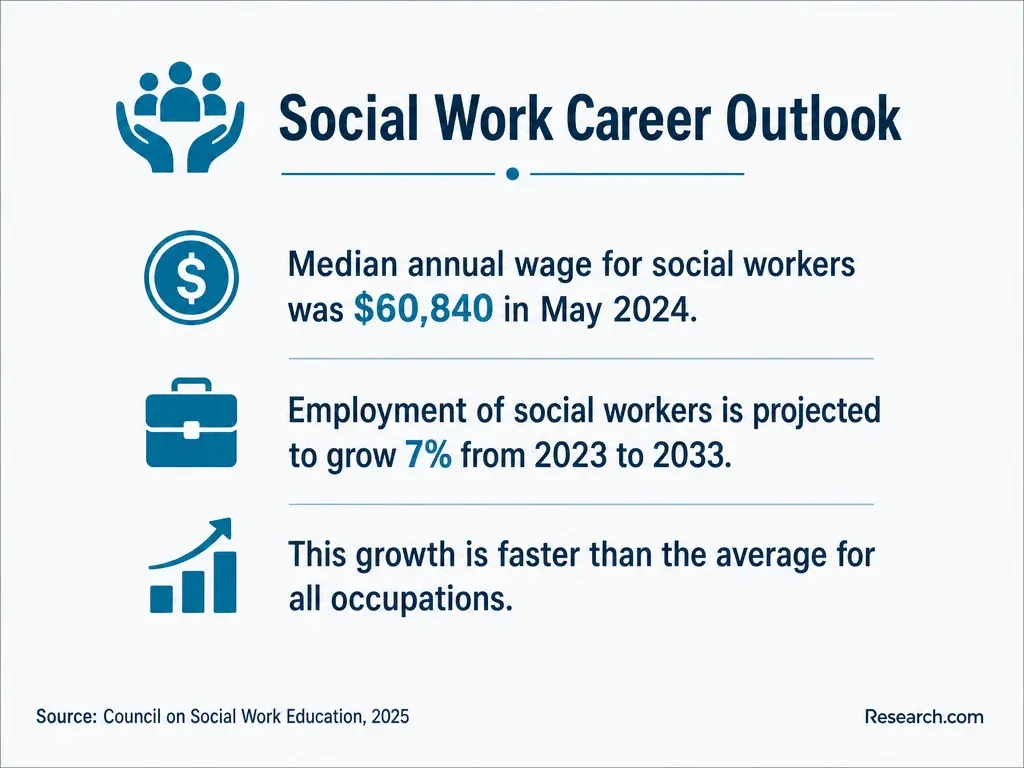
BLS projects U.S. employment of social workers across all specialties to grow 6% from 2025 to 2035. Its projections for child, family, and school social workers, healthcare social workers, and mental health and substance abuse social workers are 4%, 8%, and 10%, respectively, over the same period. These occupational projections do not predict the renewal of a particular public contract or the number of openings at one agency.
For a practical outlook, assess both occupational demand and funding exposure. Ask how long a contract runs, whether the role depends on a single award, what happens during renewal, and whether the skills transfer to other employers. Geographic wages and hiring conditions also vary; MSW earnings and geographic career planning can support a location comparison without turning a national projection into a personal job guarantee.
Other Things You Should Know About Social Work
Possibly. Check the solicitation's eligibility, insurance, financial-capacity, staffing, and past-performance requirements. A smaller organization should assess whether it can cover startup costs and administrative work before payment arrives.
Follow the agreement's notice and replacement provisions. Determine whether the substitute needs funder approval or specified credentials, and maintain service continuity within lawful staffing and supervision limits.
Not unilaterally if the change affects the approved scope, budget, staffing, or performance measures. Seek the contracting agency's written direction and any required amendment before treating a revised approach as approved.
Only with agency authorization and appropriate protection of client, personnel, financial, and proprietary information. A self-created, clearly labeled example is often safer than sharing an actual report or case document.
- Ensuring Quality in Contracted Child Welfare Services | ASPE https://aspe.hhs.gov/reports/ensuring-quality-contracted-child-welfare-services-0
- Subpart 49.4 - Termination for Default | Acquisition. GOV https://www.acquisition.gov/far/subpart-49.4
- Contracting Guidance - California Strategic Growth Council https://sgc.ca.gov/technical-assistance/toolkit/contracting-guidance/
- Developing Statement of Work (SOW) - Procurement Services | Colorado State University https://procurement.colostate.edu/developing-statement-of-work-sow/
- 2.4: Examples of Outputs vs. Outcomes | Enhancing Program Performance with Logic Models https://logicmodel.extension.wisc.edu/introduction-overview/section-2-more-about-outcomes/2-4-outputs-vs-outcomes/
- NASW Standards for Social Work Case Management | socialworkers.org https://www.socialworkers.org/Practice/NASW-Practice-Standards-Guidelines/NASW-Standards-for-Social-Work-Case-Management
- Statement of Work (SoW) | Thomson Reuters Law Blog https://legal.thomsonreuters.com/blog/what-is-a-sow/
- How to measure outcomes and outputs | New Zealand Government Procurement https://www.procurement.govt.nz/guides/social-services-procurement/developing-a-social-services-procurement-plan/how-to-measure-outcomes-and-outputs/