
2027 Social Work PhD Fieldwork with Community Partners: Relationships and Research Roles
Audited and Verified:
Our Editorial and Data Verification Process
Research.com uses government datasets, official education statistics and primary institutional information to support its career and degree guides. Our review process checks factual accuracy, occupational definitions, source dates and the requirements associated with the credentials discussed.
How This Article Was Fact-Checked
Our editorial team verifies salary estimates, employment projections, education requirements and program information against original data providers and official organizations. Salary figures are checked against the relevant occupational definitions and reporting periods. Information about licensure, accreditation and required in-person training is reviewed separately.
Fact-checked and verified on:

Co-Founder and Chief Data Scientist
A community partnership can make a social work dissertation more useful - but it also creates obligations that a student cannot manage alone. Agencies need trustworthy findings, participants need meaningful protections, and doctoral students need a project they can complete. This guide is for prospective and current social work PhD students deciding whether community-based research fits their goals. It explains what "fieldwork" means at the doctoral level, how to negotiate research roles and data access, and what to check before choosing a program or committing to a partner.
Key Things You Should Know
- Social work PhD fieldwork is usually research with communities or agencies, not a standard BSW/MSW placement; there is no universal doctoral field-hour requirement.
- Define the question, student and partner responsibilities, consent process, data access, and publication expectations before collecting information. Agency permission does not replace participant consent or required university review.
- Choose an adviser and program with relevant partnerships, realistic research access, and sufficient funding; a PhD often takes roughly four to six years, but requirements and support vary substantially.
What is community-based fieldwork in a social work PhD program?
In a social work PhD, community-based fieldwork means gathering knowledge with people, organizations, or service systems outside the university. A student might interview housing advocates, observe a community advisory process, analyze an agency's approved administrative data, or collaborate on a program evaluation. The aim is usually to produce research that is academically sound and useful to the people affected by the issue.
It is not automatically a required placement. BSW and MSW field education follows program-approved practice learning and supervision requirements; doctoral community research follows the PhD program's research milestones and the approvals required for the particular project. Paid agency work and volunteer service are different again. Students comparing social work degree options and program formats should ask which kind of field experience each degree actually provides.
"Community partner" may mean a nonprofit, public agency, advocacy group, school district, or resident-led organization. An agency can facilitate access without speaking for every client or resident. The strongest project identifies whose perspectives are missing as well as whose cooperation is easiest to obtain.
What research roles do social work PhD students have with community partners?
A doctoral student may be a research assistant on a faculty project, lead an approved dissertation study, help an agency evaluate a service, or coordinate a community advisory group. The role depends on the project's design, funding, approvals, and the student's training - not on the PhD title alone. These distinctions also matter when comparing doctoral work with the practice and management roles in a social work graduate career pathway overview.
The table separates common research arrangements by who directs the work. Actual decision-making authority should be documented rather than assumed from a job title.
| Arrangement | Typical student contribution | Key boundary |
| Faculty-led study | Recruitment, interviews, analysis, or reporting under an approved plan | The principal investigator and approved protocol govern assigned tasks |
| Student dissertation | Research question, design, data collection, analysis, and scholarly argument | University milestones and partner agreements can limit scope or access |
| Agency evaluation | Measures, feedback collection, analysis, and a usable report | Agency operational needs may differ from dissertation requirements |
| Participatory project | Shared question-setting, interpretation, and dissemination with community collaborators | Participation must include meaningful influence, not merely consultation |
A student who is also an agency employee needs especially clear boundaries. A client's access to services must not depend on research participation, and ordinary job access to records does not authorize dissertation use. An agency evaluation may yield a dissertation, but only if the design meets academic requirements and the necessary permissions are in place.
How do social work PhD students build relationships with community partners?
Start with the partner's priorities, not a finished dissertation proposal. Ask what decision the organization needs to make, what previous research experiences shaped its trust, and what time staff and community members can realistically contribute. A promising research question may still be a poor partnership if the agency cannot release data or the community sees no value in the result.
Before work begins, the student, adviser, and partner should agree on a small set of operating decisions. Written expectations reduce the chance that a change in personnel or funding derails the project.
- Name a university contact and a partner contact, and specify who can approve changes.
- Define the research question, partner benefits, feasible tasks, and expected time commitments.
- Set review points for recruitment materials, emerging interpretations, and a partner-facing report.
- Plan for staff turnover, delayed approvals, restricted data, or a partner's decision to pause involvement.
Budget for accessible meetings, interpretation when needed, and fair compensation for substantial community contributions where funding and policy allow. Partnership quality should be evaluated separately from a school's ability to arrange practice placements: choosing an MSW program with structured field support addresses a different educational obligation.
Research access has several layers. The organization may authorize contact or a data transfer; the university determines what ethics review is required; and individual participants may need to give informed consent. None of these permissions automatically substitutes for another. Students should consult the university's review process before recruitment or data collection rather than assuming that an agency's description of the work as "evaluation" settles the question.
A written data agreement should address what information the student may receive, who can identify participants, where files will be stored, how long they will be retained, who may use them later, and what happens if the partnership ends. It should also distinguish ownership or control of agency records from the student's ability to analyze findings and submit a dissertation. De-identification can reduce risk, but small communities and detailed quotations may still make people recognizable.
Discuss authorship and dissemination early. A partner may need to review a draft for confidential information or factual errors without receiving an undisclosed veto over unwelcome findings. If the student also provides services, clinical duties and research recruitment require separate role boundaries; graduate social work education and license pathway planning concerns practice authorization, not permission to conduct research. Applicable law, funder terms, agency policy, and university requirements should guide the final agreement.
Relevant PhD coursework may include qualitative interviewing, statistics, mixed methods, program evaluation, social policy, implementation research, and research ethics. A methods assignment might use a public dataset or simulated exercise; it does not guarantee access to agency records. Some programs offer community-engaged seminars or faculty projects, while others expect students to develop partnerships largely through their adviser.
For a dissertation, a feasible question is narrower than a broad service problem. For example, a student could study how housing-service staff and clients describe a referral process, provided recruitment and consent are approved. That design would support conclusions about those accounts - not an unsupported claim that the process improves housing outcomes. Students should decide whether the available sample, measures, timeline, and access can answer the question before committing to a method.
An MSW thesis or capstone can be a better fit when the goal is a bounded agency deliverable rather than an original, sustained research program. Even self-paced online MSW study options should be assessed against any scheduled collaboration and project requirements; course flexibility does not make a partner's calendar flexible.
What careers, salaries, and job prospects follow a social work PhD?
A PhD can prepare graduates for faculty research and teaching, policy research, evaluation leadership, research positions in public agencies or nonprofits, and related roles. Hiring committees assess publications, methods expertise, teaching or project experience, and fit - not the degree alone. A practice-oriented DSW, an MSW plus evaluation experience, or another research degree may be more direct when the target job does not require original social work scholarship.
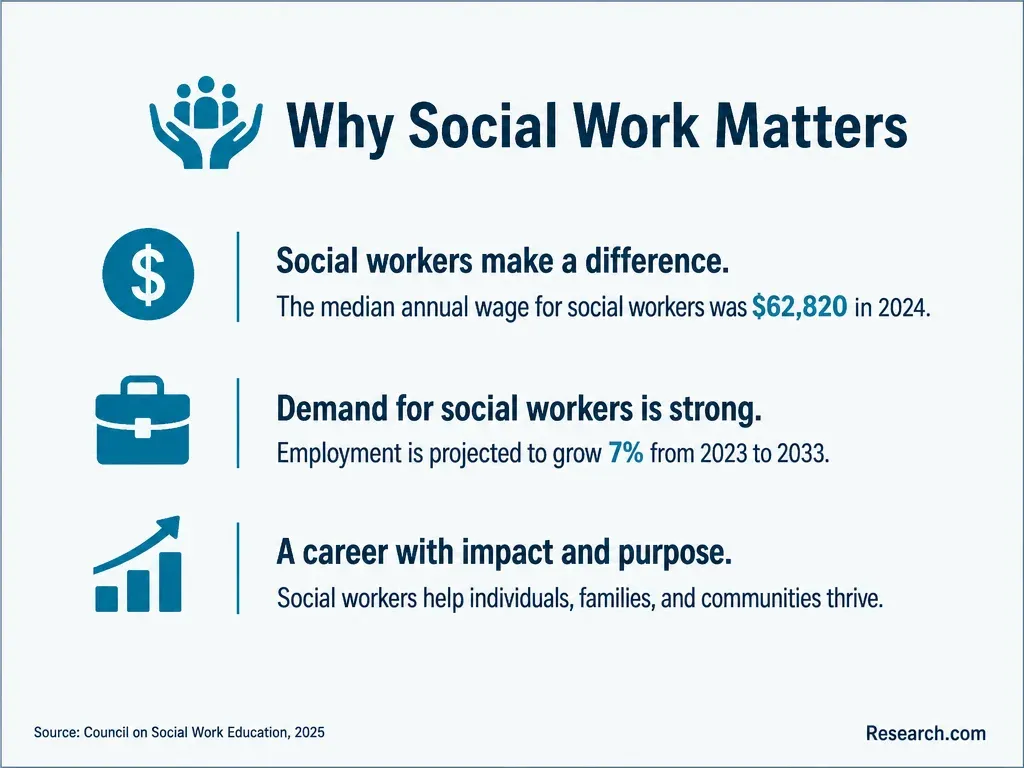
There is no single reliable "social work PhD salary": faculty, government research, and agency evaluation positions fall under different occupations and employers. For context, the U.S. Bureau of Labor Statistics reports a May 2025 median annual wage of $61,780 for social workers across specialties and projects 6% employment growth from 2025 to 2035. Those figures describe the broad social worker occupation, not doctoral graduates or faculty positions, and should not be used to forecast a PhD return on investment. A guide to comparing social worker pay by location is useful for practice-job comparisons, not as a substitute for checking salaries in specific research or academic postings.
The strongest career test is to examine jobs you would actually apply for: required degree, methods, publication record, practice credentials, location, pay range, and contract terms. Then compare those requirements with the training, partner access, and funding a prospective PhD can demonstrably provide.
Other Things You Should Know About Social Work
Often, if the budget and university rules allow it. Agree on duties, payment, accessibility needs, and any effects on benefits before asking people to commit time.
Stop activities that depend on its permission and consult your adviser and relevant university offices. A revised site, dataset, or question may require new agreements or ethics review.
Yes, subject to valid confidentiality and contractual obligations. Agree in advance on factual review and publication procedures; do not promise favorable findings.
Not necessarily. A second degree may help with a specific policy or public health role, but an adviser, methods training, and a workable partnership are more important to most dissertation plans.
- Navigating Partnerships With State & Local Human Services Agencies: Lessons from Researchers https://acf.gov/opre/report/navigating-partnerships-state-local-human-services-agencies-lessons-researchers
- What Is Ethics in Research & Why Is It Important? | National Institute of Environmental Health Sciences https://www.niehs.nih.gov/research/resources/bioethics/whatis
- Beyond Incentives for Involvement to Compensation for... - PMC https://pmc.ncbi.nlm.nih.gov/articles/PMC4783164/
- Ensuring ethical standards and procedures for research with human beings | who.int https://www.who.int/activities/ensuring-ethical-standards-and-procedures-for-research-with-human-beings
- Full article: Features and outcomes of community-academic partnerships in social work: a scoping review https://www.tandfonline.com/doi/full/10.1080/13691457.2024.2309526
- Increasing research capacity in community organizations | sciencedirect.com https://www.sciencedirect.com/science/article/pii/S0149718922001434
- Science Journals: Editorial Policies https://www.science.org/content/page/science-journals-editorial-policies


