2027 Social Work in Labor and Worker Support Organizations: Career Preparation
Audited and Verified:
Our Editorial and Data Verification Process
Research.com uses government datasets, official education statistics and primary institutional information to support its career and degree guides. Our review process checks factual accuracy, occupational definitions, source dates and the requirements associated with the credentials discussed.
How This Article Was Fact-Checked
Our editorial team verifies salary estimates, employment projections, education requirements and program information against original data providers and official organizations. Salary figures are checked against the relevant occupational definitions and reporting periods. Information about licensure, accreditation and required in-person training is reviewed separately.
Fact-checked and verified on:

Co-Founder and Chief Data Scientist
Supporting workers can mean helping a laid-off member find benefits, coordinating mental health referrals, or organizing around unsafe conditions. Those jobs call for different skills, and not all require a social work degree or license.
This guide is for students, social services professionals, and career changers considering unions, worker centers, and related organizations. It explains where social work training adds value, how to prepare through coursework and field education, and when a labor-relations or organizing route may be more direct.
Key Things You Should Know
- Worker support spans individual services and collective advocacy; a social work license is generally relevant to regulated clinical work, not every union or worker-center job.
- Choose education around the target duties: a BSW can prepare you for generalist services, while an MSW can deepen clinical or community-practice preparation; organizing roles may favor experience over either degree.
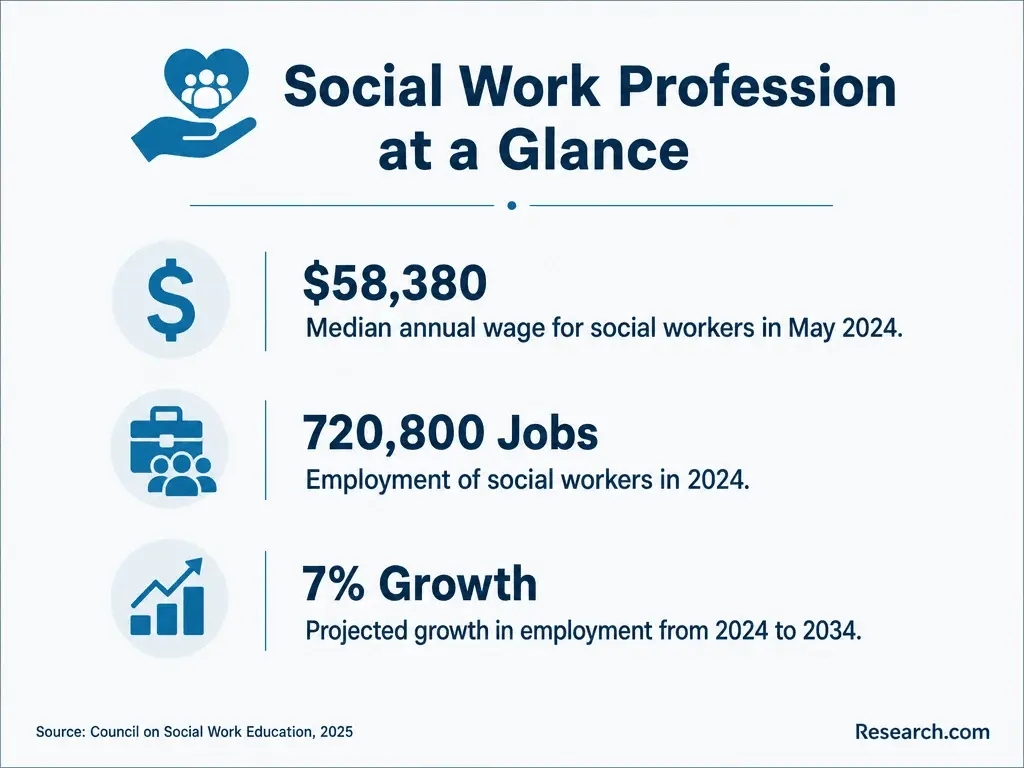
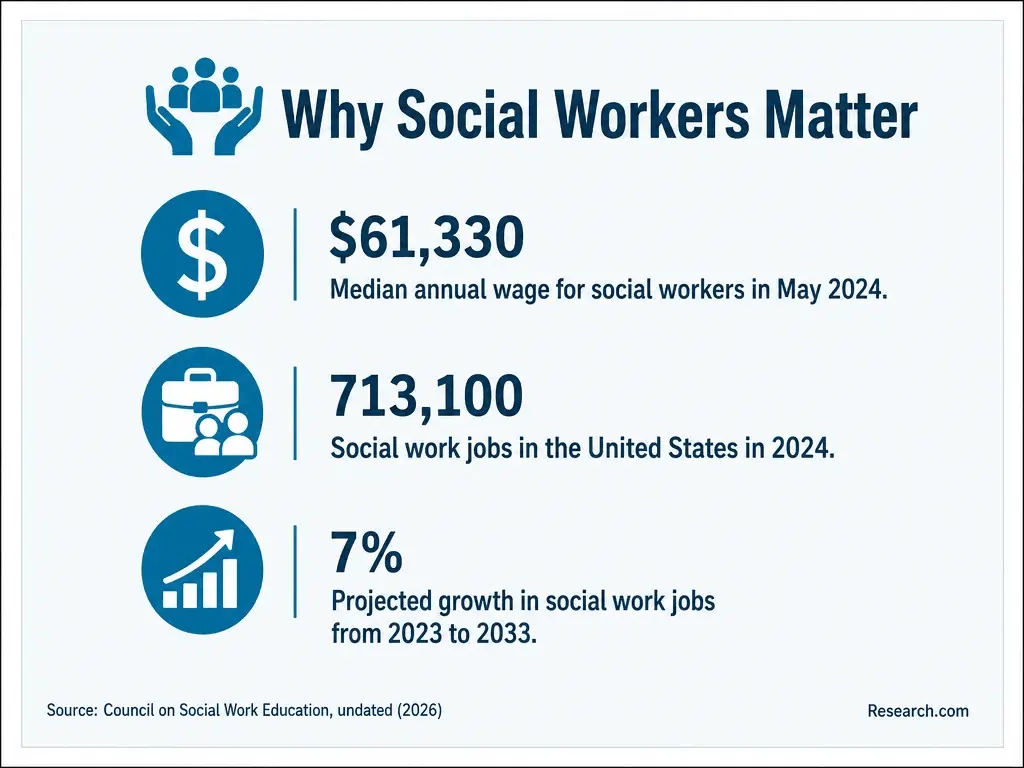
- The U.S. Bureau of Labor Statistics reports a $61,780 median annual wage for social workers overall in May 2025 and projects 6% employment growth from 2025 to 2035; neither figure describes union jobs specifically.
What do social workers do in unions and worker support organizations?
Worker support organizations include unions, worker centers, employee assistance programs, and nonprofits serving people affected by job loss, wage theft, injury, or unstable work.
A social worker's contribution depends on the organization: one role may focus on confidential individual support, while another addresses barriers affecting an entire workforce.
Direct-service duties can include assessing immediate needs, helping workers navigate public benefits or community resources, coordinating referrals, and following up after a workplace crisis.
Community-practice duties can include listening sessions, leadership development, policy research, and collaboration with organizers. The social work master's roles and employment settings offer a broader comparison of where these skills are used.
Role boundaries matter. A social worker should not promise that a benefits referral will resolve an employment dispute, and a union representative should not present ordinary member support as psychotherapy. Workers need clear information about confidentiality, recordkeeping, and whether information shared with a service provider could reach an employer or union leadership.
What degrees prepare social workers to support workers and unions?
Start with the work you want to perform, not the most advanced degree available. The routes below differ in their preparation and in how directly they lead to worker-support jobs.
| Route | Best fit for worker support | Important limit |
| BSW | Generalist case management, outreach, and resource coordination | Does not confer a license or independent clinical authority |
| Traditional MSW | Advanced practice for applicants with a bachelor's degree in another field | Includes foundational study and field education |
| Advanced-standing MSW | Advanced study for applicants with a qualifying BSW | Eligibility depends on the program's rules, including its review of prior education |
| Labor studies, public policy, or organizing training | Collective bargaining support, campaigns, and policy advocacy | Does not substitute for required social work qualifications in regulated roles |
A psychology, sociology, or human services bachelor's degree may help with traditional MSW admission but does not automatically qualify an applicant for advanced standing. Compare the foundational and specialized sequences when comparing MSW credits across entry tracks. A DSW or PhD is rarely an entry requirement for worker support; those degrees make more sense for a defined leadership, practice-improvement, or research goal.
When is a social work license required for worker support roles?
A license is not a blanket requirement for union organizing, benefits navigation, outreach, or many program-management jobs. It may be required when a position uses a protected social worker title or includes activities reserved under state law, particularly clinical assessment or psychotherapy. Employers can also require a license even when every listed duty is not legally restricted.
Check the state licensing board's current rules and the job description separately. An MSW, clinical concentration, passed examination, or school field placement does not itself authorize independent clinical practice; states may require a particular license and documented post-degree supervision. The guide to MSW programs and state licensure education requirements can help frame the education question, but the board determines eligibility and permitted practice.
For employee assistance or crisis-support positions, ask exactly who delivers counseling, who provides referrals, what supervision is available, and which jurisdiction governs services delivered remotely. The answers determine whether a nonclinical role fits your present qualifications.
There is no single Bureau of Labor Statistics wage category for social workers employed by unions or worker centers. These national figures provide context for social work occupations, not a pay estimate for a particular worker-support position.
| BLS occupation | May 2025 median annual wage | Projected employment growth, 2025-2035 |
| Social workers, all specialties | $61,780 | 6% |
| Mental health and substance abuse social workers | $60,280 | 10% |
| Healthcare social workers | $67,880 | 8% |
The specialty figures are relevant only when the job's duties fit those occupations; they should not be assigned to an organizer or benefits navigator. For an actual offer, compare the posted pay band, benefits, union contract if applicable, funding stability, and required credentials. Weigh any additional degree's cost against jobs you could pursue now; a guide to evaluating MSW degree value can support that comparison without promising a salary increase.
BSW applicants typically first meet university admission rules and may later apply separately to the social work major. MSW programs commonly review transcripts, a statement of purpose, recommendations, and evidence of readiness for professional and field learning. Prerequisites, GPA standards, interviews, and service-experience expectations vary by program.
A traditional MSW can admit applicants whose bachelor's degree is outside social work. Advanced standing generally requires a qualifying BSW and additional program-specific conditions; union service or another human services degree alone does not establish eligibility. Career changers should describe transferable experience accurately while identifying gaps in social work ethics, assessment, and supervised practice. Admission-focused online MSW comparisons can help identify programs to investigate, but confirm requirements and deadlines with each admissions office.
How long do social work degrees take, and how much do they cost?
A BSW commonly fits within a four-year bachelor's plan, while a traditional MSW often takes about two years of full-time study. Advanced-standing MSW study can be shorter for eligible BSW graduates; part-time enrollment, course sequencing, and placement availability can extend any route. Request a written plan for your entry track rather than relying on an advertised fastest completion time.
Compare total cost, not tuition alone: fees, books, screening, travel to placements, possible campus visits, and reduced paid hours during field education can change the calculation. Ask whether paid or employment-based field learning is permitted and approved, whether employer education assistance applies, and what aid remains available at your intended enrollment pace. Use comparing affordable social work master's degrees as a starting point, then obtain program-specific costs. If your target job values organizing experience more than an MSW, a lower-cost training and work-experience route may be the better investment.
Other Things You Should Know About Social Work
No. Union representatives typically focus on representation and workplace agreements. Social workers may provide services or advocacy, but their title and permitted duties depend on qualifications and state law.
They can help identify resources and coordinate an appropriate referral. Legal advice and representation belong to qualified legal professionals or others authorized under applicable law.
Not necessarily. Worker centers and unions are different organizations, and membership or employment conditions depend on the particular employer and position.
Bring examples of ethical referral work, community outreach, documentation, or organizing that you can discuss without revealing confidential information. Be ready to explain your role and its limits.
- The Role of Social Work for Emergency Medical Services (EMS) | nih.gov https://pmc.ncbi.nlm.nih.gov/articles/PMC10548022/
- Other Resources | dol.gov https://www.dol.gov/general/migrantworker/resources
- Enforcement Guidance on Retaliation and Related Issues | U.S. Equal Employment Opportunity Commission https://www.eeoc.gov/laws/guidance/enforcement-guidance-retaliation-and-related-issues
- Workplace Mental Health & Well-Being | hhs.gov https://www.hhs.gov/surgeongeneral/reports-and-publications/workplace-well-being/index.html
- National Labor Relations Act | nlrb.gov https://www.nlrb.gov/guidance/key-reference-materials/national-labor-relations-act
- 10 Careers You Can Pursue With a Bachelor's in Social Work | UMass Global https://www.umassglobal.edu/blog-news/careers-for-social-work-majors
- How Do Social Work Field Placements Work? | Virginia Commonwealth University https://onlinesocialwork.vcu.edu/blog/social-work-field-placement/
- Types of Social Work | socialworkers.org https://www.socialworkers.org/News/Facts/Types-of-Social-Work