2027 Organizational Systems Theory in Social Work: Agency Structures and Service Delivery
Audited and Verified:
Our Editorial and Data Verification Process
Research.com uses government datasets, official education statistics and primary institutional information to support its career and degree guides. Our review process checks factual accuracy, occupational definitions, source dates and the requirements associated with the credentials discussed.
How This Article Was Fact-Checked
Our editorial team verifies salary estimates, employment projections, education requirements and program information against original data providers and official organizations. Salary figures are checked against the relevant occupational definitions and reporting periods. Information about licensure, accreditation and required in-person training is reviewed separately.
Fact-checked and verified on:

Co-Founder and Chief Data Scientist
A client may qualify for help yet still face a long wait, a failed referral, or conflicting instructions from two agencies. Organizational systems theory helps social workers examine how staffing, rules, funding, information, and partnerships produce those experiences.
This guide is for students and social services professionals who want to understand agency operations - not just individual cases. It explains how the theory works, where to see it in practice, and how to choose education or experience that fits a service-delivery or leadership goal.
Key Things You Should Know
- Organizational systems theory treats an agency as an interconnected system: changes in intake, staffing, supervision, funding, or referrals can affect the entire client pathway.
- Agency charts do not tell the whole story; decision authority, information flow, community relationships, and client feedback often determine whether services are accessible and coordinated.
- A BSW or MSW can develop systems-analysis skills, but an additional degree is not always necessary for agency improvement; choose training based on the role and its credential requirements. BLS projects 6% employment growth for social workers overall from 2025 to 2035, not for every organizational role.
What is organizational systems theory in social work?
Organizational systems theory examines an agency as a set of connected people, processes, resources, and relationships operating within a larger environment. Funding and referrals enter the system; staff and procedures turn those inputs into services; outcomes and feedback can influence what happens next. Agency boundaries determine what the organization handles itself and what it relies on partners to provide.
For example, adding intake appointments may not shorten the time to treatment if clinical capacity or transportation remains the constraint. A systems explanation directs attention to the whole pathway, rather than assuming that one worker or one client caused the delay.
This is related to, but narrower than, social work's person-in-environment perspective. Person-in-environment considers how a person's circumstances and social conditions interact. Organizational systems theory focuses on how agencies and their environments organize responses. It is an analytical framework, not a clinical treatment or proof that a proposed workflow change will improve outcomes. When comparing program structures in social work education, look for opportunities to apply the framework to actual agency processes rather than only memorize terminology.
How does organizational systems theory explain social work agency structures?
The theory asks both who has authority and how work moves. A formal organization chart shows reporting lines, but service delivery also depends on eligibility rules, informal consultation, handoffs, information systems, funder requirements, and relationships with other providers.
The following comparison shows how common structural features can shape an agency's options. These are analytical patterns, not fixed categories or predictions about every workplace.
| Structural feature | Potential advantage | Potential constraint |
| Centralized decisions | Consistent policy interpretation and oversight | Slower responses when staff must seek approval |
| Decisions delegated to teams | More room to adapt to local needs | Uneven practices without clear standards and supervision |
| Specialized departments | Focused expertise | More handoffs between services |
| Cross-agency partnerships | Access to services beyond one agency's capacity | Dependence on partner availability and lawful information sharing |
Structure also reflects power. A funder may define what gets counted, while clients and frontline staff see barriers those measures miss. Mapping who can change a rule - and whose feedback reaches that decision-maker - often reveals more than the chart alone. For readers exploring positions at different levels of an organization, social work master's employment pathway comparisons can help distinguish service, coordination, and leadership duties.
How do agency structures affect social work service delivery?
Agency structure shapes access, continuity, responsiveness, and accountability. An intake unit with narrow hours can limit access even when a program has open appointments. Separate teams may provide valuable expertise yet require clients to repeat their histories. Strong referral relationships can improve coordination, but a referral is not the same as a completed connection to care.
A practical systems review follows one service pathway, such as referral to first appointment. Staff can examine where requests wait, who makes decisions, what information each handoff requires, and whether clients can report barriers safely. Measures such as wait time, unsuccessful contacts, and completed referrals are more informative when reviewed alongside client perspectives and differences in access across groups. Those measures describe a process; they do not, by themselves, establish why it performs as it does.
Improvement must remain within professional and agency boundaries. A team should not share identifiable records with a partner simply because a systems map suggests it would be convenient. Consent, confidentiality law, record access rules, and agency policy still govern. Students who want to study these handoffs in a placement should ask about approved learning tasks and MSW practicum site coordination questions before assuming they can access operational or client data.
The Council on Social Work Education (CSWE) accredits qualifying social work degree programs; institutional accreditation applies to the institution and is a separate determination. If a reader may later seek a social work license, they should confirm the specific program's accreditation status and the status applicable to their expected graduation cohort, then check the intended state board's education rules.
A state licensing board - not CSWE or a university - decides whether an applicant meets its license requirements. License categories, examinations where required, supervised experience, and permitted activities vary by state. Graduation does not issue a license, and an MSW alone does not authorize independent clinical practice. Online study also does not remove jurisdiction-specific enrollment, placement, or licensing questions; online social work master's programs and state board requirements are worth reviewing together rather than separately.
For an organizational role that does not require social work licensure, the decision may be different. Confirm the employer's actual degree and experience requirements before paying for a credential intended primarily to support a license you do not plan to pursue.
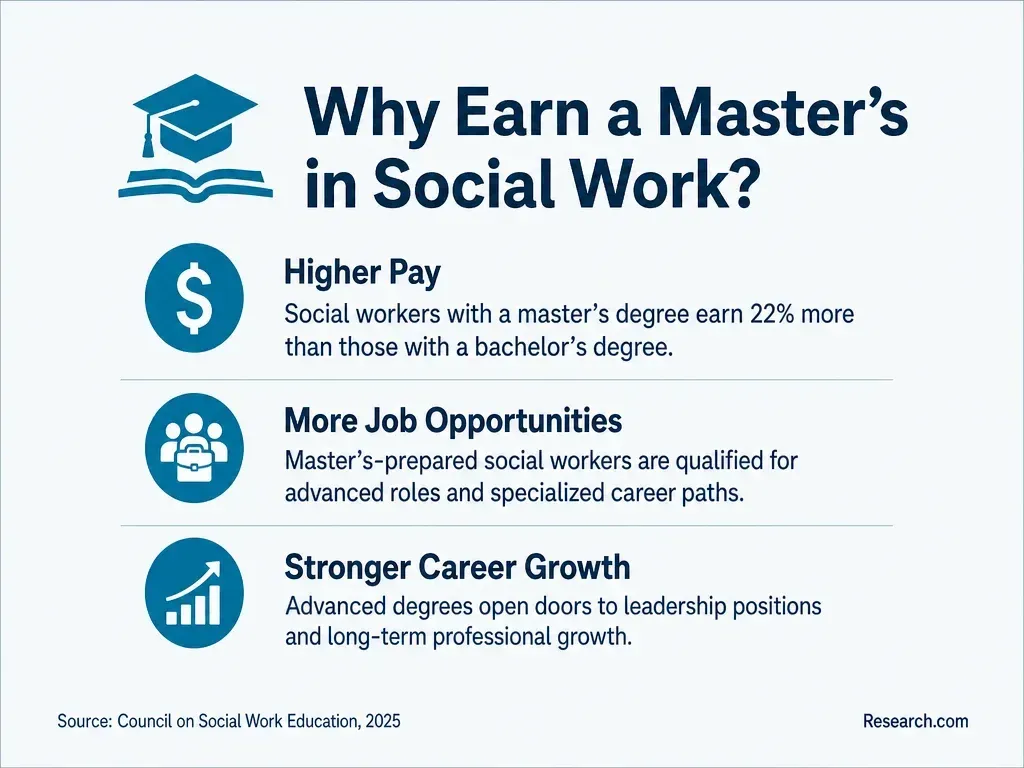
Requirements vary by school and entry route. BSW applicants may enter the university first and apply separately to the social work major after completing specified coursework. MSW applicants generally need a bachelor's degree and program-specific application materials, which may include transcripts, an essay, references, and evidence of relevant experience. Schools may also review grades or prerequisites in areas such as statistics or social sciences.
A graduate with a non-social-work bachelor's degree can pursue a traditional or foundation MSW if admitted; that degree alone generally does not qualify the applicant for advanced standing. Advanced-standing programs set their own criteria for a qualifying BSW, including any accreditation or recency conditions. Prospective students attracted to shorter online Master of Social Work pathways should first verify that they meet the exact track's admission rules and can complete its field schedule.
Admission and placement readiness are also distinct. Ask the program when background checks, agency onboarding, or other site conditions apply, especially if employment or caregiving limits placement availability.
What are the salary expectations and job outlook for social workers?
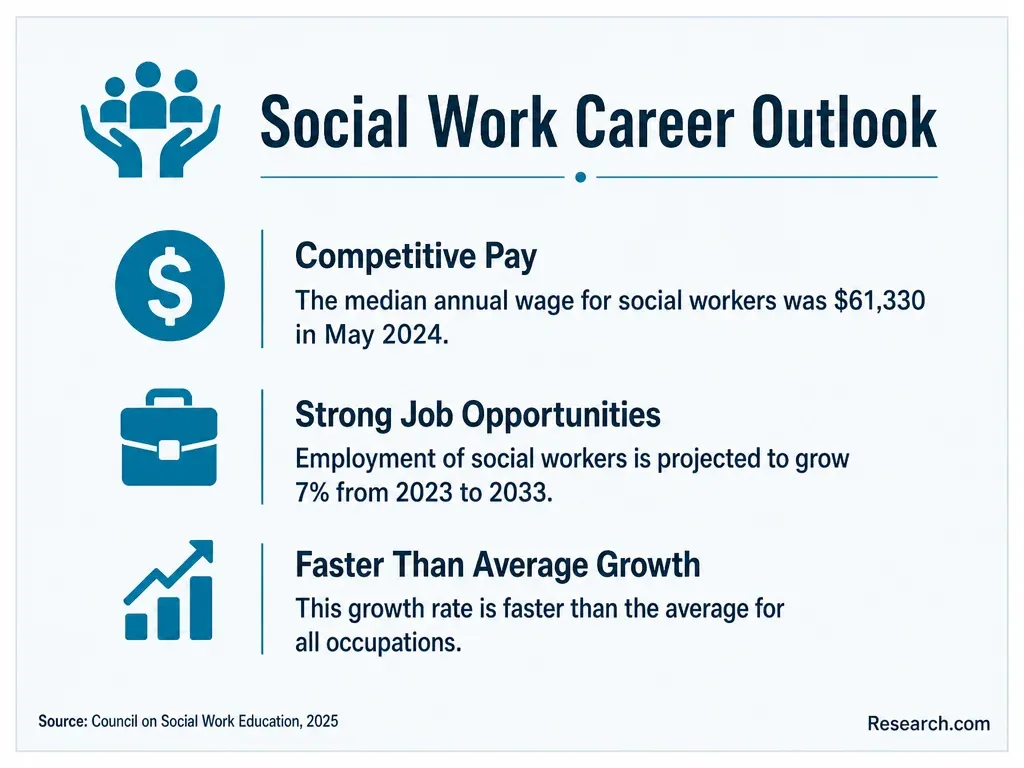
U.S. Bureau of Labor Statistics figures place the May 2025 median annual wage for social workers overall at $61,780 and project 6% employment growth from 2025 to 2035. The specialty figures below show why setting matters when considering a career that uses organizational systems skills.
These BLS occupational categories are not agency job titles or promised salaries for graduates. Use the figures to compare broad fields, then examine local postings for the actual role and credential level.
| BLS occupation | May 2025 median annual wage | Projected growth, 2025-2035 |
| Child, family, and school social workers | $59,550 | 4% |
| Healthcare social workers | $67,880 | 8% |
| Mental health and substance abuse social workers | $60,280 | 10% |
Agency funding, geography, experience, license requirements, and management responsibilities can change an individual offer. The broad projections also do not predict demand for a particular program analyst or director position. When weighing relocation or job offers, comparing pay locations for master's-prepared social workers is more useful alongside local job requirements and living costs than as a stand-alone earnings forecast.
Other Things You Should Know About Social Work
Agencies can invite voluntary, accessible feedback about service barriers and explain how it will be used. Participation should not affect eligibility or access to help; protect confidentiality and follow the agency's consent and data policies.
Not necessarily. Faster intake can reduce waits, but an agency should also check whether people reach appropriate services, understand their options, and experience equitable access.
Use the agency's current escalation procedures and seek appropriate supervision. A systems diagram does not replace safeguarding duties, applicable law, or an authorized safety assessment.
Yes. A simple, privacy-conscious map of referral steps, decision points, and handoffs can identify questions for staff and clients. Specialized software is optional; reliable information and permission to use it matter more.
- "Creative Financing": Funding Evidence-Based Interventions in Human Service Systems - PMC https://pmc.ncbi.nlm.nih.gov/articles/PMC6816239/
- Data Systems and Organizational Improvement | Child Welfare Information Gateway https://www.childwelfare.gov/topics/data-systems-and-organizational-improvement
- NASW Standards for Social Work Case Management | nycourts.gov https://www.nycourts.gov/reporter/webdocs/nasw_standards_socialwork_casemgt.htm
- How Experts Without Authority Create Change in Their Organizations | Yale Insights https://insights.som.yale.edu/insights/how-experts-without-authority-create-change-in-their-organizations
- What Are Human Services, and How Do State Governments Structure Them? | Urban Institute https://www.urban.org/research/publication/what-are-human-services-and-how-do-state-governments-structure-them
- Types of Organizational Structures | Coursera https://www.coursera.org/articles/types-of-organizational-structures
- NASW Standards for Social Work Case Management | socialworkers.org https://www.socialworkers.org/Practice/NASW-Practice-Standards-Guidelines/NASW-Standards-for-Social-Work-Case-Management