2027 Data Linkage in Social Work Research: Connecting Records Across Service Systems
Audited and Verified:
Our Editorial and Data Verification Process
Research.com uses government datasets, official education statistics and primary institutional information to support its career and degree guides. Our review process checks factual accuracy, occupational definitions, source dates and the requirements associated with the credentials discussed.
How This Article Was Fact-Checked
Our editorial team verifies salary estimates, employment projections, education requirements and program information against original data providers and official organizations. Salary figures are checked against the relevant occupational definitions and reporting periods. Information about licensure, accreditation and required in-person training is reviewed separately.
Fact-checked and verified on:

Co-Founder and Chief Data Scientist
A housing program may know who received assistance, while a hospital knows who returned for emergency care. Neither record system alone can show how those experiences intersect. Data linkage helps social work researchers study such questions, but a useful match requires more than software: it requires lawful access, sound methods, and an understanding of how agencies record services.
This guide is for students and professionals considering cross-system research. It explains how linkage works, where results can mislead, and which educational and career paths are worth pursuing for that goal.
Key Things You Should Know
- Data linkage connects records about the same person or family across systems; a matched record is not proof that one service caused a later outcome.
- Researchers must address both false matches and missed matches, as well as people who never appear in the available systems.
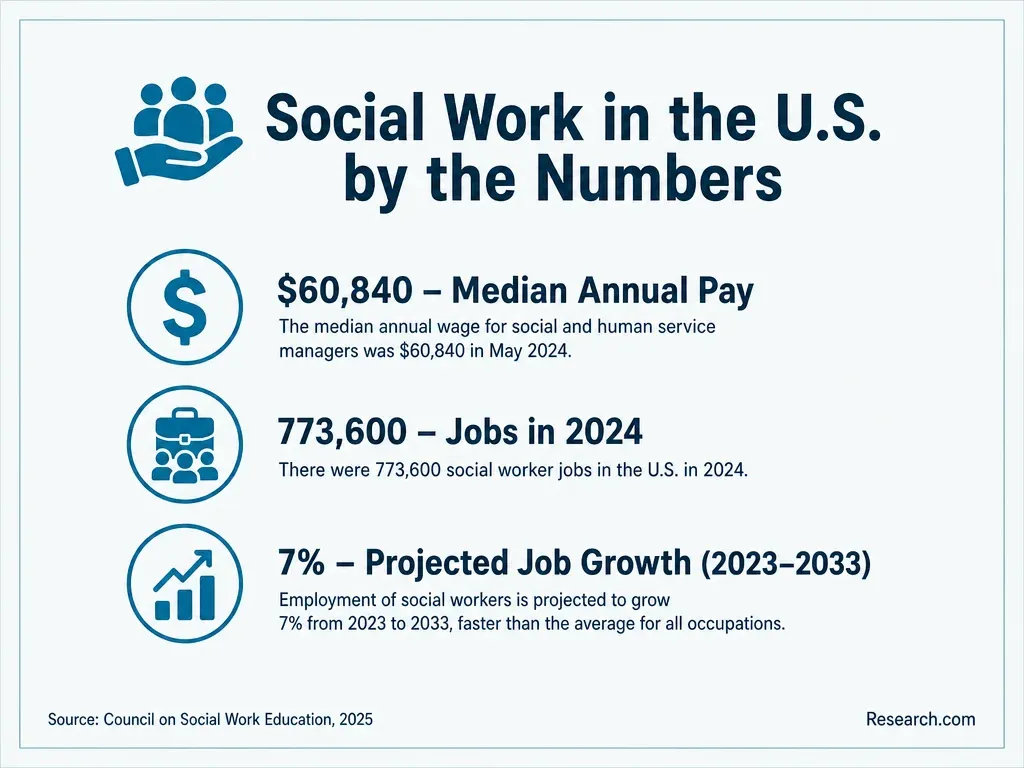
- The U.S. Bureau of Labor Statistics reports a May 2025 median of $61,780 for social workers overall, but that occupation-wide figure is not a salary estimate for data researchers.
What is data linkage in social work research?
Data linkage is the process of identifying records in different datasets that refer to the same person, family, household, or event. A researcher might connect a county housing-service file with Medicaid claims to examine service use before and after housing assistance. The unit of linkage matters: matching people does not automatically establish which people shared a household at a particular time.
Linkage can reveal service pathways that no single agency can see. It can also expose gaps in those pathways: a missing healthcare record might mean no visit, care outside the participating system, or an unsuccessful match. Researchers therefore define the population, observation period, available systems, and meaning of each recorded outcome before interpreting results.
For a social worker considering research instead of direct service, the distinction is between using records to investigate a question and providing services documented in those records. The social work master's employment pathway comparisons can help clarify whether the desired job is research, program evaluation, or practice.
How do researchers link records across health and social service systems?
Researchers first agree on a narrowly defined question, which organizations may supply data, and which identifiers are necessary. Authorized personnel then standardize fields such as names, dates of birth, and addresses; create candidate matches; review match quality; and provide an approved analysis file. The research team should retain a record of the linkage rules and versions of the source files so results can be checked.
The two common matching approaches make different trade-offs. Neither repairs incomplete source records or makes an unapproved data transfer permissible.
| Approach | How it works | Main limitation |
| Deterministic matching | Requires agreement on specified identifiers or rules, such as an approved shared ID. | Can miss the same person when an identifier is absent or entered differently. |
| Probabilistic matching | Weights partial agreements and disagreements across several identifiers. | Requires defensible thresholds and assessment of possible false matches. |
A sound study evaluates false matches, which combine different people, and missed matches, which split one person's records. When feasible, researchers test match decisions against an authorized reference set and examine whether linkage rates differ by agency, geography, age, or other relevant characteristics. They then assess whether those differences could distort the substantive findings.
Linking records for research is not the same as documenting hours for a professional credential. If the question is whether employment or supervision qualifies toward clinical licensure, use the applicable board's rules and contemporaneous documentation; online guides to social work clinical experience counting and verification address that separate task.
What degrees prepare you for data linkage research in social work?
Choose a degree for the work you want to lead, not for the impression that handling sensitive data requires the highest social work credential. Linkage teams often combine social work knowledge with statistics, public health, informatics, and agency data expertise.
The following comparison describes typical emphases, not requirements shared by every program or employer:
| Path | Best fit for linkage work | Important limitation |
| BSW or MSW | Practice-informed evaluation, agency partnerships, and interpretation of service systems; research electives or assistantships can add technical experience. | Standard coursework may not provide extensive programming or advanced linkage methods. |
| Research-oriented PhD | Designing original studies, developing methods, publishing, and pursuing academic research roles. | Requires a sustained research commitment; funding and data access vary. |
| Practice-oriented DSW | Applied inquiry and organizational improvement, where the specific program offers relevant methods training. | A DSW is not automatically a substitute for PhD-level methodological training. |
| MPH, statistics, or informatics training | Analytic or data-engineering roles that do not require a social work qualification. | May offer less preparation for social work practice and agency context. |
An MSW student seeking an agency evaluation role may benefit more from a methods elective and a supervised project than from another degree. A prospective doctoral student should compare advisor expertise, assistantship funding, and real access to partner agencies alongside tuition; a guide to lower-cost doctoral social work programs is a starting point for cost comparison, not evidence that a program offers linkage mentorship.
Privacy protection starts before identifiers move. Each data holder and research institution must determine the applicable legal basis, permitted purpose, review process, and contractual terms. Depending on the records, HIPAA, FERPA, federal substance-use confidentiality rules, state child-welfare law, and agency policy may impose different conditions. An institutional review board's determination does not, by itself, authorize an agency to disclose data; a data-sharing agreement does not replace required ethics review.
A common design separates an authorized linkage team, which handles identifiers, from analysts, who receive coded data with only approved variables. Access controls, encryption, retention limits, audit logs, and disclosure review for published results reduce risk. A hashed identifier is not automatically anonymous: repeated values can still permit records to be joined, and the underlying information may remain regulated.
For students, the practical question is whether a project can proceed with approved, appropriately limited data rather than whether they can obtain raw client files. Clinical training can deepen understanding of sensitive records, but it does not confer research access; MSW pathways for future clinical social workers should be evaluated for research opportunities separately from their practice preparation.
BSW and MSW research courses commonly introduce study design, measurement, ethics, evidence appraisal, and program evaluation. The depth of coding, database work, causal inference, and record linkage varies substantially. Doctoral study may extend these skills, but applicants should inspect actual courses and faculty projects rather than rely on a program's "data-driven" description.
For linkage research, the essential progression is from a service question to a defensible dataset and then to a cautious interpretation. Useful skills include defining who enters each administrative system; cleaning dates and identifiers; assessing match error and missing data; protecting small groups in reports; and separating association from causal effect. Qualitative interviews with agency staff can explain why fields are missing or why a policy changed the meaning of a service code.
A student without prior statistics coursework should check the program's stated prerequisites instead of assuming that an MSW requires—or waives—a particular course. Understanding barriers to online MSW admission can help frame admissions questions, but the more important research question is how the program will build the skills missing from the student's background.
How can you choose a social work program with data linkage research opportunities?
Look for evidence of a feasible project, not merely a faculty interest in "big data." A promising program can explain who mentors students, which partnerships are active, what approvals precede access, and what work a student can realistically complete during the degree.
Ask programs the following questions before comparing offers. Their answers should distinguish an established opportunity from a project a student would have to build from scratch.
- Which faculty or agency partners have supervised cross-system studies, and what tasks did students perform?
- Can students learn linkage methods without direct access to identifiable records, and what approved data or training environment is available?
- Who obtains agency permissions and determines research-ethics requirements, and what happens if access is delayed?
- Can the thesis, capstone, assistantship, or field learning agreement accommodate the proposed work within its timeline?
- What funding, technical mentoring, and backup project are available if a data-sharing agreement does not proceed?
If an MSW field placement is part of the plan, confirm that the school approves its learning objectives and site rather than assuming an agency job will count. Compare field placement assistance in online MSW education separately from research mentorship. The strongest choice is the program that can support an ethical, achievable project aligned with the job you want.
Other Things You Should Know About Social Work
Yes. Synthetic records can support practice with cleaning, matching, and error checks without exposing actual clients. They cannot establish how well a method will perform on an agency's real records.
No. IDs may be duplicated, reassigned, entered incorrectly, or used differently across agencies. Researchers still need to understand how each system creates and maintains them.
Preserve the source and date of each value, then apply a documented rule suited to the research question. Do not silently treat one agency's field as authoritative for every purpose.
Possibly, but publication depends on the project's approvals, agreements, confidentiality protections, and institutional policies. Permission to conduct an evaluation does not automatically include permission to publish its data.
- Estimating Record Linkage False Match Rate for the Person Identification Validation System | Census.gov https://www.census.gov/library/working-papers/2014/adrm/carra-wp-2014-02.html
- Developing standard tools for data linkage: February 2021 | Office for National Statistics https://www.ons.gov.uk/methodology/methodologicalpublications/generalmethodology/onsworkingpaperseries/developingstandardtoolsfordatalinkagefebruary2021
- The prevention and handling of the missing data - PMC - NIH https://pmc.ncbi.nlm.nih.gov/articles/PMC3668100/
- Approaches to data linkage for evidence-informed policy | OBS https://eurohealthobservatory.who.int/publications/i/health-and-care-data-approaches-to-data-linkage-for-evidence-informed-policy
- Privacy Laws, Policies and Guidance | commerce.gov https://www.commerce.gov/opog/privacy/privacy-laws-policies-and-guidance
- Data Protection Law: An Overview | congress.gov https://www.congress.gov/crs-product/R45631
- Quality assessment in data linkage | GOV. UK https://www.gov.uk/government/publications/joined-up-data-in-government-the-future-of-data-linking-methods/quality-assessment-in-data-linkage
- When to conduct probabilistic linkage vs. deterministic linkage? A simulation study - ScienceDirect https://www.sciencedirect.com/science/article/pii/S1532046415000921
- Missing Data and Multiple Imputation | Columbia University Mailman School of Public Health https://www.publichealth.columbia.edu/research/population-health-methods/missing-data-and-multiple-imputation
- guide to evaluating linkage quality for the analysis of linked data | oup.com https://academic.oup.com/ije/article/46/5/1699/4107250