2027 Community Health Worker vs Social Worker: Education, Responsibilities, and Career Progression
Audited and Verified:
Our Editorial and Data Verification Process
Research.com uses government datasets, official education statistics and primary institutional information to support its career and degree guides. Our review process checks factual accuracy, occupational definitions, source dates and the requirements associated with the credentials discussed.
How This Article Was Fact-Checked
Our editorial team verifies salary estimates, employment projections, education requirements and program information against original data providers and official organizations. Salary figures are checked against the relevant occupational definitions and reporting periods. Information about licensure, accreditation and required in-person training is reviewed separately.
Fact-checked and verified on:

Co-Founder and Chief Data Scientist
If you have experience helping neighbors navigate healthcare or social services, both community health work and social work may appeal to you - but they lead to different responsibilities and credential requirements. The distinction matters when you are weighing a short training program against a social work degree, especially if you hope to provide clinical services later. This guide compares the roles, education, pay, outlook, fieldwork, and costs so you can choose a path that fits the work you want to do rather than pay for a qualification you may not need.
Key Things You Should Know
- Community health workers generally focus on outreach, health education, and connections to care; social workers may also perform formal assessments and interventions, depending on their education, license, and job.
- Community health worker entry requirements vary by employer and state. Social work typically calls for a BSW or MSW, while independent clinical practice requires a state-specific license and additional steps.
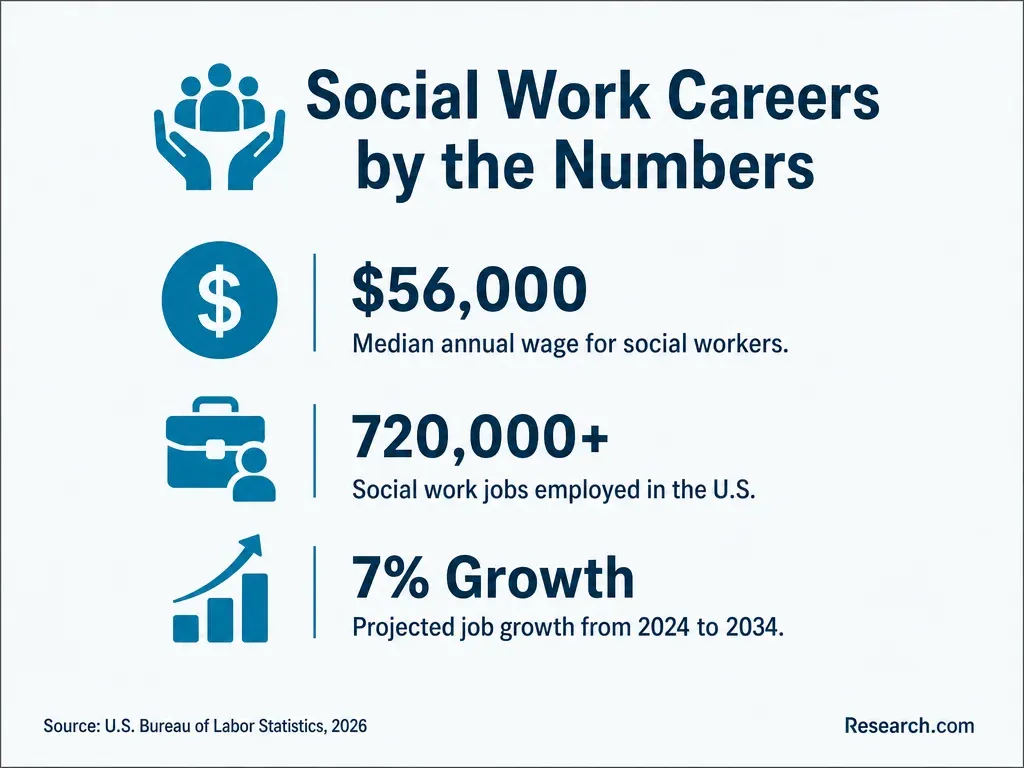
- The U.S. Bureau of Labor Statistics reports a May 2025 median annual wage of $61,780 for social workers across specialties and projects 6% employment growth from 2025 to 2035; neither figure predicts an individual applicant's pay or prospects.
What is the difference between a community health worker and a social worker?
A community health worker (CHW) is often a trusted bridge between a community and its health and social-service systems. CHWs may explain available services, offer health education, help people navigate appointments, identify access barriers, and relay community concerns to an organization. A social worker uses social work education to address individual and environmental needs through activities such as assessment, service planning, case management, advocacy, and, with the appropriate license, clinical treatment.
The titles can overlap in outreach or care-coordination jobs. The useful distinction is what an employer expects you to do, not whether both jobs involve helping people. This table compares common functions; actual scope depends on the position and jurisdiction.
| Decision point | Community health worker | Social worker |
| Primary contribution | Community relationships, health education, outreach, and navigation | Social work assessment, intervention, service coordination, advocacy, or clinical services within qualifications |
| Typical settings | Community organizations, health departments, clinics, and outreach programs | Social-service agencies, schools, hospitals, behavioral health settings, and public programs |
| Clinical practice | CHW training does not itself authorize psychotherapy or clinical diagnosis | Independent clinical practice requires the applicable state license; an MSW alone is not authorization |
| Experience that matters | Local knowledge, communication, trust-building, and navigation skills | Practice skills, ethics, documentation, field learning, and any required supervision or license |
If your goal is culturally responsive outreach or helping people overcome practical barriers to care, CHW work may be the more direct route. If your goal is psychotherapy, investigate clinical practice preparation through an MSW and the separate licensing rules in the state where you plan to work.
What education and training does each career require?
CHW employers may accept a high school diploma or equivalent followed by job training, while others seek a certificate, relevant experience, or additional education. Training commonly addresses health communication, outreach, confidentiality, referrals, and documenting services. Requirements are not uniform: check the actual job posting and any state CHW rules.
For social work, a BSW prepares students for generalist practice and includes supervised field education. An MSW adds graduate-level preparation; traditional or foundation MSW programs can admit students whose bachelor's degree is in another field. Advanced-standing MSW tracks are for applicants with a qualifying social work bachelor's education under the program's rules, not simply substantial CHW experience. A BSW can be a sensible starting point if the target jobs require it; BSW program selection for prospective students should include field placement support, not just course format.
Education and permission to practice are separate. A graduate seeking independent clinical work generally needs post-degree supervised experience and other steps set by the state board. CHW employment can develop valuable communication and referral skills, but it does not replace a degree's required field education or post-degree clinical supervision unless the responsible program or board expressly approves a particular arrangement.
How do certification and state licensing requirements differ?
CHW certification or registration is state-specific where available; employers may also use their own training standards. Do not assume that a CHW certificate is mandatory everywhere - or that a certificate issued in one state automatically meets another employer's or state's requirements. Ask the state health authority or credentialing body which training, experience, assessment, and renewal rules apply.
Social work licensing is governed by state social work boards. License categories, protected titles, qualifying degrees, examinations where required, supervision, and permitted activities vary. A BSW or MSW may help satisfy an educational requirement, but graduation is not license issuance. Likewise, a doctorate is not a shortcut around clinical licensing requirements; short-format social work doctorate comparisons address further education, not authorization to practice independently.
Before paying for any credential, match it to three things: the exact job description, the rules where you will work, and the employer's hiring policy. That check is especially important for care-coordination positions, whose titles do not always reveal whether a social work license is required.
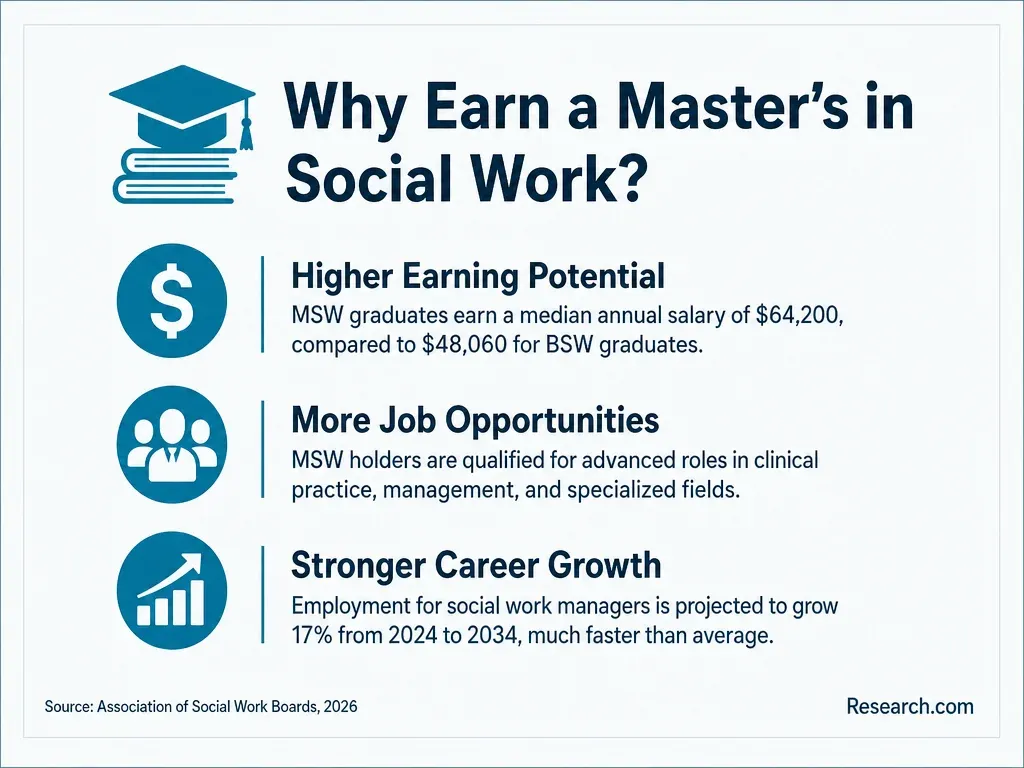
BLS projects 6% growth in social worker employment from 2025 to 2035 across specialties, including 8% for healthcare social workers and 10% for mental health and substance abuse social workers. Those projections describe national occupations, not openings in a particular community or guaranteed demand for newly licensed clinicians.
CHW prospects depend heavily on local health-system priorities, public-health programs, and employer funding. Without a comparably verified CHW projection here, it would be misleading to rank the two professions by a single growth percentage. Instead, examine nearby postings: count roles you currently qualify for, separate permanent jobs from grant-funded positions, and note whether employers offer training or supervision.
Growth alone does not justify the cost of graduate education. If you are considering an MSW primarily for more job options, use a guide to evaluating MSW degree value alongside local job requirements and your likely total cost.
Online classes can reduce commuting, but they do not remove practical training. CHW programs may require in-person skills practice, outreach, or an employer-sponsored experience. BSW and MSW programs include approved field education in agency settings, even when academic courses are online. The school determines whether a site, field instructor, learning activities, and hours meet its requirements; an existing CHW job does not automatically count.
Campus programs make face-to-face classes routine, while online programs may mix asynchronous coursework with scheduled live sessions, skills labs, or campus visits. Either format can be difficult to combine with paid work if a placement operates mainly during business hours. For a working applicant, the decisive questions are the weekly placement schedule, who finds the site, whether an approved employment-based placement is possible, and what happens if the site cannot accommodate your hours.
Use online MSW scheduling for working adults as a starting point, then obtain the actual program calendar and field policies before enrolling. "Online" and "self-paced" should never be interpreted as permission to complete fieldwork whenever convenient.
CHW training entry requirements range from employer onboarding to formal program applications. Coursework or training commonly covers communication, community outreach, health information, service navigation, cultural responsiveness, confidentiality, and documentation. Confirm whether the program expects prior healthcare experience, a diploma, background screening, or access to a practice site.
BSW admission may involve entry to both the college and the social work major. Coursework typically includes human behavior, social policy, research, ethics, and generalist practice alongside field education. Traditional MSW programs generally require a bachelor's degree but may admit applicants from other disciplines; they add foundation social work learning before specialized study. Advanced-standing MSW applicants need a qualifying social work bachelor's credential and must satisfy the particular program's other criteria.
Programs vary in grades, references, essays, prerequisites, and field onboarding. CHW applicants should highlight community relationships and language or navigation skills; prospective social work students should also show readiness for academic writing, ethical practice, and supervised learning. When comparing admission criteria across online MSW programs, check eligibility for the specific track rather than assuming general university admission guarantees an MSW seat.
How long do these programs take, and how much do they cost?
CHW training may be delivered through employer onboarding or a separate certificate, so its length and price vary widely. A BSW is ordinarily planned as an undergraduate degree; a traditional MSW adds a foundation and specialized sequence, while an eligible BSW graduate may qualify for a shorter advanced-standing sequence. Part-time enrollment, transfer decisions, course sequencing, and placement availability can change an individual timeline. Published online MSW timelines for working students should therefore be checked against the school's actual field calendar.
Because no single tuition figure represents either pathway, calculate a personal cost before choosing. Start with required credits multiplied by your applicable per-credit tuition rate, then add mandatory fees, books, technology, screening, travel, and any required campus visits. Most importantly, estimate earnings you may give up to complete classes or fieldwork; ask whether a paid or employment-based placement is available and formally approvable rather than budgeting as though it were guaranteed.
If a CHW job meets your career goal, a shorter, employer-supported training route may cost less than a degree. If your target position requires a BSW, MSW, or license, compare programs on the total cost of reaching that qualification - including time away from work - not tuition alone.
Other Things You Should Know About Social Work
Yes. Language skills can improve communication and access to services in both roles. An employer may still require demonstrated proficiency, interpreter procedures, and training in the job's professional boundaries.
Often. A CHW may identify access barriers and support outreach while a social worker handles responsibilities assigned to their position and qualifications. Clear referrals and documentation help prevent tasks from falling between roles.
Not necessarily. Care coordinator is an employer job title, not proof of a particular degree or license requirement. Read the duties and minimum qualifications, especially for assessment or clinical tasks.
Ask about onboarding, supervision, caseload, travel and safety practices, documentation systems, and referral resources. These conditions affect whether you can do the work well regardless of your credential.
- Community Health Worker (CHW) State Certification | utah.gov https://healthequity.utah.gov/chw-state-certification/
- Social Determinants of Health (SDOH) | cdc.gov https://www.cdc.gov/about/priorities/why-is-addressing-sdoh-important.html
- Becoming a Community Health Worker | Texas DSHS https://www.dshs.texas.gov/community-health-worker/becoming-a-community-health-worker
- Varying Estimates of Social Workers in the United States - PMC https://pmc.ncbi.nlm.nih.gov/articles/PMC11389054/
- Becoming a Community Health Worker [Certification & Careers] | University of San Diego Online Degrees https://onlinedegrees.sandiego.edu/community-health-worker-certification/
- What do social workers do? Responsibilities and skills | Capella University https://www.capella.edu/blog/social-work-and-human-services/what-do-social-workers-do/
- The Role of Social Work in Public Health - Online M.S.W. | Virginia Commonwealth University https://onlinesocialwork.vcu.edu/blog/role-of-social-work-in-public-health/
- Community Health Workers' Role Grows With Evidence | Penn LDI https://ldi.upenn.edu/our-work/research-updates/community-health-workers-role-grows-with-evidence-that-they-improve-care-and-equity/
- What Does a Social Worker Do? | Chamberlain University https://www.chamberlain.edu/blog/what-does-a-social-worker-do
- The Role of Community Health Workers | Center to Advance Palliative Care https://www.capc.org/blog/enhancing-care-for-diverse-communities-the-role-of-community-health-workers/