2027 Questions to Ask Before Accepting an Inpatient Psychiatric Social Worker Position
Audited and Verified:
Our Editorial and Data Verification Process
Research.com uses government datasets, official education statistics and primary institutional information to support its career and degree guides. Our review process checks factual accuracy, occupational definitions, source dates and the requirements associated with the credentials discussed.
How This Article Was Fact-Checked
Our editorial team verifies salary estimates, employment projections, education requirements and program information against original data providers and official organizations. Salary figures are checked against the relevant occupational definitions and reporting periods. Information about licensure, accreditation and required in-person training is reviewed separately.
Fact-checked and verified on:

Co-Founder and Chief Data Scientist
An inpatient psychiatric social work offer can look promising until you learn how many admissions, discharge plans, and crises one person handles in a shift. For MSW students, new graduates, and social workers considering a hospital move, the decision depends on more than the job title or salary.
This guide turns the offer into questions you can ask about duties, staffing, safety, supervision, and scheduling. Use the answers to judge whether the position fits your current qualifications, supports your development, and gives you the resources to serve patients responsibly.
Key Things You Should Know
- Ask for the typical daily census, admissions and discharges per social worker, documentation deadlines, and coverage when a colleague is absent; a nominal caseload alone can hide the workload.
- Confirm who responds to behavioral emergencies, whether you ever work alone with patients, and what training and supervision are provided before you carry an independent assignment.
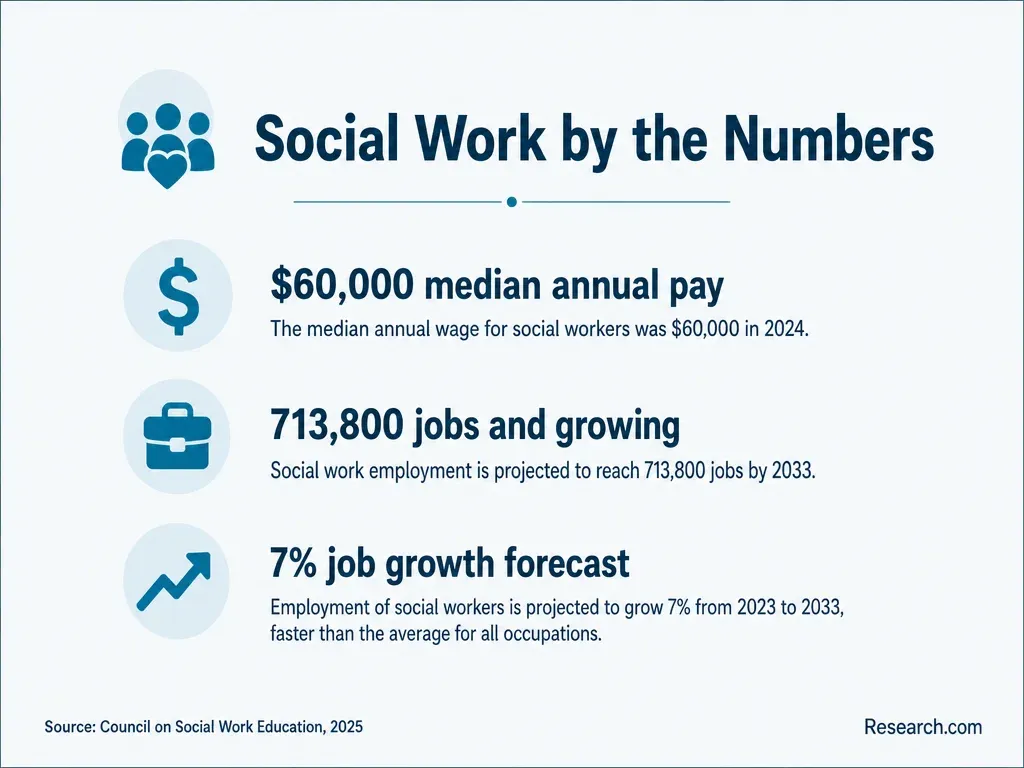
- Compare the written offer with a relevant wage benchmark: the U.S. Bureau of Labor Statistics reports a $60,280 median annual wage for mental health and substance abuse social workers in May 2025, not a guaranteed inpatient salary.
What does an inpatient psychiatric social worker do each day?
Inpatient psychiatric social workers help patients and treatment teams address the circumstances surrounding a hospital stay and the transition out of it. Depending on the unit, a day may include psychosocial assessments, family contact with appropriate consent, treatment-team meetings, benefits or housing coordination, referrals, group work, crisis-related consultation, and discharge documentation. The mix differs across adult, adolescent, geriatric, and specialty units.
Ask the hiring manager to walk you through one ordinary day and one unusually busy day. Which tasks belong to social work, nursing, psychiatry, and utilization review? Are you expected to provide psychotherapy, facilitate groups, or primarily coordinate discharge? Those distinctions matter if you want to build particular social work master's skills across career settings rather than take a role whose title obscures its actual duties.
For a new graduate, also ask which tasks are observed or reviewed during onboarding. Experience from a field placement is useful preparation, but it does not establish competence with every patient population, electronic record, or hospital procedure.
What caseload and documentation requirements should you expect?
"Caseload" can mean assigned patients, new assessments, daily encounters, or discharges. Ask for each measure separately, along with the unit's typical census, average length of stay, admission flow, and the coverage plan for vacations and vacancies. A small census with frequent admissions and complex placements may demand more work than a larger, stable one.
Find out which notes, assessments, treatment-plan updates, and discharge materials you own; when they are due; and whether documentation time is protected during the shift. Ask for a de-identified example of the workflow or a demonstration of the record system, not access to patient charts. Clarify who resolves incomplete outside referrals and what happens when a safe discharge option is unavailable.
If you are entering from an MSW placement, compare the job's pace and note-writing expectations with what you practiced under field instruction. Field placement assistance in online MSW education can help students find relevant learning settings, but a placement is not a promise that a graduate can manage a full hospital assignment without orientation.
What salary and benefits do inpatient psychiatric social workers receive?
Request the salary range for this position, its pay grade, and how experience or licensure affects placement within that range. Confirm whether the offer is hourly or salaried and how overtime, evening or weekend differentials, on-call time, and required training are paid. Compare health coverage, retirement contributions, paid leave, tuition assistance, and the cost of any employee premiums - not just base pay.
The following national figures provide occupational context, not inpatient psychiatric pay scales. Hospitals may classify roles differently, so compare the job's duties with the occupation before using a benchmark.
| U.S. BLS occupation | May 2025 median annual wage | Projected employment growth, 2025-2035 |
| Mental health and substance abuse social workers | $60,280 | 10% |
| Healthcare social workers | $67,880 | 8% |
A median divides workers in an occupation into two equal halves; it does not predict your offer. Geography, employer, shift requirements, and experience can change the comparison. Use social work master's salary geography as additional context, then ask the employer for its actual range and benefits documents before deciding.
Safety is a staffing and workflow question, not just a promise of training. Ask where interviews occur, whether staff have a reliable way to summon help, who responds to behavioral emergencies, and when two staff members are required. Clarify the social worker's role in de-escalation, searches, seclusion or restraint events, and post-incident follow-up; do not assume those duties from the unit name.
Ask to see the orientation outline and relevant written policies before your first patient assignment. It is reasonable to ask how staff report threats, how leadership reviews incidents, and whether an employee can pause an unsafe interaction and obtain assistance without being expected to manage it alone. Patient dignity and trauma-informed practice should remain part of the safety discussion.
For students weighing future inpatient work, an accredited BSW program can provide generalist preparation, including supervised field learning. A hospital must still teach its own emergency procedures and assess a new employee's readiness; classroom or field experience is not a substitute for unit-specific onboarding.
Ask who completes the psychosocial assessment, who makes clinical and medical decisions, and how the team resolves disagreements. Social workers may identify family supports, housing barriers, benefits needs, and follow-up services while psychiatrists, nurses, and other clinicians contribute within their own roles. The hospital's policies and your license determine what you may document or provide independently.
Discharge planning deserves particular scrutiny. Ask when planning begins, who confirms that referrals are available, how patients participate in decisions, and who escalates a plan when housing, transportation, or community care cannot be arranged. Clarify who has authority to approve discharge; coordinating a plan is not necessarily the same as making the final decision.
If the position includes diagnosis or psychotherapy, compare those duties with the state board's current rules and your license category. A guide to MSW education and state licensing expectations can orient your questions, but the board and hospital must confirm your actual authority. Also ask how the team handles consent, family communication, and access to sensitive records under applicable law and policy.
Separate three offers that are often blurred together: orientation to the job, clinical consultation while you work, and supervision that your state board will accept toward a clinical license. Ask who provides each, how often you meet, whether supervision occurs on paid time, and what happens if the designated supervisor leaves. Request the proposed supervisor's credentials and the employer's documentation process.
Before counting on the job as a licensure pathway, check your board's rules for eligible duties, supervisor qualifications, supervision format, and recordkeeping. MSW field education and post-degree supervised experience are different requirements. A promise that "we provide supervision" is not enough if the arrangement cannot meet your board's standards.
If you are still in graduate school, do not confuse an employer's post-degree supervision offer with MSW graduate funding and assistantship eligibility questions. Assistantships concern educational funding or work arrangements; clinical-license supervision is governed separately. Ask about both only if each matters to your next step.
Request a sample schedule covering several weeks, not just the advertised shift. Ask how often you would cover weekends and holidays, whether admissions or discharges routinely extend the day, and who handles urgent work after you leave. If the position includes on-call duty, clarify response times, remote versus on-site expectations, compensation, and backup.
These details are especially consequential if you coordinate caregiving, classes, or another job. Compare the employer's actual shift expectations with any required live sessions or placement hours; online MSW learning schedules for caregivers can vary, and online coursework does not make hospital shifts or field education flexible. A predictable daytime schedule may be worth more to you than a higher offer with frequent last-minute coverage.
What advancement opportunities are available after working in inpatient psychiatric social work?
Ask which roles former staff have actually moved into and what qualifications those positions require. Possibilities may include senior social worker, clinical supervisor, team lead, utilization or care-management specialist, outpatient behavioral-health clinician, or program manager. Advancement may depend on an MSW, a particular license, supervised experience, management skills, or an available opening - not simply time on the unit.
For a BSW-prepared worker considering an MSW, weigh the employer's tuition assistance and scheduling support against the full cost and time commitment. Online MSW programs organized by cost offer a starting point for comparison, but verify fees, field-placement expenses, aid conditions, and whether the degree is necessary for the role you want. If your goal is leadership rather than clinical practice, ask whether targeted management experience or employer training would be a more direct next step.
Before accepting the offer, request the job description, pay and benefits terms, sample schedule, orientation plan, and supervision arrangement in writing. Compare those documents with your license status and career goal. A strong offer is one whose workload, authority, support, and compensation still make sense after the details are clear.
Other Things You Should Know About Social Work
Yes. Ask whether the hospital offers a structured visit or a conversation with prospective coworkers. Follow its privacy and safety rules; you should not expect access to patient information.
Ask what the employer's policy covers, including services within your assigned role, and whether it provides legal defense. Review any exclusions before deciding whether separate coverage would be useful.
It can. If the position is represented, request the applicable agreement and check its provisions on pay steps, scheduling, overtime, discipline, and grievances alongside the offer letter.
Wait for a written offer and clarify any contingencies, such as license verification, background checks, or a confirmed start date. That reduces the risk of a gap in employment if onboarding changes.
- Shift Pay Differentials - Office of the New York State Comptroller https://www.osc.ny.gov/state-agencies/payroll/payroll-manual/shift-pay-differentials
- Night Shift Differential for Federal Wage System Employees | U.S. Office of Personnel Management https://www.opm.gov/policy-data-oversight/pay-leave/pay-administration/fact-sheets/night-shift-differential-for-federal-wage-system-employees/
- Discharge Planning and Transitions of Care | PSNet https://psnet.ahrq.gov/primer/discharge-planning-and-transitions-care
- Fact Sheet #22: Hours Worked Under the Fair Labor Standards Act (FLSA) | U.S. Department of Labor https://www.dol.gov/agencies/whd/fact-sheets/22-flsa-hours-worked
- Discharge Planning - StatPearls - NCBI Bookshelf https://www.ncbi.nlm.nih.gov/books/NBK557819/
- Supervision FAQs | Texas Behavioral Health Executive Council https://bhec.texas.gov/tbhec/supervision-faqs/
- Chapter 17 - Compensation - Policy Manual | The University of Iowa https://policy.uiowa.edu/human-resources/compensation
- Social Worker Job Description (Duties & Responsibilities) | allpsychologyschools.com https://www.allpsychologyschools.com/social-work/job-description/
- Psychiatric Social Work (Mental Health): 2026 Edition | Online MSW Programs https://www.onlinemswprograms.com/careers/psychiatric-mental-health-social-work/
- NASW Standards for Social Work Case Management | socialworkers.org https://www.socialworkers.org/Practice/NASW-Practice-Standards-Guidelines/NASW-Standards-for-Social-Work-Case-Management