2027 Advanced Standing MSW While Keeping a Social Services Job: Scheduling Questions
Audited and Verified:
Our Editorial and Data Verification Process
Research.com uses government datasets, official education statistics and primary institutional information to support its career and degree guides. Our review process checks factual accuracy, occupational definitions, source dates and the requirements associated with the credentials discussed.
How This Article Was Fact-Checked
Our editorial team verifies salary estimates, employment projections, education requirements and program information against original data providers and official organizations. Salary figures are checked against the relevant occupational definitions and reporting periods. Information about licensure, accreditation and required in-person training is reviewed separately.
Fact-checked and verified on:

Co-Founder and Chief Data Scientist
An advanced-standing MSW can shorten the route from a BSW to a master's degree, but it does not eliminate field education, or guarantee that fieldwork will fit around a social services job. If you need to keep your income, the deciding details are often your agency's hours, your school's placement rules, and the weeks when classes and fieldwork overlap.
This guide helps working BSW graduates build a realistic schedule, assess whether their job could serve as a placement, and compare programs before committing to a timetable they cannot sustain.
Key Things You Should Know
- Working full time may be possible, especially in a part-time track, but a sample term with 40 paid work hours and 16 field hours already commits 56 hours before class, study, and travel.
- A social services job counts toward MSW field education only if the program approves the site, learning tasks, instruction, and documentation; employment alone does not earn field credit.
- Compare actual placement days and live-session times, not just "online" or "part-time" labels, and obtain a term-by-term schedule before accepting an offer.
Can you complete an advanced standing MSW while working full time?
Yes, in some programs and jobs, but feasibility depends more on schedule control than on the number of credits alone. Advanced standing is an MSW entry route for qualifying BSW graduates that typically skips much of the foundation sequence. Its shorter calendar can concentrate specialized coursework and field education into demanding terms.
Full-time work is most workable when your employer permits predictable schedule changes, your program offers a part-time sequence, or an approved employment-based placement lets educational activities occur at your workplace.
It becomes harder if both your job and placement require the same weekday hours, your caseload is unpredictable, or the program requires daytime skills labs. Being able to keep a job does not necessarily mean being able to keep every shift or your current workload.
Before enrolling, compare your employer's flexibility with the specific social work master's skills across career settings you hope to develop. If your current role already meets your career goal and does not require an MSW, employer training or targeted experience may be a less disruptive choice.
If an MSW is necessary, ask your manager about a fixed field day, reduced hours, or a temporary change in duties, and ask the school whether its written policies permit the arrangement.
Can your social services job count toward MSW field placement hours?
Possibly, but only through an approved employment-based placement. The MSW program, not your employer alone, decides whether the workplace can support its specialized learning objectives, qualified field instruction, supervision, evaluation, and required hours.
Approval should occur before you count time toward field education; past paid shifts generally cannot simply be relabeled as placement hours.
Schools differ on whether field activities must be separate from ordinary job duties. Some may approve new assignments within the same agency; others require a different unit, population, supervisor, or set of responsibilities.
The key is whether the arrangement provides assessable learning rather than credit for work you already perform. Ask the field office to review a proposed learning plan and confirm which hours, paid duties, meetings, and supervision sessions it will accept.
Also keep academic field hours separate from social work clinical hour requirements for a future license. MSW placement is part of the degree; post-degree supervised practice is a separate state-board process. If you serve clients as both an employee and student, clarify documentation access, confidentiality, liability coverage, and which supervisor evaluates each role.
How many weekly hours do advanced standing MSW coursework and fieldwork require?
There is no reliable universal weekly total. Programs distribute credits, field hours, seminars, and skills training differently, and the heaviest term may not be the first one. Request the calendar for each term you would attend, including summer.
A planning calculation makes the scheduling risk visible. If a program requires 480 placement hours across 30 active weeks, that averages 16 field hours per week; this is an illustration, not a standard requirement.
Add a 40-hour job, scheduled classes, reading and assignments, field seminar, supervision, and travel. Even before study time, work plus field would occupy 56 hours. Some placement weeks may be longer to account for agency holidays or the school's hour-recording rules.
Ask for the credit load and field-hour allocation in writing, then test the busiest term against your actual calendar, not an average week. Short-format MSW program comparisons can help identify tracks to investigate, but a shorter advertised duration is not evidence of a lighter weekly commitment.
Sometimes, but availability is limited by agency services and qualified supervision, not just student preference. Crisis programs, residential services, and some community agencies may operate outside standard office hours.
Other placements, including many school and healthcare assignments, require substantial weekday availability. An agency being open on weekends does not mean an approved field instructor or suitable learning activities will be available then.
Ask the field office which local sites have actually hosted evening or weekend advanced-standing students, whether the option exists in your intended concentration, and how supervision works during those shifts.
Confirm the latest date a placement can be secured and what happens if your preferred hours are unavailable. For an online program, planning local placements through an online MSW program deserves particular attention: classes may be remote while placement remains tied to an agency near you.
Delivery format changes classroom logistics; it does not remove field obligations. The most useful comparison is the number of hours you must be available at fixed times and places.
The table separates common scheduling advantages from commitments that still need program-specific confirmation. None of these formats guarantees a particular placement shift:
| Format | Potential advantage while employed | Schedule to verify |
| Online | May reduce campus travel; some lessons may be asynchronous | Live classes, skills labs, residencies, local field days, and time-zone requirements |
| Hybrid | May combine remote study with periodic in-person practice | Frequency and length of campus visits, plus placement travel |
| Campus | May offer a predictable on-site class timetable | Commute, daytime courses, field days, and course availability by term |
If clinical preparation is your goal, compare actual practice requirements rather than assuming remote courses are less interactive. Social work master's programs emphasizing clinical preparation may differ in live skills work, placement expectations, and available agency partnerships. Request a sample timetable for the exact advanced-standing track, not the general MSW brochure.
Many full-time advanced-standing tracks are designed for roughly a year, while part-time tracks commonly extend across additional terms.
Those are planning descriptions, not promises: start term, summer enrollment, course sequencing, placement availability, and approved leave can change your graduation date. A shorter program calendar may also require more weekly time away from work.
Compare programs by counting the terms in which you must take field, not just the advertised completion date. Ask whether the same specialized courses run every term, whether field can be spread over more weeks, and whether changing from full-time to part-time status affects aid or placement continuity.
If you later consider lower-cost doctoral pathways for social workers, treat them as a separate career decision - not a way to replace an MSW field sequence or speed initial social work licensure.
Typically, applicants need a qualifying BSW from a CSWE-accredited program, subject to the MSW program's own admission rules. Schools may also assess how recently the BSW was earned, grades in social work courses, references, and readiness for specialized study.
Relevant social services experience strengthens an application in some circumstances but does not, by itself, substitute for the required social work degree.
Check the status applicable to your BSW program and graduating cohort, then have each prospective MSW program confirm your eligibility. Social work bachelor's accreditation questions are especially important if your degree program changed status while you were enrolled.
A bachelor's degree in psychology, sociology, or human services may support admission to a traditional MSW, but it ordinarily does not establish advanced-standing eligibility. Admission to the university is not the same as approval for its advanced-standing sequence.
Total cost depends on the program's charges and how much paid work you must give up to complete it. Compare tuition and mandatory fees for the entire advanced-standing sequence, then add books, technology, screening, travel, parking, required campus visits, and any extra caregiving. A lower tuition quote can be outweighed by unpaid placement time or a schedule that forces a reduction in earnings.
Use each school's published credit and fee schedule to build a term-by-term budget. Online MSW programs organized by cost can provide a starting set of options, but confirm advanced-standing charges, residency rules, and field-related expenses directly with each institution.
Ask its financial aid office about federal graduate aid eligibility, institutional scholarships, enrollment-intensity requirements, and the effect of a part-time schedule.
Ask your employer separately whether tuition assistance covers this degree and whether accepting it creates a service commitment. Neither aid nor an employment-based placement guarantees that field hours will be paid.
Check both the MSW program's applicable CSWE accreditation status and the education rules of the state where you expect to seek a license. Institutional accreditation and CSWE programmatic accreditation address different things. A school's ability to enroll you online or arrange fieldwork in your location is another question to verify with the program.
For each shortlisted program, request written confirmation of its accreditation status for your intended entry cohort, advanced-standing curriculum, field placement jurisdiction, and any state-specific disclosures.
Then compare those answers with the relevant licensing board's current education requirements. A resource on MSW programs and state licensure education requirements can help frame that review, but the board makes licensing decisions.
Graduation does not itself issue a license. Depending on the state and license category, an application, examination, and post-degree supervised experience may follow. Your MSW field instructor and a future clinical-license supervisor serve different purposes, even if one person could qualify for both roles under the applicable rules.
What careers, salaries, and job outlook can MSW graduates expect?
An MSW may support progression from a current social services role into specialized direct practice, healthcare, school-related work, program management, or positions that require graduate social work education.
The right comparison is your target job posting: check its degree, license, experience, and schedule requirements. Clinical work and independent practice may require additional state-authorized steps after graduation; an MSW alone does not grant independent clinical authority.
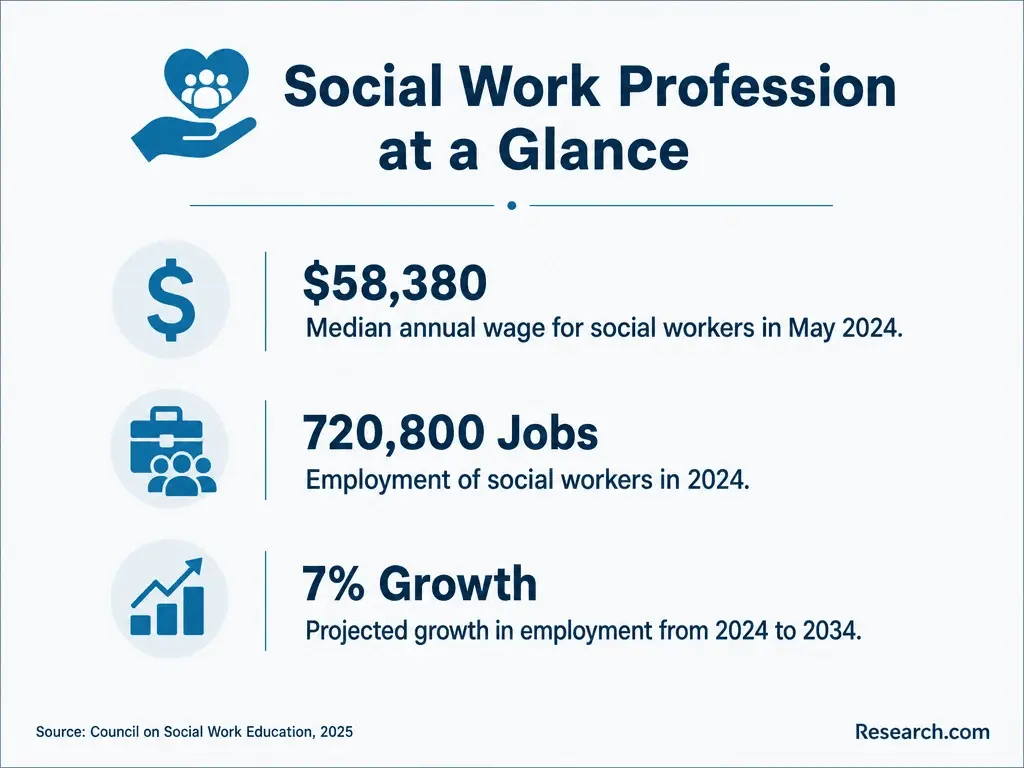
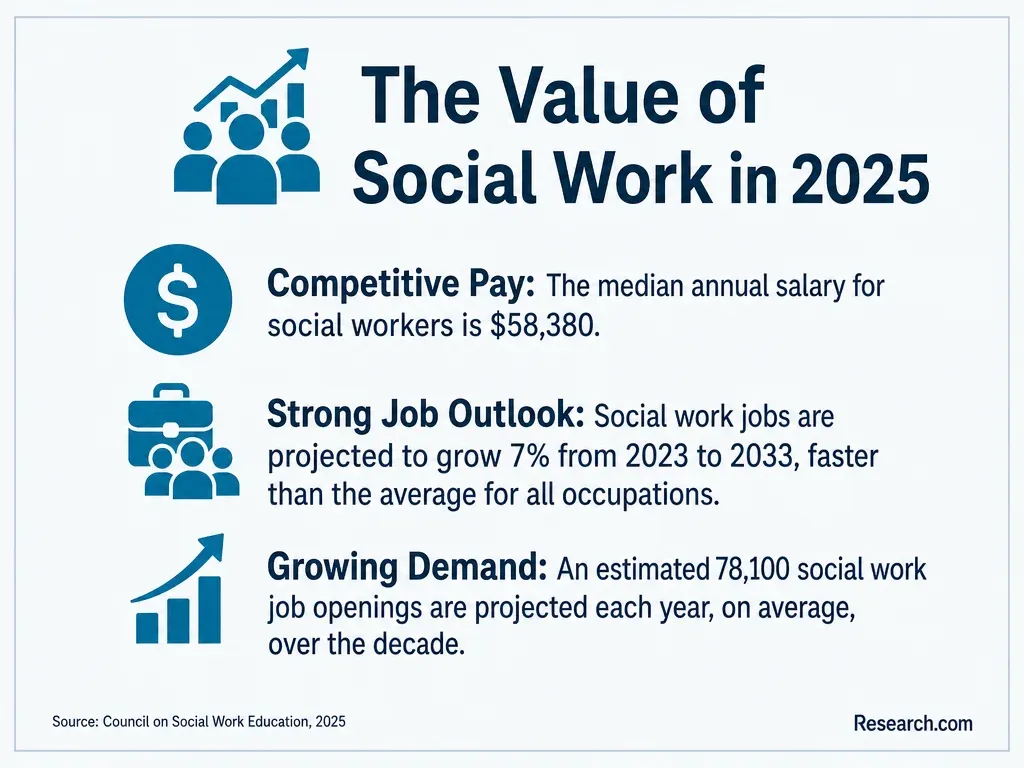
U.S. Bureau of Labor Statistics figures provide occupation-level context, not a forecast of your pay after earning an MSW. The following May 2025 medians and 2025-2035 projections describe workers across each occupation, with varied credentials, employers, and experience:
| Occupation | Median annual pay, May 2025 | Projected employment growth, 2025-2035 |
| Child, family, and school social workers | $59,550 | 4% |
| Healthcare social workers | $67,880 | 8% |
| Mental health and substance abuse social workers | $60,280 | 10% |
Use those figures to identify the occupation closest to your intended duties, then examine local openings and pay ranges before calculating whether tuition and reduced work hours are worthwhile. Social worker earnings and location considerations can add geographic context, but no occupational median guarantees a raise or promotion at your current agency.
Other Things You Should Know About Social Work
Notify the field office before the change. Approval applies to a specific learning arrangement; a new job or supervisor may require a revised agreement or a different site, which could affect your completion date.
If you will need schedule changes, tuition assistance, or an employment-based placement, an early conversation can establish what the employer can actually support. You can ask schools about their requirements first without promising your employer a placement arrangement.
Yes. Contact the school's accessibility office and field office early to discuss the placement process and appropriate accommodations. Requirements for demonstrating program competencies still apply, and an agency's available duties and schedule must be considered.
Contact your field instructor and faculty liaison promptly. The program must determine which documented hours and learning activities remain acceptable and whether a replacement placement or revised timeline is possible.
- Enforcement Guidance on Reasonable Accommodation and Undue Hardship under the ADA https://www.eeoc.gov/laws/guidance/enforcement-guidance-reasonable-accommodation-and-undue-hardship-under-ada
- FLSA Hours Worked Advisor - elaws https://webapps.dol.gov/elaws/whd/flsa/hoursworked/screenEr16.asp
- Reasonable Accommodations | U.S. Office of Personnel Management https://www.opm.gov/policy-data-oversight/disability-employment/reasonable-accommodations/
- Independent Study And Online Learning | Veterans Affairs https://www.va.gov/education/about-gi-bill-benefits/how-to-use-benefits/online-distance-learning/
- Academic Years, Academic Calendars, Payment Periods, and Disbursements | 2025-2026 Federal Student Aid Handbook https://fsapartners.ed.gov/knowledge-center/fsa-handbook/2025-2026/vol3/ch1-academic-years-academic-calendars-payment-periods-and-disbursements
- Flexible Course Options | North Hennepin C.C. https://www.nhcc.edu/flexible-course-options
- MSW Practicum FAQs | School of Social Work & Criminal Justice | University of Washington Tacoma https://www.tacoma.uw.edu/swcj/msw-practicum-faqs
- Reasonable Accommodations | dodea.edu https://www.dodea.edu/offices/equal-employment-opportunity-programs/reasonable-accommodations
- Practicum Education - Master of Social Work (MSW) Program | York College https://www.york.cuny.edu/social-work/msw/student-scholar-cardinal-journey/field
- Field FAQs for Prospective Online MSW Students | University of Nevada, Reno https://onlinedegrees.unr.edu/blog/field-faqs-for-prospective-online-msw-students