
Most Affordable Trade School & Training Programs - Leading Certification Courses in New York for 2026

Co-Founder and Chief Data Scientist
The main trade school decision in New York is not simply which school is closest or cheapest. You also need to compare program length, total cost, hands-on training, licensing or certification requirements, job placement support, and whether the schedule fits your work and family responsibilities.
This 2026 guide focuses on affordable trade school options in New York and explains what students should know before enrolling. It is designed for high school graduates, working adults, career changers, and anyone comparing short-term training against a traditional college route.
The featured trade school programs ranking was developed by the Research.com team of data scientists to give readers a clearer, data-informed starting point. Use this guide to understand costs, admissions expectations, online versus campus formats, financial aid, salary potential, and the career paths that commonly follow vocational training in New York.
Key benefits of finishing trade school programs trade school in New York
- Strong salary potential: Trade school graduates in New York can earn from $45,000 to over $130,000 annually, depending on the trade, location, experience, licensing, and employer. Electricians, for example, can earn $45,000-$130,000+, with average salaries around $73,463.
- Direct preparation for in-demand work: Many programs are built around practical skills for fields such as electrician work, HVAC, plumbing, construction management, healthcare support, automotive technology, cosmetology, and IT support. These paths can be a better fit for students who want job-ready training rather than a broad academic degree.
- Faster entry into the workforce: Many trade programs can be completed in months rather than years, allowing students to start earning sooner. This matters in New York, where living costs can make a long full-time degree difficult for many learners.
- Flexible online and hybrid options: Online trade school programs in New York can help students complete theory-based coursework around work, childcare, or commuting constraints. However, hands-on trades still usually require in-person labs, clinical practice, shop training, or apprenticeships.
- Clear credential outcomes: Good programs prepare students for industry certifications, safety credentials, state licensing steps, or apprenticeship entry. Before enrolling, students should confirm exactly which credential the program leads to and whether it is recognized by employers.
- Most Affordable Trade School & Training Programs - Leading Certification Courses in New York for 2026
- What can I expect from trade school programs trade schools in New York?
- Where can I work after finishing trade school programs trade schools in New York?
What can I expect from trade school programs trade schools in New York?
Trade school programs in New York are usually career-focused, shorter than traditional degree programs, and built around applied training. Depending on the field and program length, costs typically range from $5,000 and $15,000, although the final amount can change with tools, uniforms, books, equipment fees, exam fees, commuting, and licensing expenses.
Students considering programs such as Capital Region BOCES should expect a practical learning environment rather than a lecture-heavy college experience. In an HVAC program, for example, students may pay closer to the higher end because equipment, tools, and lab facilities are central to training. Programs in areas such as early childhood education or cosmetology may cost less, though students still need to budget for supplies and licensing-related expenses.
Most trade schools emphasize three outcomes: hands-on competence, workplace readiness, and preparation for credentials. Depending on the field, students may encounter OSHA safety training, state licensing preparation, clinical practice, shop work, simulated labs, or supervised field placements.
Flexible schedules are common, especially for adults who cannot stop working while training. Evening, weekend, accelerated, hybrid, and part-time formats can make completion more realistic, but students should ask whether a flexible schedule extends the graduation timeline or changes financial aid eligibility.
The strongest programs connect classroom instruction with real job tasks. Work placements at construction sites, healthcare facilities, salons, repair shops, or commercial kitchens can help students build confidence before applying for entry-level roles. When comparing schools, ask how much supervised practice is included, who provides it, and whether it is required for graduation or licensure.
Where can I work after finishing trade school programs trade schools in New York?
After completing a trade school program in New York, graduates may work in healthcare facilities, construction firms, maintenance departments, salons, automotive shops, restaurants, hotels, public agencies, transportation employers, and technology support teams. The right workplace depends on the credential earned, the amount of hands-on training completed, and whether the job requires licensing, certification, or apprenticeship hours.
Healthcare-focused graduates, such as those trained in medical assisting, dental assisting, pharmacy technician work, sterile processing, or medical billing, often look for positions in clinics, hospitals, nursing homes, dental offices, and outpatient facilities. In busy regions such as New York City, these settings can offer steady entry-level opportunities for graduates with strong clinical, administrative, and patient-service skills.
Graduates in electrical work, plumbing, HVAC maintenance, welding, and construction-related trades may pursue apprenticeships, helper roles, maintenance positions, or entry-level technician jobs. New York City's ongoing construction and infrastructure needs can create opportunities, but hiring standards vary by employer. Some roles require union pathways, supervised hours, safety credentials, or license preparation.
Culinary arts and hospitality graduates may work in restaurants, bakeries, hotels, catering companies, institutional kitchens, or food service operations. Trade schools in Queens and upstate New York can provide access to different types of employers, from high-volume city restaurants to regional hospitality businesses.
Technology and business programs can lead to entry-level jobs in IT support, administrative support, finance-related offices, customer operations, and help desk environments. For these fields, internships, employer partnerships, portfolio work, and career services can be especially important because job titles and hiring requirements vary widely.
After finishing a trade school program in New York, graduates can expect earnings to vary widely by occupation, location, experience, licensing status, overtime availability, and union or nonunion employment. The average annual salary is about $73,463, or roughly $35.32 per hour, compared with national averages around $67,149.
Electrician training illustrates the range. A graduate specializing in electrician work may start between $45,000 and $60,000, while experienced workers can see salaries climb to $90,000 or more. Higher earnings usually require more than completing a short program; they often depend on supervised experience, licensing steps, specialized skills, and a strong employment record.
Specialized technical fields can also pay well. Graduates with certifications in areas such as avionics may earn closer to $81,000 to $99,000 annually after moving into niche sectors such as air transportation.
Some trade school graduates in New York eventually pass the $100,000 salary mark as experience grows, particularly in high-demand trades with overtime, advanced credentials, supervisory responsibilities, or specialized technical expertise. Students should not treat that figure as guaranteed starting pay. A more realistic planning approach is to compare starting wages, mid-career wages, required licenses, and the cost of training before enrolling.
- The most common entry requirement is a high school diploma or GED. Applicants usually need to be at least 17 years old, and proof of U.S. citizenship or eligible status is required for most programs.
- Admissions are typically less competitive than four-year college admissions. Schools often focus on practical motivation, career interest, readiness for hands-on training, and basic eligibility rather than a highly selective academic record.
- Some programs may require interviews, placement testing, proof of English proficiency, physical ability requirements, background checks, immunizations, or drug screening, especially in healthcare, public safety, and apprenticeship-related fields.
- Trade school programs in New York cover fields like health care, technology, business, and skilled trades, often completed within six to 24 months.
- The average cost ranges from $8,000 to $20,000, making many trade school pathways more affordable than traditional four-year colleges.
- Starting salaries for graduates typically range from $35,000 to $46,000, while experienced workers in trades like electricians and plumbers may earn $60,000 to $80,000 annually.
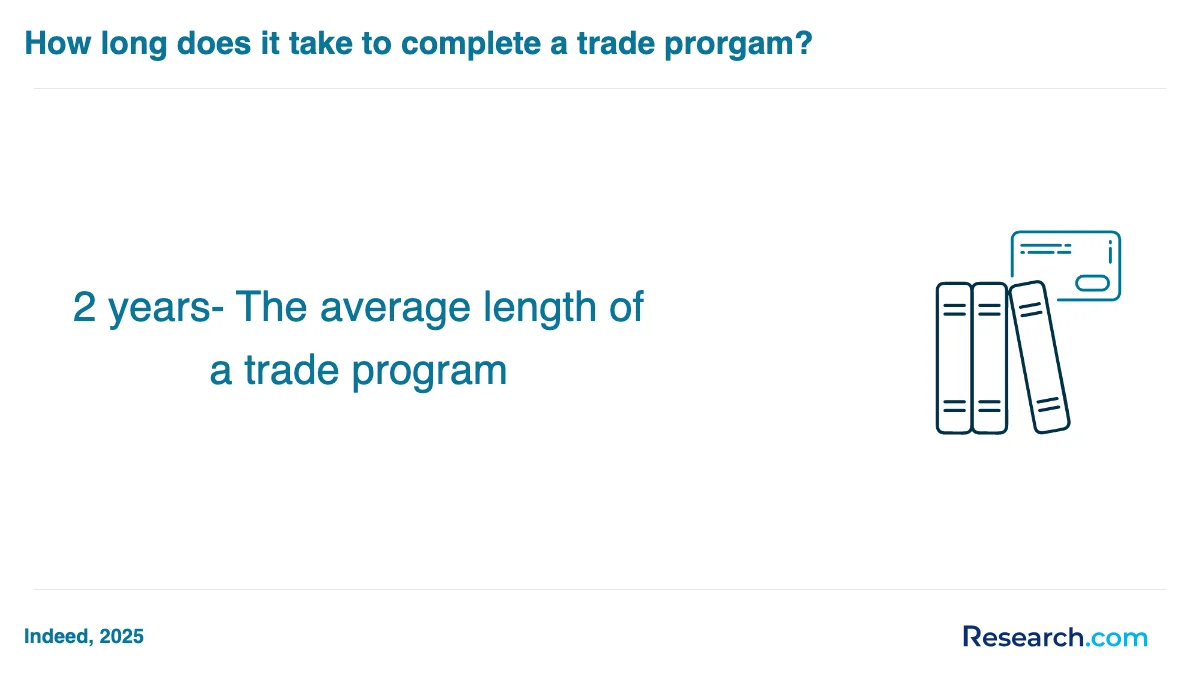
Trade school programs in New York can take anywhere from a few weeks to several years, depending on the occupation, credential, schedule, and whether the pathway includes an apprenticeship. Short programs can help students enter the workforce quickly, while longer programs may provide deeper training or lead to stronger licensing preparation.
Some certificate programs take as little as three weeks to a few months. At the Industry Trade Academy at Monroe University, students complete intensive courses totaling 80 hours over three weeks and earn certificates that can support quick entry into certain fields.
Other programs are designed around flexible scheduling. The Center for Adult & Community Services, for example, offers full- or part-time HVAC training. Full-time students complete 300 hours in just a few months, while part-time options stretch longer for students balancing school with work or family obligations.
Programs at schools such as Apex Technical School can take around seven months for more advanced hands-on training. Associate degree pathways in fields like plumbing or electrical work may require up to two years of full-time study.
Apprenticeship programs regulated by the New York State Department of Labor combine paid work with classroom instruction and typically last one to five years depending on the trade. These routes take longer, but they can be valuable for students who want structured paid experience and a clearer path toward journey-level work.
The main difference between online and on-campus trade school programs is how students complete instruction and hands-on practice. Online programs can work well for theory-based coursework, test preparation, business skills, healthcare administration, IT fundamentals, or other subjects that do not require constant access to specialized equipment. On-campus programs are usually better for trades that require labs, tools, clinical practice, shop supervision, or live demonstrations.
Online programs allow students to access lectures, assignments, quizzes, and exams from home or another location. This can reduce commuting time and help working adults study around job schedules or family responsibilities. The trade-off is that online learners need strong self-discipline and should verify whether any in-person labs, externships, or proctored exams are required.
On-campus programs require students to attend classes in person. For fields such as healthcare, automotive repair, welding, HVAC, cosmetology, electrical work, and plumbing, in-person instruction can be essential because students need direct feedback while using tools, equipment, safety procedures, and jobsite techniques.
Hybrid programs combine both formats. They may deliver academic content online while requiring students to attend campus for labs or clinical training. For many New York students, this format offers the best balance: less commuting for lectures, but enough supervised practice to build real job skills.
The average trade school cost in New York depends on the institution type, program length, residency status, field of study, and required supplies. For the 2024-2025 academic year, tuition and fees at popular trade schools in the state average around $14,757 per year.
Tuition is only one part of the budget. Students should also estimate housing, books, transportation, uniforms, tools, background checks, exam fees, and licensing costs. When total cost of attendance is included, overall program expenses can fall between $31,000 and $44,000. Students at schools such as SUNY Erie Community College or SUNY Monroe Community College often need to plan carefully for accommodation, which ranges from $12,000 to $18,000, as well as supplies and commuting.
Public community colleges can be more affordable for eligible residents. SUNY Westchester Community College, for example, lists in-state tuition as low as $4,580 annually, while out-of-state tuition is higher at $11,770. This difference makes residency status an important factor when comparing schools.
Before enrolling, ask each school for a full written cost estimate. The estimate should separate tuition, mandatory fees, optional fees, tools, books, exam costs, and living expenses. Students looking for shorter training routes may also compare top paying 6 month certifications to see whether a faster, lower-cost credential aligns with their career goals.
Financial aid for trade school students in New York may include federal grants, state grants, institutional aid, scholarships, workforce funding, employer support, and student loans. Eligibility depends on the school, the program, enrollment status, income, citizenship or eligible status, academic progress, and whether the program is approved for aid.
Federal aid often starts with the FAFSA. Students at eligible schools may qualify for Pell Grants, which do not require repayment. Federal student loans may also be available, but they must be repaid, so students should borrow only what they need after comparing expected earnings with total program cost.
New York's Tuition Assistance Program (TAP) can provide grants up to $5,665 annually, based on income and family size. Students usually need to submit both the FAFSA and a TAP application. For many students at technical schools in Buffalo and elsewhere in the state, TAP can reduce out-of-pocket costs without adding debt.
Private scholarships and institutional grants may be available through trade schools, community organizations, unions, employers, foundations, and professional associations. Some awards are based on financial need, while others reward merit, career field, residency, or membership in a specific group.
Students should confirm three details before relying on aid: whether the school is eligible, whether the specific program qualifies, and what academic progress standards must be maintained. Losing aid because of withdrawal, poor attendance, or failure to meet satisfactory progress can create unexpected balances.
The most common prerequisite for enrolling in a trade school program in New York is a high school diploma or GED. Many schools also require applicants to be at least 17 years old. If an applicant is under 18, parental consent may be required.
Some schools, including institutions such as Apex Technical School, may admit students through specific alternative pathways. Students who did not finish high school may be able to begin as non-matriculated learners, sometimes completing about 24 credits before qualifying for a full diploma pathway and later pursuing a high school equivalency diploma through the state.
English proficiency can matter for applicants educated outside the U.S. or in a non-English environment. Schools may request TOEFL scores around 100 or an IELTS score near 7.0. Applicants who graduated from U.S. high schools or associate degree programs taught in English may not need to submit these scores.
Many trade schools require placement exams in English or math to determine the right starting level. These exams are usually used for advising and course placement rather than to create a highly selective admissions process.
Depending on the program, students may also need immunization records, a background check, a drug screening, proof of physical ability, a valid driver's license, tools, uniforms, or safety equipment. Healthcare, transportation, public safety, and construction-related programs are more likely to have additional requirements.
Most trade schools in New York use rolling admissions, which means students may be able to apply and start at multiple points throughout the year. Students should also confirm that the program is approved by the New York State Education Department's Career and Technical Education when applicable.

Typical trade school courses in New York focus on job-specific skills, safety procedures, industry tools, workplace communication, and certification preparation. The exact course list depends on the field, but most programs combine classroom instruction with labs, simulations, shop work, or supervised practice.
Students at technical education centers such as Capital Region BOCES may find programs in:
- Building Trades and Carpentry Services
- Electrical Trades and HVAC/R (Heating, Ventilation, Air Conditioning, Refrigeration)
- Plumbing Technology and Heavy Equipment Repair
New York City trade schools such as Apex Technical School often emphasize foundational skills in basic carpentry, plumbing, electrical work, welding, and OSHA construction safety. Some short courses are taught with an emphasis on workplace readiness within a compact timeframe, around 80 hours.
Healthcare and service-sector programs may include:
- Medical Assistant Training
- Sterile Processing Technician
- Cosmetology and Esthiology (skin care)
- Early Childhood Education
Cosmetology programs often include more than styling techniques. Students may study sanitation, makeup, skin care, client communication, business practices, and salon operations, which can be useful for both employment and self-employment.
Apprenticeship-focused programs may prepare students for machinist roles, marine services technician work, metal refinishing, micro-computer repair, and other hands-on trades. These pathways usually emphasize safety, technical accuracy, and employer-supervised learning aligned with union standards or industry certifications common in New York's workforce.
Trade school specializations in New York span skilled trades, healthcare, technology, transportation, beauty and wellness, public safety, and business support. The best specialization is the one that matches your work style, local job demand, licensing requirements, and tolerance for physical, technical, or customer-facing work.
Architecture and Construction programs can prepare students for carpentry, HVAC installation, building maintenance, plumbing support, electrical helper roles, and related construction pathways. Some options, such as the Building Works pre-apprenticeship, may include OSHA construction safety credentials.
Automotive and Diesel Technology programs, offered by institutions such as Apex Technical School and NYADI, prepare students for automotive repair, diesel systems, welding-related work, and shop-based technical roles. These programs can appeal to students who prefer mechanical problem-solving and hands-on diagnostics.
Health Sciences specializations may include medical assisting, practical nursing, sterile processing, dental assisting, and other clinical or support roles. Programs with real-world clinical rotations in New York hospitals can help students understand workplace expectations before graduation.
Information Technology tracks may include computer networking, IT support, cybersecurity fundamentals, and network administration. Some can be completed in as little as 12 months, making them attractive to students who want a faster transition into technical office or support roles.
Other available paths include cosmetology, esthiology, criminal justice, manufacturing, marine services, and registered apprenticeship trades. Students interested in construction leadership or project coordination can compare trade schools for construction management in New York to identify more targeted pathways.
To choose the best trade school program in New York, start by confirming that the school and program are properly approved or recognized for the credential you want. A low tuition price is not a good value if the credential is not accepted by employers, licensing boards, apprenticeship sponsors, or certification agencies.
Check approval by the New York State Education Department where applicable. Also verify whether the program prepares students for industry-recognized credentials, such as OSHA safety training, specialized certifications, state licensing steps, or apprenticeship entry requirements. Graduates from reputable programs often benefit from credentials that employers already understand.
Next, compare hands-on training. Strong programs include labs, shop practice, clinical experience, internships, externships, apprenticeships, or employer-based projects. Ask how many hours are required, where the training happens, who supervises it, and whether it is included in tuition.
Career services should be specific, not vague. Look for job placement support, resume help, interview preparation, employer partnerships, job fairs, apprenticeship connections, and graduate outcome information. If a school advertises placement success, ask how it defines placement and whether the data applies to your program.
Cost and schedule flexibility also matter. Evening classes, weekend schedules, hybrid coursework, and pathways to earn college credit can be especially useful for students balancing work or family. Before committing, compare the total cost, expected completion time, aid eligibility, and likely starting salary. Students researching beauty training can also review low cost beauty schools with online cosmetology programs to compare affordable and flexible options.

Trade school graduates in New York can pursue career paths in skilled trades, healthcare support, transportation, manufacturing, technology, construction, beauty and wellness, hospitality, and business operations. Many of these roles value practical competence, safety awareness, reliability, and certification more than a four-year degree.
Graduates from institutions such as Lincoln Tech in Queens or SUNY Bronx Educational Opportunity Center may pursue work as HVAC technicians, automotive mechanics, welding specialists, or other hands-on technical roles. These jobs often require industry-certified skills that can be developed in months, followed by continued learning on the job.
Healthcare trade programs may lead to roles such as sterile processing technician, medical assistant, medical billing specialist, dental assistant, or pharmacy technician. These jobs can be found in hospitals, clinics, private practices, long-term care facilities, and outpatient centers.
Technology-focused graduates may enter IT support, help desk, computer networking, or software development support pathways. Organizations such as NPower can help students gain qualifications without completing a four-year degree, though job outcomes still depend on skills, certifications, projects, and interview readiness.
Construction, electrical work, and manufacturing remain important options. Western New York expects 60,000 new jobs by 2030, which may create opportunities for graduates with practical technical training. Students interested in a specialized installation field can review affordable flooring installers certification online as one possible pathway.
The best career path depends on more than projected demand. Students should consider licensing rules, physical demands, schedule expectations, overtime, commuting distance, union or nonunion routes, and whether the job offers room for advancement.
The job market for trade school graduates in New York is strongest in fields where employers need practical, credentialed workers who can perform essential technical, healthcare, construction, maintenance, transportation, and support functions. Graduates commonly pursue roles such as HVAC technicians, medical technologists, IT support specialists, automotive technicians, construction workers, and healthcare support staff.
New York City remains a major employment center. Private sector jobs grew by 92,000 as of mid-2025, driven by education and health services. This can benefit graduates in healthcare, education support, building operations, maintenance, and technical services, although competition and cost of living can be high.
Vocational program employment rates in New York vary by school, field, credential, and local employer demand. Programs with strong outcomes usually share several traits:
- Hands-on training tied to high-demand industries
- Preparation for recognized certifications or licensing steps
- Internships, externships, apprenticeships, or supervised field experience
- Career services that connect students with employers before graduation
- Employer networks in New York's technical, healthcare, construction, and transportation sectors
Students should ask schools for program-specific employment data rather than relying on broad claims. Useful questions include: how many students graduate, how many obtain jobs in the field, how long placement takes, what wages graduates report, and which employers regularly hire from the program.
For students who need a flexible route, cheap home renovation trade programs online may complement in-person options, especially for learners exploring repair, remodeling, or home improvement skills before committing to a campus-based program.
Most Affordable Trade School & Training Programs - Leading Certification Courses in New York for 2026
# 1 position
CUNY Queensborough Community College - Criminal Justice/Law Enforcement Administration.
associateThe Criminal Justice/Law Enforcement Administration program at CUNY Queensborough Community College offers a hybrid learning format with some distance education. It prepares students to manage public law enforcement agencies through courses in law enforcement history, leadership, labor relations, legal responsibilities, budgeting, and public relations. The annual in-state tuition is $5,210, and median earnings one year after completion are $26,907. The program is accredited by the Middle States Commission on Higher Education.
# 2 position
CUNY Queensborough Community College - Information Technology.
associateCUNY Queensborough Community College offers a hybrid Information Technology program focused on designing technological information systems to support business and research data needs. The curriculum covers computer hardware and software, algorithms, databases, telecommunications, application testing, and human interface design. The program is accredited by the Middle States Commission on Higher Education. Annual in-state tuition is $5,210, providing an accessible option for students seeking IT skills with some distance-education flexibility.
# 3 position
CUNY Queensborough Community College - Computer Science.
associateThe Computer Science program at CUNY Queensborough Community College offers a hybrid format with some distance-education options. It emphasizes computer theory, problem-solving, and system design from a scientific perspective. Students learn computational science principles, programming, and real-world applications. The program’s annual in-state tuition is $5,210. It is accredited by the Middle States Commission on Higher Education.
# 4 position
CUNY Queensborough Community College - Computer and Information Systems Security/Auditing/Information Assurance.
associateCUNY Queensborough Community College offers a program in Computer and Information Systems Security/Auditing/Information Assurance that prepares students to evaluate and secure computer and network systems. The curriculum covers computer architecture, programming, networking, cryptography, security auditing, law, risk assessment, and investigation techniques. The program is accredited by the Middle States Commission on Higher Education. Annual in-state tuition is $5,210.
# 5 position
CUNY Queensborough Community College - Accounting.
associateThe Accounting program at CUNY Queensborough Community College offers a hybrid format with some distance-education options. It prepares students for the accounting profession and related business functions, covering topics such as financial, managerial, cost, and tax accounting, auditing, and professional ethics. The program is accredited by the Middle States Commission on Higher Education. Annual in-state tuition is $5,210, and median earnings one year after completion are $25,562.05.
# 6 position
CUNY Queensborough Community College - Accounting Technology/Technician and Bookkeeping.
associateThe Accounting Technology/Technician and Bookkeeping program at CUNY Queensborough Community College offers hybrid learning with some distance-education options. It prepares students to support professional accountants through training in posting transactions, record-keeping systems, accounting software, and general accounting principles. The program's annual in-state tuition is $5,210. Graduates have median earnings of $25,562 one year after completion. The program is accredited by the Middle States Commission on Higher Education.
# 7 position
CUNY Queensborough Community College - Marketing/Marketing Management, General.
associateCUNY Queensborough Community College offers a Marketing/Marketing Management, General program that prepares individuals to manage consumer audiences and product distribution. The curriculum covers buyer behavior, marketing research principles, demand analysis, pricing theory, advertising methods, sales management, and consumer relations. Annual in-state tuition is $5,210. The program is accredited by the Middle States Commission on Higher Education.
# 8 position
CUNY Queensborough Community College - Business Administration and Management, General.
associateThe Business Administration and Management, General program at CUNY Queensborough Community College offers a hybrid learning format. It prepares students to plan, organize, direct, and control various business functions, covering management theory, human resources, accounting, marketing, and business decision-making. The annual in-state tuition is $5,210. Graduates typically earn a median salary of $24,626 one year after completing the program. The program is accredited by the Middle States Commission on Higher Education.
# 9 position
CUNY Queensborough Community College - Medical Office Management/Administration.
certificate or diplomaCUNY Queensborough Community College offers a Medical Office Management/Administration program with a hybrid format that includes some distance education options. This program prepares students to manage business functions in medical or clinical offices, covering areas such as business operations, financial record-keeping, personnel supervision, healthcare policy, and applicable laws. The annual in-state tuition is $5,210. The program is accredited by the Middle States Commission on Higher Education.
# 10 position
CUNY Stella and Charles Guttman Community College - Information Technology.
associateCUNY Stella and Charles Guttman Community College offers a hybrid Information Technology program focusing on designing technological information systems for business and research needs. The curriculum covers computer hardware and software principles, algorithms, databases, telecommunications, application testing, and human interface design. Annual in-state tuition is $5,194. The program is accredited by the Middle States Commission on Higher Education.
Frequently Asked Questions about trade school programs
Researching trade schools' partnerships with local industries is crucial. Utilize career services offered by schools, attend job fairs, and connect via LinkedIn to explore internship opportunities tailored to your field of study in New York for 2026.
Trade school students in New York often face challenges such as balancing work and study commitments, securing affordable housing, and accessing internships that provide hands-on experience. Additionally, navigating financial aid and managing expenses can be difficult given the high cost of living in the area.
In 2026, some of the most affordable trade schools in New York that offer excellent career advancement opportunities include the CUNY School of Labor and Urban Studies, SUNY College of Technology at Alfred, and ASA College. These institutions provide specialized programs with valuable certifications aimed at high-demand industries.
Part-time job opportunities in New York can effectively complement trade school education by providing practical experience and generating income. Many students find work in healthcare support roles, such as medical assistants or phlebotomists, which align with health-related trade programs. According to the New York State Department of Labor, these roles often pay between $15 and $20 per hour.
Retail and customer service positions are also common, offering flexible hours and the chance to develop communication and organizational skills. Additionally, apprenticeships in construction, electrical work, or automotive repair provide hands-on training while earning wages. The U.S. Bureau of Labor Statistics highlights that construction apprenticeships in New York pay an average of $18 to $25 hourly, making them a valuable supplement to trade studies.
To find the most affordable degree program near me in New York, consider starting with local community colleges or state universities, which tend to offer lower tuition rates. You can explore various online resources, such as Research.com, to compare tuition fees and program offerings across institutions. Additionally, contact specific colleges and universities near New York to inquire about scholarships, financial aid, and degree programs that fit your budget and academic goals.
- Most Affordable Trade School & Training Programs - Leading Certification Courses in Vermont for 2026
- Most Affordable Trade School & Training Programs - Leading Certification Courses in Rhode Island for 2026
- Most Affordable Trade School & Training Programs - Leading Certification Courses in Maryland for 2026
- Most Affordable Trade School & Training Programs - Leading Certification Courses in Maine for 2026
- Most Affordable Trade School & Training Programs - Leading Certification Courses in West Virginia for 2026
- Most Affordable Trade School & Training Programs - Leading Certification Courses in South Carolina for 2026
- Most Affordable Trade School & Training Programs - Leading Certification Courses in Tennessee for 2026
- Most Affordable Trade School & Training Programs - Leading Certification Courses in Indiana for 2026
- Most Affordable Trade School & Training Programs - Leading Certification Courses in Michigan for 2026
- Most Affordable Trade School & Training Programs - Leading Certification Courses in Georgia for 2026
- Learn A Trade - SUNY https://www.suny.edu/trades/
- Trade School: What Is It & What to Expect https://erieit.edu/what-to-expect-when-attending-trade-school/
- The Many Benefits of Mastering a Trade | Eastwick College NJ https://eastwick.edu/news/benefits-of-mastering-a-trade/
- NYC Trade School Programs | Apex Technical School https://apexschool.com/programs/
- Trade and Technical | New York State Education Department https://www.nysed.gov/career-technical-education/trade-and-technical
- Trade Schools, What Are The Benefits - InterCoast Colleges https://intercoast.edu/articles/benefits-of-trade-schools/
- Trade Schools Overview | ACT https://www.act.org/content/act/en/students-and-parents/career-planning/career-planning-resources/trade-schools.html
- Job Training Programs | Career Services | Jobs NYC https://jobs.nyc.gov/jobseekers/programs/
- Vocational programs and alternative pathways - Institute for Collaborative Education http://www.iceschoolnyc.org/vocational-programs-and-alternative-pathways
- Job Training in New York City - New York City Employment and Training Coalition https://nycetc.org/membership/full-member-list/job-training-programs-in-new-york-city/


