
Most Affordable HVAC Technician Schools & Training in Wichita for 2027
Audited and Verified:
Our Editorial and Data Verification Process
Research.com uses government datasets, official education statistics and primary institutional information to support its career and degree guides. Our review process checks factual accuracy, occupational definitions, source dates and the requirements associated with the credentials discussed.
How This Article Was Fact-Checked
Our editorial team verifies salary estimates, employment projections, education requirements and program information against original data providers and official organizations. Salary figures are checked against the relevant occupational definitions and reporting periods. Information about licensure, accreditation and required in-person training is reviewed separately.
Fact-checked and verified on:

Co-Founder and Chief Data Scientist

Reviewed by Karolina Broda
Fact-Checker and Data Verification
Choosing affordable HVAC training in Wichita means comparing more than tuition: a low-cost course may leave you paying separately for tools, certification, or the hands-on experience employers expect. The Research.com team of data scientists created the Most Affordable HVAC Technician Trade Schools in Wichita for 2027 ranking to help students identify programs worth considering. National employment of heating, air conditioning, and refrigeration mechanics and installers is projected to grow 10.9% from 2025 to 2035, according to the U.S. Bureau of Labor Statistics (BLS). This guide helps you compare costs, credentials, training routes, and career-entry requirements.
Key findings about HVAC technician degrees in Wichita
- Compare the total cost to become job-ready, not tuition alone: EPA Section 608 certification is required for technicians who handle regulated refrigerants, and exam, tool, and transportation costs may sit outside an advertised program price (U.S. Environmental Protection Agency).
- A certificate or diploma may offer a shorter route to entry-level work, while an associate degree adds broader coursework; a paid registered apprenticeship combines classroom instruction with supervised work. Confirm the actual credential and practical hours before treating these routes as equivalent (BLS; U.S. Department of Labor).
- The national median annual wage for heating, air conditioning, and refrigeration mechanics and installers was $61,010 in May 2025, not a Wichita starting-wage estimate. Compare local entry-level offers with your full training cost before borrowing (BLS, Occupational Outlook Handbook).
Table of Contents
- Most Affordable HVAC Technician Schools & Training in Wichita for 2027
- What can I expect from an HVAC technician trade school program in Wichita?
- Where can I work with an HVAC technician trade school training in Wichita?
What can I expect from an HVAC technician trade school program in Wichita?
Expect a mix of classroom instruction and physical troubleshooting. HVAC technicians install, maintain, and repair heating, cooling, ventilation, and refrigeration equipment. In Wichita, compare a school-based certificate, diploma, or associate degree with a registered apprenticeship or employer-sponsored entry route. The best fit depends on how soon you need income, whether you can attend labs, and whether the training covers the equipment you want to service.
A program should let you practice electrical measurements, wiring, airflow diagnosis, piping, controls, safe tool use, and refrigerant-service procedures - not just watch demonstrations. Ask for the current syllabus and the number of supervised lab or field hours; similarly named credentials can provide substantially different practical preparation. For an academic program, ask Wichita State University-Campus of Applied Sciences and Technology to confirm its current HVAC offerings, credential, schedule, and lab access rather than assuming every listed course leads to the same award.
Apprenticeships differ structurally: apprentices earn wages while learning at a worksite and complete related instruction, but entry depends on finding a sponsor and meeting its hiring requirements (U.S. Department of Labor, Apprenticeship.gov). Direct employment as an HVAC helper can also make sense if an employer provides structured instruction. Neither a classroom credential nor an apprenticeship should be assumed to confer a local trade license automatically.
Where can I work with an HVAC technician trade school training in Wichita?
Potential workplaces include residential service contractors, commercial building-service firms, refrigeration contractors, and facilities maintenance teams. The setting changes which training matters most: a residential service role emphasizes customer communication and common home systems, while commercial or refrigeration work may demand more experience with controls, larger equipment, and specialized service procedures (BLS, Occupational Outlook Handbook).
Ask prospective employers whether they hire trainees, what work beginners may perform under supervision, and whether they pay for EPA Section 608 testing or additional instruction. A paid helper position may be a better first step than paying for an extensive program if the employer offers documented hands-on training; a school program may be more useful when you need foundational practice before applying.
A verified Wichita-specific wage figure is not established here, so the national median should serve as a benchmark, not a local pay quote. BLS reports a $61,010 national median annual wage for heating, air conditioning, and refrigeration mechanics and installers in May 2025. That figure includes experienced workers and cannot predict what a newly trained technician will earn.
For a useful local comparison, collect current Wichita job postings and written offers for the role you can actually enter - helper, apprentice, installer, or service technician. Compare base pay and paid hours separately from overtime, commissions, vehicle use, and benefits. If a school advertises graduate earnings, ask which graduates and time period the figure covers, and whether it reflects local employment.
There is no single required school length for entry into HVAC work. A focused certificate or diploma generally takes less time than an associate degree, while a registered apprenticeship extends learning across paid employment and related instruction. Actual completion time depends on the published clock or credit hours, lab schedule, course availability, and whether you attend full-time or part-time; request those figures for each program rather than relying on a credential's name.
Speed has a trade-off. A short course may get you to an entry-level interview sooner but offer less supervised troubleshooting; a longer route may deepen practice while delaying full-time earnings. If you are comparing HVAC with 6 month certificate programs that pay well online, check whether the HVAC option includes the in-person equipment work and refrigerant-certification preparation needed for your intended job. Ask whether prior technical coursework, military learning, or documented work experience can reduce required classes without removing essential labs.
Online instruction can cover concepts such as electrical theory, load calculations, safety, and system components. It cannot by itself demonstrate that you can connect gauges, take live measurements safely, find faults, or repair equipment. A hybrid option is useful only if its required in-person labs or supervised work fit your location and schedule.
The comparison below separates delivery format from practical preparation. Confirm the specific hands-on requirements with each provider before enrolling.
| Format | Potential advantage | What to verify |
| Campus-based | Scheduled access to tools, equipment, and instructor feedback | Individual equipment time, lab hours, and commuting costs |
| Hybrid | Some theory completed remotely | Where and when mandatory labs or fieldwork occur |
| Fully online coursework | Flexible theory study | How practical skills are assessed and obtained elsewhere |
Listings of the best online colleges can help you examine delivery and student support, but an online label is not evidence of adequate HVAC shop time or occupational eligibility. EPA Section 608 certification also requires passing the applicable exam; completing online coursework alone is not the certification (U.S. Environmental Protection Agency).
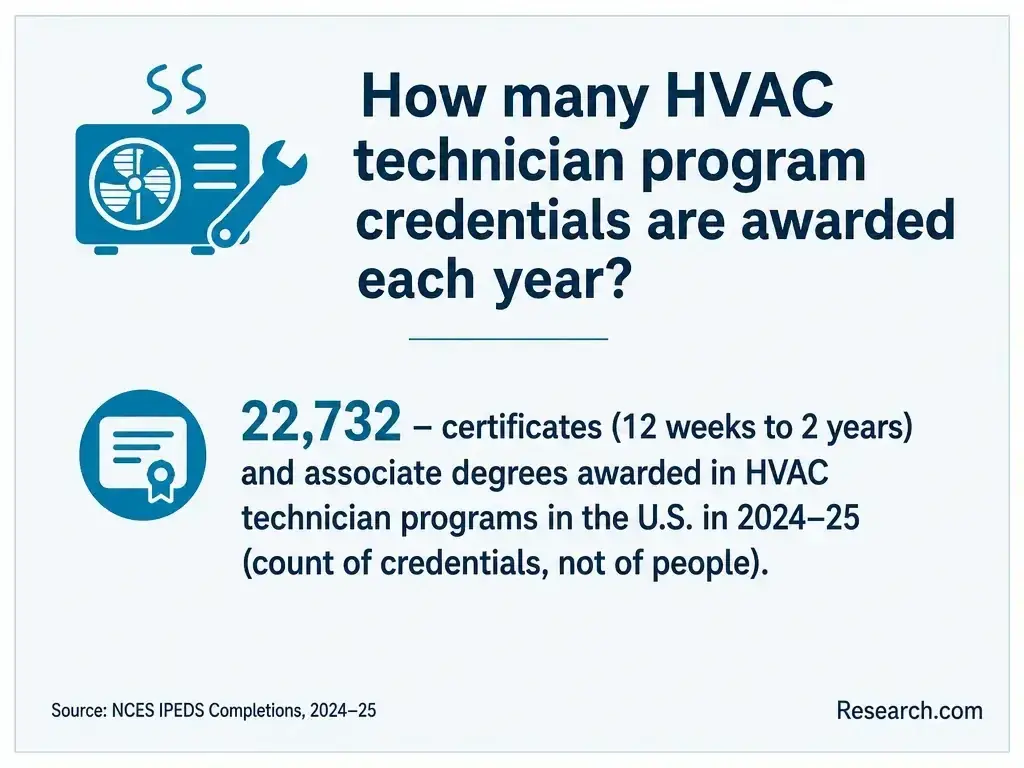
A defensible Wichita-wide average cannot be established from a single published price: programs differ in length, credential, included equipment, and funding, while apprenticeships and employer training may not appear in college cost datasets. Compare itemized, current total costs instead. This matters especially when a cheaper tuition quote excludes the items you need before your first day of work.
Use the following categories when requesting a written estimate from each provider. They show why advertised tuition and the cost of becoming job-ready may differ.
| Cost or offset | Comparison question |
| Tuition and mandatory fees | What is the full price for the credential, including required labs? |
| Tools, safety gear, materials, and textbooks | Which items are supplied, borrowed, or purchased? |
| Testing and work entry | Is the EPA Section 608 exam included? Are other required fees separate? |
| Travel and foregone earnings | How often must you commute, and can you work during training? |
| Aid or paid training | Which grants, scholarships, employer payments, or apprentice wages apply? |
Ask the school whether its particular program is eligible for federal student aid; institutional eligibility does not mean every short course qualifies (Federal Student Aid). Also ask a Kansas workforce center about current training assistance and compare it with paid apprenticeship openings. When checking national accredited universities, do not mistake an accreditation label for a price comparison or proof that an HVAC course is aid-eligible. A useful return-on-investment estimate considers aid, debt, completion likelihood, lost earnings during training, likely post-training pay, and how long you expect to work in the field - not institution type alone.
The award depends on the route: a school may award a certificate, diploma, or associate degree; a registered apprenticeship leads to its own completion credential; and an employer may provide training without an academic award. Ask for the exact credential name and a list of the skills it documents. A short certificate is attractive when it delivers sufficient lab practice for an entry-level job; an associate degree may suit someone seeking broader technical and general coursework, but it costs more time to complete.
EPA Section 608 certification is separate from a school credential. Technicians who service equipment in ways that could release regulated refrigerants must meet EPA certification rules and pass the appropriate exam (U.S. Environmental Protection Agency). Ask whether the curriculum prepares you for the exam type relevant to your work and whether testing is included. Other industry credentials may help demonstrate skills, but verify whether local employers value them before paying extra.
Even when comparing the easiest associates degree to get online, do not use ease of completion as the test for HVAC training. The decisive question is whether the credential comes with enough supervised equipment work for your intended role.
Requirements vary by provider and route. A school may set minimum education, placement, or course prerequisites; an apprenticeship sponsor can also impose hiring, age, transportation, or work-readiness conditions. Request the current admissions checklist directly rather than assuming school admission also secures an apprenticeship placement. Registered apprenticeships are employment-based opportunities, not simply courses a student purchases (U.S. Department of Labor, Apprenticeship.gov).
Before applying, ask whether you need to purchase tools, provide proof of prior learning, meet a driver or travel requirement for fieldwork, or arrange a worksite placement. If you have relevant experience, ask what documentation is accepted for credit or advanced standing and whether that changes tuition, completion time, or required practical instruction.
Foundational training should connect refrigeration-cycle theory, electrical circuits, motors, controls, airflow, heating systems, installation, maintenance, and fault diagnosis to supervised work on equipment. Safety instruction matters because technicians encounter electricity, moving machinery, and refrigerants; BLS identifies installation, maintenance, repair, and troubleshooting as central occupational duties (BLS, Occupational Outlook Handbook).
Read beyond the course titles. Ask whether students individually diagnose faults, document measurements, explain a repair to a customer, and practice on equipment relevant to residential service, commercial systems, or refrigeration - whichever job you want. A program concentrated on theory may be useful preparation for a paid helper role, but should not be mistaken for extensive field experience.
Refrigerant work and local trade authorization are different questions. EPA Section 608 certification applies to technicians who perform covered service on equipment containing regulated refrigerants; its exam is not a school diploma or an HVAC contractor license (U.S. Environmental Protection Agency). Kansas does not use a single statewide HVAC technician license in place of every local requirement. In the Wichita area, the Sedgwick County Metropolitan Area Building and Construction Department (MABCD) is the relevant local authority for checking mechanical trade and contractor licensing requirements (Sedgwick County MABCD).
Before paying for training, describe your intended role to MABCD and a prospective employer: supervised helper, technician, journeyman-level worker, or contractor. Ask what registration, experience, examination, or license applies to that role and whether school hours count toward any requirement. Do not assume graduation, institutional accreditation, apprenticeship registration, and occupational licensure are interchangeable.
Start with the job you want, then work backward to its practical skills and regulatory requirements. An affordability ranking is a useful shortlist, not a substitute for inspecting the training. Compare the following in order so that a low sticker price does not conceal a costly mismatch:
- Ask each provider for its exact credential, current syllabus, required clock or credit hours, supervised lab and field hours, and equipment access.
- Verify institutional accreditation and school authorization separately from any claimed industry recognition; ask MABCD about local occupational requirements and the provider how it prepares students for EPA Section 608 testing.
- Get a written total-cost estimate, including fees, tools, testing, travel, and lost work time, then subtract aid or paid-training income you can actually confirm.
- Ask for recent program-specific completion and employment information, its definitions and reporting period, and whether employers offer apprenticeships or supervised entry-level roles.
A warning sign is a provider that promises a job or license based solely on enrollment, cannot specify hands-on hours, or will not itemize costs. If your search has also surfaced doctoral programs online no dissertation, set that unrelated pathway aside: choosing HVAC training turns on practical preparation, job-entry rules, and cost. The right investment is the option that fits your intended role and budget, whether it is school, a registered apprenticeship, or structured employer training.
A common entry point is supervised installation, maintenance, or service work. With experience, a technician may move into more independent diagnostics, commercial systems, refrigeration, controls, estimating, or supervision. Contracting is a distinct step: technical experience alone does not replace applicable local business and trade licensing requirements (BLS, Occupational Outlook Handbook; Sedgwick County MABCD).
Choose training around the first job you can reasonably obtain, not only an eventual specialization. If you want residential service, prioritize troubleshooting and customer-facing practice. If commercial refrigeration is the goal, ask whether the curriculum and available worksites expose trainees to that equipment. Later certificates may support advancement, but confirm with employers which ones they recognize and whether they will pay for them.
BLS projects 10.9% national employment growth from 2025 to 2035 for heating, air conditioning, and refrigeration mechanics and installers. That is an occupational projection for the United States, not a forecast of Wichita vacancies or a guarantee of placement (BLS, Employment Projections). It supports considering HVAC as a career path, but it does not settle which local training option offers the best return.
Test local demand before enrolling: review current postings for entry-level requirements, ask contractors whether they hire trainees, and check apprenticeship sponsor openings. Separate jobs that accept beginners from those requiring independent service experience. That distinction will tell you whether to pay for more lab instruction now or seek a paid route that builds experience while you learn.
Most Affordable HVAC Technician Schools & Training in Wichita for 2027
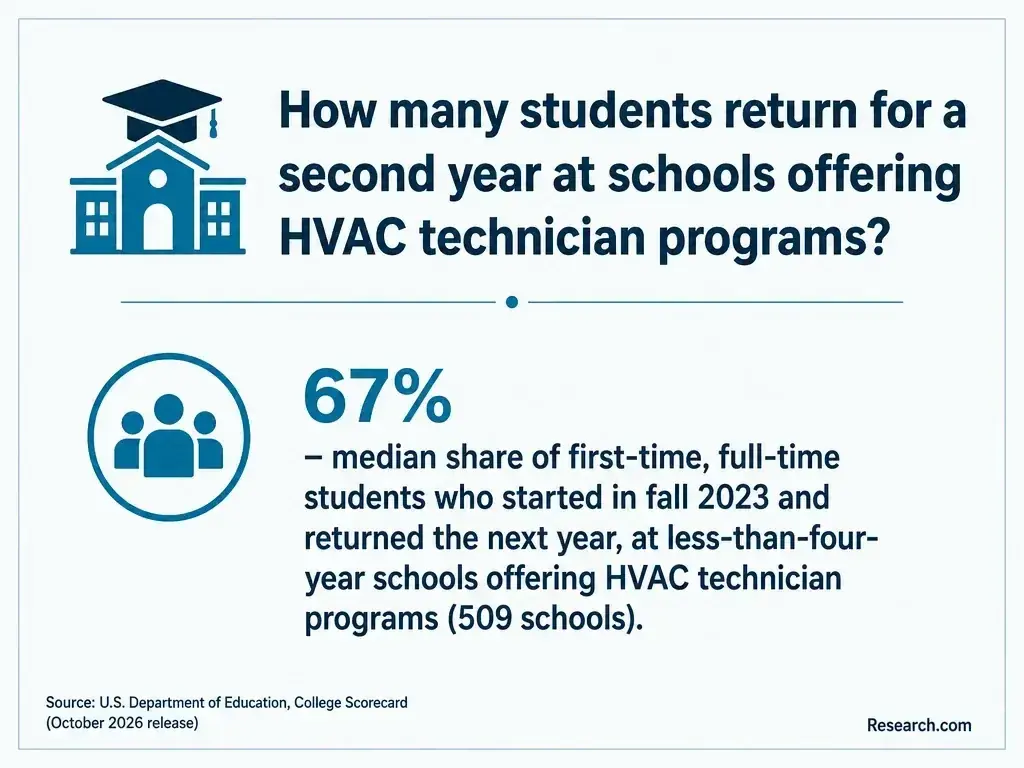
Investing in training is a consequential decision. Research.com designed this ranking to make the cost comparison more transparent, evaluating programs against others in the same occupation and location rather than against unrelated schools. Only programs with completions reported to IPEDS are eligible; an apprenticeship or employer program absent from the ranking may still be a worthwhile option.
The most affordable ranking scores tuition, cost of attendance, median student debt, and federal loan default rates. Indicator weights are assigned using an entropy-based method, which gives more weight to measures that vary more across eligible programs. Accreditation and other quality measures do not enter this affordability score. Research.com's separate best programs methodology considers student outcomes; earnings and return on investment; costs and debt; and quality and recognition. Its weights are 20% for relevant programmatic accreditation or industry recognition, 10% for institutional accreditation, 10% for student support, and 60% for outcomes, earnings, and costs, with that final portion distributed using the entropy-based method. An affordability position is therefore not a finding that a program provides sufficient lab training or qualifies a student for a particular job.
The Research.com team uses the following sources to check education, cost, recognition, and training information across its trade-program rankings. Some are relevant to other occupations, not HVAC; their inclusion does not imply that they accredit HVAC programs.
- IPEDS database - program completions and institution-reported education data.
- National Center for Education Statistics - federal education data and definitions.
- College Scorecard database - available institutional cost, debt, and outcome measures.
- Peterson's database - supplemental institution and program information.
- Commission on Accreditation of Allied Health Education Programs (CAAHEP) - occupation-specific recognition checks where applicable outside HVAC.
- Accrediting Bureau of Health Education Schools (ABHES) - health-education recognition checks where applicable outside HVAC.
- Commission on Dental Accreditation (CODA) - dental-program recognition checks where applicable outside HVAC.
- Dental Assisting National Board (DANB) - dental-assisting credential checks where applicable outside HVAC.
- National Center for Construction Education and Research (NCCER) - construction-training and credential information where relevant.
- Apprenticeship.gov Partner Finder - registered-apprenticeship sponsor discovery.
Use the ranking to narrow a shortlist, then request current, itemized quotes and verify practical training and job-entry requirements directly. More detail on Research.com's approach is available on its methodology page.

Frequently asked questions about HVAC technician programs in Wichita
What is the cheapest way to start HVAC training?
A paid apprenticeship or structured employer-training job may reduce upfront cost, but openings depend on hiring. Compare those routes with a school's full price - including tools, fees, testing, and travel - not tuition alone.
Can I become an HVAC technician with an online-only course?
Online coursework can teach theory, but it does not replace hands-on equipment practice. Ask how you will obtain supervised skills and meet any applicable certification or local work requirements.
Is EPA Section 608 certification the same as an HVAC license?
No. EPA Section 608 addresses covered refrigerant work. Check separately with Sedgwick County MABCD about authorization relevant to the work you intend to perform (U.S. Environmental Protection Agency; Sedgwick County MABCD).
Is a certificate or an associate degree better for entry-level work?
Choose based on the employer's requirements and the program's actual lab preparation. A certificate can be the more direct route; an associate degree adds coursework but takes more time. Neither credential alone guarantees a job.
Why might an apprenticeship be missing from an affordability ranking?
This ranking includes programs with completions reported to IPEDS. Registered apprenticeships and employer-sponsored training may not appear there, so compare them separately rather than treating an omission as a quality judgment.
- U.S. Bureau of Labor Statistics - Heating, Air Conditioning, and Refrigeration Mechanics and Installers
Used to verify salary, employment outlook, and typical education requirements.
https://www.bls.gov/ooh/installation-maintenance-and-repair/heating-air-conditioning-and-refrigeration-mechanics-and-installers.htm - NCCER - Accredited Training
Used to verify programmatic accreditation or industry recognition of programs.
https://www.nccer.org/ - EPA - Section 608 Technician Certification
Professional certification reference for graduates of this occupation.
https://www.epa.gov/section608/section-608-technician-certification - Wichita State University-Campus of Applied Sciences and Technology - official website
Official school website (programs, tuition, admissions).
https://www.wsutech.edu/